Russia’s Internet crackdown is drawing criticism from state-sanctioned ‘opposition’ parties. It’s all part of Kremlin-approved campaign messaging.
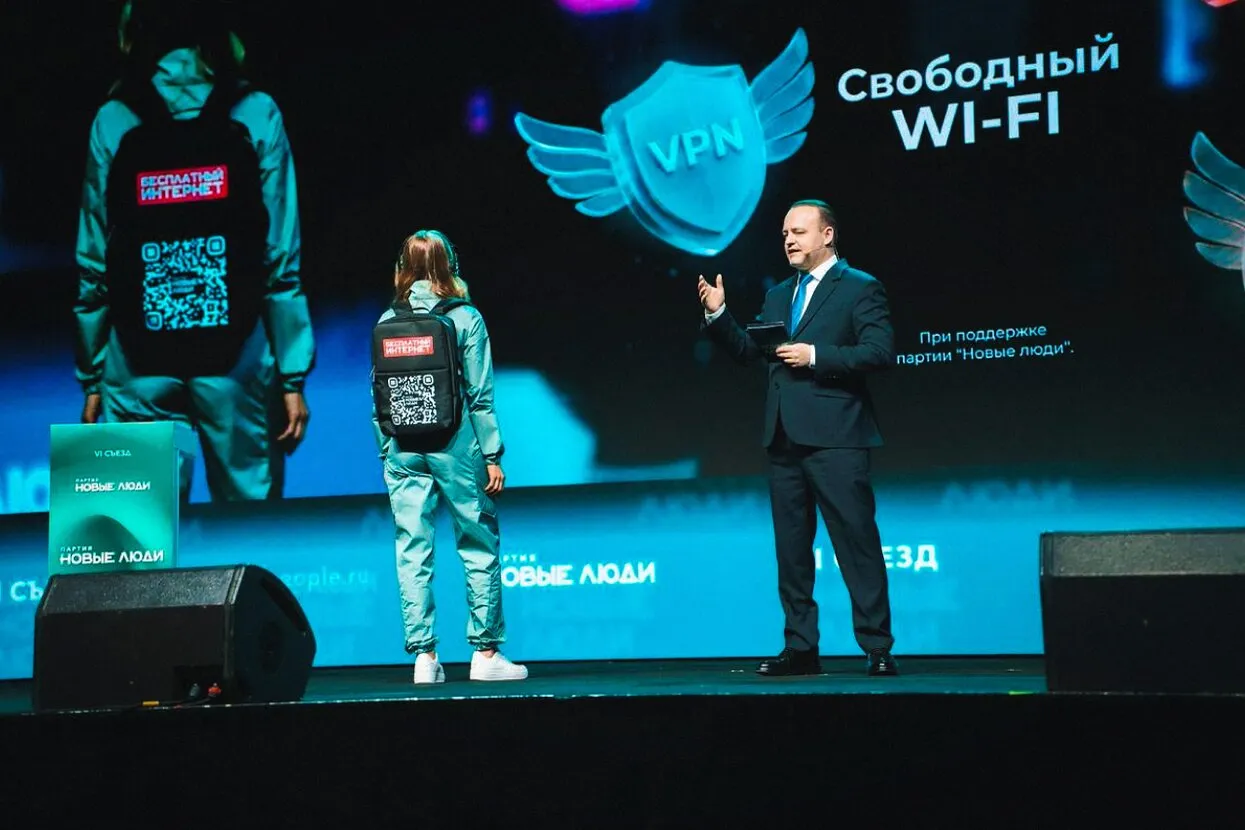
In early March, as large-scale mobile Internet disruptions began in Moscow, the 6th congress of the New People political party was taking place in St. Petersburg. At the event, Alexander Kharichev — the Kremlin’s chief of “social monitoring” and a longtime associate of domestic policy czar Sergey Kiriyenko — took the stage to read out a message from Vladimir Putin.
In it, the Russian president praised the party for its willingness to work with other political forces and civic groups. “At a time when we face serious challenges, such broad consolidation is especially important,” Kharichev quoted him as saying.
The party’s leader, Alexey Nechayev, followed with a speech introducing a new manifesto. It called for an end to Internet restrictions, the creation of “AI courts,” and free public Wi-Fi across Russia’s regions. Nechayev said:
We came to represent a new Russia — one that wants to live without bans and coercion, and to solve problems at home. We have opposed blocking and restrictions. We opposed raising the conscription age. We opposed total control over the Internet. We opposed violence.
Vladislav Davankov, the party’s 2024 presidential candidate, also addressed the congress. Standing in front of a screen displaying a winged shield labeled “VPN,” he promised to send “Wi-Fi fairies” — party activists equipped with routers in their backpacks — into Russian cities.
The party’s federal leadership and most of its regional branches have pointedly ignored the Kremlin-backed “national messenger” Max, instead urging supporters to follow their accounts on Telegram. In late March, New People also claimed credit for the fact that advertising on Telegram and YouTube would remain legal in 2026 without fines.
A few days later, the party openly opposed a proposal from the Digital Development Ministry to allow mobile operators to charge extra for VPN use. New People has also continued to criticize the ministry and Roskomnadzor, Russia’s federal censorship agency, on its VKontakte page.
However, New People is not the only “systemic opposition” party drawing attention to the Internet restrictions.
On March 18, the far-right LDPR stripped lawmaker Andrey Svintsov of his party membership after he too actively supported the crackdown — angering both voters and regional branches. The party’s supreme council said Svintsov was “damaging the party’s reputation.”
A week later, the LDPR announced it was drafting a law “On Guarantees of Citizens’ Digital Rights,” which, among other things, would enshrine “the right of everyone to Internet access” and even “freedom of expression online.” The party has not said how long the bill will take to prepare, but it has invited the public to join a “working group” — applicants are asked to provide their full name, phone number, email address, and “organization.”
The LDPR has also taken aim at its rival, New People. On March 22, the party’s youth wing published a video on VKontakte claiming that its volunteers had failed to find a single “Wi-Fi fairy” on the streets of Perm, Krasnoyarsk, and other cities.
The third party in the so-called systemic opposition, the Communist Party (KPRF), has so far stayed out of the direct clash but is also trying to engage with the issue. KPRF members have staged small street protests, describing the authorities’ actions as “digital censorship” (judging by photos, no more than about 15 people attended).
A person holds a solo protest in Perm with a sign reading “Block yourself, Roskomnadzor”
KPRF
A person holds a solo protest in Ulyanovsk with a sign reading “We demand that messaging apps be restored”
KPRF
State Duma deputy Vyacheslav Markhayev of the KPRF wrote on his Telegram channel:
Judging by what’s happening, we should rename the agency that is strangling communications and shielding fraudsters the ‘Ministry of Digital Degradation.’ Its head boasts of ‘white lists’ of a dozen websites accessible during shutdowns. First you break the infrastructure, then you hand people crumbs? That’s degradation, not development.
The quickest to respond, however, was A Just Russia leader Sergey Mironov, who was the first prominent politician to sharply condemn the restrictions. As early as February 11, he wrote on his Telegram channel that Roskomnadzor officials were “idiots” and “scumbags” for preventing Russian soldiers at the front from staying in touch with their families via Telegram.
The authorities insist that the messenger will continue to function on the front lines. At the same time, Vladimir Putin has said it is dangerous for soldiers to use Telegram.
In any case, Sergey Mironov has been silent since.
‘A way to score points on a popular issue’
Not everyone in Russia’s public sphere is free to openly vent their frustration over Internet restrictions.
Natalya Kaspersky, co-founder of Kaspersky Lab, was forced to apologize to Roskomnadzor after saying that the agency’s attempts to block VPNs had caused disruptions to banking websites and apps on April 3. Forbes Russia and the Telegram-based news outlet Mash later deleted reports suggesting the outages might be linked to the restrictions.
A source close to the presidential administration told Meduza that the issue of Internet blocking is “very sensitive,” meaning that “not everyone can speak about it — and only in limited ways.” “If [the criticism] is about everyday inconveniences, that’s fine. But if it’s about something specific, like a banking outage, it’s better to stay quiet,” the source said.
According to this source, systemic opposition parties have been allowed to criticize the restrictions — but only vaguely. “It’s both a way to score points on a popular issue and an additional signal from civilian officials to the security forces that the restrictions are unpopular,” he said with a laugh. “It’s public politics running at minimal capacity.”
A political strategist who works with the Kremlin’s domestic policy team said there is now a growing preference to position New People — rather than the LDPR — as the “second-choice” party. In the Kremlin’s view, under Leonid Slutsky, the LDPR “just isn’t taking off.”
Another strategist, who has worked with New People and remains in contact with the party, said that criticism of the restrictions could help advance that goal. He emphasized that without the Kremlin’s approval, the party would not have made “an issue that concerns everyone” a central part of its messaging.
A Meduza source close to the Russian government confirmed this, saying the Kremlin maintains full control over Alexey Nechayev’s party and does not see its pro-Telegram, anti-Max messaging as a threat. “New People is a project of Kiriyenko’s domestic policy team — and Max is also Kiriyenko’s project,” the source said. The messenger was developed under the supervision of Vladimir Kiriyenko, CEO of VK and the son of Sergey Kiriyenko.
A source close to New People’s leadership said the party is trying to “strike a balance.” Even before the congress, party member Vladislav Davankov launched a campaign via a Telegram bot to collect signatures against blocking the platform — while also gathering signatures for an appeal urging Pavel Durov to open a Telegram office in Russia. At the same time, New People has avoided criticizing “white lists,” instead calling for them to function reliably. “It’s like they’re both against the restrictions and in favor of proper ‘white lists’ — trying to please both sides. So far, the approach is working,” the source said.
The Communist Party’s campaign against the restrictions, meanwhile, was described by the source close to the presidential administration as “organic.” The Communists, he noted, have long relied on “trigger issues” such as rising prices and utility tariffs; this year, they have added Internet restrictions to the list. But in the Kremlin’s domestic policy team, there is little doubt that New People’s messaging will prove more effective. The newer, younger party is expected to easily outperform the Communists in the race for second place. “The Communist Party’s overall image isn’t associated with Internet freedom,” the source said.
The Kremlin has been looking to weaken the Communists for some time. Meduza has previously reported that officials plan to push the party out of second place in elections by replacing it with a more manageable alternative. The Communists often nominate candidates the presidential administration finds undesirable and openly criticize the Kremlin’s domestic policy team and its head, Sergey Kiriyenko.
As for the LDPR’s attempts to capitalize on the issue, a source close to the presidential administration described them as an effort “not to be left out of a popular topic.” A Kremlin-linked political strategist who previously worked with the party said its push to recruit participants for a “working group” on digital rights legislation is likely a way to collect data on potential supporters — “people who are at least open to the idea of engaging with the LDPR.”
According to a strategist working with the Kremlin’s domestic policy team, systemic parties will continue to use the issue of Internet restrictions in their campaigns up to the September elections. “That is, unless the ratings of United Russia and the authorities as a whole collapse completely,” he added. “In that case, criticism of the restrictions could be shut down — to avoid dragging those ratings down even further.”
Story by by Andrey Pertsev