‘Kyiv is gasping for breath’: Russia’s escalating attacks are upending daily life in the Ukrainian capital. Here’s how residents are coping.
Russian attacks on Kyiv and the surrounding region intensified in late spring, and since August 27, the only respite has come during a visit to the Ukrainian capital by U.S. presidential envoys. Kyiv residents were able to go a full day without air raid alerts only on September 6. The shift in Russian strike tactics is linked to the Russian army’s effort to exhaust Ukraine’s air defenses. In addition to military warehouses, civilian facilities have also come under attack. One of the new targets has been warehouses in the Kyiv region — likely struck in retaliation for the Ukrainian military’s summer strikes on Ozon and Wildberries warehouses and oil refineries. Daytime air raid alerts paralyze life in the city, while nighttime alerts interrupt the sleep of hundreds of thousands of people. Disrupted logistics have caused some goods to disappear from Kyiv supermarkets. Meduza spoke with Kyiv residents who are trying to live amid constant shelling — and are already preparing for a harsh winter.
‘We saw a fireball that looked like an exploding sun’
Marusya, 42, lives in Borshchahivka
No one in Kyiv sleeps normally these days — except for those on some kind of heavy medication. I take sleeping pills every so often, when it gets unbearable and I just want to get some sleep.
We’ve gotten used to nighttime shelling, but lately they’ve started shelling us during the day too — that’s something new. Along with the familiar buzzing, droning, and explosions, there are now sounds that put you on edge simply because they’re unfamiliar. A kind of rumble with a metallic, almost “galvanized” overtone.
Waking up to an explosion at night is scary: you’re defenseless and relaxed. During the day you keep yourself alert — so something went boom, fine. But the daytime alerts have become nonstop. I didn’t think it would drag on this long. It seemed like there’d be some banging and then it would calm down, but the lull never comes.
I don’t think this is retaliation for the strikes on Wildberries. And even if it is, it’s just a pretext. If there hadn’t been such a pretext, they would have tied it to something else. They’ve probably been stockpiling and gathering up [missiles]. If there’s an urge to pound, they’ll pound regardless.
Overnight on August 21, a friend of mine in Solomianka had a strike hit the building next door. She got lucky: the day before, she and her son had ended up staying over at someone else’s place for the night. The blast blew out the windows in her apartment, knocked the doors off their hinges, and brought down her half-condemned balcony. My friend jokes, “I was already afraid it would fall on someone’s head. Thank God the blast wave tore it off.”
There are plenty of damaged buildings in our neighborhood too [because of the war]: you look around and there’s a chunk missing from one building here, another there. I checked on my map app: the nearest building hit by a major strike is 800 meters (2,625 feet) from mine.
There’s a shelter in the building next door, but I haven’t even gone down there out of curiosity. I don’t see the point. If the building collapses, it’s harder to pull bodies out of a shelter than out of a bed. I don’t understand people who still believe in the “two walls” rule and hang out in hallways. I think if it’s going to hit, it’s going to hit. I especially crack up when I hear on the tram: “The nearest shelter is the underground crossing.” Have you seen that underground crossing in Lukianivka? What kind of “shelter” is that?!
Ukrainian women watch smoke rising over the city after a Russian drone strike. Kyiv, August 20, 2026
Over the entire course of the full-scale war, my husband and I have left our apartment [for safety] only twice. The first time was at the start of the invasion, and the second was recently, when a Zircon missile was launched at Kyiv. We saw a fireball through the window that looked like an exploding sun, followed by a glow of a different color. We went out into the courtyard, smoked a cigarette each, and went back to sleep.
Putin threatened strikes on our energy infrastructure in response to Volodymyr Zelensky’s statement about strikes on Russian airports. As if the Russians hadn’t been hitting our energy facilities before, only civilians? Right now everyone is anxious, meaning on edge: winter is close, which means there will be more strikes on the power and heat. But that’s expected. It’s not news at all.
I don’t see the point in being afraid — we’ve already been through a lot, and we’ll get through whatever new thing comes. Whatever circumstances we’re given, we’ll figure out how to live with them. My mom keeps pushing to order LED strip lights: she lives alone, and darkness scares her more. I’m just glad my laptop holds a charge for a long time so I can watch movies in the dark.
There’s a sense of mild, general panic. I live near a big mall that closes during air raid alerts. When that happens, the supermarket next door, which stays open, immediately fills up. You go in for some bread, kefir, or ice cream, and there are lines of 20 people at the register with carts piled high.
People are grabbing everything. The other day I wanted to buy some thin vermicelli for chicken broth. But everything cheap had been cleaned out completely. Out of curiosity I went to another store — same story there. I think it’s a combination of two things: people have started stockpiling in anticipation of shortages, and deliveries have already slowed down.
We badly underestimated what we had: peace, stability, and quiet nights. A night without an air raid alert, without any “booms,” has become a bonus. Normal life is starting to feel like a distant memory: “Wait, was that even allowed?” I feel anger, sadness, and resentment over the lost time that could have been good.
I used to make plans: at least once a year, take a trip to the sea without a return ticket. Now I can barely plan for tomorrow. I might guess that I’ll do something, but I don’t promise anyone anything.
‘Death has begun touching our district too’
Oleksyi, 50, lives at Kharkivska station in the Darnytskyi district
The shelling machine has kicked into high gear. It used to happen sporadically, but now we live in a world of brief pauses between attacks.
We’ve really gotten under the Russians’ skin over the past year. First, they’ve come to realize they can’t conquer Ukraine. Out of frustration, they’ve grown vicious and started smashing everything they can. Second, we’ve also become much more active in striking back at them. Our drones are reaching all the way to Yekaterinburg. They’re taking revenge. These actions are unlikely to bring the Russians victory, but they’ll cause Ukrainians a lot of suffering: hunger, a lack of medicine, and logistics problems.
My son just started first grade. First graders aren’t even supposed to have homework, but we sit down and do it anyway: the kids don’t have time to get through the curriculum in class because they spend the whole day running back and forth [to the shelter].
We decided to celebrate the start of the school year as a family at a cafe. But then an air raid alert went off, and we were told, “Finish up quickly and leave.” We also wanted to take our son to a children’s play area known for staying open during alerts. But they called and said, “We’re closing [because of the attack].” We didn’t go: what’s the point of taking a kid there and then sitting outside for hours [waiting for the alert to end]?..
Getting from the left bank to the right bank has been a problem since the start of the war: [the aboveground sections of] the metro close during air raid alerts. In the last couple of weeks, it’s gotten worse. If you live on the left bank and work on the right, or the other way around, you live in total paranoia. When you hear the alert, you’re not afraid of being bombed — you’re afraid you won’t make it to where you need to go again.
For three days in a row, I sat and waited [for a train to run], for hours at a time. It’s especially frustrating when you’re tired in the evening, just want to get home as fast as possible, walk up to the metro — and there’s another alert. Or worse, when you’re already inside the station or on the train and you hear that dreadful voice: “The trains are going to Vydubychi station, please clear the cars.” For thousands of exhausted people, that sounds like a death sentence.
To get home, you end up asking someone [for a ride], because the buses and trolleybuses are packed. And even by car it takes a long time because of the insane crawl of traffic jams.
Sleepless nights are becoming the norm, though your nervous system adapts. Sometimes people ask me how the night went, and I can’t remember. Something explodes, something burns, and your brain just stops registering any of it and keeps sleeping. My kid’s psyche has adjusted too: at night you need to sleep, not be afraid, or you’ll go crazy.
Some coworkers of mine had their homes bombed and have nowhere to live now. Compared to that, the sound of explosions outside our window is just noise. Thank God we’re alive and unhurt.
The aftermath of a strike on Kyiv on August 20, 2026. The attack also damaged a nearby children’s hospital. At least 13 people were killed in the strike, Kyiv Mayor Vitali Klitschko said.
Roman Pilipey / AFP / Scanpix / LETA
State Emergency Service personnel deal with the aftermath of a Russian drone strike on the Misto Kvitiv (“City of Flowers”) residential complex, September 1, 2026. According to reports from the State Emergency Service, three people were injured in the attack.
For a long time, no one in our district was killed. At worst, some nonresidential buildings were damaged. About a year and a half ago, death started to touch us too, little by little: three people died at Slavutych station. And this past spring, a Russian missile tore down an entire section of the building very close to our home. So many people died!
Now there’s no faith that the night will pass quietly. In the evenings, crowds rush to take shelter at Kharkivska station. We don’t go into the metro: there’s often nowhere to sit or lie down, and a direct hit would just bury everyone [since the station isn’t very deep]. There’s not much point to it.
I roughly mapped out the area around our building — figured a two-by-two-kilometer square. My wife and I agreed: if strikes start hitting inside that square, we’ll go to the metro. And if there are deaths nearby, it’s time for my wife and son to leave. In the three years of the war so far, nothing has hit here.
Kyiv is gasping for breath. It’s like a damaged ship barely staying afloat: a couple more torpedoes and it’ll go under. There’s a fear that this winter will be deadly. Right now things aren’t so bad: the power stays on, there’s water. But that could all end in a week or two.
The line between summer and fall feels like a warning shot — the calm period is over. You expect the nightmare to start again any day now: sitting for days without power, and when it comes back, frantically charging power banks. You realize just how vulnerable you are, how dependent on the power plant.
I think this fall will be decisive for our family. I’m afraid no amount of preparation for winter will help us: we simply won’t be able to hold out in the apartment. If wealthy people with powerful generators can keep themselves warm, our family specifically won’t manage without electricity, water, and heat. Most likely, my wife and son will have to wait out this winter outside Kyiv.
As for me, I’ll be left trying to make it through this ordeal and somehow winter over in the city. If not in our own apartment, then we’ll huddle together at friends’ place, wherever it’s warm. I put my trust in God: if it’s His will that I stay alive, I’ll get through this winter. And if not…
‘We maneuver under the shrapnel’
Ivan, 56, lives at Klovska metro station in the Pecherskyi district
The other day I was walking near Ukraina Palace, and I heard a siren, then cannon fire. I stopped — and then there was a piercing howl. A jet-powered drone was flying by, fast, cutting clear across the sky. And then it just tore off toward the southwest! Judging by the sound, it wasn’t shot down — it landed in one piece. This summer alone, the Russians have changed their bombardment patterns three or four times. There’s no chaos here, no scenario where guys down a glass of vodka, go on duty, and go, “Let’s go pound them!” They approach it methodically: they take into account both the body’s circadian rhythms and the rhythms of social life.
The massed strikes come overnight from Friday to Saturday, when people are relaxed, and then again from Monday to Tuesday. The Russians know exactly when a person’s “circuits blow” most reliably: they attack between midnight and 1 a.m., interrupting the first phase of sleep. Then they strike again between 3 and 4 a.m., which breaks up deep sleep. I look at people on public transit — a lot of them are falling asleep standing up.
The sky over Kyiv during a bombardment. September 8, 2026
Kyiv residents spend the night in the metro during an air raid alert. September 8, 2026
Air raid alerts often start during rush hour: it throws off the rhythm of the city, and it hits people emotionally if not financially. Time is the most precious resource, and you’re losing it.
Every increase in shelling is also tied to bigger events: the start of [last] heating season, our strikes on their oil refineries and warehouses. Right now the escalation is clearly meant to put pressure ahead of the next round of negotiations and to shape public sentiment the way they want — that’s why they’re hitting businesses.
My family lives in a safer region, while I’m in Kyiv. My daughter is dying to come here, and I tell her, “This isn’t a joke, better not right now.” They recently came to visit and were horrified: they got the full experience of what it’s like to be in an apartment during a barrage.
There haven’t been any direct hits on our neighborhood yet — they’re pounding the perimeter, while for us it’s just the windows rattling and the doors shaking. There’s constant smoke and haze in the air. We’ve even gone down to spend the night in the metro twice. Recently I was about to call my family, and then there was a serious boom. We talked, and just as I hung up, it really let loose! The door blew shut, slamming closed, and I actually ducked, thinking, God forbid, the glass [would shatter into shards].
The supermarket near my house has been picked clean, the shelves are empty — the only thing left was lentils. My neighbor went looking for vegetables and found nothing. I went looking for semolina to make cheese pancakes and had no luck either. But it’s fine, I always keep grains in stock, we’ll get by on porridge.
Public service ads have popped up around the city, with kids on posters declaring: “We are energy independent.” I guess that’s how they’re preparing people for winter, to avoid panic. Looks like I’ll have to buy a power station.
People don’t know where to build their lives, what to hold on to. The world is changing, and right now you need flexibility, the ability to jump from one foothold to the next. It’s good when a person doesn’t stiffen up but adapts instead. As Eisenhower once said, plans are worthless, planning is everything. So we set goals and maneuver under the shrapnel.
‘You’re always waiting: will it hit or not?’
Olena, 37, lives in the Obolonskyi district
It’s gotten harder for me to handle the anxiety: there’s much more unpredictability in the shelling now. There are more strikes, more danger, and life is paralyzed. You’re constantly waiting: will it hit or not?
[Friends of my daughter’s] had a children’s birthday party planned for late August at a mall next to Epicentr. The parents looked at the whole situation and moved the celebration to a less impressive but safer venue.
I work in several districts of the city and in the suburbs. Yesterday I drove past a mall that was [still intact], and today it was already standing there with its windows blown out.
The Nova Poshta logistics center was hit, and package deliveries started getting delayed. My [child’s] class had ordered printed learning materials for school. The supplier received them, we paid — but then a strike hit the warehouse in Dnipro. The supplier had to reorder a reprint, and we had to pay the difference in cost, because the price had gone up.
The destruction of warehouses causes enormous losses for businesses and the economy. I don’t care that I won’t be able to buy myself a new iPhone. What I care about is that prices are rising while my purchasing power is falling, because my salary is in hryvnias, and the hryvnia keeps devaluing.
Ukrainian firefighters extinguish a fire at a warehouse after an airstrike near Boryspil in the Kyiv region, August 27, 2026
Vladyslav Musiienko / AFP / Scanpix / LETA
I haven’t seen an actual food shortage. In late August, people cleared out the supermarket shelves, but supplies were restocked the next day. But our favorite dumplings, which a year ago cost 70 to 90 hryvnias on sale, now cost 190 to 200. I’m afraid that in a week they’ll be up to 300. I need to stock up on cat food too: the pouches have gotten more expensive, and people are panic-buying them.
From what I’ve seen in the news, Ukraine has decided to make the Russians reconsider their behavior by striking their major warehouses. But we don’t produce our own Patriot missiles — we depend entirely on deliveries. I think it’s shortsighted to take steps like that. We got hit with similar retaliatory measures in return. But because of its sheer size, losing these warehouses amounts to something like 10% for our neighboring country. Given Ukraine’s size, our damage is far greater.
The boys are measuring whose is bigger, and somehow I’m the one who suffers for it. I’m not a boy, I don’t have anything to measure, so maybe there’s something about this I just don’t understand. The Russians are going to destroy our energy grid regardless, using whatever pretext they can find. Russia’s rhetoric is harsh enough, and I’m sure they’ve had a target list ready for a long time.
We’re not doing anything special to prepare for this winter — we already prepared for the previous ones. We always keep a basic stock of food, even in peacetime. In 2025 we got a power station, and last winter we got some great sleeping bags from a charitable foundation.
Lately I’ve noticed that people around me have become more irritable and less patient from the stress. My child has long been afraid of loud noises: a motorcycle backfiring, construction equipment, the clatter from a building site. Now my daughter has gotten more anxious. And I myself have switched to fast carbs because of the stress.
I’m tired. I want the boys to make up their minds and sit down at the negotiating table without escalating things further. A human life is more important and more valuable than anything else.
‘I say out loud, “Oh, I’m scared” — and the panic subsides’
Olha, 70, lives in Troieshchyna
Until recently, the circumstances at least allowed for some kind of existence, even a life of sorts, but in the last few days things have gotten really hard. I recently spent about three hours at the clinic and never got to see a doctor: the clinic closed during an air raid alert. There’s no time even to ask a question at the front desk. First a line builds up, and by the time it’s your turn, a new alert is announced.
Getting around the city isn’t any easier. I work from home, but sometimes I need to get to the office. When the metro shuts down, everyone switches to surface transit. You can end up standing at a stop for hours, letting one packed minibus after another go by. Calling a taxi is an option, but the price triples in those moments. It’s a similar story with intercity trains: alerts delay them, so you have to build in six to eight hours of extra time for any trip.
I try to adapt, to have a plan B. I don’t waste energy being annoyed by things I can’t control. I just put my energy toward the task at hand. I didn’t get to see the doctor today — fine, I’ll come back tomorrow, I’ll just bring a folding chair and a book.
I honestly can’t understand this war at all, so I don’t ask myself why the strikes have intensified. I guess they want to terrorize us more, so we’ll be more afraid.
A Kyiv family looks at the aftermath of a strike on Kyiv, September 5, 2026. Ukrainian President Volodymyr Zelensky said Russian forces carried out “demonstrative” and “targeted” strikes on airports in Kyiv and Boryspil overnight on September 5. According to him, Russia was responding to a planned visit to Kyiv by an American delegation.
Tetiana Dzhafarova / AFP / Scanpix / LETA
The aftermath of a Russian attack on Kyiv. September 8, 2026
Alina Smutko / Reuters / Scanpix / LETA
I read the news in small doses: I skim it but don’t get deeply pulled in. My friend doesn’t sleep at night because of the shelling, and afterward she asks, “How did you [spend] that night?” I answer, “Sorry, I was asleep.” She doesn’t understand me.
Once I wanted to be like everyone else and worry along with the rest. The shelling was very heavy, and I dove into my feed. It said a Zircon was inbound. I kept reading: a drone was inbound, then another missile. I don’t really have a clear idea of what a missile actually is — I just know it’s dangerous. I started googling what a “Zircon” and “Shahed” drones are, and my brain just about broke. I could feel panic and fear washing over me. I thought: why did I even read that? So I could sit here shaking and not sleep? It’s not like I can change the Zircon’s flight path anyway.
I decided not to go to the bomb shelter — it’s far away, and I have nowhere to run to anyway. I decided that if anything happens, I’ll just unlock the front door so the blast wave doesn’t jam it shut, and go stand in the hallway. And after that, all that’s left is to say a prayer. Or rather, it just comes on its own: “Lord, help me.” Those words calm and support me.
When I was 55, I went through a hard period in my life, and I got interested in psychology. For the past three years I’ve been part of a therapy group, so I have self-help tools at my disposal. My emergency response in a moment of panic is breathing: inhale for a count of four, hold for six, exhale for eight. I keep my focus on the air entering my lungs.
The “be here now” practice keeps me from spiraling into anxious thoughts. Of course, the body reacts to the sound of explosions, and shock sets in. You can’t reason your way out of fear, so I don’t fight it — I just let the feeling be. Sometimes I say out loud, “Oh, I’m scared, I’m scared.” And when I say it, the panic recedes a little.
I believe that in a dangerous situation, my body will instinctively save me. Last year I was staying at a cottage in the Cherkasy region. And at night, something flew directly overhead. I can’t say exactly what, probably a Shahed. And a helicopter was shooting it down. Then there was the sound of the Shahed falling. But you couldn’t see the drone itself! And I had this feeling it was falling right onto me. In that moment you’re not really aware of what’s happening at all. I instinctively ran into the shower. Later the woman who owned the house told me that, as it turned out, that was the safest spot.
That woman, by the way, follows everything closely and reads all the news. She once told me, “Oh, it’s so great that our guys shelled something over there, such a big fire! They hit it, I’m so happy!” And the next day there was a strike where we were too — a bad one, a lot of people died. I sat down and thought: “God, why is it like this? Now they’re celebrating. What are we [all] doing?!”
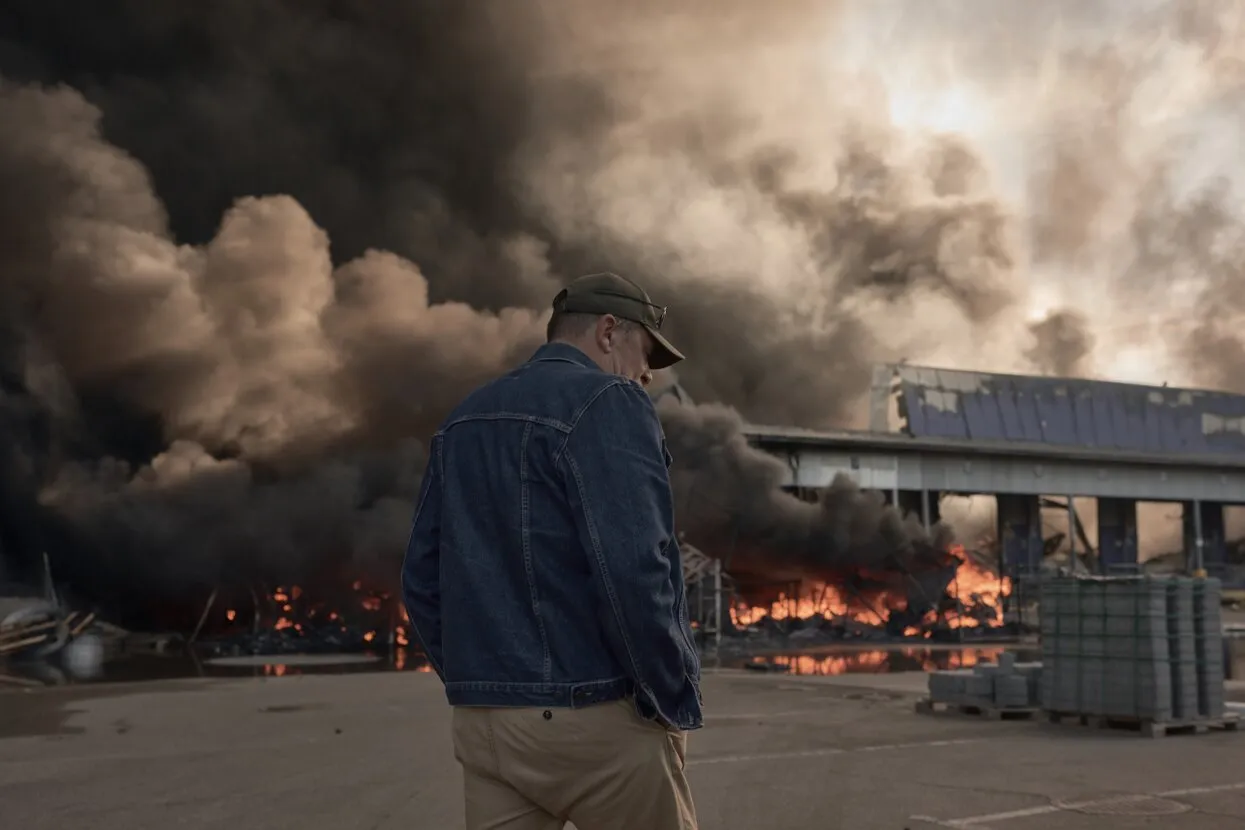
Smoke rises over food warehouses after an attack. August 20, 2026
Valentyn Ogirenko / Reuters / Scanpix / LETA
I’ve been ready for winter for a while now, given how hard last winter was. But I’m not panicking too much — we’ll take problems as they come. I’m afraid to keep a gas canister in the apartment. But I’ve stocked up on food. Not because prices will keep rising. It’s just that we’re expecting a new addition to the family in February, so I stocked up on powdered milk: what if there’s no milk, like in the nineties? And I really love coffee with milk. At the start of the war there was no milk, and it’s very hard for me to deny myself that pleasure.
I also bought a kilogram each of buckwheat, rice, and pasta; two bottles of oil; five cans of chicken. And about 50 packets of cat food — I can get by on tea alone, but the cat can’t. It came out to two boxes of food.
I’m planning to store up water, both drinking and utility. I got a special valve for the sewage pipe: I’m on the first floor, and last winter, when the building had no water, there were problems. I also have a home composting toilet.
If the heat gets shut off but the power stays on, I’ll warm up with the air conditioner and a space heater. If there’s no power either, I’ve got dry alcohol fuel tablets and an ordinary brick stashed away: you can heat them in the [gas] oven, and they hold heat really well. Hot water bottles saved me last winter too — I have five of them.
And I also dance. Honestly, I danced a lot last winter: it really warms you up and keeps your spirits up. I put on Modern Talking — great, rhythmic music. So I definitely won’t be cold.
‘There’s a nagging feeling that 2022 is coming back’
Mykola (name changed), 41, lives in Irpin, Kyiv region
I installed a Telegram bot called Kontur — it’s AI-based OSINT analytics. It shows where any given Shahed drone or missile currently is and where it’s heading. It’s not a real radar, but the bot at least lets you get a sense of what’s going on.
On average, it shows about 400 drones a day heading toward Kyiv. You can watch them coming in from the direction of Kursk and Bryansk, along the Russian and Belarusian border, heading toward the capital. It literally looks like stones falling from the sky. They just keep falling and falling, the stream never stops.
Thanks to the bot, you can at least roughly gauge the scale of the problem. It gives you the illusion of control. If you don’t track the alerts, it feels like you’re leaving yourself to chance. And when you can see the threat, it somehow feels easier to get through. For instance, when you’re on a train and you check: there’s an alert in Kyiv, and there’s a whole herd of Shaheds over the city. You immediately know the train is going to sit there for hours until the situation is sorted out.
It used to be the regular ones, what we called “mopeds with a propeller stuck in their rear.” And they almost never made it through — except during a major bombardment, when they’d bring together aircraft, ballistic missiles, ship-launched missiles, all that arta [artillery]. To overwhelm our air defenses, they’d launch 400 to 500 Shaheds at us at once, of which maybe 20 would get through. But that’s nothing compared to what’s happening now.
The type of attacking drone itself has changed. It looks like a major shift: the new jet-powered drone reaches its target very fast from the border and is harder to shoot down. If it used to come in pulses — say, one raid, and then it would settle down — now the raid never stops.
I have a nagging feeling that 2022 is coming back. Back then the sky was undefended too: planes would fly in and bomb wherever they wanted. It’s the same thing now, just without people in the cockpits. Small jet-powered aircraft fly in and hit everything indiscriminately.
A Kyiv resident walks past a building that was attacked. August 20, 2026
Francisco Seco / AP / Scanpix / LETA
On the evening of August 28, the Russian army struck the village of Myla in the Bucha district of the Kyiv region. The strike set fire to a warehouse belonging to one of the local companies, where ammunition was stored. After the attack, the ammunition began to detonate, and the fire spread to private homes. Because of the powerful explosions, authorities completely closed the Zhytomyr highway between the 15th and 32nd kilometers. Authorities evacuated almost 400 people from the area affected by the attack. Kyiv, the morning of August 29, 2026
Serhii Okunev / AFP / Scanpix / LETA
Analysts say Kyiv is just a trial run, and this way the Russians can terrorize any city. It used to be much calmer in Irpin: everything was flying toward Kyiv, not from our direction. Now they’ve taken up exactly this direction: within a 5-to-10-kilometer (3-to-6-mile) radius of our district, there are strikes constantly.
In the summer I sleep with the windows open and wake up at every explosion. When you jolt awake five or six times a night, it’s obvious you’ll be wiped out the next day. It takes a toll on both your mental and physical health. I have diabetes, and my blood sugar has been running high lately. Any chronic condition flares up when your body doesn’t get to rest properly.
Recently they burned down a warehouse belonging to a general goods retail chain. They’re trying to paralyze the capital, and Irpin is part of Kyiv’s metropolitan area. For Kyiv, our town is essentially just an upscale bedroom suburb. After 2022, it seemed like the worst had already happened here, since Irpin had been so badly burned then. But that view is changing now.
It’s precisely in the metropolitan area that a city’s life-support systems are always located. Store warehouses and hypermarkets around Irpin have suddenly become military targets. No one expected strikes on them. They’re trying to cut off the arteries that feed Kyiv from every direction, in order to terrorize it and drive people out. There’s a total destruction of infrastructure underway, aimed at extinction. They want to strip us of everything: food, water, electricity, gas. And logistics, so that nothing at all can be brought in here. It’s a kind of local genocide.
Some might say these strikes started because of the strikes on Wildberries. I don’t think so. In a war of attrition, strikes like these are one of the inevitable stages. Obviously both sides suffer, we just have fewer resources and less capacity. On top of that, Wildberries is just a trading platform — it’s not responsible for the country’s life-support systems. But here they’re destroying everything indiscriminately: food warehouses, basic enterprises. They burned down a Coca-Cola plant — who was that hurting? They burned down a big warehouse of medicine. And there’s news like this every day: one day it’s a strike on a wine warehouse, the next it’s a candy warehouse — I guess so we won’t get to eat anything sweet.
At the start of the war, people cleared out [store shelves] en masse, and now they’re doing it again. But back then, food warehouses weren’t being bombed, so there was somewhere to make up the shortfall. Now, if logistics aren’t restructured quickly, there won’t be anywhere left to draw from, especially given how many people live in Kyiv’s “human anthills” [densely packed high-rises].
In 2022 I also stocked up, and moths ended up eating half of my supplies. Now I look at it more calmly. And if it comes down to it, there’s the option of moving to a part of the country that’s safer and has more food.
For my apartment I recently bought a more modern, higher-capacity battery that can now power not just the gas boiler but the refrigerator too. But overall… what kind of self-sufficiency can you even talk about when it’s an apartment? If the water’s gone, it’s gone. I don’t feel anything about it anymore — it’s just a fact of life.
We’ll sit under LED lamps for a while, then by candlelight, then start up the generator. What else can you do? The main thing is not to freeze to death. Everything else can be survived. As a neighbor of mine, a soldier from Mariupol who went through Russian captivity, put it: “They didn’t break us in captivity, and they sure as hell won’t break us now.”
People are meant to make this world better, not destroy it. What’s happening now is a great grief and a great evil. You look at the destroyed buildings, and it aches. So much effort went into building them! So many generations wanted to leave something behind for their children. One apartment is someone’s entire life, an entire universe. And all of it gets multiplied by zero. On an unreal scale.
A building in Kyiv damaged in an attack on August 1, 2026
Francisco Seco / AP / Scanpix / LETA
This former Soviet state, Russia — it always leaves scorched earth behind. The country doesn’t build up continuity for itself, and it doesn’t let anyone else build it up either. You can’t live like that.
I’m a design engineer, and I love creating things, I want to build. You pick up a tool, go over to an old machine, fix it, it runs — that’s a good in itself. Or people sit down together and come up with, “Let’s build a kindergarten for our kids, let’s start a business.” That’s also a good — developing, living a normal life instead of stomping around in a swamp. And instead we’re being dragged back into the Stone Age.
I really want all of this to end. I want to create things, not live in constant fear of being killed.
At Meduza, we are committed to transparency about our use of artificial intelligence in the newsroom. The story you’re reading was written by one of our living, breathing journalists and translated from Russian using an AI model configured to follow our strict editorial standards. This translation process is the result of extensive testing and refinements to ensure our English-language coverage is timely and accurate. A Meduza editor reviews every draft before publication.
If you find any errors in this translation, please contact us at reports@meduza.io.
To read Meduza’s exclusive content in English, please subscribe to our newsletter.
Interviews recorded by Irina Olegova
“Gatit,” or pound
In Ukraine, this word is used to refer to massed shelling.
Solomianskyi district
A district of Kyiv located on the right bank of the Dnipro. Zhuliany Airport is nearby.
Translation
The nearest shelter is the underground crossing.
Zircon
An anti-ship hypersonic missile. It can reach speeds of more than 9,500 kilometers (5,900 miles) per hour.
Translation
The trains are going to Vydubychi station, please clear the cars.
The May 14 attack on Kyiv
The attack on Kyiv’s Darnytskyi district killed 24 people, including three children, and injured 47 more, according to the State Emergency Service.
National Palace of Arts Ukraina
One of Ukraine’s largest concert halls. Located in Kyiv’s Pecherskyi district, near the metro station of the same name on Velyka Vasylkivska Street.
Circadian rhythms (from the Latin circa dies, meaning “about a day”)
Cyclical fluctuations in biological processes tied to the time of day.
Translation
We are energy independent.
Power station
A high-capacity battery with a built-in inverter, control board, and connectors for all standard plug types. It serves as a standalone source of electricity during power outages or in the field.
Russian strikes on the power grid have driven up demand for power stations in Ukraine.
Epicentr K
Ukraine’s largest non-food retailer. Its infrastructure has repeatedly come under Russian attack since the start of the full-scale invasion. In early August, the company reported that Russian strikes had completely destroyed 10 stores and seriously damaged another 13. The chain had 80 locations by the end of 2021; it now operates 70, after continuing to open new stores in the years since. The last attack on the chain took place on September 7
What kind?
Without water, sewage pipes in apartments on a building’s lower floors can back up and leak.