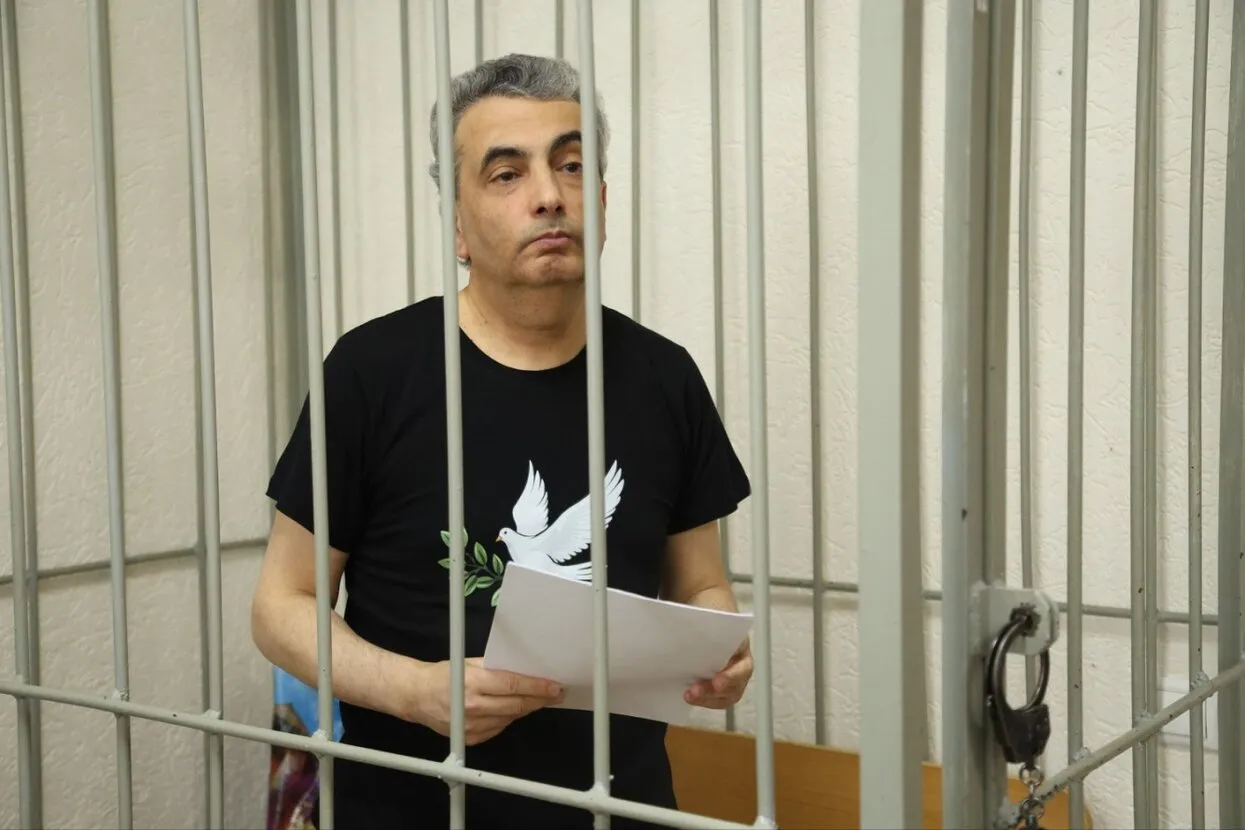
He stayed in Russia and kept saying the war in Ukraine must end. Now opposition politician Lev Shlosberg is going to prison for more than 11 years.
Judge Viktoria Malyamova of the Pskov City Court sentenced Lev Shlosberg, deputy chair of Russia’s Yabloko party, to 11 years and one month in a penal colony for repeatedly “discrediting” the Russian military and for spreading “false information” about the Armed Forces, the independent Russian news outlet Mediazona reported.
The prosecutor, Anna Goryacheva, had asked for 12 years and one month in prison. The sentence took into account an earlier punishment: in November 2025, Shlosberg was sentenced to 420 hours of community service for failing to meet the obligations of a “foreign agent.”
The “discrediting” case stemmed from a recording of a debate between Shlosberg and the historian Yuri Pivovarov, posted on the Russian social network Odnoklassniki, in which Shlosberg argued for a swift end to Russia’s war with Ukraine. He said he was accused of spreading his opponent’s own words from the debate — “that is, spreading a position I was arguing against.”
The false-information charge grew out of a repost that appeared on Shlosberg’s Telegram channel on February 25, 2022. It reproduced a post by the now-shuttered independent Russian radio station Ekho Moskvy showing the front page of the British newspaper The Daily Mirror. The page carried an image of a bloodied woman alongside Russian President Vladimir Putin, with the words “Her blood… his hands.” Shlosberg said the repost went up before Russia had a law against false information about the military. (Putin signed the law on March 4, 2022.)
Closing arguments took place at the Pskov City Court on August 14 with none of Shlosberg’s three defense lawyers present: two were appearing in other proceedings, and the third was in the hospital. Judge Malyamova declined to postpone the hearing and, over Shlosberg’s objections, brought in a state-appointed lawyer for him. Russia’s Criminal Procedure Code gives defendants the right to decline the services of a particular lawyer. In the end, Shlosberg took no part in the arguments.
When he delivered his final statement the same day, the judge constantly interrupted him. When Shlosberg spoke about the need for a ceasefire between Russia and Ukraine, she cut him off, saying that “the circumstances being described have no bearing on the criminal case under consideration.”
Shlosberg is one of the few Russian politicians who have spoken out publicly against the war while remaining in Russia. Since 2022, his position has been antiwar first and foremost: he has consistently insisted that the top priority is ending the fighting. That stance has brought him into conflict with bloggers and politicians who have left the country. The commentators Viktor Shenderovich and Sergei Parkhomenko, for example, criticized him for pushing above all for an end to hostilities. Shlosberg, for his part, has called political émigrés who support Ukraine’s armed forces the “party of others’ blood,” because they “rejoice at the fighting reaching the Kursk region and at the deaths of [Russian] soldiers and civilians.”
Here is what Shlosberg wrote about his position:
A politician stops being a politician of his own country if he begins to wish death on its citizens — any of them: civilians and soldiers, those in the right and those in the wrong, those who agree and those who disagree. […] Being cut off from your homeland, even a homeland that has driven you out, is a hard thing to endure. To get through it, you have to preserve a sense of kinship with the country — even in the hardest of times, when the people do not understand you or accept you, when they hound you and wish you dead. You must not wish death, grief, or misfortune on your own people, whether you are abroad, in prison, or facing the threat of prison. That is, of course, if you consider these people your own and this country your own.
Russian authorities designated Shlosberg a “foreign agent” in June 2023 and later fined him repeatedly under administrative charges of “discrediting” the military and failing to meet the obligations of a “foreign agent.” He had been under house arrest since June 2025 in the “discrediting” case. In December 2025, after opening the new false-information case, the authorities moved him to a pretrial detention center.
In August 2014, Pskovskaya Guberniya, the newspaper Shlosberg then headed, published a report on the funerals of paratroopers from Pskov who were killed fighting in eastern Ukraine. At the time, Russia’s Defense Ministry flatly denied that regular Russian units were taking part in the fighting there, acknowledging only that service members had died during training exercises. Soon after the report ran, Shlosberg was attacked; he was hospitalized with a concussion and other injuries.
At Meduza, we are committed to transparency about our use of artificial intelligence in the newsroom. The story you’re reading was written by one of our living, breathing journalists and translated from Russian using an AI model configured to follow our strict editorial standards. This translation process is the result of extensive testing and refinements to ensure our English-language coverage is timely and accurate. A Meduza editor reviews every draft before publication.
If you find any errors in this translation, please contact us at reports@meduza.io.
To read Meduza’s exclusive content in English, please subscribe to our newsletter.