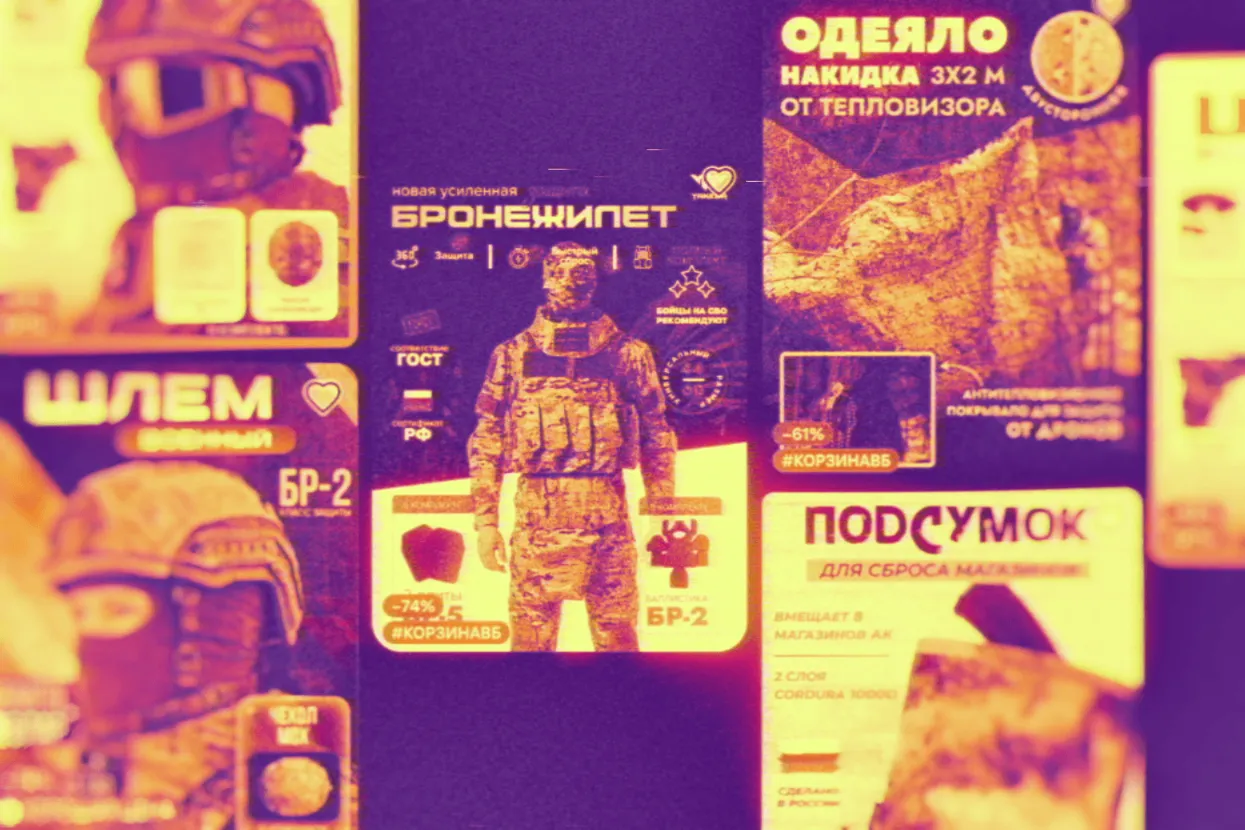
Ukraine says online retail giant Wildberries helps supply Russia’s military. Meduza examines the evidence.
Since July 18, Ukraine has struck Wildberries continuously. Kyiv says the warehouses and logistics centers are used to supply “sanctioned components for drone production and navigation equipment.” There is no information that Wildberries is systematically embedded in the infrastructure of Russia’s Defense Ministry — but it is known that volunteers helping the army buy goods on the marketplace. Meduza examined available data on such purchases by analyzing emergency fundraising appeals in pro-war Z channels. Although their overall volume does not look impressive, such purchases have grown steadily over four years, while Wildberries has openly sold goods intended for the front. Meduza also found that a comparable volume of military-related purchases goes through Ozon, a company Ukraine has not yet attacked. (Whether marketplaces can be considered legitimate military targets remains disputed.)
Ukrainian drone strikes on facilities belonging to the Russian online retailer Wildberries have killed at least nine people in Russia and injured more than 80. Thousands of entrepreneurs lost their goods in the resulting fires and are unlikely to receive adequate compensation.
Is the Russian military really shopping on Wildberries?
Volodymyr Zelensky has explained the strikes by saying the marketplace supplies components for drones and navigation systems, though the Ukrainian president has never publicly named the company. The Kremlin claims Wildberries’ warehouses are purely civilian facilities and calls the strikes on them “acts of terrorism.”
The Russian military does receive goods from Wildberries, though not directly. The marketplace has become part of the infrastructure supporting the war effort through volunteer organizations. This is no secret: volunteers post links to specific Wildberries products soldiers need and raise money to buy them, or ask followers to place the order themselves and ship it to a designated pickup point. Such pickup points exist in occupied Crimea, and through partner points and services, orders can also be picked up in occupied Donetsk, Luhansk, Mariupol, and Melitopol.
Wildberries does nothing to stop this. In fact, the “Everything for the SVO” section — where customers could order first-aid kits, radios, body armor, and even drone components, the very items Zelensky mentioned — didn’t disappear from the marketplace’s website until massive strikes on its warehouses began in July 2026. Some products carried labels like “tested in the SVO” and “SVO fighters’ choice.”
The products themselves, including drone components, are still available on the marketplace and can still be bought.
At the same time, Wildberries’ official rules state that the marketplace is banned from selling “all types of weapons, ammunition, and explosives, except those expressly permitted for civilian circulation under Russian law.” A separate clause on the platform bans finished military gear, the fabric used to make it, “other military-assortment goods,” uniforms, and special equipment and gear for internal affairs agencies.
Wildberries has not commented on volunteers’ orders for the military, nor on the “Everything for the SVO” section. Wildberries founder Tatyana Kim, like many other major businesspeople working in Russia, has not spoken publicly about the Russia–Ukraine war.
At the same time, pro-government media report that Russian authorities allegedly investigated Kim’s former husband, Vladislav Bakalchuk, in 2025 for “discrediting the military,” after he said that rising defense spending meant “business will have to survive,” and that “everyone will have to tighten their belts except those tied to this [military] spending.”
Both Kim and Wildberries have been under Ukrainian sanctions since 2021 for selling military uniforms and propaganda merchandise, including T-shirts bearing Putin’s portrait.
What Kim has said about the attacks on Wildberries
On the evening of July 31, Wildberries founder Tatyana Kim released a video statement in which she addressed the attacks on the company’s facilities in detail for the first time.
Kim repeatedly referred to Ukraine as “terrorists,” without mentioning that the strikes are part of a war launched by Russia. She insisted that Wildberries’ warehouses are exclusively civilian facilities.
The terrorists claim we’re selling military goods. But you can open Amazon or Alibaba and see whether we have anything they don’t.
At least some of the items purchased through Wildberries for use at the front can indeed be ordered from international marketplaces. AliExpress, for example, sells drone components.
However, volunteer groups supporting the Russian military use Russian marketplaces specifically. Wildberries did nothing to prevent this, even in cases where sellers openly stated that their products were intended for military use. In fact, it adapted its platform to make such purchases easier, as detailed below.
Could this just be a handful of isolated orders?
Meduza’s data show a wide range of goods being ordered through Wildberries for the front, though the supply chain doesn’t operate on an industrial scale.
Meduza examined public posts in pro-war Telegram channels and VK communities. The posts contained so-called “urgent fundraisers” — appeals for targeted help to Russian soldiers. We counted only posts that explicitly mentioned ordering or delivering goods to Russian service members, military hospitals, or workshops working for the front, and that included hyperlinks to specific Wildberries products.
In total, we reviewed posts from 77 sources, including large Telegram channels such as “Dva Maiora” (“Two Majors”), which has more than a million subscribers, and dozens of smaller communities, including regional ones.
What sources went into the study?
We included a source in our sample if we found at least one post that met three conditions simultaneously:
- it contained a link to a Wildberries product
- the authors asked people to order, pay for, or hand over that product
- the text made clear the purchase was intended for Russian service members, a military unit, a hospital, or a volunteer workshop working for the front.
Ordinary mentions of the marketplace, aid to civilians, promotional posts, and posts where the recipient could not be determined were not counted. A channel’s inclusion in the list does not mean we counted all the links posted within it: we checked each post individually.
In total, we found 77 such sources on Telegram and VK. This is most likely not an exhaustive list.
Telegram — 71 channels
- “98 DIVIZIYA — Gumpomoshch dlya Vsekh Nashikh” (“98th Division — Aid for All Our Own”)
- Romanov Light
- Shalnyak
- Voysko Zaboty Oryol (“Care Corps, Oryol”)
- ZA Stavropolskikh Desantnikov (“For the Stavropol Paratroopers”)
- Zashchitnikam V Krymu (“To the Defenders in Crimea”)
- Zapiski Veterana (“A Veteran’s Notes”)
- Avtozavodsky Front
- “Belgorodsky Angel”
- Charity Fund “ZOV Dobra”
- Charity Fund “Dva Maiora”
- Charity Fund “Nevsky Front”
- Charity Fund “Russky Poryadok”
- Foundation “Blagodeteli”
- “Budni Dobrovoltsev | Dobry Angel”
- “VSE DLYA FRONTA 70”
- “Vestochka iz Kryma”
- “Volontery Spetsoperatsii Z”
- “Volonterskaya Rota”
- “Gum Pomoshch Omsk”
- “GumPomGospital”
- “Gumanitarnaya Missiya Sevastopolya”
- “Gumanitarnaya Pomoshch Boytsam SVO”
- “Dva Maiora”
- “Edinstvo Dobra”
- “Zharsky — Russkaya Dusha”
- “ZOLOTYE RUKI ANGELA”
- “Za Zhizn”
- “Kamchatsky Reporter”
- “Krymskie Fei — Gumanitarnaya Pomoshch”
- “MOLOT — Nash Permsky Tankovy Batalon”
- “Soyuz Desantnikov”
- “MY VMESTE — Sevastopol”
- “Misha iz Kanady. Pamyati Druga”
- “Moisha Shekel”
- “Olga LNR. Khoroshie Ruki”
- “Otryad Boba Marli”
- “Otryad Kovpaka”
- “Pomoshch Soldatam RF. Nadyozhny Tyl”
- “Pomoshch Frontu Chelyabinsk”
- “Penza Svoikh ne Brosaet!”
- “Po Zovu Serdtsa”
- “Pomogaem Nashim”
- “Pomoshch Stavropolskim Razvedchikam”
- “Pomoshch Nashim 27”
- “Pomoshch Soldatam g. Ufa i Respublika Bashkortostan”
- Project “Zhit”
- “Prostye Lyudi, Kursk”
- “Russkie Svoikh ne Brosayut — Lytkarino”
- “Russky Medved, Blagodarny”
- “Restoranchik dlya Nashikh ZVO”
- “Rokirovka za VDV, za SpN”
- Roman Alekhin
- Roman Saponkov
- “S Nami Bog!! Dryomov Anatoly Official”
- “SLYSHIM ZOV”
- “Soldatsky Prival — Belgorod”
- Foundation “Putyovka v Zhizn”
- “Svideteli Bairaktara”
- “Svoikh ne Brosaem”
- “Staya. Odnoi Krovi”
- “Sudzha Rodnaya”
- “Umeltsy — Frontu”
- “Umeltsy — Frontu, Belgorod”
- “Umeltsy — Frontu, Krasnoyarsk”
- “KHILER | HEALER”
- “Khabarovsk. Svoikh ne Brosaem”
- “Tsentr Lisyona Art”
- “Shakhovskaya — Nashim!”
- “Shyom i Vyazhem dlya Nashikh — Bashkortostan”
- ZOV
- “VSE SVOI ZOV”
VK — five communities
The earliest post with links to Wildberries dates to July 2022, less than six months after the start of the full-scale invasion, while the latest is from July 2026. Volunteers have used the marketplace more actively over time — we found only 13 “urgent fundraisers” with links to Wildberries in the third quarter of 2022, a number that rose to 288 in the fourth quarter of 2024 and to 513 in the first quarter of 2026.
In total, links to Wildberries appeared 3709 times across 1008 posts. Many were repeated in reposts about an ongoing fundraiser — we counted each fundraiser only once — or pointed to an alternate supplier of the same product. Accounting for that, we kept 1882 Wildberries listings; a single listing can mean either one product or an entire batch, such as 25 radios or 500 tourniquets.
The total value of goods bought for the Russian military through Wildberries looks negligible — roughly 18.6 million rubles. Against the overall scale of fundraising for “war needs,” that’s almost nothing: one corruption scandal tied to volunteer fundraising for the military alone involved the laundering of 200 million rubles. The total looks even smaller against Wildberries’ overall revenue.
That said, this is not a complete accounting of all “military orders” placed through Wildberries since February 2022. It’s based only on public posts that openly include direct links to specific products on the marketplace, and it isn’t always clear how many units volunteers are asking people to pay for — sometimes the request is phrased simply as “whatever you can.” These posts make up a small share of the overall body of “urgent fundraiser” posts; in most cases, organizers simply don’t specify where they plan to buy the goods.
What exactly do people buy on Wildberries for the Russian military?
Most often, it’s medical supplies — we counted 333 such listings out of 1882. They include:
- first-aid kits,
- tourniquets and bandages,
- burn treatment supplies,
- medical scissors, and other items.
The most varied medical fundraiser we found included 34 items and cost about 950,000 rubles. The most expensive medical order we found was estimated at roughly 1.58 million rubles.
Sometimes volunteers ordered a completely ordinary product that was nonetheless put to medical use at the front. A channel helping service members from Bashkortostan, for instance, asked readers to buy 350 folding manicure scissors. The fundraiser’s organizers explained that a front-line medical unit had recommended using them instead of tactical ones, because they cut through clothing faster. That batch cost about 192,000 rubles.
After medical aid, the next most popular category is “tools and outfitting” — anything used in the combat zone for utility and construction work, including chainsaws, pumps, soldering irons, work gloves, fasteners, shovels, dozens of meters of cable, and even garden wheelbarrows.
Also common are fundraisers for tools — chainsaws, pumps, soldering irons — vehicle supplies such as tires, motor oil, and spare parts, clothing and footwear ranging from camouflage suits and combat boots to underwear, generators, batteries, and even food like instant mashed potatoes, canned meat, and coffee.
There are more exotic orders, too. Refrigerators, stools, mattresses, toothpaste, icons, e-cigarettes, and books written by former convicts who joined the Russian mercenary group Wagner have all been sent to the front through Wildberries.
In December 2023, pro-war Telegram channels ordered a “New Year’s sweet gift for children” for Russian soldiers.
How much money was raised for this?
Medical supplies accounted for about 3.91 million rubles, communications and electronics for 2.87 million, and clothing and footwear for 2.21 million.
The most expensive “basket” we found cost 1.77 million rubles. Among individual high-priced items, the standouts were a “Yamal-601” satellite internet kit, roughly 255,000 rubles, and an MSI Katana gaming laptop, about 173,000 rubles. The laptop was requested for the 2nd Airborne Anti-Aircraft Missile Regiment; the post claimed it was needed for calculations, planning, and communications, but did not explain why they needed this particular model.
Do people buy weapons for the military on Wildberries?
Weapons are not sold on the marketplace. But among other things, we found fundraisers for:
- various drone components (including payload-drop release systems)
- body armor
- shooting headphones
- helmets
- sights
- night vision devices
- assault rifle magazines
- radios and satellite communications systems, including Starlink and “Yamal-601.”
All of this was ordered on Wildberries, and technically, nearly all of it could be considered dual-use — items that also serve civilian purposes. But sellers usually made no effort to hide what the products were really for.
Marketplace listings, for example, described products outright as “tactical assault body armor with plates,” “tactical combat helmet,” “anti-drone blanket,” and “poncho with thermal-imaging protection.” Sometimes military and civilian uses coexisted in the same product name — one pair of binoculars was marketed simultaneously as “military” and “for fishing and recreation,” while tactical medical scissors were billed as being “for crafts and tourism.”
Posts about “urgent fundraisers” also make clear how some products get used in combat. Volunteers from Bashkortostan, for instance, ordered potassium permanganate for sappers of the 57th Motorized Rifle Regiment, writing that the chemical was needed to make munitions for drone drops.
A similar case involved a 3D printer for producing drop-release systems. Another post, raising money for six Fly More battery kits and four sets of propellers, said the equipment was needed for reconnaissance and fire adjustment.
Who exactly received purchases made through Wildberries? (Spoiler: sometimes people accused of war crimes)
The ultimate recipients of these goods aren’t always clear. In 839 of the posts with marketplace links we found, the goods are simply described as needed by service members, with no further detail.
In another 427 “urgent fundraiser” posts about Wildberries, though, we found references to a specific pickup point, delivery address, or similar detail.
In March 2026, the pro-war movement “MY VMESTE — Sevastopol” (“We Are Together — Sevastopol”) collected supplies for the 205th Brigade, which the post said was fighting in the Kherson direction. The 82,600-ruble “basket” included a power cable, shade netting, a surge protector, a soldering iron, and thermal underwear. Organizers asked buyers to send the items to a pickup point in Sevastopol and promised to deliver them “directly to the fighters.”
The “Gumanitarnaya Missiya Sevastopolya” (“Sevastopol Humanitarian Mission”) Telegram channel collected clothing and gear for artillery crews of the 40th Brigade fighting in the Zaporizhzhia direction, after one of the unit’s positions was hit and the soldiers’ belongings burned. The list was drawn up almost individually, with call signs listed next to clothing and shoe sizes and a rundown of what each person needed — sleeping bags, flashlights, multitools, and backpacks. Orders were to be sent to a Wildberries pickup point in Sevastopol, with the pickup code passed on to a coordinator.
A list for an artillery unit in the Donetsk direction included axes, nails, camouflage netting, motor oil, and wet wipes. For the Bryansk direction, people were asked to order an impact wrench, a portable power station, a diesel generator, a car battery charger, and a toolkit through Wildberries; the goods were to arrive first in Oryol, from where volunteers planned to take them onward.
Specific regiments, brigades, and other units are named in 53 posts. Recipients also included units whose service members have been named in investigations into war crimes committed by the Russian military.
The 205th Brigade has been linked to drone strikes on civilian vehicles in Beryslav, and one of its service members is accused of kidnapping and torturing local residents. A Ukrainian court sentenced a 40th Brigade service member to life in prison for shooting two soldiers who had surrendered. Ukrainian investigators have linked 83rd Brigade service members to the unlawful detention, torture, and deportation of residents of Dymer. The UN has also documented kidnappings, torture, and sexual violence carried out by fighters of the Donbas battalion “Vostok,” a unit later absorbed into the Russian military and reorganized into what is now the 114th Separate Motorized Rifle Brigade.
Some soldiers who received goods from WB later described how they used them. The “MOLOT” channel, which regularly posted Wildberries links, preserved one recipient’s review of a delivery: “The mesh camo suit is fire. Three days in the vehicle, it was hot. The breathable pants are just wonderful.” In the same post, he said the batch was handed over to the commander and the sergeant major, and that the medic was astonished by the amount of “medicine” that had arrived — before that, she’d had nothing to treat wounds with but a household antiseptic.
Another project requested 3D-printer plastic through Wildberries, then publicly showed off printed parts for Mavic drones being handed over to drone units.
Can you order all the same things on Ozon?
Volunteers helping the Russian military also place orders on Ozon, and Meduza found it’s used almost as often as Wildberries. In the same Telegram channels, we found 3577 direct links to products on Ozon, compared with 3687 links to Wildberries.
Ozon’s official rules ban “weapons, ammunition for them, explosives, detonating devices, and gunpowder,” as well as civilian firearms that require a license for sale, stun guns, telescopic batons, and certain other special equipment. Unlike Wildberries, though, Ozon’s published policy has no separate ban on military gear, uniforms, or “military-assortment goods” in general.
What about other marketplaces?
In the same Telegram channels, we found 68 posts with 84 links to Yandex Market — an order of magnitude fewer than Wildberries and Ozon. After removing duplicates and links to alternate suppliers of the same product, 41 items remained on the list. In another 151 cases, Yandex Market was mentioned only as a possible delivery method or place to buy, with no direct link in the post.
Orders placed through Yandex Market included:
- 10 muzzle brakes/compensators for the AK-74 and AK-105 (post, product)
- batteries for the Mavic 3T drone (post, product)
- digital radios for paratroopers (post, product)
- a VoIP gateway for signal troops (post, product)
- a Raspberry Pi for a unit alert system (post, product)
- netting to protect roads from drones (post, product)
- 500 sapper spades for the 433rd Engineer Sapper Regiment (post, product).
Both marketplaces were used to order:
- medical supplies
- body armor
- armor plates
- helmets
- sights
- radios
- and drone components, including payload-drop release systems.
Volunteers, for instance, raised money to order an Atom 2.0 body armor vest, a helmet, a thermal-imaging sight, a battery for a Mavic drone, and several payload delivery and drop systems from Ozon. After a Russian drone unit’s position in the Donetsk direction was destroyed, subscribers were asked to buy a signal booster and a drone charger on the marketplace — the post explained that without the new equipment, the unit couldn’t conduct reconnaissance.
Meduza also found one post in which volunteers asked people to order 10 body bags on Ozon. “To bring the guys home,” the authors explained.
How do military orders on Wildberries and Ozon differ?
Overall, Wildberries is used far more often to buy medical supplies, clothing, footwear, food, and finished gear — it functions as a universal storefront where a unit can source almost everything it needs, from socks and wet wipes to body armor, radios, and satellite communications.
Only among links to Wildberries did we find:
- Starlink and “Yamal-601” kits — we found five such orders in total;
- active shooting headphones, which protect hearing from gunfire while still allowing the wearer to hear speech and ambient sound;
- night vision devices (one post asked for six of them at once);
- 60-round magazines for the AK-74 and the Saiga;
- large batches of tactical medical supplies: in particular, requests through Wildberries for hundreds of tourniquets, occlusive dressings, bandage packs, and hemostatic gauze.
Links to Ozon, based on our sample, more often involved specialized parts for weapons and drones, including:
- a “Dronoboy” attachment for AK-74, AK-103, and AK-105 rifles — Tomsk volunteers asked people to buy it in December 2025 to counter Ukrainian drones (the product listing has since been removed); one set of attachments, the authors said, had already been tested by fighters from an unnamed special unit, who gave it “good reviews”;
- a device the seller directly called a “suppressor”;
- a forend for rifles;
- a magazine for the Makarov pistol described as “standard combat-issue”;
- 30-round magazines for the AK-12 and TR-3;
- an FPV video receiver, which the seller calls ”nonstandard for the SVO”;
- a “Mrak” (“Darkness”) drop-release system, a payload delivery system, and additional body armor for a Mavic quadcopter — all three listings appeared in a single order.
We found no separate “Everything for the SVO” section on Ozon. Products that volunteers order for the military are spread across ordinary categories and are usually positioned on the marketplace as regular civilian goods — for hunting or fishing, for example. The phrase “for the SVO” sometimes still appears in a product description, along with keywords such as “military,” “army,” “combat,” “combined-arms,” “tactical,” or “anti-drone.”
As noted above, drone components are ordered from both Ozon and Wildberries — even more often from Ozon than from WB, 36 orders versus 23.
Why does the Ukrainian military attack Wildberries but not Ozon?
It isn’t known for certain. Kyiv hasn’t explained why it chose Wildberries specifically for the strikes and hasn’t even mentioned the company by name.
There are several possible explanations. The most obvious is that Wildberries is larger than Ozon, so strikes on it hit the economy — and ordinary Russians — harder.
A second explanation ties into the reason Zelensky gave for the strikes: he said the targeted facilities had been used to supply the Russian military with drone components, navigation equipment, and gear. It’s possible Ukraine had specific intelligence on military supplies moving through the logistics centers it struck, though this can’t be verified using open sources.
Another explanation relates to how Wildberries’ logistics network is structured. It’s not that Ozon doesn’t also have large warehouses — that marketplace also has centers spanning more than 100,000 square meters (about 1.1 million square feet) — but Wildberries may depend more heavily on a handful of especially large mega-hubs.
Five of the Wildberries facilities that were attacked — in Koledino, Elektrostal, Kotovsk, Krasnodar, and Nevinnomyssk — covered a combined 802,000 square meters (about 8.6 million square feet), or 14.3% of Wildberries’ entire logistics infrastructure, according to an estimate by the Russian business daily Kommersant. Ozon, meanwhile, has reported 50 fulfillment centers and more than 150 regional hubs, suggesting its network is more spread out across facilities of different sizes. But an exact comparison isn’t possible, since neither company discloses how much of its total capacity is concentrated in, say, its five largest warehouses.
There are conspiracy theories, too. One holds that Ukraine avoids targeting Ozon because the company has Western investors, and that it steers clear of the marketplace’s facilities so as not to anger its allies.
Is there any basis at all for this theory?
As of March 2026, 34.95 percent of Ozon was owned by O23, the investment company of billionaire Alexander Chachava. Another 31.8 percent was held by Vladimir Yevtushenkov’s AFK Sistema, while the remaining 33.25 percent was owned by minority shareholders.
Ozon does not disclose the identities of all its minority shareholders. However, the market data provider Investing.com lists companies such as Alfred Berg Kapitalforvaltning (0.58 percent), Norges Bank Investment Management (0.07 percent), and BlackRock (0.05 percent), as well as Vanguard, HSBC, and UBS, each with stakes of about 0.04 percent.
These aren’t necessarily active investments, however. A report from one of BlackRock’s funds, for example, states that its Ozon shares are valued at zero. HSBC’s report carries the same notation, and the fund’s Russian equities portfolio is being liquidated. In other words, these are mostly small — and possibly frozen — holdings that give their owners no ability to influence the company’s management.
Wildberries doesn’t trade on any exchange. The marketplace has no freely traded shares and no large pool of minority investors the way Ozon does. After it merged with outdoor advertising operator Russ, its business passed to RVB LLC, in which Wildberries LLC holds 65% and Stinn LLC, a Russ entity, holds 35%.
The sole owner of Wildberries LLC is the marketplace’s founder, Tatyana Kim. Before her divorce, she owned 99% of the company, and her husband, Vladislav Bakalchuk, owned 1%. A court transferred Bakalchuk’s stake to Kim in April 2025, and the change was entered into the Unified State Register of Legal Entities in December. Through Wildberries LLC, Kim now owns 65% of the merged company.
An official disclosure filed by a Wildberries financial subsidiary also names Kim as the only person who controls or has significant influence over the group.
Russ’s ownership structure remains not entirely transparent. Kommersant named brothers Robert and Levan Mirzoyan as its beneficiaries in 2024, and a source told the outlet that senator and billionaire Suleyman Kerimov “is behind Russ.” The independent Russian broadcaster TV Rain also reported on Kerimov’s role in the merger. But neither the Mirzoyans nor Kerimov is listed in the Unified State Register of Legal Entities as a direct owner of RVB.
But just because Ozon hasn’t been struck so far doesn’t mean it won’t be in the future. The market is already pricing in that risk — Ozon’s shares fell 11% immediately after the first strikes on Wildberries.
So why, despite all this, is it hard to call Wildberries’ warehouses legitimate military targets?
Under international humanitarian law, only military objects can be legitimate targets. Wildberries’ warehouses could qualify if, first, they held dual-use goods intended for the front — which seems to be true — and second, if enough of that material was stored there to give Russia a clear military advantage at the front, which is far harder to prove.
Moreover, under the international laws of war, not even every military object automatically qualifies as a legitimate target. Another criterion applies here too: whether Ukraine gained a military — not economic — advantage from the strikes on Wildberries substantial enough to justify the resulting civilian deaths and the destruction of ordinary goods.
Either way, the International Criminal Court is unlikely to take an interest in the legality of these strikes.
Wildberries and Ozon did not respond to Meduza’s requests for comment before publication.
At Meduza, we are committed to transparency about our use of artificial intelligence in the newsroom. The story you’re reading was written by one of our living, breathing journalists and translated from Russian using an AI model configured to follow our strict editorial standards. This translation process is the result of extensive testing and refinements to ensure our English-language coverage is timely and accurate. A Meduza editor reviews every draft before publication.
If you find any errors in this translation, please contact us at reports@meduza.io.
To read Meduza’s exclusive content in English, please subscribe to our newsletter.
Meduza
What exactly?
The list spells out the ban in detail, covering firearms and their main components; signal and gas weapons; stun guns; ammunition, hunting bullets, cartridge cases, primers, and gunpowder; mock-ups of cartridges, grenades, and mines; edged weapons; non-lethal pistols, batons, flash-bang grenades, and handcuffs; certain bows, crossbows, and air guns; airsoft grenades; knuckle dusters; and replicas of the weapons listed above.
What is this?
Sturdy, blunt-tipped scissors used to quickly cut through a wounded person’s clothing and gear without cutting the skin.
And what is that?
A folding multi-purpose tool that includes a knife, pliers, screwdrivers, and other implements.
An important caveat
In a handful of cases, the products listed in older posts are no longer available on Wildberries. In those cases, we relied on either the price preserved in an archived version of the marketplace page or the cost of the closest comparable product.
More details
Starlink kits were ordered in 2025. In February 2026, SpaceX began shutting down unauthorized terminals used by the Russian military. A Starlink kit can still be bought on Wildberries for 85,000 rubles.
In what sense?
The product description states: “Supports 12 channels in the non-standard 1.4–1.7 GHz frequency range, providing a stable, high-quality video feed — a feature particularly valued in the SVO.”
What is this?
This refers to the many volunteer workshops that produce gear and equipment for Russian soldiers, from camouflage netting to converted civilian vehicles for military use.
Alfred Berg Kapitalforvaltning
Норвежско-шведская компания, управляющая инвестиционными фондами и деньгами частных и институциональных клиентов.
Norges Bank Investment Management
Подразделение Центрального банка Норвегии, управляющее государственным нефтяным фондом страны — одним из крупнейших инвестфондов мира. Это фактически деньги норвежского государства, вложенные примерно в 7,2 тысячи компаний по всему миру.
BlackRock
Крупнейшая американская компания по управлению инвестициями: на конец 2024 года ее клиенты доверили ей 11,6 триллиона долларов. Однако упоминание BlackRock среди акционеров не означает, что компания купила акции Ozon для себя: как правило, такие бумаги находятся в фондах, которыми BlackRock управляет от имени миллионов клиентов.
Vanguard
Один из крупнейших американских управляющих фондов, известный прежде всего своими индексными фондами. Vanguard принадлежит не одному бизнесмену или корпорации, а собственным фондам, которыми, в свою очередь, владеют их вкладчики; поэтому пакет Ozon также представляет собой инвестиции клиентов фонда, а не долю единого «владельца Vanguard».
HSBC
Инвестиционное подразделение британской банковской группы HSBC, управляющее деньгами частных и институциональных клиентов. На март 2026 года под его управлением находилось 876 миллиардов долларов.
UBS
Подразделение швейцарской банковской группы UBS, которое управляет фондами и другими инвестициями клиентов. Как и в случае с BlackRock или Vanguard, отраженный в статистике пакет не следует считать личной инвестицией владельцев или руководителей UBS.
Special Military Operation
The Kremlin’s euphemism for its full-scale war against Ukraine