
stories
Three years since October 7: Israelis tell Meduza how the worst terrorist attack in their country’s history changed them and the world around them
Source: Meduza
Memorial to the victims of the Nova music festival. October 7, 2026
Atef Safadi / EPA / Scanpix / LETA
The Hamas attack on October 7, 2023, was one of the most horrific events in recent world history. Ahead of its third anniversary, Meduza spoke with residents of Israel, where the terrorist attack touched everyone. Eight people from cities across the country described what happened to them in those days and how they and the world around them have changed since.
Warning: This article contains profanity.
Exactly three years ago, on October 7, 2023, some 3,000 militants from the Palestinian terrorist movement Hamas attacked Israel and took 251 people hostage. About 1,200 other civilians, including 38 children, were killed; more than 350 of them were at the Nova music festival. Some were tortured, others burned alive. The militants also raped a large number of women — Israeli human rights advocates believe this was a deliberate Hamas strategy.
In response to October 7, Israel launched an operation in the Gaza Strip. Tens of thousands of people have died. Hamas has been defeated but still exists. The operation has drawn international criticism and has been accompanied by a rise in anti-Israel and antisemitic sentiment. During the operation, Israel freed 166 hostages. Another 85 died.
Yeva Broyde-Zaitsev, 37, ceramics shop owner and Hebrew teacher, Tel Aviv
In Russia, I worked in the archives of an art college and played in a band. I left Russia 10 years ago through the repatriation program. Russia had already seized Crimea, things were looking ominous, and I wasn’t expecting anything good.
At first, I didn’t think I’d stay in Israel: I planned to get Israeli citizenship and a darkon — an Israeli passport. Then I saw how much more people value human life here, how they respect individual freedom. My friends in Russia started scattering around the world, and in the end, I had no reason left to go back.
Throughout Israel’s history, there’s always been some fucked-up shit happening, terrorist attacks every year. But that happened in Moscow too. Whenever people asked whether I was scared of being blown up, I’d always say that if you’re going to get blown up, it might as well happen by the sea. So moving to Israel didn’t scare me. I think you face far more dangers every day in Moscow than you do in Israel. Here, I’m not afraid that someone passing by will give me grief about how I look or get aggressive. People are much friendlier here.
Before October 7, I didn’t have a feeling that something bad was going to happen. Or rather, this is the Middle East — you can have that feeling every day.
I was looking forward to my birthday on October 12. My friends and I were planning to fly to London and have a fucking amazing celebration. We ended up having to celebrate in a bomb shelter. Lots of people came, even though getting to my place was dangerous. We kept getting bombed, and we got horribly drunk because there was so much stress and terror, and we needed to let it out.
My husband serves in the military’s medical corps. When the siren went off early on October 7, he didn’t even wake up. That morning, I told him this whole nightmare had begun, and he reassured me that if things were really bad, he’d have been called up.
That happened the next day.
Several of my friends died at the Nova festival, where Hamas massacred people and took hostages. I spent the first few days with a friend. We just sobbed.
Whenever I was home alone, I’d sit there with a knife. I thought that if a terrorist broke in, of course I wouldn’t be able to fight him off. The knife was so I wouldn’t be taken captive: I was prepared to kill myself. That would have been much more peaceful than the endless suffering of being a hostage.
From the start of the attack, I also had this strange feeling… Relief, in a way. When Russia attacked Ukraine, I felt guilty because I’m from Russia, and my country had attacked another country. Here, we weren’t the ones attacking — we were being attacked. Finally, we weren’t the bad guys. But then [after the war in the Gaza Strip began], Israelis faced even more hatred than Russians.
In November, a friend in Berlin invited me and a mutual friend to stay with him. He said: Come over, just take a breather. Here, you won’t have to run to a bomb shelter 10 times a day.
We flew to Berlin, walked around the city a lot, and kept coming across pro-Palestinian flyers everywhere. The most progressive neighborhoods in Berlin were plastered with Free Palestine imagery. On one wall, there were photographs of Israeli hostages, and every one of them had nasty things written and drawn all over it.
How is that possible? To me, it’s just the usual barbaric attitude. “We’re so good and innocent, and those Israelis are killing Palestinian babies and deserve to have Hamas take them all captive.” “We can afford to forget that we do terrible things ourselves.” Meduza itself writes a lot whenever Israelis destroy something in Gaza, but not when Hamas destroys something in Israel and people are killed.
Anyway, my friend and I stayed in Berlin for a week and left because it was emotionally hard.
The water in the fountain in Tel Aviv’s Dizengoff Square was dyed red on the anniversary of the terrorist attack. October 7, 2026
Jack Guez / AFP / Scanpix / LETA
Since October 7, almost every time I meet people in other countries, I have to watch what I say. Because plenty of people take pleasure in hating Israelis. It’s easy to feel virtuous when you say you support everything good and oppose everything evil.
If someone near me starts talking about Palestine, I jump right into the conversation. I feel responsible because there’s so much people don’t know. They don’t know that Hamas literally governs Gaza, that it really is under Sharia law, or how extensive Hamas’s network of tunnels beneath civilian sites in Gaza is. Or that if Hamas had let ordinary Gazans shelter in those tunnels, there would have been far fewer casualties.
I feel I need to share my experience and tell people about Israel. I try to do that without downplaying Palestinians’ suffering.
We have to remember that we’re all human, and you can’t hate someone simply because they belong to a particular social group.
But I want the world to know that rockets landed near my home, that my friends no longer have a home, that people I loved were killed at a music festival — and in this war in general. And how many of us have suffered? All of us — every single one.
Further reading
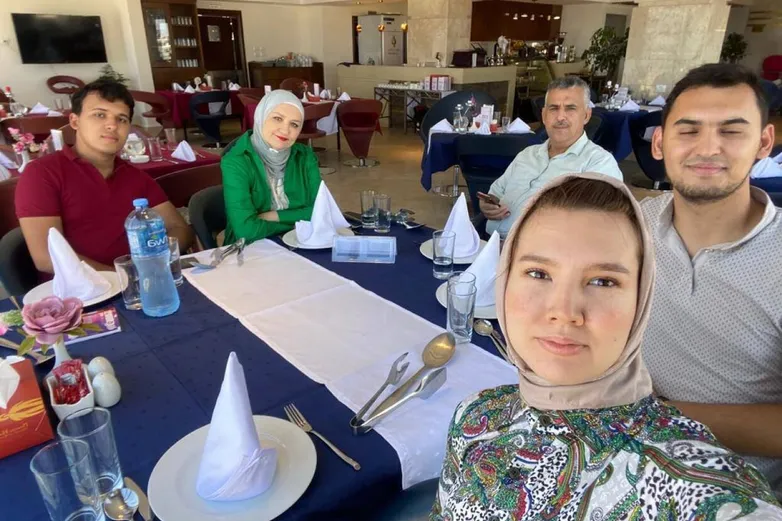
Tatyana Konev, 59, marketing specialist, Karmiel
I’ve been in Israel for 30 years — my husband and I came here in 1995. We were born and raised in Donetsk.
The war after October 7 isn’t our first war in Israel. There was the Second Lebanon War in 2006. It was very frightening because we had two small children, and my husband kept getting called up for military training, though he wasn’t sent to the front.
On October 8, this new war reached the next generation: My son got a call-up notice. It came while he was at work, and I packed his backpack while he was on his way home. Then my husband drove him to his military unit.
A couple of hours later, they came back. It turned out that 20% more people had reported for duty than the unit needed because some had shown up without call-up notices. They let my son go because they didn’t need that many people, and he worked at an important medical equipment manufacturer.
I don’t know what would have happened if my son had stayed with the unit. Its soldiers cleared mines from tunnels in Gaza. So many of them died.
In Israel, war is always close by. There’s an old saying here that our children won’t have to fight. Meaning that any day now, the wars will end. But children and grandchildren have been fighting for generations.
October 7 was Shabbat and the holiday of Simchat Torah — “Rejoicing in the Torah.” Religious families had their phones and televisions, all their means of communication, switched off that day. They didn’t know what had happened. October 2023 also marked 50 years since the start of the Yom Kippur War. I kept saying that Israel’s enemies would want to mark the occasion.
I know a family whose kibbutz was invaded by militants. The family hid in a bomb shelter and stayed there for 28 hours. The militants took over their house. The Israeli army came to liberate the kibbutz, and the militants fired back from inside the family’s house. When the family came out of the bomb shelter, their house was covered in blood.
That day turned many Israelis’ worldview upside down. People in the kibbutzim in the south were mostly very left-wing. I often argued with them about left-wing ideas and told them about my life in the Soviet Union. Left-wing people here couldn’t believe things like that could happen under socialism — to them, it was the ideal.
A lot of people on the left thought that if we helped the people of Gaza, they’d warm to us. October 7 showed how badly that idea failed. A colleague of mine called herself a “proud leftist,” and after October 7, she wrote that she’d lost faith in her ideals.
Some people moved further right, others turned to religion. Israelis generally started looking at life differently. So many times before bed, I’ve thought: “Here I am, going to sleep in my own bed. Tomorrow I’ll get up and have coffee. What’s it like to be a hostage underground? To spend a year or two like that, with almost no food or water, under constant threat of violence?”
One of my colleagues served in the army in a role we call the “knock on the door.” When a soldier’s death is confirmed, someone assigned to that task goes to their family to tell them what happened. For two years after the war began, my colleague was hardly ever in the office. She had so many doors to knock on.
And even after all the hostages were released, my colleague was still making lots of visits to people’s homes. We asked her why. She said not all hostages and soldiers are mentally well when they return to civilian life. People can’t cope with what happened and take their own lives.
For example, last year, a young man whose girlfriend had been killed right in front of him at the Nova music festival took his own life.
Memorial to the victims of the Nova music festival. October 7, 2026
Ohad Zwigenberg / AP / Scanpix / LETA
Another colleague of mine lost his daughter. I’d drawn cards for her bat mitzvah, and then the girl was gone, killed in combat on October 7 or 8.
Now, every morning, I thank God that my house hasn’t been bombed and my children are alive.
Boris Voitsekhovsky, 53, artist, cook, and former journalist, Haifa
In November 2022, my wife and I moved from Moscow to Haifa through the repatriation program because of the mobilization. We’d never been to Israel before. When I left, I had a remote job as the managing editor of Moslenta, but I quit after moving. Now I write children’s books, cook food to order, and paint — a whole range of things.
There was a blizzard in Moscow that November. We were freezing at the airport, and then we arrived in Haifa: warmth, sunshine, palm trees. Beautiful. It was a strange contrast. For the first year, it felt like some kind of extended vacation. There was a forest near our apartment, and we could get to the sea in 20 minutes by bus. We really relaxed and didn’t feel any danger.
That’s pretty much how the whole year before October 7 went: meeting friends, grilling kebabs, drinking wine by the sea. In time, I realized Haifa reminded me of Sukhumi, the largest city in Abkhazia, where I used to spend vacations as a child. Even the smells are the same — the same flowers grow there.
Of course, we understood that terrorist attacks happen regularly in Israel: Someone shoots at a car somewhere, someone gets stabbed. But we saw them all as isolated incidents. There was no sense that trouble was brewing.
On October 7, I was alone in Haifa. My wife had flown to Moscow to see her parents. I was planning to go to a friend’s birthday party. I woke up and read the news. At first, I thought: All sorts of things happen in Israel. Give it a day or two, and it’ll be over. Then reports started coming in that huge numbers of people had been killed, both at the festival and in the kibbutzim…
A bomb shelter in southern Israel where people were killed during the terrorist attack. October 7, 2026
Ohad Zwigenberg / AP / Scanpix / LETA
It seemed like it wouldn’t affect us because Haifa is in northern Israel, and the main events happened in the south, on the border with Gaza. So I went to the birthday party, and my wife flew back the next day.
Toward nightfall, we started hearing explosions. It wasn’t clear exactly what was happening, but it was clearly nothing good.
We started getting daily warnings about the risk of rocket attacks. A special app sent us instructions on what to do if an alarm went off. First, you’re supposed to go into a mamad — a reinforced room in your apartment. But our building is old, and we don’t have one. The instructions say that if you don’t have a room like that, go to the basement; if there’s no basement, go to the stairwell; if there’s no stairwell, stay in a room without windows. We don’t have a basement. We live on the second floor of a two-story building, and the stairs lead straight from the street into our apartment. We even have windows in the bathroom. Basically, as unsafe as it gets.
So every time, my wife and I ran to the stairwell of the building next door. You get an alert, and you have a couple of minutes to get there. But when ballistic missiles started coming from Iran, it got harder because then you only have about a minute.
In 2024, my wife and I spent nights in a bomb shelter at a school. If an attack happens at night, it’s hard to get to the building next door in time. But being in the school’s bomb shelter was great. You get an alert, and you don’t have to go anywhere — you’re already there. We slept on a camping mat. We brought blankets and pillows from home. The concrete floors were cold, and the air was stuffy. My back hurt afterward — it was a concrete floor, after all.
I couldn’t count how many warnings we got, but Haifa itself wasn’t hit all that often. There were deaths, though: In the first few months, for example, a rocket hit an oil refinery outside the city, killing workers.
Some people in Israel are, let’s say, bloodthirsty. They say all of Gaza should be paved over because they’re all scum there. I don’t understand that. Just as I can’t accept the idea that all Russians are assholes because Russia attacked Ukraine. I know plenty of good people in Russia. My parents live there, after all.
But there are fewer bloodthirsty people now — that’s how it seems to me. Because people are exhausted. When the war began, it seemed like it would end quickly, and now it’s been going on for years. People want to make plans and live in peace.
It was impossible not to follow what was happening with the hostages. Everyone was writing and talking about it, and there were constant street protests. I didn’t take part because, of course, the hostages need to be brought back, but I don’t know how rallies could help with that. Is the army going to do more, or what?
But I cooked for soldiers. Jews came to Israel from all over the world to fight. People helped however they could: putting them up in their homes, feeding them, raising money for equipment and footwear.
I don’t know if you could say I have PTSD, but sudden noises bother me. When a car suddenly starts honking, for example, or a tire bursts. Or that bang-bang when a motorcycle goes by. A motorcycle sounds just like a drone. Exactly the same.
When we first arrived in Israel, people had so many plans: They were opening shops, galleries. Now it’s impossible to know how to make plans at all. What’s going to happen tomorrow? Maybe another war? Should we buy property here, start a business? Or maybe move to another country before the kids get called up?
Further reading
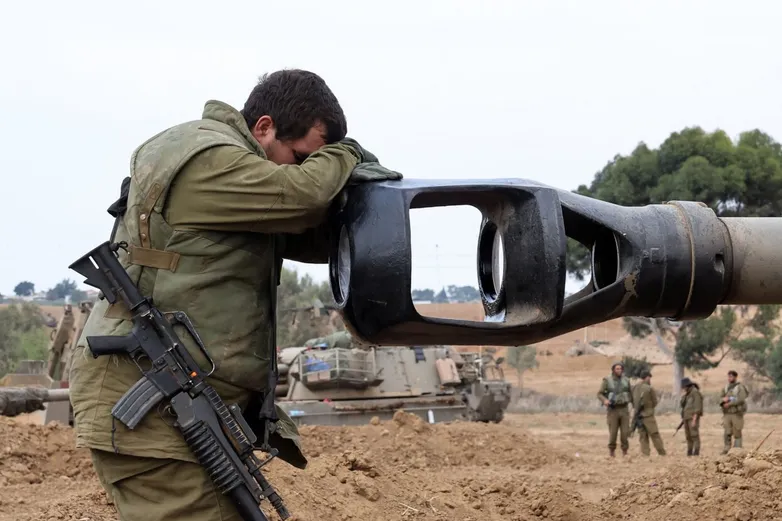
Larisa Zimina, 52, HR specialist, Netanya
In August 2023, there was a hot-air balloon festival at the very spot where the music festival took place, or somewhere very close by. I went with my children. There were several thousand big Israeli families there, with very young children, tents, and dogs. There’s only one road in. It still terrifies me to think that we wouldn’t have gotten out if the attack had happened that day. If I’d felt there was a threat [of a terrorist attack], I wouldn’t have gone.
On the morning of October 7, I was talking to a friend in America. Her son was in Israel and wasn’t answering her calls. She said he’d gone to some event. I said: It’s seven in the morning. He’s been dancing and drinking and partying all night. He’s probably asleep, and maybe his phone’s dead. We joked that trees don’t have power outlets. The guy’s 23, he’s finished his military service. Why keep calling him?
Then I started reading the news and realized things were looking bad. My mother called from Beersheba and said the sirens were going off there. I also remember religious [Jews] stopping me in the street. They couldn’t read the news [on Shabbat] and were asking what was happening.
The boy whose mother I’d been talking to was killed. That boy used to babysit my child. His brother was my son’s best friend. His mother flew in from Chicago right away — on October 9, we were at the missing-persons center that had been set up near Ben Gurion Airport. People were sobbing, screaming, wailing.
October 7 profoundly changed how safe I feel in Israel. It always used to be a short war, a long break, then another, and another. Suddenly, the war turned out not to be short. The odds of losing our “lottery” got much higher.
Kibbutz Kfar Aza, which was attacked by terrorists. October 7, 2026
Ariel Schalit / AP / Scanpix / LETA
[Before,] there were knife attacks and suicide bombings, but they didn’t stop me from working, taking buses, going to parties, or just living my life. I used to work in news in Russia, and I know that the chance of dying of any cause in Russia is much higher than the chance of being killed by a terrorist in Israel.
I live my life as I always have — but if I had a house, I’d build a bomb shelter. Many of my friends have gotten gun permits. Now I’d think twice about renting an apartment in Kfar Saba.
October 7 was an astonishing combination of a fuckup and Israel’s usual laid-back attitude. I used to spend a lot of time working on this conflict, working with left-wing organizations that support two states for two peoples. And I understand how complicated it all is — how nobody’s hands are clean. How many stupid things and mistakes both sides have made, Israel included…
But I’m Israeli, and I’m on the Israelis’ side. And it always matters who started it — with the attack from Gaza, that’s obvious.
Really, everyone should be ready for anything. You can start with the basics: stock up on food, water, portable gas stoves, and blankets at home. Be ready for everything to suddenly shut down and another endless war to begin. I teach my children to steer clear of crowds and watch who’s walking behind them.
And you’ve got to keep yourself sane any way you can: exercise, sex, sleep.
Grigory Nedayev, 31, software developer, Tel Aviv
I moved from Moscow to Israel in March 2022, shortly after [Russia invaded Ukraine]. I knew where I was going, so the possibility that one of Israel’s neighbors might fire a rocket at it, or that a terrorist attack might happen somewhere, didn’t surprise me. So I was prepared — and before October 7, I felt safe.
The Hamas attack happened the day after my wife and I got back from a vacation in France. We flew into Israel on October 6 — lovely weather, warm, peaceful. Around 6:30 a.m. the next day, an outdoor warning siren went off. I woke up and thought: Something’s happening.
A moment of silence in Tel Aviv. The sign reads “Remember and never forget.” October 7, 2026
Jack Guez / AFP / Scanpix / LETA
But something’s always happening here. I went up to the roof of our building. The sky was clear, no rockets or explosions, just the siren. So I went back to sleep. I really underestimated the danger.
That morning, my wife and I started reading the news and realized it was serious. There wasn’t any panic, though. I’m not an anxious person. I thought: There were Hamas attacks in 2019 and 2021 too. And the Gaza Strip is 80 kilometers [about 50 miles] from us. That’s a ridiculously short distance by Russian standards, of course, but it’s still not right on our doorstep. It seemed like it would last a couple of days, so the next day I didn’t even read the news.
I work on Sundays, and at the morning meeting I saw how tense my colleagues were. We didn’t discuss work, just what was happening. Over the next few days, I followed the news closely. Rockets were coming toward Tel Aviv, and the Israeli army was intercepting them. I’d never seen anything like that before — at most, some smoke in the distance from an intercepted rocket. Now it was frightening: Things were exploding right over your head.
I’m pretty resilient, but even I struggled with all the reports of people being burned and brutally killed. You read it and absorb all that horror. You get depressed.
After the hostage deal fell through and Hamas killed six hostages, I was so shaken that I went to a rally. I wanted to, how do I put it, express my opinion.
Then I came across a post looking for volunteers in a Russian-language Telegram chat. I signed up — I wanted to help however I could. They took us somewhere, something like a military base, and we spent the whole day packing food, canned goods, and all sorts of little things for soldiers.
About a year ago, all the hostages came home. There was almost jubilation in the streets. People weren’t exactly walking around shouting “hooray!” but you could see from their faces that they were happy. I felt a kind of happiness too, real relief. Because that horror had dragged on for so long, deals kept falling through, politicians did nothing but argue — you just wanted it to end.
Over these years, I’ve started questioning whether I want to live in Israel, and I’ve become more pessimistic about the future. Even though none of this has affected me personally. I live in a building with a reinforced room — my bedroom is a bomb shelter, so I don’t have to run anywhere. A couple of months after the war began, our company switched to remote work, so I just sat and worked in that room to the sound of rockets exploding. In theory, if a rocket hit the wall of that room, I’d be stunned by the blast, but it wouldn’t kill me.
I haven’t changed. But I think the country has. This war has pretty much killed the idea of peaceful coexistence with Palestine. My impression is that many people who used to be left-wing or centrist have shifted to the right.
Zina Kapitovskaya, 74, retiree, Haifa
When I learned what was happening on October 7, I was overcome with horror, fear, hatred. And sorrow, like any normal person, over the deaths of completely innocent people, including children.
We knew about the balloons they sent from Gaza. We knew they hated us. But we never thought it could turn into such a horrific massacre.
Years ago, I happened to miss a bus that later exploded. For a while afterward, I couldn’t get on buses. Israel is a country where something can happen at any moment. But a massacre like October 7 was unimaginable.
I didn’t see a therapist after October 7: It turns out I’m pretty resilient, and I can cope on my own. Probably partly because October 7 didn’t affect anyone close to me. My grandchildren were in the army at the time, but they didn’t get caught up in that meat grinder. If they had, I’d probably have been losing my mind just like other parents and grandparents in that situation.
I can’t say my everyday routine has changed since October 7. My sense of safety hasn’t changed either. Nor has my attitude toward the Arabs who live near us: I’m not afraid of them.
The worst thing is that no state commission of inquiry into the October 7 attack has been set up. There’s a law specifying how a state commission of inquiry must be formed and who must sit on it. Commissions like that were set up after several wars. Three years have passed, and no one has been held responsible. Only a few people acknowledged responsibility and resigned on their own. Elections are coming up in Israel, and setting up a state commission of inquiry is at the top of the sensible parties’ platforms.
A protest outside the Knesset in Jerusalem calling for a commission of inquiry into the October 7 attack. October 7, 2026
Ammar Awad / Reuters / Scanpix / LETA
My attitude toward the government changed enormously [after the events of October 7]. I think they bear a lot of the blame, and they absolutely need to be replaced. [Israeli Prime Minister Benjamin] Netanyahu says one thing, but who knows what he really thinks.
Of course, the problem didn’t start on October 7. This has all been going on for a very long time. I’m not a politician. I don’t know how to fix it, but I’m sure war isn’t necessarily the answer.
Further reading
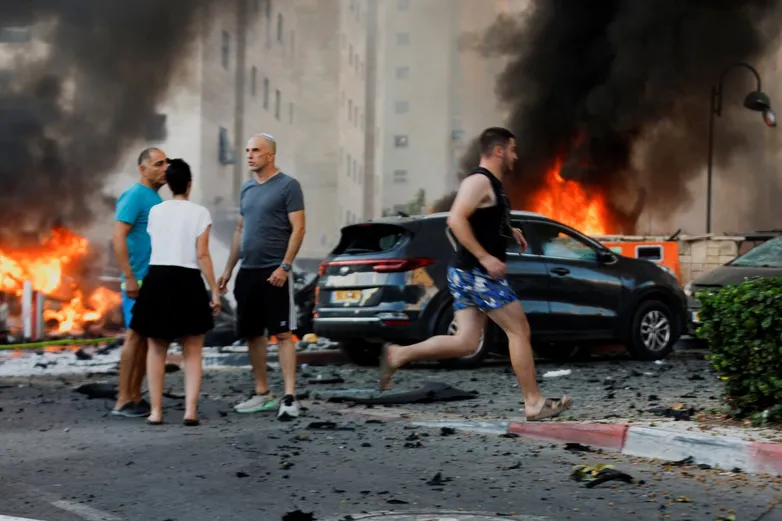
Gavriel Feldman, 49, editor of Mir Torah (World of Torah), a publication about Judaism, Jerusalem
October 7 was Simchat Torah. I went to the synagogue for the very first minyan [communal prayer service]. Most people go to the other, longer minyan: They sing for hours, dance with the Torah scrolls, and socialize. I went to the first minyan because it’s very short, so I could get home to the children and take them back [to the synagogue] for the main celebration and dancing without rushing.
Large floor-standing air conditioners had been set up in the room for the dancing. They were humming, and we couldn’t hear the sirens. I realized something was happening when I got home during a lull in the sirens.
Then rockets started hitting. We had to decide whether to take the children [to the synagogue]. Something was clearly happening, but we didn’t know what. We decided to go for a little while. The lower hall in our synagogue doubles as a bomb shelter. When we arrived, it was clear that the dancing was winding down.
Rumors started circulating because people in our community were being called up to fight. Secular neighbors told us a few things. We knew militants had broken through and hostages had been taken. A picture was beginning to emerge, but nobody understood the scale of it, how many people had been killed or abducted.
Turning on a phone or television is a direct violation of Shabbat. You can do it if there’s an immediate threat to life, but there wasn’t one. Rocket attacks are fairly routine in Israel.
This [observing Shabbat] is a difficult issue: It’s a holiday, Simchat Torah. There are stories about our great teachers who, even in moments of immense personal grief, set it aside when a holiday began and fulfilled the commandments. After the holiday, a person like that returns to their deep mourning, but during the holiday they rejoice, and it isn’t an act.
But we’re ordinary people… [For us,] that’s quite difficult. The children and I left the synagogue and went home fairly quickly. After that, we started going to bomb shelters…
The next day, once Shabbat and the holiday were over, people started collecting supplies for soldiers. Because it had become clear that the state wasn’t prepared for anything. The army couldn’t provide reservists with what they needed. On the morning of October 8, I bought the most urgently requested items and took bags of them somewhere.
Kibbutz Nahal Oz in southern Israel, where women serving in Israel’s army were killed during the terrorist attack. October 7, 2026
Ariel Schalit / AP / Scanpix / LETA
Not long before that, our son had been born, and he had some [health] complications. He was our sixth child. Even as experienced parents, we had to learn a lot of things all over again. We were really tied down [caring for the baby], while the war was going on in the background.
I coped with it fairly easily. It was harder for my wife. Anxiety, not knowing what would happen next, no sense of certainty or safety.
For many people in Israel, October 7 shattered their understanding of the world. For me, it didn’t. If you start from the belief that the Almighty governs the world, while the world’s progressives are trying to take it in the wrong direction, then you understand that stability and tranquility are something of an illusion, a way of fooling yourself. If everything’s okay for you today, you shouldn’t assume it necessarily always will be.
October 7 woke a great many people up. In that sense, some good came out of this horrific tragedy. For a while, you could see the unity in Israel that everyone loves to talk about.
Then, of course, that unity fell apart — turning to “mold and linden honey,” as the Russian song goes. But at least we knew unity was possible.
Vitaly Starov, 44, programmer, Acre
My wife and I left Russia because repression was growing, and we suspected I might be jailed. We understood that we were moving to a country where terrorist attacks could happen, a country that’s constantly at war.
We arrived in Israel about three months before October 7. Luckily, we managed to get all our paperwork done except for my driver’s license. We got identity cards, bus and commuter train passes, and joined a health insurance fund. After October 7, everything closed, then opened only intermittently. It took me six months to get my license.
On October 7, I woke up with an inflamed ear, apparently because I’d walked barefoot on the tile [in our apartment] the day before. My ear hurt, and the pain spread to a tooth. I thought I should probably see a doctor, but then I started reading the news and felt even worse.
The Hamas attack was shocking: a brutal massacre with large numbers of civilian casualties. The videos of hostages being dragged through crowds in Gaza, beaten and spat on, really hit me hard.
That same day, checkpoints were set up at the northern entrances to Acre, and armored vehicles with men carrying automatic weapons were brought in. The Lebanese border is 10 to 15 kilometers [about six to nine miles] north of the city. The thinking was that Hezbollah might break through the border and make it as far as Acre. But it limited itself to rocket attacks. There were fears that unrest would break out among Israeli Arabs, but that didn’t happen.
Hezbollah launched its first attacks from Lebanon a day or two later, and after that, there were air-raid sirens on many days. Almost all the rockets were shot down. Only a few got through. The bomb shelters in Acre, like those in many cities in northern Israel, were full of junk and partly flooded. I went to help clear them out as a volunteer.
My attitude toward Israel hasn’t changed since October 7, but my attitude toward the current Israeli government has. For the worse: They haven’t solved a single problem, only compounded them. No state commission of inquiry into the events of October 7 has been set up. The goals of the war Israel has become embroiled in are unclear, and there are serious questions about how it’s being fought.
I wouldn’t say I have PTSD, and I probably don’t need to see a therapist. But naturally, there’s nothing good about air-raid sirens either. Now, wherever you go, you automatically look around for the nearest bomb shelter. Still, I don’t feel threatened by Arabs — and there are a lot of them in Acre.
After October 7, it became much clearer why so many Israelis carry guns in public. It doesn’t surprise me to see people carrying automatic military rifles while buying groceries in a supermarket. And overall, the Israeli army and security services showed their strength and proved they could regroup even after a huge failure.
An installation commemorating the tragedy. Tel Aviv. October 7, 2026
Oded Balilty / AP / Scanpix / LETA
Acre is a small city, and we didn’t really have rallies calling for the hostages’ release. But my wife and I went to roadside protests with signs several times, handed out ribbons, and put up banners around the city. Relatives of hostages came to Acre, and we met with them. The main demand was for the government to agree to a deal to free the hostages.
We did all this with local Hebrew speakers. There were no Russian speakers there. There was very little information in Russian about the movement supporting the hostages. I posted in Acre’s Russian-language chats a few times, but nobody came to the protests.
Israel is a small country. Almost everyone who’s lived here a long time has relatives or acquaintances who were harmed [in the terrorist attack] — or at least knows someone who does. Most Israelis think their country upholds European standards. Seeing that brutality [during the terrorist attack] convinced them that barbarians had attacked, people they couldn’t negotiate with. That’s where all those statements come from about there being no innocent people in Gaza, about building a parking lot in its place. Those statements cast Israel in the worst possible light.
I definitely don’t want to go back to Moscow. Sometimes it all gets too much, and I want to move somewhere else [to a third country]. But we’re citizens here, and in another country we’d have to go through all the bureaucracy again. Learn another language, unless it’s English.
Israel’s actually not a bad country to live in. Apart from the wars and the rocket attacks.
At Meduza, we are committed to transparency about our use of artificial intelligence in the newsroom. The story you’re reading was written by one of our living, breathing journalists and translated from Russian using an AI model configured to follow our strict editorial standards. This translation process is the result of extensive testing and refinements to ensure our English-language coverage is timely and accurate. A Meduza editor reviews every draft before publication.
If you find any errors in this translation, please contact us at [email protected].
To read Meduza’s exclusive content in English, please subscribe to our newsletter.
Interviews conducted by Alexander Leonidovich and Anatoly Sychev