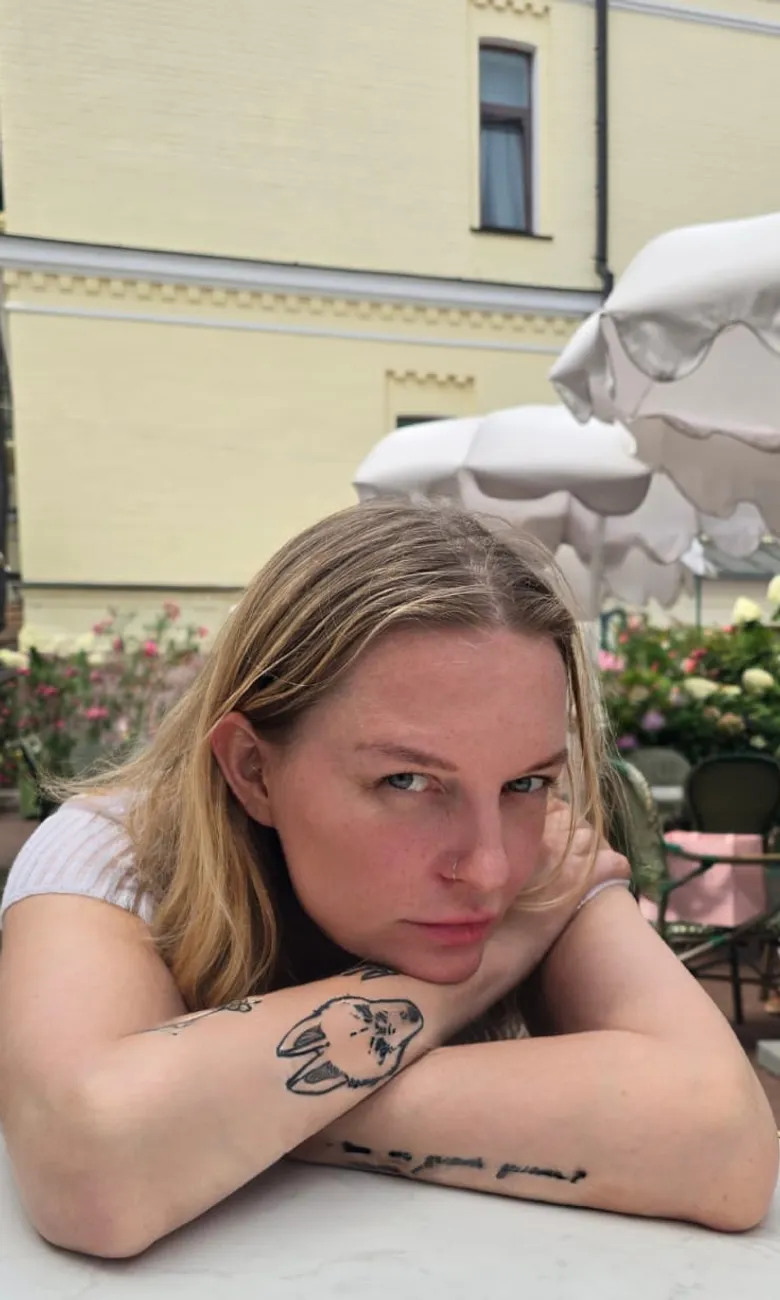
‘I’m not very interested in a hypothetical “democratic future for Russia.”’ Antiwar activist and former top model Ksenia Maksimova has more immediate priorities.
At the end of September, Russian authorities put Ksenia Maksimova, head of the London-based antiwar group Russian Democratic Society (RDS), on an international wanted list. Shortly before that, she had been added to Russia’s registry of “terrorists and extremists,” and RDS had been declared an “undesirable” organization. Before entering politics, Maksimova worked as a top model and later as an agent for fashion photographers. She is now heavily involved in helping Ukraine (she even lives there), while also advocating for antiwar Russians in the British Parliament. In May 2026, she won a seat in London’s municipal elections, becoming a councilor for the borough of Ealing. Meduza spoke with Maksimova about life in London and Kyiv, Britain’s turn to the right, infighting in the opposition, and how to help Ukraine and antiwar Russians at the same time.
‘I’m not very interested in a hypothetical ‘democratic future for Russia”’
— You’ve been added to the terrorist list, a criminal investigation has been opened against you, and your organization has been declared “undesirable.” Were you ready for all this? How are you feeling right now?
— Obviously, it didn’t come as a surprise. People on our team even used to joke that if someone still hadn’t been put on an official blacklist, they had to be working for the FSB. And then, bam — everybody, one after another. I figured, OK, they’ll blacklist me, they’ll convict me in absentia. That’s literally what I told my mom: “It’s all fine.” But a couple of days later, this wild, unexpected attack started. They were trashing me in prime time on every channel, the video the FSB recorded was playing absolutely everywhere, and they were branding me a “Vlasovite” — for God’s sake, I didn’t even know that word! After that much TV exposure, it got genuinely unpleasant. It also hits hard that I still have family in Russia, who now have to brace for intimidation from the authorities too.
The most surprising thing is that the British police, whom I’d given information about the threats [from the FSB], took it all much more seriously than I did. It’s gotten to the point where I’m probably safer in Kyiv right now than in London: the [Russian] security services definitely have bigger things to worry about there than me, and I just want to keep trouble away from home so my kids or my dad don’t get caught in the crossfire [he also lives in London]. So for the near future, I’ll be based in Ukraine.
That said, I haven’t become paranoid. I don’t have eyes in the back of my head, and my head’s a bit in the clouds anyway: I can easily get lost in a parking lot, even with Google Maps. And emotionally, I honestly couldn’t care less.
— Russia really has been paying a lot of attention to you in recent months. NTV, for example, aired a five-minute segment that labeled you a “run-of-the-mill model” and the “leader of a Russophobic cell.” But you’ve been an activist since the start of the full-scale war. Why do you think such a massive campaign has started now?
— Several things came together. At first, we thought we’d brought it on ourselves by getting Instasamka’s concert canceled, but the scale of the hate on TV is clearly disproportionate to that. Actually, they started pressuring me back in May 2025. That’s when the Telegram channel Underside published an “investigation” into me and RDS. They dragged my whole family into it: my husband, who just carried the flag [the white-blue-white flag of the antiwar protest movement] at rallies (because the flag is heavy!), and my daughter, who was 19 at the time. They brought up a Beslan protest she’d taken part in, where the kids ran across the road to the Russian Embassy to tie notebooks with “Putin is a murderer” written on them to the metal barriers. They leaked her LinkedIn, her photos, where she studies. The message couldn’t have been clearer: “Keep quiet.”
This year they rolled out an enormous leak, tying a bunch of people I’ve never met to my work. It turned out that back in 2024, my email had been hacked for a couple of hours and they’d downloaded my correspondence with the British FCDO [the Foreign Office]. In their sick minds, that instantly added up to “MI6 handlers,” even though I was the one writing to the ministry about our plans, not them giving me orders.
The security services sat on those emails for a long time, and in 2025, I think, they decided to scare me before I launched a committee on Russia in the British Parliament. I launched the committee anyway, and now I’m putting together an international inter-parliamentary alliance. I’m constantly traveling around Europe, the U.S., and Ukraine, and I also launched a think tank where Russians themselves provide expertise on Russia, because understanding of the threat here was abysmal to begin with. Moscow sees me keeping busy, writing, working with Western politicians, and becoming increasingly visible — and that’s what set them off.
— You brought up the Instasamka cancellation yourself, and that’s a pretty high-profile case. But why did you even need to do it? What does canceling her concert change?
— The whole thing came about by accident. There are almost no other antiwar Russian organizations in the U.K., so people often turn to us as “fixers.” One of our followers sent us the news: “You’ve got Instasamka herself performing over there.” Before that, I’d never even heard her music. An activist in Washington just recently played me the track “Za dengi da” (“For Money, Yes”) for the first time. But I knew the general backstory: in Russia they’re pushing traditional values, and meanwhile Instasamka was living it up without a care, and when they put the squeeze on her, she ran off to take photos with [Yekaterina] Mizulina, perform for officials, and kiss portraits of Putin. And nobody forced her to do it. She’s perfectly comfortable there.
So I just wrote to the venue: “Do you even know who’s performing at your place?” They answered literally 40 minutes later and canceled everything.
Of course, this isn’t an attempt to defeat Putin with one letter. But she also got canceled in Kazakhstan and Cyprus, for example. Targeted decisions like these don’t change the course of the war, but they do affect who gets a public platform in the West and what’s considered acceptable.
— You recently got back from PACE. What were you doing there? Is there any point to that organization’s sessions?
— I go to PACE strictly as Ksenia Maksimova, and at every meeting I immediately distance myself from the Platform of Democratic Russians. Otherwise, Europeans automatically assume we have the same agenda.
Ksenia Maksimova’s personal archive
Unlike them, I’m not very interested in a hypothetical “democratic future for Russia.” We still have to live to see it. What I care about is the period in between: how to make sure Ukraine holds out during that time and Europe doesn’t fall the hell apart. For me, PACE is just a convenient venue where lots of lawmakers from different countries gather in one place. I simply don’t have the money to fly to each of them separately, and there you can talk to everyone at once. Although right now it’s sheer chaos there: so many Russians have shown up with their entourages that the café where everyone always used to lobby [for their projects] has been closed to the public. Now everyone just bustles around in the hallways.
For me, the point of these meetings isn’t photos for social media. It’s developing practical ways to get things done. Our inter-parliamentary alliance is designed precisely to help overcome Europe’s main problems: fragmentation and fear. Right now, different countries often act on their own, like ostriches with their heads in the sand. The alliance can create peer pressure. When European politicians are sitting in the same room, they can no longer cut a deal under the table, lift sanctions on someone like Usmanov, or brush it off with “we didn’t know about it.” That makes it possible to coordinate and make decisions faster.
Yes, in the fifth year of the war, European laws are getting tougher, and protecting antiwar Russians is getting harder. But that doesn’t demotivate me. On the contrary, I energize the people around me. If you do nothing, it’ll only get worse. There’s not going to be some magical collapse of the system overnight — change comes from lots of small developments that we have to work to bring about. Everyone wants to find the regime’s hidden weak spot — its “Koschei’s needle,” from the Russian fairy tale — and Europeans won’t find it without Russians themselves. So it always pays to keep moving.
— For the past few months, you’ve spent almost all your time in Ukraine. How did that happen? And what do you do there?
— I started traveling to Ukraine regularly in February 2025, and it’ll soon be two years since I fell completely in love with the country. Before that, I’d organized a closed-door roundtable in Kyiv with British and Russian experts, but at some point I realized I was working on a subject I hadn’t experienced firsthand. On my first long trip, I was terrified. I kept waiting for people to identify me as the enemy. But then I lived through my first big bombardment there, realized I wasn’t afraid, and started making friends. This time, I was actually going there for a month and a half on “summer vacation,” to sit quietly and write my dissertation [titled “Recycling Sovereignty: AI Adoption, Sanctions, and Prolonged Shock in Russia’s Oil and Gas Exploration and Production Sector”].
In the end, I had no time for it at all. Kyiv is an incredibly happening city. I didn’t have any plans, but there were meetings every day. Experts, politicians, and journalists come there from all over the world, and with everyone I meet, some project immediately takes shape.
I also realized how badly Ukraine lacks quality expertise on Russia, especially on the economy. Both in the West and in Ukraine, people just don’t get how Russia’s economy actually works, and Ukrainian analysts, in the middle of an active war, simply don’t have the time or resources to dig deep into it. And there was no one to ask for help, either, because Russians used to be terrified of working with Ukrainians, thinking they’d get “thrown under the bus.” We managed to break the ice. Maybe being an outgoing, diplomatic woman helped us pull it off.
— Don’t you see a contradiction in helping Ukraine while also asking Western politicians to deal with Russians’ problems?
— For me, supporting Ukraine and helping antiwar Russians have never contradicted each other. I come from traditional, hands-on human rights work, where you do whatever it takes to pull people out of precarious situations. Since the very beginning of the war, there have been both Ukrainians and Russians there, and often they’re mixed families. How are you supposed to tell the right ones from the wrong ones?
And the West matters to me too. People in the Russian opposition sometimes scold me for that. They say I’ve got a British passport, I’ve forgotten Mother Russia, and I’m defending the West against her. But when I talk to Western politicians, I distinguish between the Russian state and Russian people. I tell them directly where the Russian state is attacking them and what they’ve overlooked. And in the same breath, I calmly ask for help and protection for Russians who don’t support any of that. Judging people by their passports when they need help sets a very dangerous precedent. You have to help everyone who needs it.
‘We have to explain basic things to British ministries in the simplest terms’
— How did RDS come about? Russian TV channels, for example, credit Mikhail Khodorkovsky or Vladimir Ashurkov with founding it.
— TV loves telling fairy tales. According to them, I’m also Khodorkovsky’s mistress — basically, sex, money, with Ashurkov thrown in for good measure, and a whole “army of models.” Propaganda somehow very deftly jumped from my modeling career straight to service in MI6, completely erasing the 20 years when I slogged away at ordinary jobs.
In reality, RDS grew purely out of activists’ own initiative and came together completely spontaneously. In March 2022, when people in some international chat were choosing the white-blue-white flag, I stuck my nose in there too, as usual. As soon as the flag was settled, we [the other activists and I] went to the market, bought a bunch of fabric, and sewed them [the flags] ourselves. We’d go to Ukrainian protests with those flags, but after Bucha and Irpin, I got an extremely long message in English: “You and your people, don’t come anymore.” That’s how I was suddenly appointed “the one in charge.” So as not to get on anyone’s nerves, we moved our protests to the Russian Embassy.
Originally, I wanted to register the organization with three directors, so decisions would be made by a majority of votes and nobody could grab power. I couldn’t find a third person, so I asked Ashurkov to become one of the directors. He agreed, but then the second candidate dropped out. In the end, everyone I discussed it with said, “Maksimova, stop agonizing over it and just register it in your own name.” I told Volodya [Ashurkov] never mind, but the rumor that he was behind the founding of RDS had already started.
Back then I wasn’t in contact with Khodorkovsky at all. I spoke to him for the first time later, at one of the antiwar conferences. I was terribly shy; I was completely in awe of MBK [Mikhail Borisovich Khodorkovsky]. That was before all these endless opposition squabbles.
Later, when I quit my job [until 2024, Maksimova worked in London’s fashion industry as a photographers’ agent and producer] because I was physically falling apart, I went to him [Khodorkovsky] myself and asked for some side work. He also gave me a grant to launch the parliamentary committee, for which I’m incredibly grateful. But nobody demanded anything of me, and he didn’t take over RDS.
— Apart from helping persecuted Russians with paperwork, what have you mostly been doing over these years?
— We really have been doing human rights work and helping refugees from the very beginning. And back then, huge numbers of refugees were arriving. These days, though, new people facing political pressure hardly ever come to the U.K., and we’ve mostly switched to appeals after absurd asylum denials. The most common case is guys getting turned down even though they have a draft notice in hand, on the grounds that there’s “no mobilization” in Russia. People come to us through the form on our website, write to us on social media, or reach us through acquaintances. I write the expert letters myself and speak at the hearings. So far, knock on wood, we’ve won absolutely every appeal.
We have other areas of work, too. We keep organizing protests and cultural events in London, giving a platform to people who are too political or not well-known enough for commercial venues. We don’t make any money on it, but it’s a niche that really needs filling. Plus, we run a psychological support group.
Ksenia Maksimova outside the Russian Embassy. London, February 25, 2024
Hannah Ellison / Reuters / Scanpix / LETA
We’re also relaunching the group in the British Parliament right now, and my main goal is to get young people involved and bring new faces from RDS onto the international stage. Other RDS activists attended the recent Russie-Libertés forum in Paris and the Anti-War Committee conference, so it’s not just me popping up everywhere.
— What would you personally count as RDS’s biggest successes and failures over the years?
— It’s hard for me to name one big win: it’s all made up of small steps. But the main positive, as I see it, is that we’ve moved from purely emotional street activism to practical, substantive work. At the start, people came to us driven by pure pain and anger, wanting to do “something, anything.” But once the emotions died down, the group, which had no formal hierarchy, got stuck in endless arguments about who was responsible for what, and everyone burned out.
I haven’t heard the word “burnout” in about two years. RDS has grown up, gotten organized, and things started running on their own. We have a strong team; people come with their own ideas and carry them out well. For example, we’ve started focusing on helping students, who now have a really hard time leaving Russia to study in places like the U.K. We do it together with the Diplom Svobody (Diploma of Freedom) project, help people get scholarships, and plan to scale it up.
As for what flat-out didn’t work, we never managed to find money for a permanent space, a kind of antiwar alternative to the Kremlin-backed Russian House that would become a gathering point for antiwar Russians in London. We looked into options, but the people who had empty buildings or money weren’t interested.
— As for your research and analysis projects — why are they needed, and why is it so important for a country like the U.K. to understand what’s happening inside Russia?
— Everything I do is built on advocacy, that is, standing up for people’s interests. How can you ask Western politicians for help and constructive engagement if they’re terrified of Russians and have no idea who they’re dealing with? In that situation, they’ll just try to lock you away somewhere far off so you don’t stick your head out.
That isn’t happening because of hatred for Russia. It’s a plain lack of expertise. Think tanks like Chatham House have had their budgets cut, and Parliament used to be briefed mostly on Ukraine. That left a big gap in expertise that needs to be filled. And there are holes in the understanding of Russia almost everywhere; maybe Germany and Poland are doing slightly better.
For the inter-parliamentary alliance, I’m bringing together experts with hands-on experience, not just academic knowledge. We have to explain basic things to British ministries in the simplest terms, starting from scratch: from the fact that different regions of Russia have completely different dynamics to the fact that Zhirinovsky is dead and the Communist Party of the Russian Federation isn’t a genuine opposition party.
Politicians here still think with an imperial mindset along the lines of “our state is bulletproof, we’ve stood for centuries, and everything’s under control.” They don’t notice that Russia already has its tentacles in here, and that huge sums are being laundered through crypto right under their noses. They don’t understand the public mood and ask when people will finally march on the Kremlin with pitchforks. They think all you have to do is turn up the heat and the crowds will come out.
Why does Britain need to understand this? First, to assess its own risks properly. Second, to keep supporting civil society inside Russia. The British are tightening the screws on migration, and in the end it’s people like students who suffer, because visa delays mean they can’t leave in time to start their studies. If you don’t help the guys get out, they’ll be crushed inside the country and forced to sign a contract to go to war. Or they’ll go study in China, which will only increase technology exchange and strengthen Russia itself.
Sealing everything off completely is a dead end. We don’t want our combined efforts to create another giant North Korea.
‘Once you’re elected, they’re required to hear you out and give you an official answer — they can’t just say “no”’
— You have a long history with London. When did you finally move here? And how did you make that choice? Was there a point of no return, when it became clear you no longer wanted to live in Russia?
— I moved here for good in 2016, but I first came here in 1999, when my dad, who worked in IT, was transferred for his job. My family lived very modestly — there wasn’t even money for summer sandals — so if my dad hadn’t been part of the “brain drain,” Britain would never have been in the cards for us.
Back then I hated London. After my Moscow lyceum, where we may have smoked behind the garages but they made us study hard, I got stuck in a prim British girls’ school. You had to wear a uniform and go to school for a whole 13 years instead of 11, and the curriculum turned out to be too easy. In the end I rebelled and went back to Moscow to finish 11th grade.
Because of that stunt, I missed all the university prep courses, there was no chance left of getting a tuition-free university place, and nobody could pay for me. And then Natalia Vodianova’s modeling agent spotted me in a café. They dragged me to fashion weeks, and my career took off instantly. For three years I traveled the world, living out of a suitcase in New York and Paris.
But that industry wasn’t for me: you’re always alone, you’re not your own boss, and the money you earn doesn’t bring any joy. As soon as I’d saved up enough for school and a financial cushion, I got out of modeling. I came back to London and enrolled in university to study media arts and design. I finished just as the aftershocks of the 2010 financial crisis hit, there were no jobs, and I left with my two small children, first for Argentina and then for Italy. There I had to start from absolute zero, with no old connections: I slogged away as a bank secretary, a bar manager, and in communications for a hostel.
Later, I went back to the fashion world, this time as a producer and a photographer’s agent. At the peak of my career, in a month when five covers I’d worked on came out (including British Vogue with Florence Pugh), I made a graceful, final exit into unpaid activism. And I recently finished my studies: I defended my dissertation on sanctions and AI in the oil and gas sector.
The point of no return with Russia came in 2014. When Crimea was annexed and that ill-fated Malaysian plane was shot down, I realized everything was sliding into the abyss and there was no point in dealing with that country anymore.
I urgently withdrew all my modest savings from a Russian bank, where they’d been earning interest. In the West, there were no deposit rates that high, short-term or long-term. Once I took my money out of Russia, that passive income disappeared, and for a year and a half in Italy, I had almost nothing to live on, with two kids and no child support at all. In 2016, I had to come back to London not out of some great love for the city but for practical reasons: the apartment my dad and I had bought together was still here, and so was my dad, who could help with his grandkids.
I’ve never been a huge fan of London. But over time I realized how great it is here. If you work hard, you really do get promoted on merit — meritocracy works here. In Italy, if you don’t have the right friends or family, you won’t get anywhere, especially if you’re a woman. I wanted my kids to grow up in a healthy, well-functioning society. So I stayed.
Ksenia Maksimova’s personal archive
— Has London changed in the years you’ve been watching it?
— Now I’m going to get nostalgic like a real old granny. The city used to feel calmer, quieter; there was a sense of stability and safety. Now there’s none of that at all. Maybe when I was young, I just didn’t understand that the whole system here was cobbled together from whatever crap was lying around. Now that I know how everything works behind the scenes, I can see all the shit holding it together.
And the world has gotten badly out of whack in recent years. London has become much dirtier and less safe — that’s a fact. But the tragedy is that, in their heads, people are still living in the old Britain, unaware that it no longer exists.
Politics here is totally absurd. Parliament is sure everything’s great at the Foreign Office and the police; the police point to Parliament “working excellently,” and in reality it’s a complete mess everywhere, and nobody is responsible for anything. When you see this giant black hole from the inside, the depth of the abyss is a little scary.
To stay afloat in this system, you have to know how to operate in chaos and not be afraid of it.
— What about the Russian-speaking diaspora in London? How is it changing?
— It’s hard for me to say with 100% certainty, because I never used to have anything to do with Russians in London. I know that in the old days there was a well-known rule here: “If you hear Russian on the street, cross to the other side.” There was a sharp dividing line, because the people living here were mostly first-wave “Sovok” emigrants with a Soviet mentality who were endlessly nostalgic for the USSR. Then came a wave of young professionals: IT people, biologists, scientists.
Now all those programs for Russians have been severely restricted. Getting a work visa or a talent visa is incredibly complicated. It makes me furious that because of these barriers, the people managing to get to the U.K. now aren’t talented kids from ordinary families but mostly the children of elites, who have the resources for it.
I have no idea how ordinary smart kids are supposed to get out now. At the same time, I’m completely cut off from the rich-kid crowd in London and don’t know what makes them tick. All I’ve been told about them is that they were very unhappy we got Instasamka’s concert canceled. That’s all you need to know about them.
Ksenia Maksimova’s personal archive
— Why did you decide to run for local council here?
— Even before the war, I was always fixing something up in my neighborhood. During COVID, for example, I organized a crowdfunded cleanup of a local pond that the council had let turn into a swamp. And it’s such a rush! You report a broken trash can or bring excavators to a pond, and you see real results.
When [former British Prime Minister] Rishi Sunak called an early election in 2024, I decided to enter party politics and joined the Liberal Democrats. By the way, they became “undesirable” in Russia partly because of me, when they put forward an emergency motion on delegitimizing Putin. The butterfly effect.
— How did a British party even react to a Russian woman with such an activist background? Was there any wariness?
— The party gave me a great welcome. I got very active right away and even went to their international conferences. It was as simple as it gets. You show up and say, “Hi, guys, my name’s Ksyusha, I want to do everything.” And unlike the Russian opposition scene, where everyone’s just tearing each other apart, they sincerely tell you, “Oh, that’s so great, we’ve got an enthusiastic new member! So what exactly do you want to do? We’ll help you right now.” They explain everything step by step and really support you. After the Russian political crowd, that was incredibly nice.
Before the municipal elections in May 2026, they asked me to run. At one point I got scared I wouldn’t be able to handle it alongside my master’s [Maksimova was studying in the Global Political Economy program at King’s College], and I wanted to drop out of the race. But my friends from Ukraine talked me out of it. A year and a half ago, they explained something important to me: if Russia starts aggressively going after you, you shouldn’t hide — you should go as public as you can, as fast as you can. The more public you are, the safer you are.
And that moment came. Going after an ordinary émigré is one thing; pressuring an elected British councilor is something else entirely. As soon as there’s a threat from Russia, strict procedures immediately kick in: the police come to see me. For an ordinary person, getting that kind of protection would be a thousand times harder.
— Why doesn’t this British model — “an active person shows up, let’s help them” — work in the Russian opposition? And what’s your own experience been with that world?
— Since I grew up in a different system, that actually came as a complete surprise to me. I naively expected the same open attitude in the Russian scene, especially from human rights defenders; dammit, they’re not even politicians! But back at the end of 2022, when I came to the first gathering of the Berlin Platform of Civic Initiatives, I immediately saw wild competition and snobbery. Supposedly we were all meant to work as equals, but I instantly ran into unhealthy territoriality: if someone gets access to funding or useful data, they hang on to it for dear life and won’t share it with anyone for anything.
The way I think, if there’s a resource that will help the common cause, you should share it with everyone. I didn’t live or work in Russia as an adult, so I don’t know much about how society works there, but from the outside I can see that things haven’t improved over the years.
Then there was this endless fight between [Alexei] Navalny’s team, Free Russia, and [Mikhail] Khodorkovsky and [Leonid] Nevzlin, which is obviously not encouraging at all. Meanwhile, people keep trying to assign me to one camp or another, usually to MBK’s, even though, God forbid, I’m not “one of Khodorkovsky’s people.”
I try to be friends with everyone. Well, OK, [Anti-Corruption Foundation political director] Leonid Volkov blocked me, even though we’ve never even met. If I see colleagues making mistakes, I’m always ready to give them constructive feedback directly; I think fair criticism only helps. But in the Russian opposition, it’s either met with hostility or ignored.
It’s important to clarify, though, that this is far from the case everywhere. With diaspora organizations and the people who do evacuations, the work really is getting done, and getting done well. There’s none of that there; we’re very close. It’s a few hundred people working very hard, most of them for free, and we really stick together.
— How did your election campaign go? Did you run into any difficulties because you’re a foreigner?
— The campaign itself is insane — a huge workload! We were walking 25,000 steps a day, because it’s all built on talking to voters in person: you walk around the neighborhood, knock on doors, and talk to people. Someone doesn’t like where a particular pole is on their street, someone’s worried about local budgets, and someone’s concerned about what’s happening in, say, the U.S. In Britain, local reputation plays an enormous role. If people see that you’re doing good for the neighborhood, they’ll happily vote for you, even if you were born abroad and have a background in international activism.
Ksenia Maksimova’s personal archive
— Judging by the media coverage, Britain also seems to be taking a “turn to the right.” At least there’s a lot of noise around Reform UK, which plays up anti-migrant sentiment. Do you run into its representatives or supporters while campaigning?
— The scale of that problem is greatly exaggerated. A lot of what we see in the media really is just noise. If I were campaigning in the north of the country, it would be a different story, but in London, the whole time, I came across five Reform UK supporters at most. They start out with the stereotype that we Lib Dems are these “soy snowflakes” who dream of letting every last migrant into the country. But literally five minutes is enough for me to win them over. I walk them through some simple logic.
Our agenda doesn’t involve thoughtlessly opening the borders. On the contrary, we support rejoining the European Union, partly to restore the Dublin Regulation. Before Brexit, illegal migrants could simply be returned to France under that rule. So the current migration crisis in Britain is a direct consequence of Brexit, which the right itself pushed. When you lay out that two-minute chain of reasoning for people, it all clicks instantly.
And honestly, in local elections it doesn’t matter which party a person votes for. What matters is that the councilor just does their job. In Britain, because of the failures of one government after another, people have gotten poorer and angrier and started looking for simple solutions to complex economic problems. That’s what Reform UK’s populism grew out of in the first place. But now their popularity is declining. People are tired of hearing about migrants for the 150th time and are starting to see the real causes of the crisis, which lie in the economy, not in newcomers.
— In August, you had 160 cases in your council work. What about now? And what kinds of cases are they? What do people in your area complain about?
— There are more than 300 requests now. I’ve known Ealing since 1999 [that’s when Maksimova first came to London with her parents; in total, before returning for good in 2016, she lived in the city on and off for about seven years], I remember every pothole, and I can see how much it’s changed.
Historically, it was a well-off, middle-class area, where many families still live off generational wealth — they simply inherited their parents’ houses. But there are also some extremely troubled, neglected patches now, where people use drugs in broad daylight and homeless people sleep right by the door of the children’s library.
I oversee that area on the council. My colleagues were happy to dump it on me, because it’s the deepest circle of hell. But for some reason, complicated bureaucracy comes easily to me. Within six months, I helped the first person on my caseload move from homelessness into council housing, and I have six more difficult cases in progress.
What really drives me crazy is when simple things get stuck. For example, when red tape means I can’t get a dangerous tree cut down for six months, I start losing my mind. Parks are an endless headache: this summer they caught fire because of the drought, and the council said it had no money budgeted for water. Or another story: some kind of grass in the parks wasn’t mowed in time, and its seed heads got stuck in dogs’ paws and ears, burrowing in so deep that the animals needed surgery under anesthesia. The owners of five injured dogs came running to me, and I had to push urgently to get that grass mowed.
There are also tons of complaints about roads and development when a new building is planned so close to existing homes that its windows practically face straight into those homes and block people’s light. My job is to be a mediator. A person comes to me with a problem, and I go fight it out with council officials. I figure out the right department, request the plans, and check whether the consultations with neighbors were done properly. A couple of times I’ve managed to stop a construction project entirely at the approval stage this way.
But the best thing about being a councilor is the authority that comes with elected office. When you’re an ordinary human rights activist, you have to go from door to door begging — “please, please” — only to have them shut in your face. Once you’re elected, they’re required to hear you out and give you an official answer — they can’t just say “no.”
Ksenia Maksimova’s personal archive
— Let’s talk money. You left your main job, so what do you live on? Do you get paid as a councilor?
— I do, but it’s very little, about £1,000 a month. It at least partly plugs the financial hole, but don’t celebrate yet: you’re also required to hand over 10% of that to the party. When I left the fashion industry, I lost half my usual income. Thankfully, my kids are grown up now and earn some money themselves.
Right now, Mikhail Khodorkovsky also pays me a nominal salary for promoting documentaries he sponsors. For example, we organize screenings for Western politicians right in the British Parliament. The latest projects were very important: they’re about Ukrainian children whom Russia forcibly takes from the occupied territories.
I wouldn’t say Mikhail Borisovich is burying me in work. It’s more a smart form of support, because he sees that I’m doing something useful, and at the same time he doesn’t interfere in my projects at all. That’s how I get by.
‘I learned to handle a schedule like this from Ukrainians’
— Why are you still working on Russians’ problems? Wouldn’t it be easier to devote yourself completely to your new country and its problems?
— None of us can just part with that side of ourselves — Mother Russia never lets you go… The truth is, I really love Russia. For years, I wanted to go back there with my kids and live there. Every so often I’d be on the verge of it, even though I knew perfectly well that if I went, I’d immediately start making noise somewhere and quickly get punished for it. My personality is completely incompatible with the current political situation in the country. But the very fact that I can’t live there normally with my family and freely visit my loved ones is deeply wrong. And whenever some outrageous injustice happens, I always automatically want to go and do something about it.
Before this whole thing started [before Russia’s full-scale war against Ukraine], I was completely assimilated. I’d practically forgotten I was Russian at all. I was just living a normal British life in Britain with my kids, who are only half Russian anyway.
And then, at some point, I got caught up in Russia’s machinery and dragged back in. It all happened by accident. RDS was originally created to help Ukrainians and to protest; there was never any plan to work on Russian issues. But in early 2023, I put together an antiwar human rights coalition and tracked down Indigenous peoples’ organizations myself to figure out how to help them, and, without noticing it, I became the person all the requests flowed to. But I don’t mind; it’s not hard for me.
— There are two main areas of your life right now: British politics on one side, and Russian civil society and the war in Ukraine on the other. Which do you think will win out in the end?
— Actually, it’s all closely interconnected. Right now I’m thinking about whether to run for the British Parliament. For a long time I whined that I shouldn’t, but in the end I filled out the application. And even if I become an MP, I still won’t give up my human rights work. Obviously, I physically won’t be able to spend as much time in Ukraine as I do now, but I’ll keep working on Ukraine and Russia. That’ll remain my main focus. And if people vote for me, they need to understand that clearly.
Ksenia Maksimova’s personal archive
As for the long term, it’s hard to plan ahead. We’ll have to see where everything goes. It’s possible the world will sink into some even more apocalyptic conflict where my skill set will be needed for something else.
— You’ve got kids, constant trips to Kyiv or Washington, your council seat, running RDS, the think tank, the alliance… How do you even manage?
— If I don’t look at my phone for one day, that’s it: 70 emails, 300 messages. The next day I won’t be able to cope. Taking two days off is completely out of the question for me. And if I went on a real vacation, one of the people I’m defending could literally die in the meantime. When you’re constantly going at high speed, you can’t slow down. It’s hard to pick it back up afterward.
I learned to handle a schedule like this from Ukrainians. A lot of people in Ukraine work 24/7; stopping isn’t an option there, and I picked up their ruthless time management. When I go to Kyiv, everything runs like clockwork for me, because everyone around me lives at that pace. But when I come back to London, the adrenaline wears off and my body demands sleep. And it’s important to keep an eye on that too. Getting enough sleep is essential.
Memes on Instagram help me unwind. Everyone’s always surprised I have time to post them. Someone even suggested I have a special meme assistant. Actually, the algorithms have just figured out my taste. I go on, toss a bunch of memes into my stories in seven minutes, feel like I’ve had my say, and happily go back to work.
Further reading
Berlin’s ‘Russian House’ stayed open despite Russia’s war in Ukraine and EU sanctions, shielded by a reciprocal deal over Moscow’s Goethe-Institut. Germany’s sabotage accusation was the final straw.
Leaving Russia doesn’t necessarily mean leaving trouble behind. Fortunately, help is out there: Meduza has compiled a list of organizations that support Russians abroad.
‘It was the first election where I could vote — and didn’t know the result in advance.’ Meet Russian-born Berlin politician Elizaveta Kapinos.
At Meduza, we are committed to transparency about our use of artificial intelligence in the newsroom. The story you’re reading was written by one of our living, breathing journalists and translated from Russian using an AI model configured to follow our strict editorial standards. This translation process is the result of extensive testing and refinements to ensure our English-language coverage is timely and accurate. A Meduza editor reviews every draft before publication.
If you find any errors in this translation, please contact us at reports@meduza.io.
To read Meduza’s exclusive content in English, please subscribe to our newsletter.
Interview by Yekaterina Mezentseva
RDS
The Russian Democratic Society is a grassroots association of Russians living in the United Kingdom who oppose Russia’s full-scale military invasion of Ukraine. It was formed in London in March 2022.
Russian Anti-War Committee
The Russian Anti-War Committee was founded in February 2022, after Russia invaded Ukraine, with the participation of Mikhail Khodorkovsky, Evgeny Chichvarkin, Sergey Aleksashenko, and other opposition politicians and public figures abroad. In Russia, the committee was first declared an “undesirable organization,” and in March 2026, the Supreme Court designated it a terrorist organization. In April, the FSB added the committee to the official list of terrorist organizations.
What video?
This refers to an official video release from the FSB’s Public Relations Center, which the security service sent out to Russian media on the day a criminal case was opened against Ksenia Maksimova. The video accused Maksimova of collaborating with British intelligence.
What threats?
The FSB video released when the criminal case against Ksenia Maksimova was opened includes, among other things, the following words: “Counterintelligence knows by name the people who have decided to cast their lot with London and who want Russia to be defeated. We see their every step; their fates are sealed. We will not repeat Khrushchev’s mistake of amnestying the Banderites.”
Underside
An anonymous pro-Kremlin channel that publishes the personal data of Russian activists, NGOs, and independent journalists, accusing them of working for Western intelligence agencies.
What protest?
The antiwar protest commemorating the victims of the Beslan terrorist attack was organized by the Russian Democratic Society and took place in London on September 3, 2022.
About what?
According to Ksenia Maksimova, the correspondence concerned building a working relationship and keeping the British Foreign Office informed of RDS’s activities. Developing these contacts allowed her to advocate more effectively for Russians in dealings with British officials (on visa issues, for example) and also enabled her to ask the British ambassador directly for urgent diplomatic intervention when members of the band Bi-2 ended up in jail in Thailand.
What committee?
The All-Party Parliamentary Group (APPG) Russia Watch is a cross-party group of members of the British House of Commons and House of Lords, initiated by Ksenia Maksimova and RDS to work together on Russia-related issues. The group raises awareness about Russia’s war against Ukraine and advocates for Russia’s antiwar civil society abroad.
IPAR
IPAR (the Inter-Parliamentary Alliance on Russia) is an international association of lawmakers from various countries, created to develop a coordinated response to Russian aggression, hybrid threats, disinformation, and election interference. The alliance is to be modeled on a similar alliance on China (IPAC). Its members will likely include sitting members of national parliaments in European countries (including the U.K., Germany, and Poland) and the United States, as well as representatives from Ukraine.
What center?
GRID (the Group for Russian Regional Insights and Dynamics) is an independent think tank registered by Ksenia Maksimova. It operates as a closed network of experts, investigators, and OSINT specialists.
What happened?
Instasamka (Darya Zoteyeva) has repeatedly been targeted by informers. Back in 2021, the Ivan Chai center filed a complaint with prosecutors over one of her tracks, and in 2023, Safe Internet League head Yekaterina Mizulina accused the singer of “promoting drugs and lewd acts” and got her Russian tour canceled.
After a “working meeting” with Mizulina and a promise to delete her provocative tracks, she was able to resume performing. Soon afterward, Instasamka appeared at Russia’s Civic Chamber to propose child-protection measures and publicly reported the singers Dora and Maybe Baby to the authorities herself, accusing them of “destroying the country” and lacking patriotism.
PACE
The Parliamentary Assembly of the Council of Europe is a consultative body made up of lawmakers from the parliaments of all EU member states and a number of nearby non-EU European countries (such as Turkey, Serbia, Armenia, and others). Until February 24, 2022, PACE also included a Russian delegation, headed by State Duma Deputy Speaker and propagandist Pyotr Tolstoy. Russia’s participation in the Council of Europe was suspended in 2022.
What flag?
The white-blue-white flag (WBW) is one of the symbols of Russian antiwar protest. It was created in 2022.
Why?
You can only apply for asylum in a country while you’re on its territory, but it’s hard for Russians to get any kind of British visa because of strict vetting and high financial requirements. In addition, tighter immigration rules and shorter periods of refugee status have made it difficult to move to the U.K.
Russie-Libertés
A French organization similar to RDS. Its name translates as “Free Russia.” It works to protect the rights of Russians.
Diploma of Freedom
An independent nonprofit project that helps students, scholars, and teachers from post-Soviet countries who have faced political persecution get into foreign universities and obtain scholarships and visa support.
Chatham House
A London-based British think tank focused on international affairs. The budget cuts mentioned are linked to sweeping funding cuts by the U.S. agency USAID and to the reallocation of government spending to defense.
How?
In the fall of 2026, British media reported a sharp rise in unjustified refusals and months-long delays in the issuing of student visas by the Home Office, amid a general tightening of migration rules. Instead of the standard three weeks, processing stretched to as long as four months, causing foreign applicants, including Russians, to miss enrollment deadlines and lose university places and scholarships.
Liberal Democrats
The Liberal Democrats (Lib Dems) are a centrist party and Britain’s third-largest political party. The party traditionally champions human rights, deeper European integration, and environmental protection.
More details
The motion by ALDE (the Alliance of Liberals and Democrats for Europe) was adopted ahead of Russia’s presidential election and called on the international community to recognize Vladimir Putin as illegitimate after his presidential term ended in May 2024.
Berlin Platform of Civic Initiatives
A forum of antiwar and human rights movements abroad. The platform’s mission is to end Russia’s aggression against Ukraine and to build democracy in Russia.
Free Russia Foundation
A nonprofit organization founded by Russian emigrants in the United States in 2014. Among other things, the foundation helps Russian political prisoners and emigrants and says it fights propaganda. The foundation’s website describes it as “an international organization supporting civil society and democratic development in Russia.”
In June 2019, the Free Russia Foundation was declared an “undesirable organization.” In July 2024, Russia’s Justice Ministry added the foundation to its list of “extremist organizations.”
Reform UK
A right-wing political party in the U.K. It was founded in 2018 as the Brexit Party and renamed in January 2021. Reform UK’s leader is Nigel Farage.
What is it?
The Dublin Regulation (sometimes called the Dublin Agreement) is a core EU law under which responsibility for reviewing an asylum application lies with the first EU country a person entered, legally or illegally. Before leaving the EU, the U.K. had the legal right to quickly send illegal migrants back to continental Europe (mostly to France).
Why “models”?
That’s what the authors of Russian TV segments and pro-government Telegram channels call Ksenia Maksimova, reducing her entire biography to her modeling past.
The details
This refers to a set of visa and research restrictions. The mandatory ATAS security vetting for foreign researchers in sensitive fields has been in place since 2007 and was expanded in 2020 (the same year Trusted Research guidelines on protecting scientific work were introduced). After 2022, the U.K. froze joint research projects with Russia and imposed sanctions on technology transfers.
To brief
To hold short instructional or analytical sessions for politicians or officials, in which experts quickly bring them up to speed on a complex topic.
Why?
For a work visa, under the general rules, the employer must offer a salary of at least £41,700 a year, and a “talent visa” requires passing a rigorous selection process at specialized British institutions, with an extensive dossier of evidence of achievements, publications, and recommendations from industry leaders.
The application itself also costs a lot of money: on top of visa fees and legal services, the applicant must pay a health surcharge in advance — £1,035 for each year — so a five-year visa can easily cost even a single person £6,000 to £8,000.