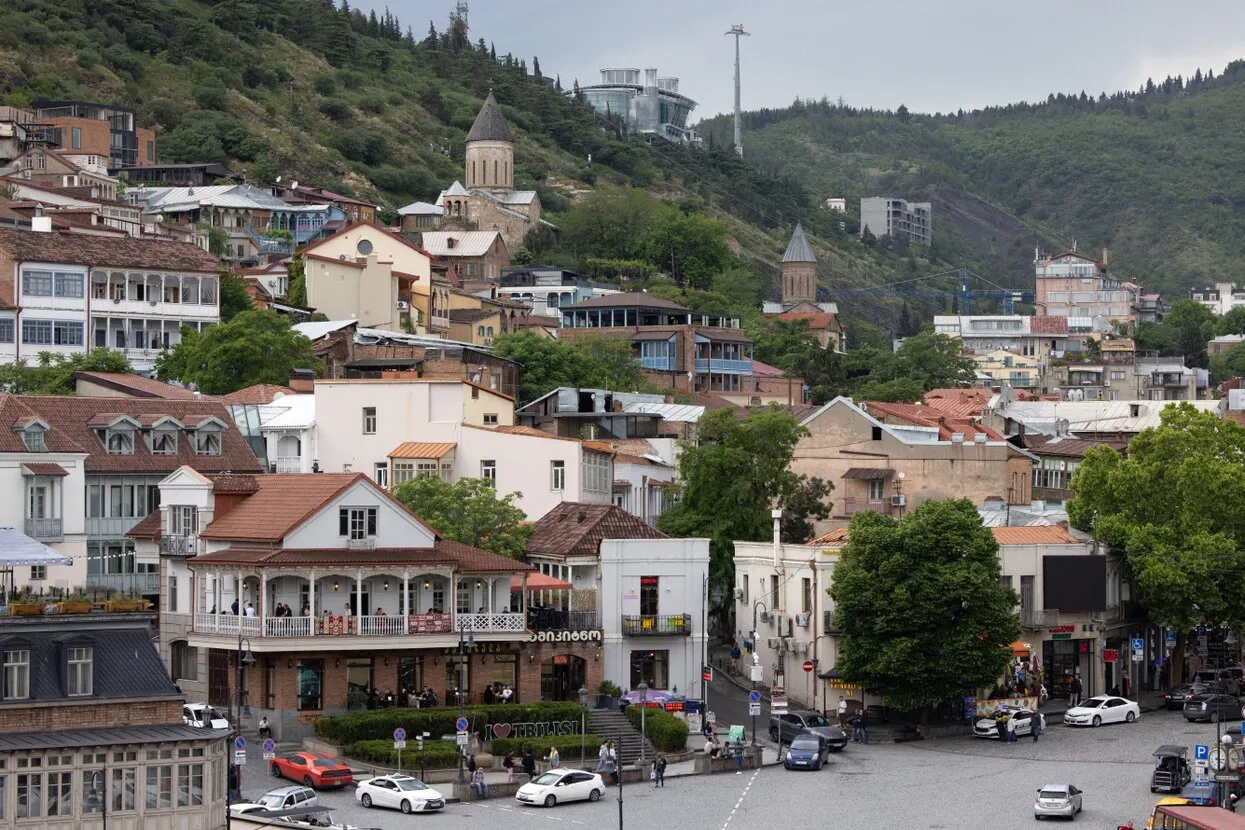
Russian emigrants thought marijuana use was safe in Georgia. Now some are facing years behind bars.
People visiting Tbilisi for the first time are sometimes surprised by how often they can smell cannabis in the city. That’s because Georgia has effectively allowed the legal use of marijuana since 2018. In addition, acquiring and possessing the drug, even in large quantities, has often not resulted in prison sentences. The situation changed dramatically in 2025, when Georgian authorities tightened the country’s drug laws for both residents and visitors alike. As a result, in the first nine months of 2026 alone, Georgia’s Prosecutor General’s Office registered more than 200 drug-related crimes committed by Russian citizens, some of whom are already serving time in Georgian prisons. Meduza tells their stories — and explains exactly how Georgia’s laws have changed.
“They have a stadium there, so you can exercise. There are animals — rabbits, cats — and the women take care of them. There’s a store, so you can buy things. The shower is shared, each cell has a toilet, and everyone takes turns cleaning. There’s a library, and she reads a lot. You can take part in concerts. You can work, but it’s not mandatory,” said Kristina (name changed), describing her friend Masha Ova, who is serving a two-year sentence in a women’s prison in Rustavi. Kristina said Masha generally describes her life there as a “strict-regime sanatorium” and doesn’t complain about anything.
In 2022, Masha left for India because of Russia’s war with Ukraine, and in 2023 she moved to Georgia. In Tbilisi, she worked at a tattoo studio and sang in the rock bands MÖRÖCÖLI, PUNKI, and NECROFEST, occasionally performing solo acoustic concerts. In early May 2026, she suddenly disappeared, and a few days later a court-appointed lawyer contacted one of her friends on Instagram and said that Masha had been detained.
Friends later learned that police had searched her apartment. According to Kristina, officers found four grams of marijuana. Masha, her friend said, was what’s known in slang as a “helper.”
“For example, your friends want to smoke. And you know where to get it. You go to buy some for yourself, and naturally they say, ‘grab me some too.’ Masha would agree, but only for friends, and she’d take a cut for it. Basically, she wasn’t even a dealer, just a helper. But she admitted guilt right away,” Kristina explained. According to her lawyer, David Lagadze, Masha maintains that police found four grams of marijuana on her, not 9.5 grams as was later written in the case file. But Masha decided not to contest this, so as not to worsen her situation.
David Lagadze told Meduza that, along with the marijuana, police seized scales with traces of narcotic substances from Masha’s home, and that “in such cases, Georgian courts already find a person guilty of aiding distribution, regardless of the amount of drugs seized from them.” The Article on “aiding distribution” was added to Georgia’s Criminal Code in 2025 as part of a sweeping tightening of drug policy initiated by the ruling Georgian Dream party.
How Georgian authorities changed the country’s drug laws
“Nothing could be more anti-national and anti-Georgian than the extremely serious effects caused by liberal drug policy,” Mamuka Mdinaradze, then the leader of the parliamentary majority from the Georgian Dream party, said in 2025, announcing amendments to the country’s anti-drug legislation. Authorities justified toughening penalties for marijuana-related crimes by citing the spread of “hybrid cannabis strains,” which they said “have a more harmful effect on the human body.”
The changes took place in two stages. In April 2025, they primarily affected Article 45 of the Administrative Offenses Code, which regulates the acquisition, possession, and use of small quantities of drugs (the article applies to all drugs except marijuana and several substances for which there is no “small quantity” threshold). Under this article, penalties were tightened, liability was introduced for refusing to take a drug test, and the list of penalties involving deprivation of rights was expanded.
Lawmakers removed Article 273(1), which had regulated actions involving cannabis or marijuana plants in large and especially large quantities, from the Criminal Code in July of that year. Possession and other marijuana-related criminal offenses now fall under Article 260, which carries harsher penalties.
What quantity is considered large in Georgia?
A small quantity is up to 5 grams for dried marijuana, up to 10 grams for raw.
A large quantity is 5 to 70 grams dried, or 10 to 140 grams raw. Beyond that is an especially large quantity.
Small quantities are regulated by the Administrative Offenses Code. The rest fall under the Criminal Code.
For example, under Article 273(1), illegal acquisition, possession, or transportation of a large quantity was punishable by a fine, community service, or up to two years in prison. Under the new version of Article 260, the same offense now carries five to eight years in prison. Authorities also split Article 260 into four separate articles, which created the new Article 260(4) on aiding distribution.
The Georgian human rights organization the Social Justice Center says one of the main changes is the restoration of the possibility of sentencing people to prison for acquiring, possessing, and growing marijuana for personal use in large amounts.
The amendments effectively allowed authorities to circumvent rulings by the Constitutional Court, which had eased penalties for marijuana-related offenses over the past decade.
How the Constitutional Court's rulings worked
The Constitutional Court’s first major ruling on drug-related cases came in 2015, in the case of Beka Tsikarishvili. Police found 69 grams of marijuana on him for personal use. Under the law in effect at the time, he faced seven to 14 years in prison. Tsikarishvili challenged the sentencing provision in the Constitutional Court as violating the constitutional ban on cruel and degrading punishment (his lawyer managed to prove that a disproportionate punishment does not serve the goal of restoring justice but instead turns a person into a tool for intimidating society to prevent future crimes).
The court ruled in Tsikarishvili’s favor, and it became impossible to send someone to prison for possessing up to 70 grams of marijuana for personal use. Tsikarishvili himself was ultimately sentenced to a fine of 2,000 lari (just under 50,000 rubles). After the Tsikarishvili case, the Constitutional Court issued a whole series of similar rulings on penalties for growing marijuana for personal use, using marijuana, and acquiring and possessing small amounts of other drugs.
“When the Constitutional Court issues a ruling, it must be taken into account in subsequent proceedings, and laws must change in accordance with that ruling. Instead, they [Georgian authorities] used legal maneuvering to circumvent these rulings and ended up detaining drug users again,” lawyer Lasha Tkesheladze told Meduza.
Formally, the Constitutional Court’s rulings remain in force. But they were incorporated into specific legal articles, and it was exactly those articles that the 2025 reform removed from the Criminal Code or rewrote.
At a rally in support of marijuana legalization. Tbilisi, 2013
David Mdzinarishvili / Reuters / Scanpix / LETA
One Constitutional Court ruling untouched by the new amendments effectively legalized the use of marijuana. In 2018, in a case initiated by leaders of the opposition Girchi party, the court ruled that fines for marijuana use, when it does not pose a threat to others, violate the constitutionally guaranteed right to the free development of personality. That ruling was incorporated into the law, and marijuana use stopped being considered an offense. But possession, acquisition, transfer, production, and sale remained administrative or criminal offenses, and the amendments passed in 2025 deepened this paradox.
The legal changes have already led to a doubling in the number of arrests. Prisons are almost out of space.
In 2024, the Interior Ministry registered 5,598 drug-related crimes under the Criminal Code; in 2025, that figure was almost twice as high, at 10,475; and in the first half of 2026, it was 7,533. More than half of these crimes involve possession and acquisition (Article 260). However, the Interior Ministry attributes the rapid rise in registered drug crimes to more active efforts to detect them.
Georgia’s Prosecutor General’s Office told Meduza that criminal prosecutions under drug statutes against Russian citizens in Georgia also increased in 2025 and 2026. The office opened 119 such cases in 2024, 196 in 2025, and 234 in the first nine months of 2026 alone.
Among drug crimes committed by Russians in Georgia, as in the country as a whole, “possession and acquisition” ranks first. In 2026, the agency opened more than half of all prosecutions (124 of 234) under this article.
Among foreign nationals facing criminal prosecution under drug statutes, Russians rank second, behind Turkish citizens (274 cases in 2026), while Ukrainian citizens rank third, with 196 cases.
As the crackdown on drug crimes intensified, prison overcrowding also began to rise. According to data from Giorgi Burjanadze, Georgia’s former deputy public defender, the number of inmates in Georgian prisons grew by 43% over the past year and a half. Georgian prisons held 12,344 people in June of this year, a record in nearly 14 years of Georgian Dream rule. Burjanadze calculated that only 12 free spaces remained in Georgian prisons in June.
The number of Russian citizens imprisoned in Georgia also grew by 50% in just over a year. Georgia’s Penitentiary Service said Georgian correctional facilities held 214 Russian citizens at the end of August 2026. In June 2025, before the reforms, that number was 141.
How many Russians are serving sentences for drug-related crimes is unknown. In response to a request from Meduza, the Penitentiary Service said it does not keep statistics on defendants or convicts broken down by article of the Criminal Code. But many Russian émigrés in Georgia have learned from personal experience that police have stepped up their fight against drugs.
From a vegetarian café to prison. Police have started stopping Russians on the street much more often.
In late July, Polina Riske, who lives in Georgia and helps Russian drug users, posted a reel titled “A Message to Weed-Smoking Émigrés in Tbilisi.” In the video, she says she learns about another arrest on drug charges every two weeks. Riske also urges people who use marijuana or are involved in distributing it to stop, because raising money for lawyers and fines has become too difficult. Within a few weeks, the video had drawn more than 150,000 views.
Russian émigrés regularly write on social media about increasingly frequent street checks in Tbilisi. Sergei, a programmer from St. Petersburg, rents an apartment in Saburtalo, a district popular with Russians. He told Meduza that police have stopped and searched him on the street four times over the past year while he was walking his dog: “A car pulls up somewhere in the courtyard, sometimes just black, sometimes with ‘police’ written on it, and several men get out and ask you to show what’s in your pockets. They also take photos, look at the recent photos on your phone, and write down your address,” Sergei said.
He attributes the police attention to the graffiti near his home, which advertises drug drops and “drug shops” in Russian: “It makes sense to pay attention to people who look Slavic. And I really have seen people picking up drug drops several times while walking my dog.”
“The last time was the scariest,” Sergei said, “because at some point they started saying that an investigator was about to arrive and we’d all go to my place together for a search. We know how that can end from the case of Zinovkina and Gribul. But in the end they looked at my phone and changed their minds.”
Discussing these checks, Russians in Georgia speculate about what exactly might arouse police suspicion: a fanny pack, a dog, walking in a deserted area, or an appearance that police consider unconventional, such as piercings, tattoos, or colored hair.
A check on another Russian émigré ended with a search of his home. “On Russia Day, June 12, he was supposed to come to a meeting, but he didn’t show up,” said Anton about his friend Pasha (names changed). “Usually, if something’s going on with him, he lets us know; he doesn’t just disappear. So we immediately suspected something was wrong.”
Anton met Pasha back in Russia. Both were into music, and “Pasha played in bands himself and helped organize events.” After Russia’s full-scale invasion of Ukraine began in 2022, Pasha moved to Georgia. At first he worked at vegetarian cafes founded by fellow émigrés. But, as Anton said, “the situation there is pretty sad.” At some point Pasha started looking for work on the local market and became a food delivery courier. His earnings improved, and over time he even saved enough for a motorcycle.
However, amendments to Georgia’s Law on Labor Migration that took effect at the start of 2026 required foreigners to obtain work permits and capped the number of permits available in different sectors. For foreign couriers, the quota was zero.
Pasha went back to working in food service and tried to save up money to leave for Europe. When he failed to show up to a meeting without warning, his friends immediately went to his home and discovered that it had been searched. “He was planning to leave in July, but he was arrested in June,” Anton said.
Anton doesn’t want to go into detail about the circumstances of the detention. “They seized about 60 grams of weed, a few thousand lari, electrical tape, and scales from his home. According to his lawyer, that’s considered sufficient evidence that a person is involved in distribution,” he explained.
Anton doesn’t believe that scales and electrical tape found in someone’s home can be evidence of distribution, and he doesn’t understand why investigators didn’t look for witnesses or buyers, or seize Pasha’s phone or computer to identify the people he allegedly sold drugs to and prove the distribution charge.
Pasha was charged under the same article as Masha: aiding distribution, which carries a sentence of five to 10 years in prison.
Hi, I’m Katya.
I’ve been running Meduza’s crowdfunding since 2021. Today, supporting Meduza is a crime in Russia. You can be sent to prison just for donating. We’re still able to do our work thanks to thousands of our Russian readers who now live abroad. But even they’re no longer safe.
Imagine you’ve left Russia, but then your mom becomes seriously ill. It could be your last chance to see her, so of course you go home. At the border, you’re interrogated. Officers hack into your phone and search for any trace that you’ve donated to Meduza.
The Kremlin is counting on that fear, and it’s working. People are afraid to donate. I’m afraid for our supporters, because any one of them could end up in prison. And I’m afraid for Meduza. Without crowdfunding, we simply can’t continue. So if you live outside Russia and don’t have to worry that donating to Meduza could keep you from going home to your family, I’m asking for your help. Please support our work.

Authorities often offer Russians a deal, and for money they can reduce a sentence. But not everyone manages to raise the money.
Pasha’s lawyer, Zaza Kachibaia, told Meduza that cases of foreigners, including Russians, being detained on drug charges have become more frequent over the past year and a half: “In our practice, among the lawyers we work with at our firm, roughly seven out of 10 cases involve citizens of a foreign country.” At the same time, Kachibaia said he hasn’t noticed discrimination against migrants.
Anna (name changed) runs support groups for people dependent on cannabis in Tbilisi. Anna said police attention toward drug users increased starting in the fall of 2025, a couple of months after the new amendments took effect, while émigrés from Russia “had relaxed after several years of living in Georgia and didn’t have time to adjust.” Masha, for example, according to her friend, simply “wasn’t following local news,” didn’t track changes in the law, and wasn’t too worried, because “it’s just marijuana in Georgia.”
Anna said police sometimes detain people during a random street check: “A guy with a suspicious appearance, a hipster, roughly speaking, walks by, and he’s stopped. And he has a few grams on him for personal use. In that situation, everything depends on the weight.” Sometimes detainees say they bought marijuana “for friends,” and the outcome can depend not only on the weight but also on the packaging: “If it’s several one-gram bags, they can already pin a distribution charge on you,” Anna said.
Sometimes police come straight to someone’s home for a search, acting on a tip. That’s apparently what happened with Masha. Police staked out her building and searched her apartment, even though she had nothing on her at the time. According to her friend Kristina, Masha also believes a tip explains why police “tacked on” an extra 5.5 grams during the search. “If the apartment turns out to be empty, at least plant that,” Kristina said, explaining the police’s possible logic.
News about the detention of users or small-scale dealers from the émigré community sometimes appears in chats: acquaintances write that a person has stopped responding, and then he’s found in prison. Sometimes, while someone is still being searched for, news of the case reaches the media.
“If you realize that an acquaintance of yours, say, went to get ‘stuff’ and hasn’t been in touch for several hours, given the current climate, he might have been detained. So we find a lawyer right away,” said Anna, who has helped arrested acquaintances more than once.
Anna said that when someone faces charges under a criminal statute, investigators often offer the option of admitting guilt and entering a cooperation agreement. In some cases, this lets detainees pay a fine and go free: “I know guys who’ve already been released, and of course they’re all in a hurry to leave the country.”
In other cases, a procedural agreement makes it possible to reduce the sentence set out by a given article. Anna sent Meduza a “price list” circulating in chats that explains “how much it costs” to reduce a sentence through a cooperation agreement with investigators. Pay 50,000 lari (approximately 1,350,000 rubles), and you go to prison for eight years (instead of, say, the maximum of 20). Pay 100,000 lari (2,700,000 rubles), and you get four years. Pay 200,000–250,000 lari (5–7 million rubles), and you get deported from the country. The “price list” doesn’t specify which articles or specific crimes these fines apply to.
According to lawyer Zaza Kachibaia, there’s no single “price list” for fines. The prosecutor’s office determines the amount case by case, based on the article, the circumstances of the crime, and the defendant’s resources: “If it’s just possession, the fine might be five to ten thousand lari, but for distribution it could be ten times more,” the lawyer said.
Kachibaia urged against generalizing that everyone enters into procedural agreements. He advised taking a deal only when there’s enough evidence and no real chance of winning the case in court.
In the lawyer’s view, sentencing practices in émigré cases tend to be more lenient, because deportation can be applied as a punishment in Georgia: “It’s a completely logical and rational approach. Why sit in Georgian prisons for 10–20 years when you can impose some sentence or fine and deport the person to a third country with a ban on entering Georgia for a certain period of time?” Kachibaia said.
The prosecutor’s office also offered Pasha a procedural agreement: a fine of 200,000 lari (6.4 million rubles) and deportation, or three years in prison. His friends, like the friends of other detainees in similar cases, launched a fundraiser immediately after his detention. But they raised only about 15,000 lari (485,000 rubles), enough to pay for a lawyer and support their friend in prison. On September 24, Pasha was sentenced to three years in prison.
Masha also entered into a procedural agreement. Prosecutors offered her a fine-and-deportation option, but her loved ones couldn’t raise the 200,000 lari, so she was sentenced to two years in prison, to be followed by deportation from Georgia and a 20-year entry ban. According to her friend, having seen what other convicted women went through, Masha considers this a very good outcome and feels lucky: both the cost of legal representation and the sentences of some of her cellmates are many times higher.
After sentencing, she was moved to a cell with more lenient conditions: she can move around the prison grounds, attend classes, and work. Kristina said Masha is holding up well and tries to think of this experience as a creative project. She reads a lot, draws illustrations inspired by the books she’s reading, and her loved ones post letters and drawings on Instagram whenever she manages to get them out.
“Whatever happens, I accept everything happening to me fully, and with gratitude for the chance to be human. Different, alive, capable of change. Only now do I feel my true strength. Yes, in a cramped cell with heavy bars on the window, in uninterrupted, clear consciousness,” Masha wrote from prison.
How effective is Georgia’s new drug policy
In 2023, Alternative Georgia, a Georgian nongovernmental organization that studies addiction, published a study on Russian drug users living in Georgia. David Otiashvili, an addiction specialist and the director of Alternative Georgia, explained to Meduza that their study can’t be used to draw conclusions about how widespread psychoactive substance use is among migrants in general, but that it does reveal certain patterns.
Tbilisi
Michael Kochiashvili / Alamy / Scanpix / LETA
According to the study’s findings, the stress of forced migration increases the risk of psychoactive substance use. “What was common to everyone was that the initial shock, depression, and confusion mostly contributed to erratic use of depressants. But all of that passed after a few months,” Otiashvili said.
Use of stimulants among study participants, by contrast, declined somewhat in the initial stages. Otiashvili attributes this decline to people’s tendency to stick with substances they’re already used to, even though not all of them were available in Georgia. Context also matters for stimulants, he said: “It’s about mood, pastime, having fun, and migrant status doesn’t really contribute to that.”
In Otiashvili’s view, migrant drug users are distinguished by their isolation: as a rule, they don’t interact with locals. “If drug use happens in groups, it’s a Russian-speaking group,” he said, adding that they also almost never use local harm-reduction and prevention services.
“When problems arise, they try to solve them within their own migrant circle or through online consultations with Russian-speaking specialists. If people prone to risky behavior have no contact with services that could reduce potential risks, that’s not a good thing,” Otiashvili said.
In conversation with Meduza, Otiashvili said there currently isn’t enough systematic, up-to-date information, not just about migrants, but about drug use in Georgia overall. “Mechanisms and platforms for cooperation between the academic community, nongovernmental organizations, and government bodies haven’t worked for the past two years, starting from spring 2024,” the expert said.
Zurab Sikharulidze, an addiction specialist and member of the opposition Federalists party, also told Meduza that there’s little information about the “Russian segment” of drug users, but he considers it a major problem for Georgia. According to Sikharulidze’s assessment, there are many users among migrants overall, and NPS and chemsex are widespread. At the same time, except in severe cases, émigrés don’t seek addiction treatment or medical help, and no separate diagnostic or prevention programs exist for them, such as for HIV or hepatitis C.
Many addiction specialists fear that migrants will affect the HIV situation in the country, Otiashvili said. According to him, these concerns stem from the gap between a high prevalence of injection drug use in Georgia and a low rate of HIV, both nationwide and among injection drug users (unlike, for example, in Russia).
At the same time, migrants, in Sikharulidze’s view, are already affecting the local drug market. “After the war began and Russian and Ukrainian populations relocated, cocaine became very popular,” the expert said. On the darknet in Georgia, “the largest marketplaces are Russian and Kazakh.” Otiashvili agrees that migration affects the popularity of certain substances, but cites other examples: crystal methadone and certain synthetic stimulants.
Both experts agree that the reforms Georgian Dream has carried out solve neither the problems linked to drugs and migration nor the broader problems of drug use or drug trafficking. In Sikharulidze’s view, current drug policy, especially when it comes to addiction treatment, increasingly resembles Russia’s repressive model, and the changes in drug policy fit a broader trend: “Georgia has established an autocratic regime that copies laws from the [Russian] State Duma,” the expert argued.
Otiashvili said that, in reforming drug policy, Georgian authorities are, first, engaging in populism: “They try to show society that they care about public health, that they’re taking measures to protect the next generation, reduce crime, and so on.” Second, in his view, decisions on drug policy often disregard expert opinion or scientific data and are instead based on the personal convictions of the people making them. Third, Otiashvili said, “these laws are needed to maintain control over a large mass of people,” and he added that they also serve as a tool of blackmail, control, or political pressure.
Georgian Dream appears to be pleased with the results of the drug policy reform. In May 2026, at a meeting of the European Coalition to Combat Drugs, Georgia’s Prime Minister Irakli Kobakhidze described how Georgia stepped up anti-drug-trafficking measures in 2025: arresting a record number of drug traffickers, increasing crime detection rates, and seizing an unprecedented amount of drugs. Georgia’s Interior Ministry also reports on anti-drug successes almost daily, with press releases typically featuring news about the interception of large shipments.
Experts don’t trust the authorities’ reports of success in fighting drug trafficking. “Every day they show on TV how they catch huge drug shipments, but there’s no shortage on the black market, and prices haven’t gone up,” Sikharulidze said. In his view, the Interior Ministry is boosting its numbers by detaining ordinary users. “Any use can end in a hefty fine, the loss of certain rights, a suspended sentence, or prison,” the addiction specialist warned.
In her counseling sessions and conversations with acquaintances, Anna actively encourages people to quit using drugs. “It’s better to quit now while you’re free than to be forced to quit in prison,” she said. “Take our friend, who they’re trying to pin a twenty-year sentence on. Do you think she’s smoking now? No, she’s not smoking. She quit, because there’s no way to do that there. You can do it while you’re free; you have a unique chance.”
After Pasha’s case and similar stories, many of Anton’s acquaintances really did quit, he said: “Those who used any drugs have stopped, or they do it in other countries when they travel, because it’s become too dangerous. In that sense, the law really does work.”
At Meduza, we are committed to transparency about our use of artificial intelligence in the newsroom. The story you’re reading was written by one of our living, breathing journalists and translated from Russian using an AI model configured to follow our strict editorial standards. This translation process is the result of extensive testing and refinements to ensure our English-language coverage is timely and accurate. A Meduza editor reviews every draft before publication.
If you find any errors in this translation, please contact us at reports@meduza.io.
To read Meduza’s exclusive content in English, please subscribe to our newsletter.
Olga Alexandrova
What article is this?
“Aiding distribution” is Article 260(4) of the Georgian Criminal Code. Aiding is defined as “creating conditions for illegal distribution: packaging substances, possessing items or equipment necessary for packaging, placing substances in publicly accessible locations openly or covertly, disseminating information about their location, providing information on methods and means of acquisition, and any other actions that facilitate distribution.”
How exactly?
Before the amendments, possession of a small amount of narcotic substances carried a fine of 500 lari (16,000 rubles) or up to 15 days of arrest. After the amendments, it became a fine of 500–2,000 lari (16,000–65,000 rubles) or up to 60 days of arrest.
What kind?
A fine of 500–2,000 lari (16,000–25,000 rubles) or up to 60 days of arrest.
More details
For example, a court may, for a set period, strip an offender of the right to drive, work in educational institutions, acquire or possess weapons, or run for public office.
Crimes in Georgia
In the Prosecutor General’s Office’s statistics, Article 260 ranks first by a wide margin in 2025. The office opened 6,122 criminal prosecutions under it that year; Article 177, theft, ranked second, with 3,733 crimes.
Who is this?
The ombudsman. The Public Defender’s Office monitors human rights compliance in the country.
Anastasia Zinovkina and Artyom Gribul
Georgian police detained Anton Chechin, Artyom Gribul, and Anastasia Zinovkina in December 2024 on charges of large-scale drug possession. All three had actively taken part in pro-European protests in Georgia. None pleaded guilty, and lawyers and human rights advocates say the searches were conducted improperly and that police may have planted the drugs. Three Georgian activists faced similar charges but were acquitted because there were no witnesses in their case. In the Russians’ case, the court treated the interpreters who accompanied police during the detention as witnesses. In the summer of 2025, the court sentenced all three to eight and a half years in prison.
How long?
The entry ban can last from two to 20 years.
Which books?
Masha’s Instagram features illustrations for books by H.G. Wells (The First Men in the Moon, The Food of the Gods, The War of the Worlds), Robert Crichton (The Secret of Santa Vittoria), and the Strugatsky brothers (The Doomed City).
Depressants and stimulants
Depressants are psychoactive substances that suppress the central nervous system, slowing heart rate and breathing. Examples include alcohol and opioid drugs. Stimulants are the opposite of depressants: they improve focus and make a person more alert and excited. Marijuana doesn’t fall into either category.
What kind of services are these?
For example, Georgia has services for exchanging and distributing sterile injection equipment, testing and self-testing for HIV and other infections, overdose prevention, drug-content checking, and free consultations with doctors, psychologists, and lawyers.
What happened then?
In the spring of 2024, Georgian Dream passed a “foreign agents” law, making it harder for most nonprofit organizations to operate.
NPS
New psychoactive substances are compounds designed to mimic the effects of traditional banned drugs.
Chemsex
Sex while under the influence of drugs.
Where can someone turn for help?
Zurab Sikharulidze advises turning to private clinics or looking for contacts of helping organizations through the Georgian Harm Reduction Network.
How high?
According to data from a 2022 study, about 49,000 people use injection drugs, or 2.2% of the adult population.
Details
In 2026, Georgia registered 11,892 people living with HIV (about 0.3% of the population).
What’s the similarity?
Sikharulidze cites, as an example, Georgian authorities’ criticism of substitution therapy programs. After the 2025 amendments took effect, access to substitution therapy declined, since private clinics could no longer provide it. Georgian Dream justified this by arguing that substitution therapy at private clinics amounts to a “legal supply of narcotic substances.” Substitution therapy is banned entirely in Russia, and Russian healthcare officials have made similar statements.
What does this mean?
In recent years, Georgian authorities have passed several laws resembling Russian ones, such as a “foreign agents” law or a “family values protection” law.
Are there examples?
Georgian authorities force people convicted under criminal statutes, along with their relatives, to vote for ruling party candidates or take part in mobilizing voters in elections in exchange for lifting a suspended sentence or reducing punishment.
A month before the 2024 parliamentary elections, authorities carried out an amnesty covering about 27,000 citizens. According to an assessment by the OSCE, this may have given the ruling party an advantage.
More details
Courts have already convicted 144 of them, and 70 are awaiting a ruling.
What does this mean?
This refers to penalties for drug-related crimes. Georgia’s Constitutional Court has eased them several times over the past 10 years.