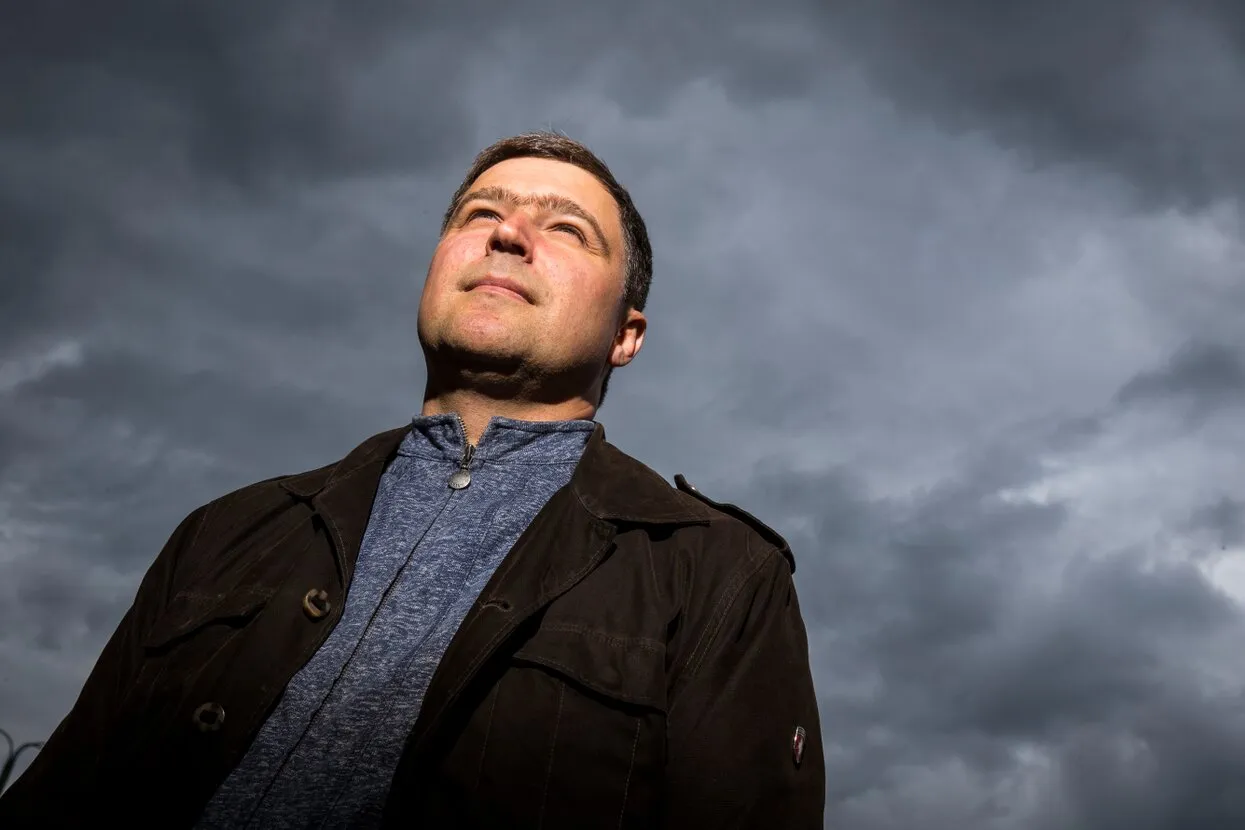
‘My only home.’ Russian journalist Leonid Ragozin spent 12 years building a life in Latvia. Now he’s afraid to return.
Latvia’s Foreign Ministry said on October 6 that it had added a Russian citizen to its list of personae non gratae. It did not name him. According to Delfi and Politico, he is journalist Leonid Ragozin, who moved from Russia to Latvia after the annexation of Crimea, obtained permanent residency there, and writes for Western media outlets. Ragozin appears set to become the first independent journalist opposed to the war on Latvia’s persona non grata list, which includes more than 150 Russians. He would find himself alongside numerous Russian propagandists and prominent supporters of Russia’s aggression, including filmmaker Nikita Mikhalkov, singer Larisa Dolina, television presenter Tina Kandelaki, and the singer known as SHAMAN, whose real name is Yaroslav Dronov. Meduza spoke with Ragozin about his views on the war, his conflict with the Latvian authorities, and his love for the Baltic country.
Leonid Ragozin’s conflict with Latvian politicians began long before the Foreign Ministry’s latest decision.
In 2019, Ragozin coauthored a story with Sanita Jemberga, a journalist at the investigative journalism center Re:Baltica, about ties between members of Latvia’s National Alliance party and both Ukrainian far-right groups and Russian neo-Nazis. After its publication, he faced criticism and threats of deportation.
In 2022, after Ragozin gave an interview about Russian journalists’ attitudes toward the war, Latvian Defense Minister Artis Pabriks called him a “possible Russian agent of influence” and said he was repeating Russian propaganda narratives.
Four years later, in late September 2026, on the eve of parliamentary elections, Latvian Interior Minister Jānis Dombrava called on Foreign Minister Baiba Braže to declare Ragozin an “undesirable person.” He accused Ragozin of justifying Russian aggression and discrediting Ukraine. Dombrava is a member of the National Alliance, the party Ragozin wrote about.
The ministers publicly argued over who should decide whether to expel the journalist. Other politicians joined the calls for the Foreign Ministry to act. Rihards Kols, a member of the European Parliament from the same party, said that if the Interior Ministry banned Ragozin from entering Latvia, he could challenge the decision in court. To avoid that, Kols said, the journalist should be declared persona non grata. (Notably, it was Latvia’s Interior Ministry that banned former TV Rain presenter Alexey Korostelev from entering the country in 2022 amid the public controversy surrounding the channel.)
Many Russian-speaking and English-speaking journalists have come to Ragozin’s defense. Sabīne Sīle, the head of Media Hub Riga, which supports journalists from Russia and Belarus who have found refuge in Latvia, believes the situation sets a dangerous precedent because Ragozin has no way to defend himself in court.
On October 12, Russian journalists in exile published a letter defending Ragozin, addressed to two U.N. special rapporteurs. At the time of publication, 143 people had signed it.
Meanwhile, on October 7, the Latvian investigative center Re:Baltica published a statement saying it had not worked with Ragozin since 2019 and considered some of his social media statements “unacceptable and condemnable.”
Anastasija Tetarenko-Supe, chair of the board of the Latvian Association of Journalists, told Novaya Gazeta Europe that the organization stood with Re:Baltica.
Ragozin himself does not know whether he has officially been added to the list of personae non gratae; the authorities have not contacted him.
Latvian Foreign Ministry spokesperson Līga Jermacāne confirmed to Meduza that the ministry had begun the process of adding “a citizen of the Russian Federation” to the list, but it remains unclear whether that person is Ragozin.
The Foreign Ministry’s full response to Meduza follows:
Under Article 104, Part 3, Paragraph 1 of the Republic of Latvia’s Immigration Law, and in close cooperation with the relevant authorities, the Foreign Ministry decides whether to add individuals to the list of persons whose presence in the Republic of Latvia is undesirable.
In some cases, the Foreign Ministry makes this information public.
We confirm that another citizen of the Russian Federation was added to this list on October 7, 2026. The ministry will not provide further information about the decision-making process or the identity of the individual added to the list.
Latvia condemns in the strongest terms Russia’s aggression against Ukraine, which began in 2014, and its violation of Ukraine’s territorial integrity, as well as its unprovoked and unjustified full-scale war against Ukraine.
Meduza also contacted Latvia’s Interior Ministry. “The Foreign Ministry has already answered this question within its remit,” the ministry said.
— You’re not in Latvia right now. Did you leave because of the efforts to declare you persona non grata, because of the threats you’ve written about, or for other reasons? Do you plan to return?
— I was already outside Latvia when all this happened, for reasons unrelated to the situation. And I can’t go back right now. Even though the government hasn’t contacted me directly or publicly named me as someone added to the list of personae non gratae — no such announcement has appeared on the Foreign Ministry’s website — there’s a substantial risk that if I turn up in Latvia, they’ll start deportation proceedings against me. And they would deport me specifically to Russia.
The people who set all this in motion have spent years threatening to deport me specifically to Russia, because they understand that it’s a way to put me in prison.
— How did you feel when you learned about the decision?
— I’d lived with these threats for years and always understood that something like this could happen. I had a pretty realistic understanding of Latvian politics and how these things get decided.
On the other hand, the sadism of this decision is shocking, of course. It’s going to take some serious emotional work to get through this and process my feelings about it. Because Latvia is a place I sincerely loved and considered my home. And of course I’d like to contribute something to Latvia. I’m not a threat to this country.
I think the threat to Latvia comes from the people who alienate people like me, break the law, engage in political repression outside the courts, and punish people harshly for their honestly held views, for trying to give an intellectually honest analysis of the political situation and the military conflict.
All this was shocking to me, but there’s also a sense of liberation… Liberation from self-censorship, too. I didn’t talk about Latvia for a very long time. And I have a great deal to say about it.
But I’m not going to smear Latvia. I love this country, its culture, and its language. And I’ll try to act in ways that don’t harm it.
— You’ve lived in Latvia since 2014. Why did you move in the first place? And why Latvia specifically?
— We decided to leave on the day of the referendum in Crimea. My ex-wife and I decided that this chapter was over, that we had to leave Russia, that we simply couldn’t be associated in any way with what was happening.
Latvia wasn’t a random choice. It’s the land of my ancestors, and I feel very much at home in Riga, partly because I like Latvian culture and the language. I think it’s the most beautiful language in the world.
[Moving to Latvia] was a dream, and quite a long-standing one — going back to when I took part in the democratic revolution of 1991 and defended the White House in Moscow. Even then, my political priorities were tied to the idea of Baltic independence. One of the largest rallies in Moscow — in the entire history of Moscow and Russia, really — was held in January 1991 in support of Baltic independence.
Leonid Ragozin. Moscow, 2016
Alexander Zemlyanichenko / AP / Scanpix / LETA
So Baltic independence and the possibility of living in the Baltic countries, specifically Latvia, always had a place in my heart.
— How did your feelings about the country and about life in Europe more broadly change?
— I learned a lot about Latvian society that I probably never wanted to know. It didn’t change my views on Latvia’s independence, the Soviet occupation of Latvia and the other Baltic countries, or the Molotov–Ribbentrop Pact. My views just became much more complex, informed, and nuanced.
My fundamental beliefs stayed the same. I oppose all violence as a matter of principle. I consider the seizure of territory an occupation.
But over the years, of course, I’ve accumulated a pile of questions — just a little Everest-sized pile — about the motives of various figures and organizations in the West, various politicians, their role in this conflict, and their attitudes toward Ukraine.
I went through the same process with Ukraine, where I also worked a great deal and spent a lot of time.
‘I’m just an easy target they use to solve their political problems’
— Your career has taken some turns: You trained as a hydrogeologist and a translator, then spent many years as an international affairs journalist before writing for Lonely Planet guidebooks. What was your life like when you decided to leave Russia?
— I worked as a journalist in Russia from 1998 to 2013. Almost all that time was at the BBC, apart from three or three and a half years at Russian Newsweek. I worked in various roles for Britain’s public television and radio broadcaster. First in the monitoring service, then in the Russian service, and toward the end as a producer for English-language television. I was coming around to the idea of trying freelance work, of becoming a self-employed journalist.
A few years before that, I’d more or less stopped traveling all over the world and realized I wanted to focus on the countries I had ties to — Russia and Ukraine. I started traveling extensively around both countries and getting a better grasp of Ukrainian politics in particular. In 2013, I got the chance to write a Lonely Planet guide to Ukraine, but I also wanted to spend a substantial amount of time there, do some political reporting, and lay the groundwork for working in Ukraine.
Of course, I had absolutely no idea what was going to happen there [Maidan]. Partly because at that point I was only beginning to develop my expertise on Ukraine. But I don’t think anyone expected it.
Back then, Ukraine was something of a dream for me. A country much more tolerant than Russia, and much more diverse, too. A country where the two main languages coexist — you know, soccer matches where one commentator speaks Russian and the other Ukrainian. A country with many faiths and cultures.
Even then, I supported Ukraine’s movement toward Euro-Atlantic integration, the European Union, and NATO. In that sense, Ukraine seemed like a beacon to me, one Russia might eventually follow. Ukraine could set an example for Russian society, show that a better life was possible.
I arrived in Ukraine in late June 2013. My last story for the BBC was about Edward Snowden at Sheremetyevo Airport. I pretty much drove straight from Sheremetyevo to Ukraine.
Then I traveled around Ukraine in 2013 and watched the whole story unfold. At first it seemed very clear to me: Ukraine was moving toward the European Union… Then it became less and less clear… I started digging deeper and deeper.
By the fall, I was one of a small number of English-speaking journalists on the Maidan when the student protests were broken up. After that, I got a lot of calls from all sorts of media outlets. I had quite a few options about who to work with. I ended up working with Bloomberg, but I also tried freelancing for various major outlets.
— When you started working as a journalist, what mattered most to you about the profession? Has your understanding of journalism changed over the years?
— I had very nuanced views on a range of issues, but I was also clearly a fairly typical pro-Western Russian liberal. Very radical on some issues.
When Arkady Babchenko talked about Estonian tanks on Red Square, it occurred to me that I’d used that exact phrase, half-jokingly, 10 to 15 years before him. Russia could have followed the path of Euro-Atlantic integration, too, like other countries.
In many ways, my political views led me into journalism. And then, simply because I’m generally inclined to go to pretty extreme lengths in pursuit of objectivity, my views became more nuanced and changed a great deal.
When I realized that my views didn’t reflect reality at all, I adjusted them.
— You said that at some point you decided to focus on Ukraine and made it your journalistic specialty. Why did Ukraine interest you more than Russia?
— Ukraine was relatively unexplored territory back then, while plenty of excellent journalists, both Russian and Western, were covering Russia.
I tried different kinds of journalism. For example, I investigated yet another corrupt official in Putin’s circle, a deputy governor of St. Petersburg, and found a four-star hotel he owned in Prague. I published a story about it for the BBC Russian Service. But I just found that kind of work boring.
At some point — I can’t say exactly when — I settled on a principle that’s now in my Twitter bio: I want to tell people what they need to know, rather than what they want to hear. And I think that’s now the main difference between journalism about Russia and journalism about Ukraine.
Journalism about Russia is good journalism. People are still reporting on Russia’s military and corruption. I’m not diminishing the work of those journalists in the slightest. But it’s what the audience wants to hear. It’s a kind of confirmation bias.
Ukraine is a different story, because there are so many untold stories there.
When you talk to Ukrainians, especially people in the political establishment, you realize they’re very aware of this. In private conversations, including at very senior levels, they say things that completely contradict what they say in public.
Then some of it comes out in stories like that of Yuliya Mendel, Zelensky’s former press secretary, who began expressing entirely different views.
My sources are primarily in Ukraine, and to a much lesser extent in Russia. I have people I can talk to in private and, to some extent, have heart-to-heart conversations with. The picture of Ukraine I get from conversations with my sources, from what Ukrainians say, is very much at odds with the story being told in the mainstream right now.
People tell horrifying stories about mobilization, and they themselves have been hiding at home for years. Political sources at very senior levels agree with my analysis of the war and talk a great deal about corruption. There are lots of people like Hetmantsev, but within Ukraine, only [Danylo] Hetmantsev and [Oleksiy] Honcharenko speak out [publicly].
— It sounds as though, when you went to Ukraine, you were idealizing the country to some extent.
— There was a lot of idealization. Actually, I was mostly idealizing the West. I’d always done that. To a great extent, what drove my journalism career was my understanding of Western ideals — or, more precisely, the ideals of a liberal democratic society.
The problem was that I tried to follow those ideals to the letter. And when you start doing that, you find yourself in serious conflict with people who claim to uphold those ideals, with organizations and entire countries that consider themselves the embodiment of them.
— What happened after 2022, when, as I understand it, you could no longer travel to either Russia or Ukraine?
— I could no longer report from either country. I’d spent quite a long time reporting for Bloomberg. At the same time, I wrote columns for Al Jazeera and some pieces for bigger outlets, The Washington Post, for example. And I tried my hand at investigative journalism in Latvia and Ukraine.
In Latvia, I wrote a story about the Harmony Party, which represented the interests of the Russian-speaking minority. It was very well received and, I think, contributed somewhat to the change of government in Riga and the end of the whole Harmony era there.
Another story concerned the far-right party [National Alliance] of the current interior minister [Jānis Dombrava], who’s the one most eager to deport me. It was an investigation into his party’s ties to Russian National Socialists whom I’d met in Kyiv and written other stories about. We now know them as part of the Russian Volunteer Corps — back then, they were all simply connected to Azov.
One of them is the Russian neo-Nazi Alexey Lyovkin, a key figure in the Wotanjugend platform. They [National Socialists in Russia] organized the world’s largest National Socialist black metal festival. And in 2019, these people from Wotanjugend were distributing a Russian translation of the manifesto of the man who carried out the terrorist attack in Christchurch, New Zealand — who killed 51 people in mosques. The translation was posted [on their website] suspiciously soon after the attack. An 80-page document in Russian.
A Latvian journalist and I established a connection between this political party [National Alliance] and Russian neo-Nazis who’d settled in Kyiv. That seemed pretty shocking, of course. It doesn’t anymore.
Another, much bigger project was an investigation by the Ukrainian outlet Zaborona into the murder of Pavel Sheremet, which I took part in.
I think those investigations were the main reason I became a target for forces that probably didn’t want what was best for Ukraine — that were more interested in simply having a war happen. There’s a lot to say about the nationalists, but of course many people in Ukraine wanted to fight and win. Arms industry lobbyists wanted a war, too, and that was very noticeable.
— Recently, you’ve been publishing in The American Conservative, writing your own analysis blog on Substack, and continuing to publish with Al Jazeera. Why these particular platforms?
— Like many other people, I have a big problem with where mainstream journalism has ended up in its coverage of the conflict in Ukraine. But I think my colleagues in America and Europe have had an even bigger problem with coverage of the conflicts in Gaza and Iran. Though the coverage of Russia’s war against Ukraine has also been rather peculiar.
So I have complicated views on mainstream journalism. I’ve stepped back from it a little for now. That doesn’t mean I don’t respect major news organizations. I’m a product of the BBC myself. It’s where I learned journalism, my alma mater.
[But] now I publish where I can express my thoughts. There’s barely any room left for free thought and free discussion, especially about the Russian-Ukrainian conflict. All these years, people with an interest in keeping the war going have been working to destroy that space in various ways: intimidation, online harassment on Twitter, where most politicians, journalists, and experts are.
Thinking objectively and talking honestly about this conflict makes you a target — one these people and organizations want to destroy. And that explains why I’ve become one of their targets.
— Let me ask you directly: Have other outlets refused to publish your work?
— No, we’ve been drifting apart. I wouldn’t say it’s an unbridgeable divide. I’m still in touch with journalists and editors at mainstream outlets. We have good relationships. I just don’t really agree with their editorial policies right now.
As for The American Conservative, they represent a very specific strand of American conservatism known as paleoconservatism. They matter to me because they oppose American interventionism. Their foreign policy analysis really speaks to me and overlaps quite a bit with my own approach, which is more left-liberal. So I’m grateful to them for the opportunity to publish.
But you see, my most recent piece was in Jacobin, an outlet more closely associated with democratic socialism in the United States, with Senator [Bernie] Sanders — though I actually criticize Senator Sanders in that piece — and with politicians like [Zohran] Mamdani, the mayor of New York.
Leonid Ragozin’s column in Jacobin
There’s a very interesting process happening right now that I write about in my articles. Largely in an effort to counter the far-right populists and extremists they constantly compete with, mainstream politicians in Western countries are adopting [equally radical positions]. As a result, mainstream politicians’ own views are becoming quite extreme. It’s most apparent in foreign policy, in their attitudes toward the Russian-Ukrainian conflict and, to a considerable extent, toward Gaza and Iran.
Paradoxically, their rivals in far-right parties, like Germany’s AfD, are starting to sound like the voice of reason. Like people who don’t want a nuclear war to wipe us all out. Who don’t want us to spend our entire lives in this endless war, with a front line running through Europe all the time.
— Have you ever caught yourself self-censoring? For example, after what happened to TV Rain. Did that worry you at the time, by the way?
— I should say that before what happened to TV Rain, exactly the same thing had happened to me. And exactly the same figures in Latvian politics were involved.
In my case, Latvian Defense Minister Artis Pabriks wrote an official letter about me [to two media regulators: Latvia’s Public Electronic Mass Media Council and National Electronic Mass Media Council], accusing me of being a Kremlin agent of influence.
Then exactly the same thing happened to TV Rain, six months later. In my case, nothing came of it at the time. For TV Rain, it ended with the channel being forced to leave Latvia.
Of course I felt I was censoring myself. It seemed to me that I was doing it all the time. At some point, many years ago now, I stopped writing or saying anything about Latvia out of concern for my personal safety.
At the same time, as many of my friends know, self-censorship and I don’t get along very well. In any situation, in life or in politics, I tend to say what I think.
I think both the attack in 2022 and the current one were entirely about Latvia’s elections. Back then, the defense minister [Artis Pabriks], who published the letter and tried to get me deported, was in a party [Development/For!] that lost the election badly.
Now it’s two parties that started this discussion in the final week before the election. In theory, they might not have made it into the Saeima [Latvia’s parliament]. They were fighting to keep their seats. In the end, they got in, but finished in the last two places among the parties that won seats.
Now they’re fighting to join the governing coalition. There’s a good chance they’ll get in as two small parties joining the large party [United List] that won the election.
I’m caught up in all this almost by chance. I’m just an easy target they use to solve their political problems.
The other thing is that one of the parties also has a long-standing personal score to settle with me. They campaigned against me for a very long time, seven years, practically every day, without stopping.
It was a nonstop campaign of abuse and smears on Twitter: daily threats and mockery, constant public denunciations sent to Latvia’s State Security Service, and the publication of photos of me taken surreptitiously in Riga.
They were shaping public opinion about me. It was an industrial-scale campaign of character assassination. Later, Ukrainian psyops joined in. An InformNapalm article published my 78-year-old mother’s full address in Moscow. The article came out in 11 languages, and the Latvian version appeared on the website of Raivis Zeltīts’s new party [Rising Sun for Latvia].
And now they’ve got what they wanted.
— On Latvia’s list of personae non gratae, you’re alongside people like Tina Kandelaki, Dmitry Guberniev, Nikita Mikhalkov, Valery Gergiev, Denis Matsuev, Yekaterina Andreyeva, Polina Gagarina, Shaman… How does that feel?
— You’ve listed people who are connected to Putin’s regime and work for it. I don’t work for Putin’s regime. I’m disgusted by it, which is why I left. But I think the people persecuting me politically in Latvia are cut from the same political cloth as Putin’s regime. And unfortunately, they’re taking Latvia in the same direction. It’s very sad, of course.
I think the threat of Eastern Europe and all of Europe becoming more like Putin’s Russia, of security concerns being used to justify more control, of whole countries being taken over by political police and intelligence officers, as happened in Russia — all of that has been a very strong motivation for me to warn about this danger.
I really wouldn’t want that to happen. Fortunately, it hasn’t happened yet. But there are very strong signs, including in my own case, of a creeping shift toward Putin-style rule.
‘I’m only human, and I probably tend to say more than I should’
— You wrote about a “character assassination campaign involving far right infowar and fake news outfits” intended to “destroy my life” and “put a gag on me as a notable voice in public debate on the Russo-Ukranian war.” What did you mean?
— I mean the outlet Visegrád 24. An outlet with an audience of two million used my interview with Aaron Maté to put words in my mouth that I never actually said.
It wasn’t my best interview, but they interpreted it in a way that distorted my thoughts beyond recognition.
— You’re talking about your appearance on the podcast “Useful Idiots,” where Aaron Maté and Katie Halper interviewed you. Could it be connected to your being declared persona non grata?
— I have no idea whether that interview could have anything to do with the Latvian authorities’ decision. I’ve said all sorts of things over the years. And I’m often not happy with what I’ve said. I haven’t always expressed my thoughts well or clearly.
I’m only human, and I probably tend to say more than I should.
I think there are information warfare groups on social media that have always looked for a reason to pick apart something I’ve said. Their goal is simply censorship, to shut me up and stop me from saying what I think. To keep my analysis out of the public sphere altogether.
The main thing here is the way I’m being banished from Latvia, from my only home. This is a decision made outside the courts. And the people involved talk openly on Twitter about why they chose that particular way of banishing me. They want to keep all this out of Latvia’s court system.
Let me quote Rihards Kols, a senior National Alliance politician and member of the European Parliament who could even become [Latvia’s] foreign minister if the party gets that post: He wrote that it’s very important to do this through a persona non grata designation, because that kind of decision can’t be appealed in Latvian courts.
It’s a decision made entirely outside the courts. But if they simply revoke my residence permit, then I’ll sue and Latvia will lose, Rihards Kols wrote. You can go look up his post before he deletes it.
— One of your most widely discussed statements on the podcast was that Russia sees itself as being under constant pressure from the West, which “compels them to respond” to Western actions in the post-Soviet region. If you say the Russian authorities were forced to act, does that mean you’re absolving them of responsibility?
— In that passage, I’m conveying what I think the Kremlin thinks. I’m describing the Kremlin’s motives in my own words — how the Russian government sees its situation, its position in this conflict.
They, I say, feel they’re the “weaker side.” And as the weaker side, they feel compelled to compensate by striking first, with a preemptive, devastating blow, a disproportionate response. The “stronger side” can afford to act calmly, to take small, relatively inconspicuous steps, to use salami tactics to force the weaker side into a disproportionate response.
That isn’t what Leonid Ragozin thinks. That’s what, in Leonid Ragozin’s view, the Kremlin thinks.
— Many people heard it as a justification of Russian aggression.
— No, I’m interpreting the Kremlin’s understanding of this situation, explaining it to a Western audience.
But you see, this was a live interview. You can pick apart any live interview. The people attacking me, including politicians and experts, say an insane amount of incendiary nonsense. If they were in my position, they’d be thrown out of their countries every two minutes.
I’m generally pretty careful about what I say. But I’m human, and some days I feel better than others. I give interviews from time to time. Sometimes I express myself better, sometimes worse.
If someone says something awkwardly or unclearly, instead of asking what they meant, what they actually wanted to say, do you really have to punish them in such a completely draconian way? Take away their home, throw them out of the home they’ve spent 12 years building and making their own, turn them into a homeless person?
But I want to repeat: We don’t know, and most likely never will know, the grounds for throwing me out.
Judging by how Latvian courts have handled such cases, this decision most likely won’t even be made available to the court itself. Because it’s classified. What does it say? Something intelligent, or some nonsense? I don’t know.
I can see that the people accusing me over this interview weren’t directly connected to Latvia. And Latvian politicians were actively retweeting all those stories. I was also subjected to the most bizarre allegation that I’d traveled to Russia after 2022.
This is being done through various mouthpieces of information warfare. And nobody says it directly, probably because they’re all afraid I’ll just sue for defamation.
One politician who talks about this deliberately misspells my surname with an “o,” so that later he can say he wasn’t talking about me at all, but about Dmitry Rogozin, for example.
Of course I can respond to all these allegations, but they’re being made on Twitter. They’re not being made in court or before official bodies.
This whole thing is about denying me access to justice. I’m accused of all sorts of outrageous sins, but it’s not happening in a courtroom or in government offices. I don’t understand what exactly I’m being accused of. I’ve been denied access to justice in Latvia.
Read more
— One of the public allegations against you concerns your blaming the West for obstructing peace talks. You openly write that the aim of Western strategy now is “not a better Russia or Ukraine, but conflict itself.” You argue that prolonging the conflict benefits Western arms manufacturers and is being used to weaken Russia.
— You see, there’s always a danger in talking about very complicated things in simple terms.
The West isn’t a single entity, of course. And right now it’s particularly fragmented. The United States, for instance, is very different from the countries of Europe. But I have serious doubts about the motives of a significant part of the Western political establishment in this war.
I have a strong sense that the fate of Ukraine and Ukrainians, which is very important to me, isn’t a priority [for part of the Western political establishment]. The priority is the conflict with Russia itself and some illusory goal of weakening Russia and achieving a strategic victory over it.
You can find all sorts of quotes from Western politicians, starting with Lindsey Graham, who actually talked about fighting to the last Ukrainian. Quite a few politicians and experts also talk about a strategic victory over Russia as a goal, one that seems less and less achievable.
For me, the priority is human life. And I’d really like to see the Ukraine I remember and love exist again. A Ukraine that included Crimea and the Donbas — precisely the regions I know best. That country became something of an ideal for me, or a potential ideal.
But right now, I think the priority is preserving what’s still left in Ukraine. Over this summer, [for example,] Ukraine’s steel industry was completely destroyed.
— How do you see the war between Russia and Ukraine ending under the current circumstances?
— After the enormous loss of life, economic damage, and territorial losses Ukraine has suffered, I don’t see a way to achieve what President Zelensky calls a just peace.
Let alone a way to regain the occupied territories. However much I’d like that.
I probably shouldn’t say this as a journalist, but I will — this is my position. Given the circumstances, the morally right decision now would be to end the war and try to start some sort of political process that might, over time, restore justice.
I have doubts about this [my position], as I think most people do. But ideally, I’d probably like all of that. I can describe possible bargaining scenarios, but I don’t think it’s my role to tell politicians how to negotiate with one another.
And of course I deeply regret that the war wasn’t ended earlier, when it could have ended on much better terms for Ukraine.
Meduza
‘The life I built in Latvia is my real home, my ideal home’
— What kind of life did you build in Latvia, and who has been part of your circle of friends and loved ones lately? What are you losing with this order declaring you “undesirable” in the country?
— I don’t want to name my friends, because I’m afraid it might harm them in some way. Probably the only people I want to mention are Lena Nemirovskaya and Yuri Senokosov [who moved to Latvia in 2021], who’ve become very close to me. And I know they feel the same way about me. They founded the School of Civic Education, an organization that was declared “undesirable” and a “foreign agent” in Russia. People who, at the age of 80, were thrown out of Russia and forced into exile.
I have quite a lot of friends from all sorts of backgrounds. At some point, half of Moscow descended on Riga. I mean journalists, people I’d met at the Pussy Riot trial, on trips with [Alexey] Navalny when I interviewed him. They expanded my social circle. People who’d always been hard to meet up with in Moscow, because meeting up and arranging anything in Moscow is difficult in general, suddenly turned out to be a 10-minute walk away here. And that’s wonderful, of course.
But originally, my social circle in Latvia was very Latvian, very Latvian-speaking. Many of us later went our separate ways politically, but I still have a lot of very good friends who are Latvian citizens.
— You said you came to feel that Latvia was your only home.
— Yes, I think that will stay with me for the rest of my life. Latvia has a very special place in my heart. And the life I built in Latvia is my real home, my ideal home. I’ve invested a great deal in it emotionally. So much happened there — dramatic things and good, wonderful things. So yes, it’s a great personal tragedy.
Leonid Ragozin’s Facebook page
And that’s why, above all, what’s being done to me seems sadistic. Pointless, stupid, and very sadistic.
— You consider yourself a victim of persecution for your political beliefs. But Latvia and other European countries have real reasons to fear Russian influence. In that case, how should a state distinguish an independent journalist with unpopular views from someone knowingly participating in another state’s information campaign? And what is it entitled to do in the latter case?
— First, I think that in a country governed by the rule of law, a person should have the right to defend themselves. And that’s a right I’ve been denied. I have no way to defend myself in court against being designated persona non grata.
Whether I’m a threat to Latvia, whether I’m spreading certain narratives — though Latvian law doesn’t actually prohibit any narratives, at least none I’ve heard of — is something a court should decide, one way or another.
And the second thing that’s probably important to say is this: When people start being punished, especially outside the courts, for inconvenient opinions, whatever those opinions may be, that’s where the rule of law ends. That’s where freedom of speech and constitutional freedoms end. That probably matters. Because what’s at stake is the future of a very complex, imperfect civilization governed by law, but still the best one we have.
Whatever comes after that, I’m afraid, will look more like Putin’s Russia.
— Can you talk about your plans, about where you intend to settle? Aren’t you afraid you could lose your home yet again there?
— No, I’m not going to give the people who continue to persecute me a chance to make my life even worse. So I’m not commenting on my whereabouts.
As for plans, they’re very fluid. I’ll have to respond to circumstances as they develop. One way or another, I’ll have to build a new life. But I’ll keep doing my work. That’s what matters most to me.
I’ve had a very interesting life so far. The people persecuting me couldn’t even dream of the kind of life I’ve had. Something tells me my life will carry on much the same way — happy and good overall, by my definition of happiness.
At Meduza, we are committed to transparency about our use of artificial intelligence in the newsroom. The story you’re reading was written by one of our living, breathing journalists and translated from Russian using an AI model configured to follow our strict editorial standards. This translation process is the result of extensive testing and refinements to ensure our English-language coverage is timely and accurate. A Meduza editor reviews every draft before publication.
If you find any errors in this translation, please contact us at reports@meduza.io.
To read Meduza’s exclusive content in English, please subscribe to our newsletter.
Interview by Ekaterina Fomina
National Alliance
National Alliance (Latvian: Nacionālā apvienība) is a right-wing nationalist conservative party in Latvia that advocates strengthening Latvian national identity, restricting immigration, and reducing the use of Russian. Latvia’s current interior minister, Jānis Dombrava, is a member of the party. He was the one who called for Ragozin to be declared persona non grata in September.
Which rally?
Ragozin is likely referring to the January 20, 1991, rally in Moscow in support of the Baltic states and against the Soviet leadership’s actions. According to various estimates, it drew more than 100,000 people.
Student Maidan protests
The first protests in Kyiv in November 2013 began in response to the authorities’ refusal to sign an association agreement with the European Union. In the early hours of November 30, 2013, the Berkut special police unit violently dispersed a peaceful student tent camp.
What Estonian tanks?
Ragozin is likely referring to statements by Babchenko, who has repeatedly said he would like to see Western tanks on Red Square.
What is it?
A tendency to seek confirmation that one is right. The term is often used in discussions of biased journalism.
Yuliya Mendel
A Ukrainian journalist and Zelensky’s former press secretary. After leaving the position, she sharply criticized him. Among other things, she claimed that Zelensky is a dictator, that he is one of the biggest obstacles to peace, and that he regularly uses drugs. Russian propaganda makes extensive use of all these claims.
Harmony
Harmony (Latvian: Saskaņa) is a social democratic party in Latvia that has traditionally represented Russian speakers’ interests. It had a cooperation agreement with United Russia from 2009 to 2017. One of its leaders, Nils Ušakovs, was mayor of Riga from 2009 to 2019, a period when Harmony won the city’s municipal elections.
The party failed to win any seats in the 2022 parliamentary election, having lost a significant share of its voters after condemning Russia’s invasion of Ukraine.
Wotanjugend
Wotanjugend (“Wotan’s Youth”) is a neo-Nazi online platform. Its supporters organize neo-Nazi concerts, hold classes on “racial theory,” and conduct firearms training. The platform’s activities are linked to Russian far-right activist Alexey Lyovkin, the leader of the National Socialist black metal band M8L8TH. After Lyovkin moved to Ukraine, Wotanjugend established ties with members of Ukraine’s far-right Azov movement.
Sheremet’s murder
Journalist Pavel Sheremet was murdered in central Kyiv on July 20, 2016. Sheremet was a presenter for Russia’s ORT and worked at Channel One until 2008. His departure was prompted by an article he wrote in Vedomosti saying that “Russia is following Belarus’s path.” He worked in Ukraine from 2012 and contributed to Ukrainska Pravda. He was known for criticizing authoritarian regimes, particularly Lukashenko’s.
The American Conservative
An American conservative political magazine. Its founders describe their goals as follows: “Promoting a ‘Main Street’ conservatism that opposes unchecked power in government and business, helps families and communities flourish through vibrant markets and free people, and embraces realism and restraint in foreign policy based on America’s vital national interests.”
Paleoconservatism
A strand of American conservatism whose adherents oppose globalism and advocate traditional values, immigration restrictions, and nonintervention in conflicts in other countries.
Jacobin
A left-wing American magazine founded in 2010. The publication espouses socialist and Marxist views.
Is it really similar?
The situations can be described as similar, with caveats: in both cases, journalists faced accusations of spreading Russian narratives and posing a threat to Latvia’s national security. In Ragozin’s case, however, the public media regulator rejected Defense Minister Artis Pabriks’s complaints. In TV Rain’s case, it confirmed violations that subsequently led to the revocation of the channel’s broadcasting license.
More details
Latvia’s parliamentary election took place on October 1, 2022, six months after Defense Minister Pabriks contacted media regulators with accusations against Ragozin. The next election took place on October 3, 2026, three days after Interior Minister Jānis Dombrava accused Ragozin and demanded that he be declared persona non grata.
Details
The liberal alliance Development/For! failed to clear the 5% threshold in the 2022 parliamentary election and lost all its seats in the Saeima.
Which parties?
National Alliance and New Unity. Representatives of both called for measures against Ragozin ahead of the election. Both parties won seats in the Saeima.
Visegrád 24
An English-language conservative media platform with Polish roots. Known for its right-wing conservative editorial stance, it has repeatedly faced criticism for spreading false information.
On October 5, it published a post featuring a clip from Ragozin’s interview with the Useful Idiots podcast and a call to send the journalist “home to Russia.”
Aaron Maté
A Canadian journalist who contributes to the American outlet The Grayzone and hosts the Useful Idiots podcast. He frequently criticizes Western support for Ukraine and U.S. foreign policy.
Useful Idiots
An American political podcast covering U.S. politics and international relations. It frequently criticizes U.S. foreign policy.
Ragozin’s exact words
“They [Russia] always consider themselves as the underdogs and as the side that is being under constant pressure from the West, encroaching on its sphere of influence, on its strategic interests. It compels them to respond to hybrid actions, to clandestine actions, to sort of invisible actions that change the landscape in the former Soviet Union.
Who is it?
Ragozin is likely referring to Latvian politician Dāvis Stalts, who did spell the journalist’s surname as Rogozins.
What did Graham say?
U.S. Senator Lindsey Graham did not explicitly call for fighting “to the last Ukrainian.” But at a meeting with Zelensky in May 2023, he compared Ukrainians’ resistance to U.S. history, saying, “There was a time in America that we were this way, fighting to the last person; we were going to be free or die.”
School of Civic Education
An independent nonprofit educational organization founded by Yelena Nemirovskaya and Yuri Senokosov in 1992. It was then called the Moscow School of Political Studies. The organization held educational seminars for journalists, politicians, and civic leaders. It was designated a “foreign agent” in 2014. In December 2020, the affiliated Association of Schools of Political Studies of the Council of Europe was designated an “undesirable” organization. The organization ceased operating in Russia in 2021.
Hetmantsev and Honcharenko
Danylo Hetmantsev and Oleksiy Honcharenko are members of Ukraine’s parliament, the Verkhovna Rada. Both actively criticize corruption in the country.
More details
A Russian translation of the manifesto appeared on Wotanjugend’s website and was circulated through the neo-Nazi platform’s Telegram channel. The investigative project Bellingcat established this.
What was the investigation about?
In an investigation published by Zaborona and coauthored by Ragozin, journalists examined the theory that someone with links to associates of former Ukrainian Revenue and Duties Minister Oleksandr Klymenko was involved in Sheremet’s murder. The investigation did not establish the guilt of any specific individuals, but it called the official investigation’s work into question.
What is it?
A targeted campaign to discredit someone and destroy their reputation.
Psyops
A psyop, short for “psychological operation,” is a set of measures aimed at influencing people’s thoughts, feelings, and actions through information. The goal is to change public opinion or sow fear, confusion, or suspicion among an adversary’s population.
Address of a property Ragozin owned
InformNapalm subsequently removed all addresses from the article.
What article?
An article published in October 2021 by InformNapalm, an open-source intelligence project covering the Russia–Ukraine war. It accused Ragozin of spreading Kremlin narratives and suggested he might be cooperating with Russian intelligence services.
Raivis Zeltīts
A Latvian politician who spent six years as secretary general and a board member of the far-right National Alliance party, which Ragozin wrote about. He also appeared in Ragozin’s 2019 investigation into Latvian politicians’ contacts with Ukraine’s Azov movement and Russian neo-Nazis.
Arkady Babchenko
A journalist and blogger who worked as a war correspondent for Moskovsky Komsomolets and Novaya Gazeta. He moved to Kyiv in 2017. In Russia, he has been designated a “foreign agent,” placed on the list of “terrorists and extremists,” and put on the wanted list. In 2018, Ukrainian media reported that Babchenko had been killed in Kyiv by three shots to the back. The next day, however, Ukraine’s Security Service (SBU) announced that he was alive. The agency claimed it had received advance information about an assassination plot and had managed to prevent his murder. He left Ukraine in 2019 and lives in Estonia.
Persona non grata
A diplomatic term for a person whose presence in a country has been declared “undesirable” by its authorities. The person can no longer remain in or enter the country.
Which ones?
The U.N. special rapporteur on the promotion and protection of the right to freedom of opinion and expression and the special rapporteur on the situation of human rights defenders.