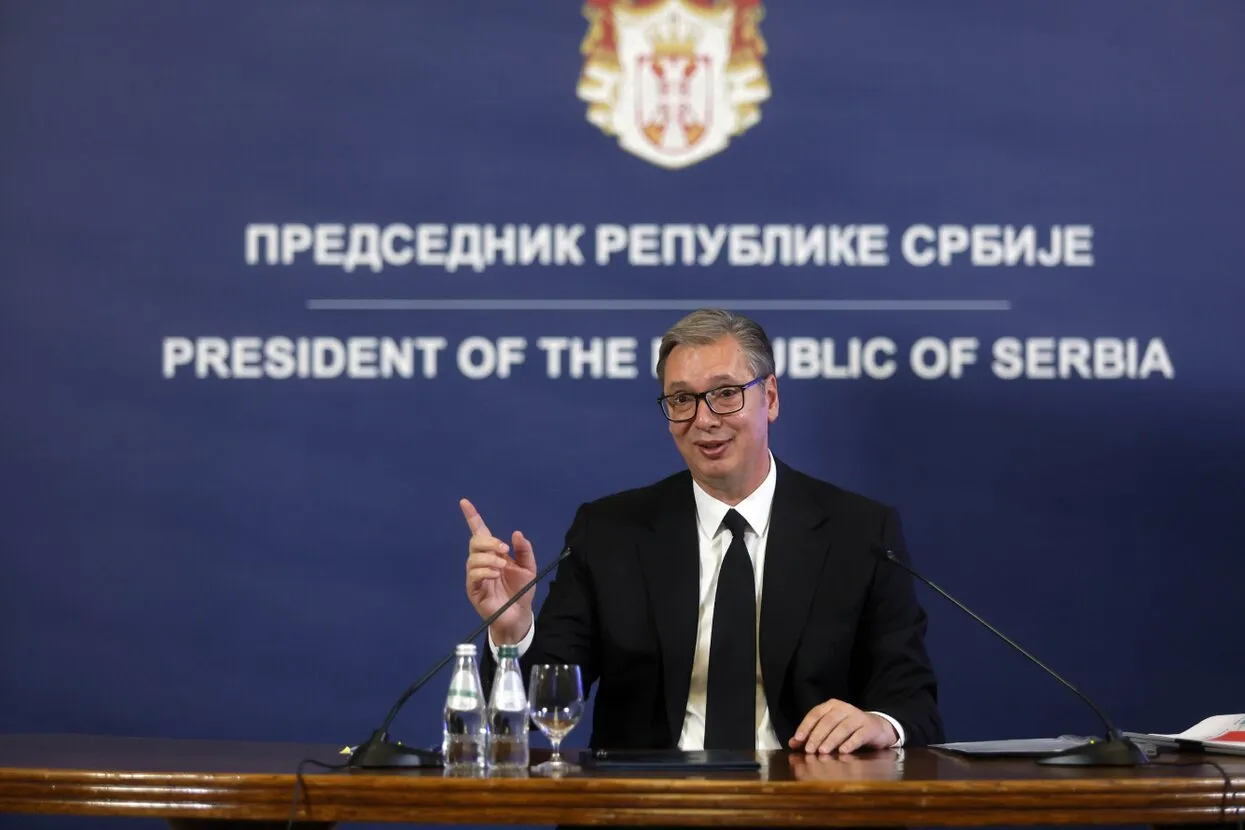
Aleksandar Vučić resigns as Serbia’s president eight months early to run for prime minister instead
Serbian President Aleksandar Vučić has announced his resignation. His opponents have demanded it for nearly two years, since 16 people died when a railway station canopy collapsed in Novi Sad in November 2024. But Vučić appears to be leaving the presidency to try to stay in power, rather than to give in to protesters. Meduza briefly explains how it came to this.
Who is Aleksandar Vučić?
Vučić has dominated Serbian politics for more than a decade. He began his career in the 1990s as a lawmaker for the Serbian Radical Party and served as information minister under Slobodan Milošević. In 2008, he broke with the far right and co-founded the more moderate Serbian Progressive Party.
The party first came to power as part of a coalition in 2012. Two years later, it won a majority in parliament, and Vučić became prime minister. He became president three years after that. He served almost two terms, resigning eight months before his second term was due to end. The resignation was expected: Vučić said in June that he was in his “final weeks” in office.
His longtime ally Ana Brnabić, speaker of Serbia’s parliament, the National Assembly, has become acting president. A new presidential election must be held within three months.
What was Serbian politics like under Vučić?
Serbia is a parliamentary republic in which the prime minister has more authority and responsibility than the president. But Vučić retained control of his party even after becoming president in 2017, despite the presidency being the formally weaker office. His party has governed Serbia for 14 consecutive years.
Freedom House, a U.S. organization that studies rights and freedoms around the world, rates Serbia as “partly free” under Vučić. It says he has sought to suppress the opposition and concentrate power at home, while balancing Serbia’s pursuit of EU membership with its ties to Moscow and Beijing abroad.
That balance became harder to maintain after Russia’s full-scale invasion of Ukraine. Serbia condemned the war and refused to recognize Russia’s annexation of Ukrainian regions, but it still has not joined EU sanctions against Russia. Since 2022, Serbia has also become one of the main destinations for Russians leaving because of the war: tens of thousands of Russian citizens have settled there over the past four years.
Why is Vučić leaving?
By his own account, he is leaving to take part in snap parliamentary elections on October 25. Vučić called the elections himself amid protests that have continued for nearly two years. They began after a canopy collapsed over the entrance to the recently renovated railway station in Novi Sad, Serbia’s second-largest city, in November 2024, killing 16 people. Gatherings to remember the dead grew into political rallies, with protesters accusing the government of negligence and demanding that those responsible be put on trial.
The protests peaked in spring 2025. On March 15, an estimated 150,000 to 300,000 people joined a demonstration in Belgrade, where authorities may have used an acoustic weapon against protesters. Soon afterward, students — the core of the protest movement — called for early parliamentary elections. “Corruption has taken root too deeply in state institutions,” the protesters said.
Vučić ignored that demand for 16 months, until early September 2026. Analysts believe he was counting on the student protests to lose momentum. Instead, the demonstrators gained experience in local elections and drew up their own slate of parliamentary candidates. Other opposition groups backed it, too.
What happens next?
Vučić cannot become Serbia’s president again: the country limits presidents to two five-year terms, and he has exhausted his eligibility. That is why, some believe, he decided to leave office early and take part in the parliamentary elections. If his Serbian Progressive Party wins, he could hold on to power as prime minister: fellow party members have already nominated him for the post.
But victory is far from certain. Polls in recent months suggest the Student List could pose a serious challenge to the ruling party’s slate, at the very least. Serbia’s coming election looks set to be its most interesting in years.
At Meduza, we are committed to transparency about our use of artificial intelligence in the newsroom. The story you’re reading was written by one of our living, breathing journalists and translated from Russian using an AI model configured to follow our strict editorial standards. This translation process is the result of extensive testing and refinements to ensure our English-language coverage is timely and accurate. A Meduza editor reviews every draft before publication.
If you find any errors in this translation, please contact us at reports@meduza.io.
To read Meduza’s exclusive content in English, please subscribe to our newsletter.
Slobodan Milošević
Milošević was president of Yugoslavia from 1997 to 2000. The International Tribunal in The Hague charged him with war crimes in Kosovo and had him arrested. In 2006, during his trial, he died in prison of a heart attack.
SRS
A far-right party founded in 1991, it called for creating a “Greater Serbia” spanning Serbia and neighboring countries, opposed joining the EU and NATO, and favored closer ties with Russia. The party’s founder, Vojislav Šešelj, was sentenced in 2018 to 10 years for inciting the deportation of Serbia’s non-Serb population during the Yugoslav Wars. The court considered the sentence already served, counting the 11 years (2003–2014) Šešelj had spent under arrest in a cell at the Hague Tribunal.
SNS
A center-right party formed in 2008 after a split in the Serbian Radical Party, the SNS softened its predecessor’s nationalist course: it supports both Serbia’s accession to the EU and friendship with Russia and China. Like the Serbian Radical Party, however, the SNS does not recognize Kosovo’s independence. Vučić is a co-founder and former chairman of the party.
Was there one?
Authorities opened a criminal case over the canopy collapse. Thirteen people became defendants in the case, including officials — the highest-ranking is former Construction, Transportation, and Infrastructure Minister Goran Vesić — as well as designers, engineers, and people who oversaw construction of the station. The case has not yet gone to trial.
Who are they?
The so-called Student List included doctors, teachers, lawyers, athletes, and other professionals who supported the protests.