As support for Putin slips, the Kremlin lowers the ruling party’s election target amid fears a landslide victory would look suspicious
Russia’s Presidential Administration announced in March 2026 that it expected United Russia, the country’s ruling party, to win 55% of the vote in September’s elections, with 50% turnout, according to a public statement.
Meduza’s sources in regional administrations, however, cited a different target: 60% of the vote, with 55% turnout.
In June, media outlets loyal to the Russian authorities reported that the Presidential Administration had lowered its expectations for United Russia to as much as 50%, with turnout unchanged. A Meduza source close to the Presidential Administration warned the figure could drop further.
That’s exactly what happened in mid-July. Several officials and United Russia members from the Central, Northwestern, and Far Eastern federal districts, along with a source close to the Presidential Administration, told Meduza the Presidential Administration had lowered the KPI again for a number of regions.
The Kremlin now wants the ruling party to win at least 45% of the vote, down from 50%. The turnout target of 50% remains unchanged.
“We’re the middle of the pack,” says an official who oversees the elections in one of the aforementioned federal districts, describing his region. “At first, our minimum KPI for United Russia was 55%, then it dropped to 50%. Now we’re aiming for 45%.”
He’s confident the Kremlin won’t lower the KPI any further.
The source’s region has long been neither a standout performer for the ruling party in elections nor a laggard, and he believes other “average” regions now have similar KPIs. A United Russia lawmaker from another Russian region confirms this, saying his own region has always posted “middling” results.
Officials and lawmakers from United Russia in regions with stronger results say the KPI has been lowered there too, compared with the original targets.
“Previously, the figure for United Russia was 55%, but from the way [members of the political bloc] talked to us, it was clear they actually expected around 60%. Now the conversation about the KPI is softer,” says an official from a region that typically posts high election results. United Russia is now expected to win 50% of the vote in these regions, with turnout of 50–55%.
Both this official and his colleague from an “average” region believe the KPI has likely not been lowered in the so-called electoral sultanates, which produce abnormally high results. An official well acquainted with the situation in one of the “sultanates” confirms this: “The [vote-rigging] machinery there has been running smoothly for decades.”
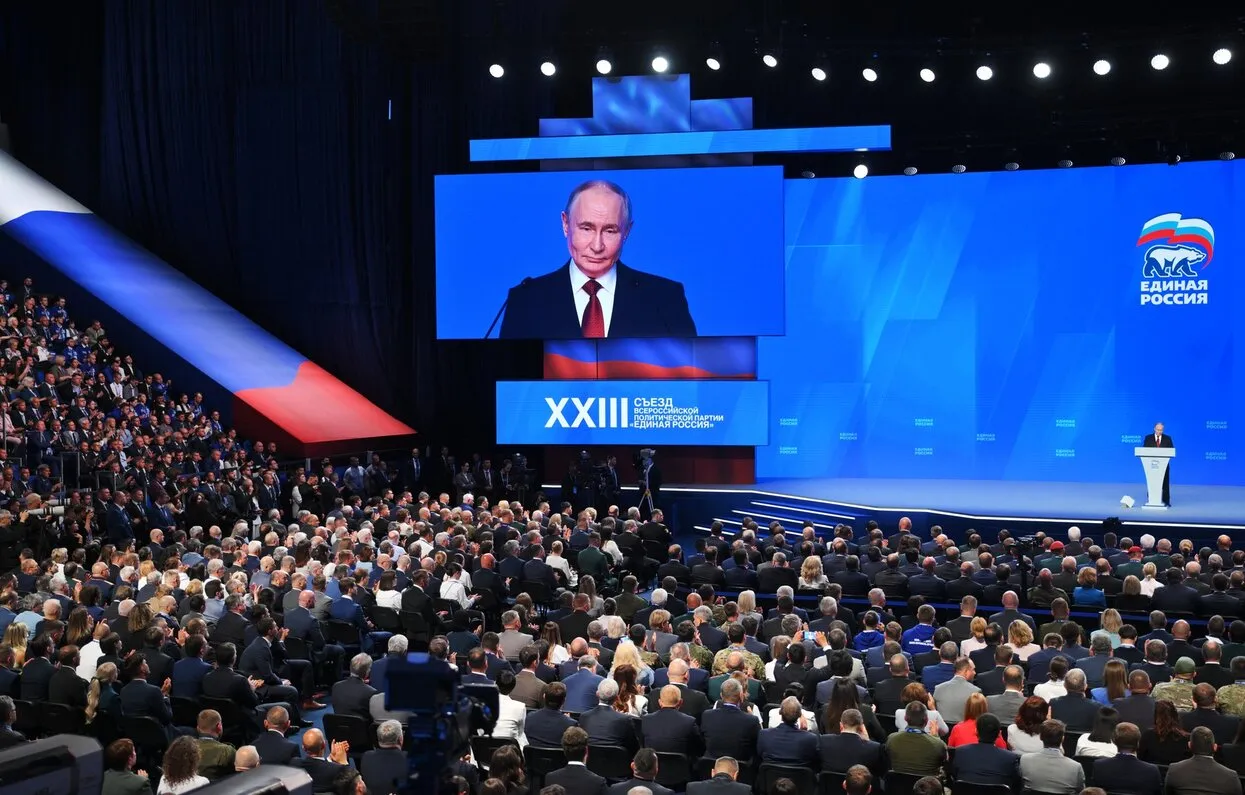
Plenary session of United Russia’s 23rd congress at CSKA Arena in Moscow. June 28, 2026
Grigory Sysoyev / the Russian state news agency RIA Novosti / Sputnik / Profimedia
A Meduza source close to the Presidential Administration says the reasons behind the concessions are clear: a gasoline shortage, rising prices, and public fatigue with the war in Ukraine, all of which are dragging down the ratings of the ruling party and Vladimir Putin.
In mid-January, for instance, pollsters at the Russian Public Opinion Research Center (VTsIOM) found that 79% of respondents trusted the president and 75% approved of his work. By July, those figures had fallen to 71% and 65%, respectively, according to VTsIOM.
VTsIOM changed its polling methodology after the ratings for both the president and the ruling party dropped sharply. The numbers then recovered: April polling showed only 27% of citizens willing to vote for United Russia, a figure that has since climbed back to 35% — the same level as at the start of 2026.
Nationwide, the Kremlin’s expectations for United Russia in the upcoming election now average around 45–50%. A Meduza source close to the Presidential Administration doesn’t rule out the KPI dropping by another “5 percentage points or so” as election day nears.
A political strategist who works with the Presidential Administration, however, says the KPI could actually be raised before the election, “regardless of whether the situation in the country gets worse or not,” though any increase would be selective.
This source says the political bloc understands that in some regions, “governors can, if need be, deliver more votes” for the ruling party: enough, the strategist assures, “to bring the result up to what’s needed for the country as a whole.”
A couple of weeks before the election, the source continues, deputy governors for domestic policy in these regions will be summoned to meet with Presidential Administration political bloc chief Sergey Kiriyenko and Alexander Kharichev, head of the Presidential Directorate for Monitoring and Analysis of Social Processes. “They’ll ask whether the deputy governors can boost the result if needed. They’re unlikely to refuse,” the political strategist says.
A United Russia campaign poster in Kaliningrad. July 22, 2026
Alexander Podgorchuk / RIA Novosti / Sputnik Kaliningrad Russia
For now, a source close to the Presidential Administration says the political bloc is working on “legitimizing” United Russia’s future result. “Officials are being asked not to pressure [budget-funded employees] too hard,” he explains. “Many really won’t be required [to post excessively high numbers]. Why put the squeeze on, say, Pskov or Novgorod, when it can all be done quietly in Krasnodar?”
The political strategist who works with the Presidential Administration suggests the lowered KPI will mean less election fraud. “And officials themselves will sleep better. That’s the kind of therapy this turns out to be,” he laughs.
An “official result of 45%” for United Russia “would be politically correct,” he continues:
Probably, [Russians] would perceive it as close to the real number, and it would raise fewer doubts than 60% or 50%.
United Russia would still win a constitutional majority through single-mandate districts. But I think that’s impossible for [Sergey Kiriyenko], who constantly emphasizes his records. So they’ll try as hard as possible to give no less than in 2021.
United Russia scored 49% in that year’s election to the State Duma, the lower house of Russia’s parliament.
At Meduza, we are committed to transparency about our use of artificial intelligence in the newsroom. The story you’re reading was written by one of our living, breathing journalists and translated from Russian using an AI model configured to follow our strict editorial standards. This translation process is the result of extensive testing and refinements to ensure our English-language coverage is timely and accurate. A Meduza editor reviews every draft before publication.
If you find any errors in this translation, please contact us at reports@meduza.io.
To read Meduza’s exclusive content in English, please subscribe to our newsletter.
Andrey Pertsev
СВК
Сергей Владиленович Кириенко.
Что важного произошло на съезде?
Глава «Единой России», бывший президент РФ Дмитрий Медведев снова не попал в федеральный список. Его возглавили министр иностранных дел Сергей Лавров и мэр Москвы Сергей Собянин.
Какие это регионы?
Традиционно это Татарстан, Башкортостан, Краснодарский край, многие республики Северного Кавказа.