
stories
Investigation finds Russia’s billboards featuring troops fighting in Ukraine include men with criminal convictions and soldiers accused of war crimes
Source: Bumaga
stories
Investigation finds Russia’s billboards featuring troops fighting in Ukraine include men with criminal convictions and soldiers accused of war crimes
Source: Bumaga
Billboards featuring portraits of soldiers fighting in Russia’s war in Ukraine are a common sight in Russian cities. Their stories appear on the Russian Defense Ministry’s website — but the official biographies leave out some facts. The news outlet Bumaga identified 24 soldiers featured on billboards in St. Petersburg. They include soldiers killed at the front, former prisoners awarded the title of Hero of Russia, and suspected perpetrators of war crimes in Ukraine. Meduza is translating Bumaga’s full report on these men and other soldiers featured on the Defense Ministry’s website — more than 700 in all.
In the summer of 2026, Bumaga photographed banners displayed in St. Petersburg and identified the 24 soldiers pictured on them. Journalists then researched their biographies using official publications, government registries, social media, social media profiles of people close to them, and other sources.
In October 2026, the outlet compiled a list of soldiers’ names from the Defense Ministry’s “Real Heroes” website, which profiles Russian soldiers who have fought in Ukraine. The billboards display the site’s web address. It appears to be a central database of soldiers the Defense Ministry uses in its public relations campaigns — the ministry also features them on social media. Names from this database appear on billboards across Russia.
In early October 2026, the “Real Heroes” website had information about 737 soldiers, excluding those identified only by their call signs. Bumaga cross-checked these names against the list of war dead compiled by Mediazona and the BBC Russian Service, death announcements on social media, and the probate registry. We also looked for the names in war crimes investigations by media outlets and human rights advocates, and on the websites of Ukrainian agencies pursuing cases against Russian soldiers.
These findings may be incomplete. One difficulty was that the Defense Ministry publishes only limited information about the soldiers it honors — usually just their first and last names and ranks. Some soldiers’ faces are obscured in the photos, and no patronymics, birthplaces, or ages are given. As a result, journalists could not identify some of the soldiers on the Defense Ministry’s website, particularly those listed only by call sign or with common surnames, such as Ivanov and Sidorov.
War crimes investigations are also ongoing. By March 2026, for example, Ukrainian prosecutors said they had documented more than 210,000 alleged crimes by Russian forces. Only 1,127 people have been identified as suspects, 809 have been charged, and 242 have been convicted.
The story behind one portrait: How Moscow resident Pavel Zamokin ended up on a St. Petersburg billboard
In 2026, a photo of Pavel Zamokin, a 40-year-old Moscow resident called up for military service, appeared on billboards in both Moscow and St. Petersburg. His former wife, Anna, does not know exactly how he ended up on the banners. “They signed some papers [with the Defense Ministry] before, after all. They might not even know what they’re agreeing to,” she said.
Pavel’s 13-year-old daughter had her picture taken next to his portrait at a bus stop, the girl’s mother told Bumaga. And when Anna’s mother saw Zamokin’s photo at a train station, she “came running over, wide-eyed” to ask Anna, “What happened to Pasha?” She thought the soldier had died: “They wouldn’t put it up for no reason.”
Anna separated from her husband in late 2021. Before that, she said, he “was like everyone else”: He spent time with his family, raised his daughter, and wanted to travel. Then he ran up about 10 debts with microlenders and started spending time with different people. In 2022, Pavel lost his job at Moscow’s Chernyshev aircraft engine plant. He was mobilized that fall. In March 2023, both of Pavel’s parents died in a car crash, according to probate records.
“It was an accident. They were coming back from church. His mother was religious. And his dad had recently become religious, too, after Pavel left [for the war]. They were getting off a tram, and his father was holding out his hand to help his mother down. The taxi driver just didn’t see them, didn’t stop. His father died right away, but his mother was still alive and died that night. Of course, they managed to get word to Pavel somehow. He took it really hard,” Pavel’s former wife told Bumaga.
In 2024, Zamokin took part in the fighting for the village of Robotyne in the Zaporizhzhia region. The Defense Ministry said he “eliminated five enemies” there. For this, Pavel was awarded the Cross of St. George, fourth class, and then interviewed for the ministry’s Telegram channel. A still from that video later appeared on the billboards.
Bumaga
After receiving the award, Zamokin was granted leave. By then, he had suffered two shrapnel wounds, lost his hearing in one ear, and had a nervous breakdown. Anna said her former husband was diagnosed with schizophrenia at Burdenko Military Hospital. She could not provide Bumaga with documents confirming the diagnosis.
But he was not discharged from the military. “They decided [schizophrenia] was basically fine. I talked to the hospital’s chief psychiatrist. He said it was all right; they take people like that, they’re more than happy to take them,” his former wife said.
After his hospital stay, Pavel remained in Moscow for a while. But one day, Anna said, he was stopped on the street. “They checked his papers, then said, ‘What are you doing wandering around? Get ready [to go back to your unit].’ That was a year and a half ago. We haven’t spoken since,” his former wife said.
In a leaked database, Bumaga found an entry listing Zamokin as wanted under Article 337 of the Russian Criminal Code, which covers going absent without leave. It is the charge most often brought against soldiers who leave their units without permission or fail to return, often while on leave or undergoing treatment.
“When we saw each other while he was on leave, he’d be scared: ‘I’m not coming back.’ I’d always say, ‘Oh, come on, you always used to tell me that.’ He’d been through a lot of bad things in his life, but he always got through them,” his former wife, Anna, said.
It is unclear what has happened to Pavel Zamokin. His sister declined to speak with Bumaga in detail, saying only that her brother was “alive, well, and fighting.” In late October, Pavel Zamokin’s page disappeared from the “Real Heroes” website.
How billboards featuring soldiers fighting in Ukraine appeared in Russian cities
Exactly how people are selected for the billboards has not been publicly explained. The initiative likely comes from the Defense Ministry, which regularly publicizes the achievements of soldiers who later appear on banners across Russia.
In St. Petersburg and Moscow, the portraits may be replaced after a few months or left up for six months. Some portraits, however, stay in the same place for more than a year — we noticed this with photographs of officers awarded the title of Hero of Russia.
The centrally coordinated campaign to display portraits of soldiers fighting in Ukraine began in the summer of 2022. Russ Outdoor, Russia’s largest outdoor advertising company, put up photographs of soldiers on 8,000 advertising displays in more than 200 cities. “Everyone fighting selflessly for peace in the Donbas is a hero. It’s important that Russians know their heroes by sight,” Russ commercial director Boris Peshnyak said of the campaign.
The first posters featured photographs of soldiers, their names and ranks, the Russian tricolor, and the words “Glory to Russia’s heroes!” Beside them was a QR code linking to the Defense Ministry’s website, which described the achievements of the soldiers pictured.
The campaign expanded over time. A year and a half later, in December 2023, Russ CEO Robert Mirzoyan told the news outlet RBC that the company was using about 70,000 advertising displays for portraits of soldiers and that the campaign reached more than 380 Russian cities each month.
Mirzoyan classified the banners as public service ads. By law, government agencies can claim 5% of available ad space or airtime free of charge, including on billboards. But Russ said it had devoted 10% of its advertising displays to the portraits. Russ used its own billboards in only 90 cities, buying space from competitors elsewhere.
Most likely, however, Russ is simply carrying out the campaign. The same company also displays banners advertising contract military service, for example. Media reports identify Suleiman Kerimov, a Federation Council senator representing Dagestan and one of Russia’s wealthiest men, as the man believed to be Russ’ real owner. Investigative journalists say he has direct access to the president. The investigative outlet Proekt reported that Kerimov was involved in Russ’ merger with Wildberries and that the Kremlin approved it.
The design of Russ’ posters featuring soldiers has changed during the war. The banners now read “Pride of Russia” and show the web address in place of the QR code. The Defense Ministry hosts the site, which profiles only soldiers who have distinguished themselves. Each soldier still has a page with a photograph and a description.
In early October 2026, the website featured profiles of 737 Russian soldiers.
Soldiers called up for the war and a Hero of Russia with a criminal record: Who else appears on St. Petersburg’s banners
Pavel Zamokin is one of the 24 Russian soldiers whose portraits Bumaga found on banners in St. Petersburg in the summer of 2026. Most, like Zamokin, have no obvious connection to the city. The soldiers on the billboards include residents of Dagestan, Kalmykia, the Volga region, the Krasnodar region, and Luhansk. Ten have received the title of Hero of Russia.
Most — 15 men — are career soldiers who were already serving before February 24, 2022. They include commanders of major Russian military units, such as Colonel Denis Pirogov, who heads the 123rd Motorized Rifle Brigade, and Colonel Yaramir Temirkhanov, who commands the 6th Separate Motorized Rifle Brigade. Both became Heroes of Russia after the fighting for Siversk, whose capture the Defense Ministry announced in December 2025. The city is now completely destroyed.
Bumaga
Some had already been serving under contract for several years when the war in Ukraine began. Among them is Dolaan Sat from Tuva, who worked as a court bailiff before joining the army. His name was misspelled on the banner as Dallan Sat — no person with that name exists. Bumaga learned of the mistake from local social media groups.
But not all the soldiers on the billboards had committed to a military career before the war. Five are believed to have been mobilized in the fall of 2022. For example, 24-year-old Senior Sergeant Artyom Lopatkin from the Transbaikal region was sent to the front during mobilization, his mother told Bumaga.
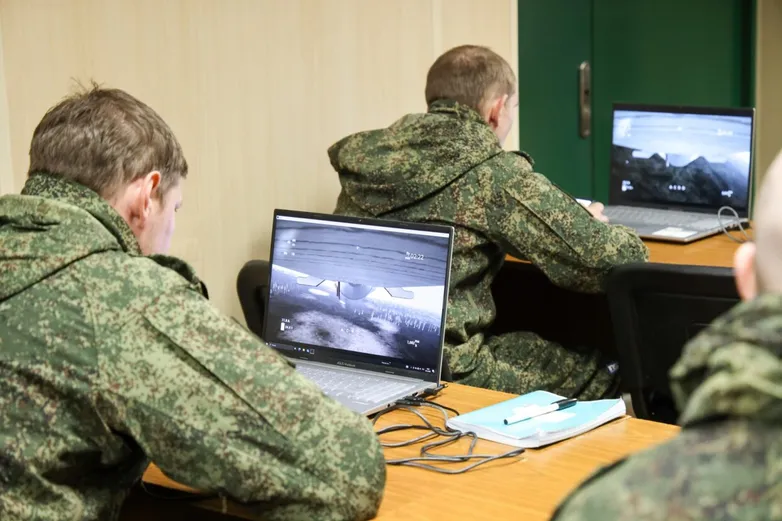
Lopatkin was drafted shortly after he turned 18. Artyom’s mother counted down to his return on her VKontakte page. In December 2021, the family met him at the train station and posed for a photograph together to mark the occasion. Just nine months later, Lopatkin received a mobilization notice. He now serves as a drone operator, and the Defense Ministry uses his photograph to advertise service in its drone forces.
Bumaga
Bumaga estimates that four soldiers featured on the banners signed contracts with the Defense Ministry after the war began. They include 23-year-old Nikita Syromyatnikov from the Sverdlovsk region. He signed a contract in August 2025. Just a few months later, he received the title of Hero of Russia. According to the Defense Ministry, during the capture of Siversk he “destroyed eight enemy military targets in three days,” then was wounded and refused evacuation until the fighting was over. No other details are known.
Nikita Syromyatnikov leads military-themed classes for schoolchildren known as “lessons in courage,” and his biography appears on the website of the president’s envoy to the Urals Federal District. The official account of his life, however, does not mention that Syromyatnikov was tried twice for theft before going to war.
Bumaga
In September 2020, he was sentenced to 80 hours of community service. He was charged with theft involving unlawful entry into a building, but what he stole remains unknown; the verdict has not been published. Soon after his first criminal case, Nikita Syromyatnikov and an acquaintance climbed over a fence in the village of Guzeyevo, took an adjustment wheel from a plow worth 13,000 rubles, and hid it in a car trunk. The court ruling said Syromyatnikov admitted his guilt. The court ordered him to work for eight months and forfeit 5% of his pay.
From Buryatia and Kalmykia: The soldiers who died and appear on billboards or the Defense Ministry’s website
A billboard near Murinsky Park in St. Petersburg features Sergeant Pyotr Mandzhiyev. The photo shows the Order of Courage pinned to his uniform — an honor he received posthumously. Mandzhiyev died a year and a half before Bumaga spotted his portrait on the street. The decoration appears to have been added to the photograph after his death.
Mandzhiyev’s obituary says he was born in Kalmykia. After technical college, he served as a dog handler in the Internal Troops, worked as a combat engineer in Chechnya, and fought in the war with Georgia. He later worked on the railroad, then moved to St. Petersburg in 2017 and took a job laying asphalt.
In November 2024, Mandzhiyev signed a contract with the Defense Ministry. “He didn’t decide [to go to war in Ukraine] overnight. He’d been eager to go since the start of the special military operation, because a lot of the men he’d served with were already there. He was desperate to join them,” his wife, Svetlana, told Bumaga. One of Pyotr’s younger brothers followed him to war. He has been hospitalized twice with wounds and continues to fight.
Bumaga
Pyotr Mandzhiyev died the month after signing his contract. His widow asked that his portraits be displayed in St. Petersburg. This is why there is no page on the website describing his achievements, unlike the pages for the other soldiers featured on the banners. “His registered address is in Kalmykia, and he left for the special military operation from his home republic, too. But we were living in St. Petersburg. And I wanted his portrait to be up here. […] I sent a formal request to the Defense Ministry. They gave the go-ahead. Then the Defenders of the Fatherland Foundation worked it out with the city. I don’t know what the process was,” his widow said.
Pyotr Mandzhiyev is one of four deceased soldiers whose portraits were displayed in St. Petersburg in the summer of 2026. He was one of the two with ties to St. Petersburg. The other was Artyom Vasilyev, a graduate of the city’s military communications academy. He was buried in his native Buryatia in December 2025 — six months after his death.
Two other St. Petersburg banners featured photographs of deceased Senior Lieutenants Naran Ochir-Goryayev from Kalmykia and Artyom Belikov from Buryatia.
We found that at least 61 of the 737 soldiers featured on the campaign’s website had died.
The “Butcher of Bucha” and the shooting of civilians: Which soldiers on the billboards are accused of crimes
In the summer of 2026, 31-year-old Artyom Belikov, call sign “Bilbo,” was wounded. Four days later, he died in a military hospital in Mariupol. All that is officially known about him is that he liked sports, took part in Zarnitsa (a military-themed game for children), got along with his classmates, and respected his elders. He signed a contract with the Defense Ministry almost 10 years ago. After earning a degree in geography, he was drafted for compulsory service and stayed in the army. He fought in Ukraine starting in February 2022, first as a gunner-operator before becoming a drone operator.
Bumaga
Ukrainian authorities first accused Belikov in 2023 of killing civilians on the “road of death” — a stretch of the Zhytomyr highway in the Kyiv region. According to Ukrainian law enforcement agencies, he was serving in the 37th Motorized Rifle Brigade in March 2022. Russian soldiers set up a checkpoint on the road, which residents of the Kyiv region were using to flee west. Ukrainian authorities believe Belikov’s commander ordered him and other subordinates to open fire on two cars. Ukraine’s Security Service, the SBU, says a family was in one of the cars that Russian troops fired on. The parents died at the scene. Russian forces allegedly took their older daughter, 15, to Belarus with severe injuries, and she died there. The younger girl was handed over to residents of a nearby village. She was less seriously injured than the others and survived.
In northern St. Petersburg, just over half a mile from the banner featuring Belikov, hung a portrait of Maxim Krasnoshchekov, who was named a Hero of Russia and promoted to major general in May 2025. The Defense Ministry said Krasnoshchekov’s units had captured more than 50 settlements and “eliminated more than 6,500” Ukrainian service members. “We won’t let anyone harm our land,” he said in an interview after receiving his award.
Krasnoshchekov is a career officer from the Smolensk region who fought in Syria. Until 2024, he served in the 15th Separate Motorized Rifle Brigade — the only brigade in Russia officially designated a peacekeeping unit. Ukrainian authorities suspect the brigade of a series of war crimes.
Bumaga
On February 28, 2022, the 15th Brigade entered the village of Peremoha in the Kyiv region. Soldiers detained five residents at a branch of the Nova Poshta delivery service, according to an investigation by the news program Schemes. Ukraine’s Security Service says Krasnoshchekov and another member of his unit, Vasilyev, may have interrogated and beaten civilians to obtain information about the Ukrainian Armed Forces and Territorial Defense. The officers then allegedly ordered the detainees shot with assault rifles and the building containing their bodies blown up. All five detainees died. Ukrainian authorities formally named both officers as suspects.
In addition to Belikov and Krasnoshchekov, the Defense Ministry’s website features at least 10 other soldiers — roughly one in every 61 people on the site — whose names appear in Ukrainian authorities’ records concerning alleged war crimes and the deportation of children, as well as in journalistic investigations. Here are some of them:
- Dmitry Zharkikh. According to the Russian Defense Ministry, he has provided artillery support for Russia’s offensive since the first days of the war. In Ukraine, Zharkikh was sentenced in absentia to life in prison. Investigators said that in December 2022, Zharkikh ordered a strike on central Kherson using BM-21 Grad multiple-launch rocket systems. The strike hit homes, a hospital, and other facilities that serve the public, killing 13 people.
- General Roman Demurchiyev. Investigative teams at Radio Liberty published a report based on an archive of his correspondence. Journalists found regular discussions of the torture and execution of prisoners. For example, in October 2022, Roman Demurchiyev sent several acquaintances a photograph of severed ears hanging on a string draped over a metal pipe. In December 2024, the general forwarded colleagues a video showing Russian soldiers recruited from prisons hacking three Ukrainian prisoners of war to death with entrenching shovels after the prisoners had raised their hands and surrendered. Six months after the report was published, Demurchiyev was added to the EU sanctions list.
- Nikita Zheludkov. In Ukraine, he was sentenced to 12 years in prison for the cruel treatment of civilians. The court found that soldiers acting on Zheludkov’s orders detained two people in the village of Khaliavyn in the Chernihiv region. Their phones and money were confiscated. Both had their hands tied and were held in a cold basement for three days. Throughout that time, the men were not allowed out to use the bathroom. The detainees were then taken for questioning, after which they were blindfolded, driven to a field, and ordered to lie on the ground. After the soldiers left, the two residents managed to reach Chernihiv.
- General Azatbek Omurbekov. In the spring of 2022, he commanded the 64th Separate Motorized Rifle Brigade, which Ukrainian authorities and media outlets link to the killings of civilians in Bucha. Journalists call Omurbekov himself the “Butcher of Bucha.” In interviews with the investigative outlet iStories, for example, soldiers alleged that Omurbekov ordered troops to fire on cars carrying civilians and kill “anyone you find with a phone.” In April 2026, he appears to have been the target of an assassination attempt in the Khabarovsk region. He was named a Hero of Russia because his 64th Brigade “held a defensive line in the Kyiv region for three weeks” at the beginning of the war.
The Defense Ministry’s website also lists another 18 names — roughly one in every 40 — that appear on lists of war criminals published by Ukraine’s military intelligence agency, the HUR. The HUR does not, however, accuse them of specific acts. In the first half of 2022, the agency was primarily identifying soldiers who took part in the invasion. Some soldiers named by the HUR did later become suspects in criminal investigations, but Bumaga found none of those suspects among the people whose names are currently published on the Defense Ministry’s website.
From billboards to the Kremlin: Many soldiers on St. Petersburg’s banners are the people the authorities intend to make Russia’s “new elite”
Some of the soldiers on St. Petersburg’s banners have become public figures in recent years, and several meet periodically with the president, officials, and propagandists.
In November 2025, state TV host Vladimir Solovyov aired a segment about the 123rd Motorized Rifle Brigade commanded by “Samarkand.” Just a month later, the soldier with that call sign — Colonel Denis Pirogov — was invited to a meeting with Vladimir Putin at the Kremlin. With cameras rolling, Pirogov was the only person seated beside the president, personally briefing him on the capture of Siversk in the annexed Donetsk People’s Republic.
After Pirogov, Senior Lieutenant Naran Ochir-Goryayev joined by video link. He commanded an assault company in the 6th Separate Motorized Rifle Brigade, which fought alongside Pirogov’s brigade in the battle for Siversk. Naran’s connection kept dropping. “The enemy is jamming the signal,” the generals complained over the video link.
Bumaga
Shortly afterward, both Naran Ochir-Goryayev and Denis Pirogov were named Heroes of Russia. Putin also invited Naran to his December televised call-in show. The annual event began with an introduction of Ochir-Goryayev to the studio audience and viewers at home. “He’s being modest. He started out as an ordinary driver,” Putin said. At his request, a nervous Naran once again recounted the capture of Siversk. Putin enthusiastically asked him to repeat what they had discussed off camera after the award ceremony. The hosts prompted the soldier: “These people had no weapons at all, they were civilians. [Ukrainian forces] were shooting at them just for staying there?”
After this scene, both pro-government and opposition journalists tried to identify the soldier. It emerged that he had previously served in the police and later owned a business in Moscow selling radio, television, and video equipment. Ksenia Sobchak’s channel speculated that Naran Ochir-Goryayev might become a lawmaker or governor. Just six months later, the head of Kalmykia announced the soldier’s death. The circumstances are unknown.
The banners featuring both soldiers — Pirogov and Ochir-Goryayev — probably appeared in St. Petersburg after Siversk was captured. Whether Ochir-Goryayev’s portrait was put up before or after his death is unknown.
St. Petersburg also has photographs of other soldiers who periodically appear alongside Putin. All have received the title of Hero of Russia, too.
Paratrooper Denis Skakunovsky, originally from the Pskov region, appears regularly on Russian television. At the start of the war, he served as a deputy company commander responsible for political affairs and took part in the assault on Kherson. By February 2023, he was attending Putin’s address to the Federal Assembly. Before the address, he told journalists, “It’s too early for negotiations. First we’ll show everyone what we can do, and then we’ll dictate the terms.” On New Year’s Eve, as Russia rang in 2025, he was a guest on the television show “Goluboi ogonyok” (“Little Blue Light”). On May 9, 2026, he watched the parade alongside Putin from the main reviewing stand — a scaled-back parade due to the risk of drone attacks.
Bumaga
From his reviewing stand on May 9, Putin watched another soldier whose portrait also appeared in St. Petersburg: Mirlan Dzhumagaliyev, who led a column of veterans of the war in Ukraine. Dzhumagaliyev said one of his subordinates was the first to raise the Russian tricolor in Avdiivka, a city that remains under Russian control.
In recent years, Vladimir Putin has repeatedly said that veterans of the war in Ukraine should become the “country’s new elite” and that the government is working to build a “pool of future leaders” from their ranks. St. Petersburg’s banners also feature men now taking roles in government or in institutions it controls. For example, Ivan Vlasenko, a 59-year-old military pilot from Krasnodar who followed in his family’s footsteps, was discharged after reaching the military’s age limit. Before the Soviet Union collapsed, he served in Odesa, then fought in Chechnya, Georgia, Syria, and Ukraine. Immediately after leaving the military, he joined the regional Civic Chamber, and in the summer of 2026 he was elected its chairman.
Public accounts of his appearances suggest that Yegor Zakharov, 30, of the Novosibirsk region, has also spent the past few years away from the front. Since 2025, he has participated in the federal Time of Heroes program, created to prepare soldiers for “senior government positions.” The program includes a fairly rigorous selection process and mentoring: Applicants must be veterans with a university degree and experience managing people.
Bumaga
Zakharov is now doing an internship with Anatoly Seryshev, the president’s envoy to Siberia, speaking at the Znanie forum, and praising lectures by Sberbank head German Gref and Foreign Minister Sergey Lavrov.
Zakharov’s training is scheduled to continue until 2027. Meanwhile, his mother, Tatyana, a Russian language and literature teacher at a rural school, won a seat in the Novosibirsk regional legislature for the first time as a United Russia candidate. State media promoted her as an active member of the community and the mother of a Hero of Russia.
‘Meat assaults’ and corruption: The charges soldiers featured by the Defense Ministry faced in Russia and the accusations troops made against their commanders
“Don’t believe rumors!!!” read promotional posts from the 123rd Motorized Rifle Brigade. Before films and propagandists’ posts celebrated the brigade commanded by Denis Pirogov — “Samarkand” — the unit made the news because of “zeroings,” or extrajudicial killings of Russian soldiers by their fellow service members, and soldiers’ disappearances.
At the beginning of 2025, about 100 relatives of soldiers affected by the alleged abuses put together a petition demanding an investigation into the 123rd Brigade. At the time, the soldiers’ relatives were seeking the removal of the brigade commander, Roman Shkroba (“Kashtan”), and the battalion commander, Alexey Korchagin (“Cap”). Earlier, in 2024, the news outlet Astra reported that an audio recording of torture had been found on the phone of a missing soldier from the unit. Inspections followed, but they did not extend to the commanders responsible for “meat assaults” — attacks in which commanders send troops forward with little regard for casualties.
Exactly when Denis Pirogov took command of the brigade is unknown. Russia’s equivalent of Wikipedia says he took over after the previous commander’s death in the summer of 2023. Astra, however, reported that Roman Shkroba, commander of the 123rd Brigade, was suspended after inspections in late 2024. That was probably when Pirogov replaced him.
The brigade established social media accounts in the spring of 2025, and Pirogov’s call sign, “Samarkand,” appeared there for the first time soon afterward. It is difficult to say whether his appointment improved conditions in the brigade. Accounts of violence from soldiers in the 123rd and their relatives continue to appear on social media.
Bumaga
Subordinates also made direct accusations against Lieutenant Colonel Ivan Pashchenko. A Telegram channel that publishes appeals from soldiers and reports of deaths posted a video in which two men alleged that their commander, call sign “Sokol,” sent people he disliked on dangerous assignments and ordered troops into assaults without adequate preparation. The men identified themselves as soldiers from the 382nd Naval Infantry Battalion. The “Sokol” they named is Pashchenko. In 2024, he received the title of Hero of Russia for his actions in the Kursk region, and in 2026, he took command of the 40th Naval Infantry Brigade.
Public reports identify only a handful of soldiers who faced prosecution over alleged extrajudicial killings of fellow troops, known as “zeroings.” The names of those formally charged do not appear on the “Real Heroes” website. But it still features photographs of soldiers tried in Russia after 2022.
In October 2026, a military court in St. Petersburg sentenced Lieutenant Colonel Konstantin Frolov, call sign “Palach” (“Executioner”), to 21 years in a high-security penal colony and stripped him of all his awards. Frolov was found guilty of illegal weapons trafficking and fraud involving soldiers’ injuries. According to investigators, injuries were passed off as combat wounds to claim compensation, but they were actually self-inflicted gunshot wounds or injuries deliberately caused by other means, such as inserting shrapnel under the skin. Media reports said Frolov stood trial for fraud totaling 32 million rubles and accepting more than 800,000 rubles in bribes.
In the fall of 2023, a court convicted another soldier featured on the Defense Ministry’s website: Captain Derenik Temirkhanov. He received a three-year suspended sentence. According to the news outlet Kavkaz.Realii, he organized the theft of 800 metric tons of sunflower seeds from a business in the occupied Zaporizhzhia region. Just a few months after the verdict, Temirkhanov was already addressing teenagers in Rostov on the anniversary of the lifting of the siege of Leningrad. A television screen behind him displayed the slogan “Russia. Putin.”
Russian soldiers and military service
At Meduza, we are committed to transparency about our use of artificial intelligence in the newsroom. The story you’re reading was originally reported by Bumaga and translated from Russian using an AI model configured to follow our strict editorial standards. This translation process is the result of extensive testing and refinements to ensure our English-language coverage is timely and accurate. A Meduza editor reviews every draft before publication.
If you find any errors in this translation, please contact us at [email protected].
To read Meduza’s exclusive content in English, please subscribe to our newsletter.
Bumaga