

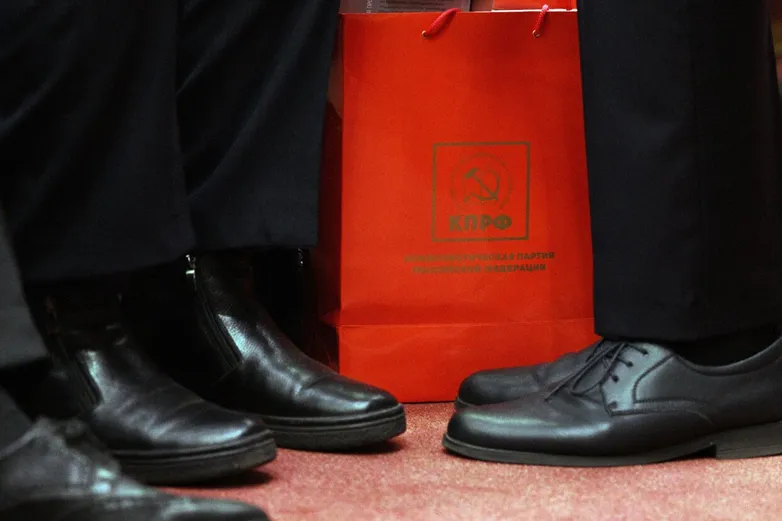
Communist Party of the Russian Federation (KPRF)
Moscow’s Basmanny District Court has ordered Oleg Mikhailov, a former State Duma deputy and former head of the Communist Party’s Komi branch, held in pretrial detention. He is charged with justifying terrorism over a post supporting imprisoned political scientist Boris Kagarlitsky and faces up to seven years in prison. Mikhailov built one of the Communist Party’s strongest regional branches, brought together people with different political views, took part in environmental protests, and challenged the republic’s authorities. During his State Duma election campaign, he was also one of the few Communist candidates to campaign for peace. Yet after Russia’s full-scale invasion of Ukraine began, Mikhailov repeatedly voted for repressive laws.
Warning: This article contains profanity.
Meduza previously reported that the presidential administration was urging the Communist Party’s leadership not to nominate strong regional candidates who had defeated United Russia candidates in single-member districts in the previous election. Among them was Mikhailov, a Communist from the Komi Republic.
The Communist Party partly complied, but its Komi branch leader ran anyway, both in his district and on the federal party list. His original position on the list offered him no prospect of winning a seat.
A Communist Party source told Meduza that the party leadership provided almost no funding for Mikhailov’s district campaign. After his nomination, the source said, Mikhailov and the party began receiving “hints” from the Kremlin: If he did not withdraw, he would face a criminal investigation. Meduza has learned, however, that the authorities planned to launch an investigation regardless, and that the Federal Security Service (FSB) began examining Mikhailov’s social media accounts as early as 2024.
“I told him: Go on vacation after the election, to whatever country you can, and maybe stay a little longer. He agreed to take a vacation, but he ruled out emigrating. He wanted to stay in Russia,” an acquaintance of the former deputy told Meduza, requesting anonymity.
Mikhailov failed to win reelection to the State Duma in September 2026. On October 21, he was detained at Moscow’s Domodedovo Airport as he returned from vacation.
Mikhailov was born in 1987 in Pechora, a district seat in Komi. After studying biology at Syktyvkar State University, he went to graduate school, earned a doctorate, and worked at Komi’s Institute of Biology. He joined the Communist Party in 2007 while still a student and became an activist. At the time, the party’s Komi branch attracted little attention compared with branches in other regions that had prominent local politicians.
“You could’ve called the Komi regional party committee a retirees’ club. They were an opposition group — not very active, but honest,” Pavel Andreyev, founder of the Revolt Center and an acquaintance of Mikhailov’s, told Meduza. “At first, he came across as pretty off-putting — this guy with no sense of fashion, like he’d stepped out of Soviet times. But the older crowd liked that.”
An acquaintance of Mikhailov’s who spoke to Meduza anonymously said he “steadily worked his way up through the party”:
He’d help [the branch leadership] with one thing, lend a hand with another. They promoted him for obvious reasons: He did the things [the branch leadership] didn’t have enough people to do, and [the party leaders] also felt it was time to retire.
And before he knew it, Oleg had become a Syktyvkar city council member, then head of the regional party committee and a member of the regional legislature.
As head of the committee, Mikhailov actively supported protests against the construction of a landfill at Shiyes railway station. The station is in the Arkhangelsk region, practically on the Komi border, and much closer to Syktyvkar than to Arkhangelsk. Mikhailov laid out his position on Shiyes in 2019:
There’s no middle ground on Shiyes: You’re either for it or against it. If you’re for it, you’re an accomplice to the garbage occupiers; if you’re against it, you’re a normal person. There’s no third option.
Another deputy once said to me, “Maybe you should go work in the Arkhangelsk region? It’s their problem, after all.” That tells you something about a deputy who doesn’t understand that administrative and national borders are drawn by people, while nature has no borders. It’s all one ecosystem: Pollution will flow into the Vychegda and Northern Dvina [rivers], then into the White and Barents seas, and we’ll pollute half of Europe.
Oleg Mikhailov at a rally against the construction of a landfill at Shiyes. Syktyvkar, April 7, 2019
Communist Party
Oleg Mikhailov tries to enter Komi’s government building to deliver a copy of the resolution from the rally against the construction of a landfill at Shiyes to Sergey Gaplikov. The door was locked. April 7, 2019
Communist Party
Syktyvkar residents march against the construction of a landfill at Shiyes railway station in a protest organized by the Communist Party’s regional branch. April 7, 2019
Communist Party
Speaking to Meduza that same year, Mikhailov called the landfill’s construction “a political issue, rather than an environmental one.” He spoke with considerable emotion in that interview:
The federal government treats Russia’s regions and the people who live in them unfairly. What are we, second-class citizens? Is that why you’re building a dump here? How about we put a dump in your backyard? We’re a region that sends out huge amounts of resources — 151 billion rubles in taxes last year. We send you money, resources, and even our talent. The best of everything goes to Moscow! And we get Moscow’s garbage.
At the time, Mikhailov organized Syktyvkar’s largest protest in several years: The Communists said at least 1,800 people attended. The republic’s authorities authorized the rally at the local “Hyde Park,” a designated protest area, but it turned into a march and continued in the city’s main square.
During the Shiyes protests, the Communist Party’s Komi branch built ties with environmental activists and the Komi national movement. Mikhailov told Meduza that he was half Komi himself and supported compulsory Komi-language instruction in the republic’s schools. It had become voluntary shortly before, in January 2018.
“In places like Vorkuta or Inta, nonindigenous residents openly say, ‘What do we need this language for?’ But if you live here, if you’re staying rather than waiting to move away, then respect the traditions of the local people. If I move to any European country and want to live there, I have to learn the language,” Mikhailov told Meduza indignantly.
In 2019, the Communist Party’s Komi branch actively supported Komi national activists in elections to the interregional civic organization Komi Voityr. For the Communists, that campaign was something of a warm-up for the 2020 elections for the republic’s leader and its State Council. By then, residents saw the Communist Party as the main force for political protest.
Hi, I’m Yulia.
I’m an editor at Meduza, and for almost five years now, I haven’t been sleeping well for one reason: I’m worried about my colleagues in Russia.
I’m often woken up by messages from our freelance reporters inside the country. They sometimes work late at night or early in the morning, and they message me at all hours. I never silence my phone at night in case of an emergency. Every notification jolts me awake. Half-asleep, my first thought is always the same: they’re texting me because the police have come to search their home. In Russia, you can go to prison for working with Meduza. Sometimes I have nightmares about my reporters being interrogated by the FSB. Some of those nightmares have come true.
Meduza’s reporters risk their freedom to tell the world what’s happening inside Russia. They believe their work can help make a better future possible, and they refuse to leave. Please donate so they can keep reporting.

An acquaintance of Mikhailov’s said he had “an ability to build electoral alliances with people of different views.” Previous secretaries of the Communist Party’s regional committee had focused solely on the party and its voters, the acquaintance told Meduza, while Mikhailov worked with “the whole range of civic activists — environmentalists, housing activists, human rights advocates, liberals, and patriots.”
“This guy, who basically never picked fights, hoovered up opposition-minded people and pulled them into his orbit. But the activists didn’t roll over for him. They just understood that Oleg was a reasonable person they could work things out with,” Mikhailov’s acquaintance said.
Opposition to the Kremlin’s appointee, Komi leader Sergey Gaplikov, and his team of “outsiders” was central to the Communists’ 2020 State Council campaign. Gaplikov had had no connection to Komi before his appointment. Mikhailov spoke about him to Meduza in 2019:
Before Gaplikov, the leaders had at least built their careers here. He’s a complete outsider. The State Council meets seven to nine times a year, and the republic’s head shows up exactly once a year, to deliver his report. [During rallies,] people stand on the steps of the republic’s government building, shouting, “Gaplikov must go!” — and he couldn’t care less. The main thing is that everyone who’s more or less politically active understands that these people are just passing through, here for a stint. They’ll leave anyway.
The Communists did well in the republic’s State Council election, winning 14.8% of the vote — nearly twice their share in the previous election, in 2015. Four Communist Party candidates won seats in Komi’s parliament: three through the party list and one in a single-member district. United Russia received 28% of the vote.
Shortly before the election, the republic did get a new leader: Another “outsider,” Vladimir Uiba, replaced Gaplikov. Mikhailov was barred from running for Komi’s top job after the republic’s election commission ruled that he had failed to collect the required endorsements from municipal officials.
Uiba proved a poor choice for the job. The new leader clashed with local residents and with Mikhailov himself. At a State Council meeting in April 2021, Mikhailov told the republic’s head that Uiba had “even run his campaign like a complete coward, picking outright spoiler candidates as his opponents.” Uiba responded by calling Mikhailov a “horse” and threatening to “beat the shit out of” him.
Vladimir Putin during a video meeting with Vladimir Uiba. August 31, 2020
Mikhail Klementyev / RIA Novosti / Sputnik / Profimedia
This confrontation only cemented Mikhailov’s position as Komi’s leading opposition politician — and possibly its most popular politician overall. He regularly traveled around the region and met with residents. In the 2021 State Duma election, he won his single-member district, while the Communist Party received 26.9% of the vote in Komi, according to official figures. United Russia had one of its lowest vote shares nationwide in Komi that year: 29.4%, compared with 49% across Russia.
After Mikhailov moved to the federal parliament, libertarian Viktor Vorobyov took over his State Council seat and his position as the party’s caucus leader there.
In the State Duma, Mikhailov did not vote for the 2022 laws recognizing the independence of the self-proclaimed Donetsk and Luhansk people’s republics, or for the law imposing penalties for “discrediting the army.” Nevertheless, the European Union, the United States, and Canada sanctioned him for allegedly supporting the latter law.
Mikhailov did support other measures, including the November 2022 ban on “LGBT propaganda,” the November 2024 ban on adoptions by people in countries that allow “sex changes,” and the July 2025 law allowing the FSB to establish its own pretrial detention centers.
Meanwhile, the Communist Party’s Komi branch continued to oppose Uiba, who remained in office until November 2024 despite his unpopularity. He was replaced by Rostislav Goldstein, the former head of the Jewish Autonomous Region. Goldstein had close ties to Komi: He had run businesses in the republic, served in its State Council, and then represented the region in the federal parliament.
An acquaintance of Mikhailov’s said that, unlike Uiba, Goldstein and his team initially “tried to reach an understanding” with the Communists. “At least an agreement not to fight dirty with each other,” the acquaintance told Meduza. Gradually, however, relations between the republic’s authorities and the Communist Party branch began to deteriorate, he said.
“Goldstein is a pretty tough guy. He also wanted to show the federal leadership that he’d brought everyone to heel in a region known for protest and dealt with the Communist Party problem,” a source close to the presidential administration’s domestic politics team told Meduza.
The confrontation between Goldstein and the republic’s Communists culminated in Mikhailov being barred from the 2025 election for regional leader. As before, the official reason was his alleged failure to collect the required endorsements from municipal officials.
Ahead of the 2026 parliamentary election, Komi’s authorities deliberately worked to keep the “troublesome deputy” out of the State Duma, a political consultant who works with the presidential administration’s domestic politics team told Meduza. To that end, the consultant said, they fielded Stanislav Kochev, who had fought in the war against Ukraine, in the single-member district. “A veteran can’t lose — anything goes to make sure he wins,” the consultant said.
Oleg Mikhailov at a protest against the blocking of social media in Ukhta. April 4, 2026
Communist Party
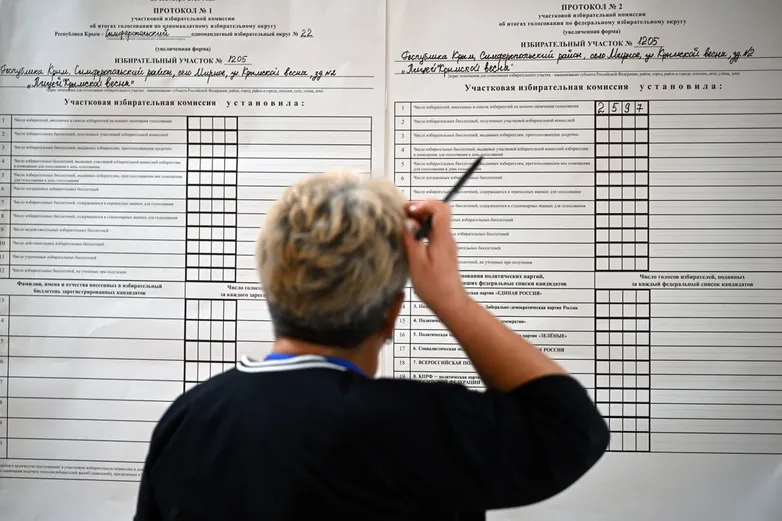
Mikhailov, meanwhile, campaigned on the slogan “For peace,” a rarity among Communist Party candidates. Officially, he lost the State Duma election, but the vote tallies from in-person polling stations where observers were present indicate otherwise. In electronic voting, the United Russia candidate received 2.5 times as many votes as Mikhailov.
An acquaintance of Mikhailov’s said the politician’s arrest could make it harder for the Communist Party’s Komi branch to function and would probably turn it into a typical, largely inactive party branch. “Yeah, he probably could’ve done more. But he could’ve done jack shit, like most politicians,” the acquaintance said of Mikhailov’s work.
The acquaintance still considers Mikhailov one of Komi’s most popular political figures: “His [Telegram] channel is called ‘Voice of the Republic.’ I think that’s how residents see him — as the voice of the people.”
Russia’s State Duma election
At Meduza, we are committed to transparency about our use of artificial intelligence in the newsroom. The story you’re reading was written by one of our living, breathing journalists and translated from Russian using an AI model configured to follow our strict editorial standards. This translation process is the result of extensive testing and refinements to ensure our English-language coverage is timely and accurate. A Meduza editor reviews every draft before publication.
If you find any errors in this translation, please contact us at [email protected].
To read Meduza’s exclusive content in English, please subscribe to our newsletter.
Andrey Pertsev