
stories
Russia’s invasion left thousands of Ukrainian children stranded in Russia. For one 12-year-old girl, the only way out of her occupied village led away from her mother.
Source: Meduza
A military airfield in Chuhuiv, near Kharkiv. February 24, 2022.
Aris Messinis / AFP / Scanpix / LETA
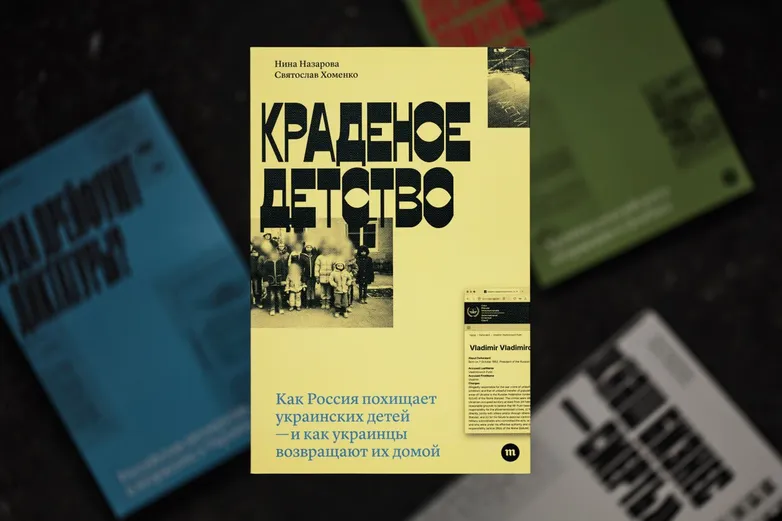
In October, Meduza’s publishing house released ”Stolen Youth: How Russia Kidnaps Ukrainian Children — And How Ukrainians Get Them Back.” Written by Russian journalist Nina Nazarova and Ukrainian journalist Sviatoslav Khomenko, the book was published with support from the StraightForward Foundation. From the start of Russia’s full-scale invasion of Ukraine, the authors tracked how thousands of children were taken deep into Russia from Ukrainian territories devastated by the Russian army. They reached some of the separated families, and the idea for this book grew out of those conversations. It details four ways children were illegally deported. One of the people featured in “Stolen Youth” is Veronika, a girl from the Kharkiv region who left occupied territory with a relative and was unable to return to her mother. We are translating the full chapter “Veronika Takes Shelter in a Cellar,” about how and where the war began for her.
On February 24, 2022, Nina Vlasova woke to a phone call. It was dark outside. The caller was her daughter, 12-year-old Veronika. Before answering, Nina noticed the time: It wasn’t yet 5 a.m. Something had to be wrong.
Nina and Veronika had last seen each other the day before, at home in the village of Pylna, an hour’s drive from Kharkiv, right on the Russian border. Nina was a former soldier: She had spent several years fighting separatists in the Donbas before leaving the military and returning to her home village. She was raising her daughter and had opened a small business in Kharkiv, a couple of shawarma stands. She didn’t need to be there all the time, but she stopped by regularly to make sure everything was running smoothly.
This trip looked to be much like any other. On Wednesday evening, Nina left for Kharkiv, promising her daughter she would be back around lunchtime the next day. Veronika had spent the night alone many times before, but this time she decided to visit relatives. Her aunt Tetiana Melnyk, her mother’s sister and a nurse by training, lived in the neighboring village of Borysivka, a half-hour walk from Pylna. At least she could have more fun there than at home alone: Tetiana and her husband, Serhii, had a biological daughter, Oleksandra, who was Veronika’s age, and two adopted daughters — another Oleksandra, who was 11, and her 9-year-old sister, Diana.
Veronika arrived at her relatives’ house, they ate dinner together, and everyone went to bed. Shortly after 4 a.m., a terrifying crash woke the whole family.
At almost the same moment, Russian television began broadcasting an emergency address by Vladimir Putin. Three days earlier, the president had announced that Russia was recognizing the independence of the “Luhansk People’s Republic” and the “Donetsk People’s Republic.” His speech that day was almost entirely a lengthy account of history as Putin understood it: In effect, he denied Ukraine any right to statehood. While European leaders condemned the violation of international law, memes circulated on social media comparing the Russian president to a talkative taxi driver or a teacher of basic safety and survival skills filling in for a sick history teacher. The hashtag #нетвойнесУкраиной (“No to war with Ukraine”) trended on Twitter. “I feel like a dinosaur watching a meteorite,” one woman said on the platform. But even then, many people thought recognizing the self-proclaimed republics would be the end of it.
Now, in the early hours of February 24, Putin said Russia was launching a “special military operation” to “protect people subjected to genocide by the Kyiv regime” and bring about Ukraine’s “demilitarization and denazification.” (Russian propaganda had spent years claiming, without evidence, that neo-Nazis were in power in Kyiv.) Minutes after the announcement, residents of dozens of Ukrainian cities woke to explosions from Russian missiles, bombs, and shells. One of those explosions woke Veronika Vlasova and her relatives.
“I remember it was 4:21 a.m. We were running to the pit where the water pump was, in my aunt’s yard,” the girl said later. “My uncle was yelling for us to hurry up and get ready, put on jackets, something warm, and then he took us over to the pit one by one.”
She called her mother from the shelter. “Mom, they’re shooting here!” Veronika shouted into the phone. As her daughter spoke, Nina could hear mortar fire in the background, a sound all too familiar from her time in the military.
Cars drive across a field instead of using the roads as they leave Kharkiv after the start of Russia’s invasion. February 24, 2022.
Antonio Bronic / Reuters / Scanpix / LETA
A Ukrainian soldier at a combat position on the outskirts of Kharkiv. February 24, 2022.
Maksim Levin / Reuters / Scanpix / LETA
Kharkiv residents shelter from shelling in the subway. February 24, 2022.
Sergey Kozlov / EPA / Scanpix / LETA
After calming her daughter as best she could, Nina began calling neighbors, acquaintances, and former fellow soldiers to gather as much information as she could about what was happening in the border villages. She soon learned that Russian troops had crossed the border overnight and were advancing rapidly toward Kharkiv in large numbers.
At daybreak, Nina jumped in her car to try to break through to her daughter on her own. By 7:30 a.m., she had reached Saltivka, a huge residential district in northeastern Kharkiv, where a Ukrainian army checkpoint was already in place at the end of the subway line. Under Russian fire, Ukraine’s 92nd Mechanized Brigade was setting up defenses on the outskirts of Kharkiv, the country’s second-largest city. Soldiers at the checkpoint weren’t letting anyone leave the city — it was too dangerous — so Nina turned back rather than argue.
Related reading
* * *
Borysivka is a small village — fewer than 300 people lived there before the start of the full-scale war. It sits right on the border with Russia, where some residents’ vegetable gardens run up against a green mesh fence, the kind used to enclose playgrounds in big cities.
Just beyond the fence runs the Lipchik River — though calling it a river is a stretch, since in summer the stream is narrow enough to jump across. Russia lies on the other side. Until 2014, many locals crossed a dam built over the stream to work or visit friends in the neighboring Russian village of Solntsevka. After the annexation of Crimea and the start of the conflict in the Donbas, authorities dug up the dam and placed a small trailer near what remained of it, where several border guards were stationed around the clock; the green fence went up around the same time. Since then, the only legal way to enter Russia has been the major border crossing at Hoptivka, about 15 kilometers (9 miles) to the east. The nearest permanent post of the Ukrainian border service was also in Hoptivka, though people in camouflage were a common sight in Borysivka, walking along the fence with a service dog or stopping by the store in the village center.
Many residents of border villages in the Kharkiv region saw crossing the border through official channels as an optional formality. Small-scale smuggling had flourished in the area for years — the green fence was never going to stop anyone determined to cross into the neighboring country. Fuel was always noticeably cheaper in Russia, and people carried food out of Ukraine along secret paths; selling walnuts abroad was considered especially profitable. In short, illegal crossings back and forth provided many local residents with extra income.
In early 2022, residents of Borysivka sensed no rising tension. The war reached their village overnight on February 24, 2022, when it came under artillery fire from Russian territory. It’s hard to identify any military logic behind the attack: Borysivka had no strategically important sites and no Ukrainian army units stationed there. It amounted to little more than a chaotic strike on the settlement closest to the border.
The nighttime shelling caught Borysivka’s residents off guard and brought the war’s first casualties. Three border guards were found dead near the trailer by the embankment. Their bodies were covered with blankets and not buried until several days later. A fourth border guard lost a leg and was quickly loaded into a car and driven to Kharkiv. Another passenger in that car — a 15-year-old girl who had suffered a shrapnel wound to the neck while running, like Veronika, to the basement in her own yard — died on the way to the hospital.
The shelling left such a mark on Borysivka’s residents that for a long time afterward, they kept sleeping in basements at night — laying mattresses on the floor and bundling up in warm jackets, hats, boots, and blankets. Even though the village was no longer under fire, staying aboveground at night felt too dangerous. Russian forces had also placed artillery near Borysivka, and the sound of outgoing fire at night kept people awake.
Tetiana didn’t have a cellar of her own, so her family spent nights in the basement of a nearby two-story apartment building — a long hallway lined with doors leading into small individual “rooms.” It was cramped and cold, but calmer than staying aboveground.
* * *
In the war’s first days, Veronika and Nina had little trouble staying in touch. The shelling knocked out Borysivka’s electricity, and mobile service from Ukrainian carriers went down immediately, but a signal from nearby Russian cell towers still reached the village. Roaming wasn’t too expensive, so locals called relatives elsewhere in Ukraine over Russian networks. Nina talked to her daughter by phone almost every day, if only briefly. Nothing special was happening with either of them — it just mattered to hear each other’s voices.
“Mom was very scared at first. She thought Borysivka was already in ruins, something like that,” Veronika recalls. “So at first she told us to leave. When we explained to her what was happening, she said we should wait for her, because she would come to us.”
“The connection was good,” the girl’s mother adds. “I tried to support her emotionally, to tell her that I would come get her no matter what. That everything would be fine, that there was no need to be afraid of the shelling. And that there was no need to be rude or disrespectful to anyone, either.”
In any case, there was no one for the girl to be rude to — tiny Borysivka clearly wasn’t a priority for the Russian army, and for the first several days there were no signs of occupation at all. A truck carrying “humanitarian aid” eventually arrived, distributing grains, vegetable oil, canned goods, soap, and toothpaste, all made in Russia. In the neighboring villages of Lyptsi and Lukiantsi, residents received sausages and cold cuts from a local meat-processing plant in Tsyrkuny. Locals concluded that Russian forces had simply looted the plant, but for obvious reasons, no one protested.
Life in Borysivka grew harder by the day. The village has never had a municipal water supply: Locals typically pumped water from wells with electric pumps. When the power went out, residents ran the pumps off generators — only a handful existed in the whole village — and used them to charge phones as well. Lines formed for water, and fuel for the generators was also scarce.
The mobile connection kept deteriorating — Veronika could hear her mother talking, but Nina heard only silence. Rumors spread that Russian troops had turned on some kind of jamming equipment.
The uncertainty weighed on everyone. Residents of Borysivka pieced together fragmentary information about what was happening from calls with relatives in Ukrainian-controlled territory. This information gap would prove typical of front-line areas generally: In September 2022, an employee of a Western diplomatic mission delivered humanitarian aid to a newly liberated village near the city of Balakliia and was startled to find that many locals believed Russia had occupied all of eastern Ukraine and that Polish troops had entered Lviv, where people were now paying with zlotys instead of hryvnias.
A few days after the shelling, word spread that Russian soldiers had broken into the Vlasovas’ empty house in Pylna, searched it, and looted it. Neighbors had most likely told the occupying forces where former and current Ukrainian service members lived.
Russian soldiers then showed up in Borysivka, driving into the village in an infantry fighting vehicle, checking the documents of people on the street, and taking several young men who had previously served in the Ukrainian army in for questioning. This time, Borysivka’s residents got off with a scare — but no one knew what the next visit from occupying forces might bring.
On top of everything else, Tetiana came down with pneumonia. The former nurse first tried to treat herself, and when the house ran out of suitable medicine, she searched for it in the nearest occupied villages — without success. As her condition worsened, the family began thinking about leaving Borysivka.
* * *
Leaving the occupied territories of the Kharkiv region was difficult in the war’s first weeks. Ukraine tried to evacuate as many people as possible to government-controlled territory, but this often proved impossible — the Russian army was trying to encircle Kharkiv at the time, and reaching the city would have meant crossing the front line.
One Borysivka native was in Kharkiv when the war began and was determined to reach the village no matter what. He walked for several days through fields, forests, and tree lines, avoiding checkpoints and soldiers from either army, and eventually made it home — but he warned fellow villagers against repeating the trip, calling it extremely risky.
Central Kharkiv. March 3, 2022.
Sergey Kozlov / EPA / Scanpix / LETA
The Ukrainian authorities’ attempts to organize humanitarian corridors were unsuccessful. In early March, Ukrainian Deputy Prime Minister Iryna Vereshchuk said Kyiv had asked Moscow to agree to a ceasefire so that civilians in the Kharkiv region could evacuate from occupied areas and combat zones to places farther inside Ukrainian-controlled territory. Russia, for its part, proposed taking Ukrainian residents willing to leave, including those in Kharkiv itself, to Belgorod, a Russian regional capital 30 kilometers (19 miles) from the border, and then sending them to temporary shelters across Russia. Vereshchuk called these proposals unacceptable: Kyiv’s position was that Ukrainian citizens should be given refuge in their own country rather than taken to the aggressor state.
Whatever the arguments, anyone who wanted to leave Borysivka had no choice: They had to leave in their own vehicles and head toward Russia to avoid crossing the front line. On March 2, Tetiana’s family piled into their Lada hatchback, with a trailer hitched to it. Two fellow villagers went with them: Eight people in all squeezed into the small car, with the smaller children sitting on adults’ laps.
Hundreds of thousands of other parents in Ukraine were forced to make similar decisions. Maria Lvova-Belova, President Vladimir Putin’s commissioner for children’s rights, said in an official statement that 730,000 children from Ukraine had entered Russia during the first 14 months of the war.
Normal cell service returned only once Tetiana’s car had crossed the border into Russia. Veronika called her mother and told her she was no longer in Ukraine. By the evening of March 2, the girl was in Belgorod.
From Meduza’s archives
At Meduza, we are committed to transparency about our use of artificial intelligence in the newsroom. The story you’re reading was written by one of our living, breathing journalists and translated from Russian using an AI model configured to follow our strict editorial standards. This translation process is the result of extensive testing and refinements to ensure our English-language coverage is timely and accurate. A Meduza editor reviews every draft before publication.
If you find any errors in this translation, please contact us at [email protected].
To read Meduza’s exclusive content in English, please subscribe to our newsletter.