
stories
The true story behind Moscow’s new big-budget racing movie: How Imperial Russia’s first Monte Carlo Rally team crossed Europe in 1912 without a windshield
Source: Meduza
Andrey Nagel and Vadim Mikhailov in Monaco. 1912
Bibliotheque nationale de France
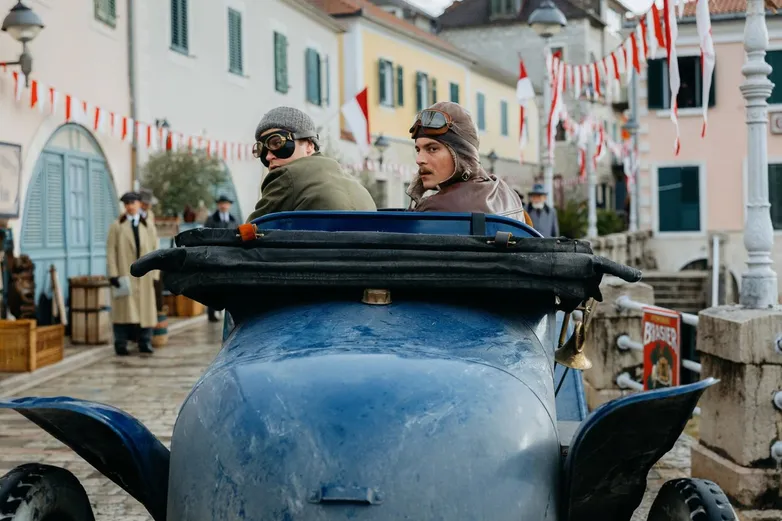
On October 8, Ilya Malanin’s film “Bitva motorov” (“Battle of the Motors”) opened in Russian theaters. Starring Yura Borisov and Ivan Yankovsky, it tells the story of a Russian team that competed in the 1912 Monte Carlo Rally in a Russo-Balt car. The historical adventure drama draws heavily on real events, though its creators emphasize that it takes plenty of artistic liberties. Writing for Meduza, history educator Andrey Aksenov, creator of the podcasts “Zakat imperii” (“Twilight of the Empire”) and “Vremya i dengi” (“Time and Money”), explains how the race actually unfolded.
The film’s protagonist is race car driver and Avtomobil magazine publisher Andrey Nagel (Ivan Yankovsky). He dreams of creating a Russian car, but no one believes in his idea. Officials laugh at him, as does his competitor Gustav List (Yehezkel Lazarov), a supplier of German Benz cars.
Nagel travels to Riga, where he persuades Mikhail Shidlovsky (Alexey Guskov), chairman of the board of the Russian-Baltic Wagon Works, to build a car. During its development, Nagel meets Dmitry Bondarev, a taciturn mechanic. Together, they assemble a team of fellow enthusiasts and try to build the Russo-Balt.
When the project threatens to fall apart, Nagel decides to enter the famous Monte Carlo Rally, a 3,000-kilometer (about 1,860-mile) race, to prove the Russo-Balt’s worth. He and Bondarev set off for Monaco from St. Petersburg, getting stuck in snow and mud along the way but heroically finishing the rally.
Reviewers say the makers of “Battle of the Motors” take liberties with history. The most conspicuous departure is that Nagel’s actual teammate was Avtomobil employee Vadim Mikhailov, rather than Bondarev.
The film’s main villains are foreigners scheming against the Russian project. Emperor Nicholas II (Sergey Volkov) is a charming jokester — and a “deus ex machina”: “Nothing short of a fairy-tale vision of an ideal government in the Russian Empire,” RBC said.
The film “plays it safe” with historical parallels. The race itself takes up the final 30 to 40 minutes; the opening focuses on the drama of building the car.
The filmmakers care far more about the technical details of creating the Russo-Balt than about the characters’ relationships or politics, Kinopoisk said. Several authentic cars were built specifically for the shoot using actual blueprints.
Why was the 1912 Monte Carlo Rally important for Russia’s auto industry?
Today, the Monte Carlo Rally is just one round of the World Rally Championship, but a century ago, the race followed entirely different — and surprising — rules. Its aims were different, too.
In 1912, a Russian team entered the rally in a Russo-Balt. One reason the event became legendary was that it marked the first appearance of a Russian team in the race. Drivers Andrey Nagel and Vadim Mikhailov were in the most technologically advanced and fastest car ever built in the Russian Empire. Their route was the longest: It began in St. Petersburg and ended in Monaco, covering about 3,200 kilometers (1,990 miles).
They traveled in winter in an open car, without detailed road maps. Both the car and its drivers needed painstaking preparation. Their result was a major achievement for Russian motorsport. Here’s how it all worked.
Were cars really a luxury back then?
In early 20th-century Russia, cars were no longer a novelty. They could be seen in every Russian city, from St. Petersburg to Verny, now Almaty. Still, they remained an expensive, prestigious way to get around. A car owner was seen as either someone of high social standing or an enthusiast for technological progress.
The average worker in the Russian Empire earned about 20 rubles a month. A standard Russo-Balt Model C cost about 8,000 rubles — a hefty sum even for the middle class in the capital. Only 350 of these cars were ever made. The cheapest car of the day, the Ford Model T, cost 2,500 rubles, also well beyond many people’s means.
In the major cities, Moscow and St. Petersburg, streetcars were the main form of transportation. Horse-drawn cabs came second, and cars third, though most people preferred to walk. City streets were littered with manure and horseshoe nails, and sometimes even dead horses. The nails seriously hampered the spread of cars by puncturing tires. Some places even introduced special vehicles equipped with electromagnets to pick up nails from the ground every day.
Nizhny Novgorod, 1898
Corbis / VCG / Getty Images
Alongside private cars, taxi fleets were already appearing in cities. At the time the film is set, St. Petersburg had about 300 taxis and Moscow roughly 80. There were trucks, too: Some businesses, such as Blandov’s dairy company, bought them to deliver food, in large part for the marketing benefits. This helped the company build a reputation as modern, technologically advanced, and “forward-looking.”
In 1911, when Nagel and Mikhailov set off for Monaco in their Russo-Balt, Russia manufactured only one make of car: the Russo-Balt itself. The Russian-Baltic Wagon Works in Riga had been assembling the cars since 1909. Production was small-scale: The factory specialized mainly in railroad cars, while automobiles remained a promising sideline. Mikhail Shidlovsky, chairman of the board, oversaw the automobile business; in 1908, he had recruited a chief designer from Switzerland.
A Model C 24/55 before the start of the rally in Monaco. Andrey Nagel and Vadim Mikhailov are in the car. 1912
Wikimedia Commons
In 1912, another manufacturer emerged in St. Petersburg: Ivan Puzyrev. He intended to build a technologically sophisticated car using only Russian components. His cars did have some innovative features, including an aluminum gearbox with a novel design. Before World War I began, however, Puzyrev managed to produce only about 40 cars.
Russia lagged disastrously behind Europe and the United States in both car production and use. In 1913, the newspaper Moskovskiye Vedomosti reported that the United States had 196 factories, Britain 100, and Germany 50. Russia had just two, and the total number of cars ever produced in the country was no more than 600.
Ford’s factory in Michigan sold 70,000 cars in 1911 alone. By 1914, it had sped up its assembly line so much that the famous Ford Model T could be built in an hour and a half. Annual sales reached 300,000 cars. At that point, people in Russia owned no more than 8,000 cars altogether.
Why hold long-distance motoring runs?
Long-distance motoring runs are now a thing of the past, but in the early 20th century, they were very important.
The biggest problem with cars at the time was reliability. Traveling several hundred kilometers without a single breakdown was almost inconceivable. Imagine being stranded in the forests around Pskov with a broken carburetor when the nearest repair shops were in St. Petersburg and Riga. Then there were punctured tires: Changing wheels along the way was routine.
These problems put off potential buyers. Organizers held long-distance runs to demonstrate cars’ reliability and show that the roads were passable. If a car could make it from St. Petersburg to Sicily and back, it could certainly get you to your summer house in Kuokkala or Malakhovka — you could go ahead and buy one.
Cars were also still a rarity in the provinces in the early 20th century. Enthusiasts and car geeks wanted to show that automobiles were fast, convenient, and fashionable, rather than frightening or dangerous.
Motoring runs and races also attracted tourists. That was precisely why, in 1909, Prince Albert I of Monaco came up with the idea of holding an international competition that would finish in Monaco. Monte Carlo was a popular resort among the aristocracy and the bourgeoisie. Motorsport was a fashionable and, just as importantly, expensive hobby that would draw wealthy visitors to his principality, he reasoned.
A poster for the 1911 Monte Carlo Rally
Wikimedia Commons
Winter was also the off-season in Monaco, so a major event would help fill Monte Carlo’s hotels and casinos. And so it did — which was why the Russian team had to travel from St. Petersburg to Monaco in January. They completed the journey in a little over eight days.
The rules of the Monte Carlo Rally
In its early years, the rally had rather surprising rules. You could enter from any city and start right from home. All participants had to finish in Monaco, and teams were expected to arrive at roughly the same time. Yes, this bears no resemblance to racing as we know it.
Andrey Nagel and Vadim Mikhailov started in St. Petersburg and had the longest route. Their main rivals, the Germans Karl von Esmarch in a Dürkopp and Julius Beutler in a Berliet, set off from Berlin several days later. The team from Turin had the shortest journey.
Each team’s starting time was calculated separately: The judges assumed an average speed of 10 kilometers per hour (about 6 mph), meaning teams would need to cover 240 kilometers (about 150 miles) a day. Remember that many roads were unpaved then, and in Russia, they were covered in snow to boot.
Rally participants before the start in Paris
Bibliotheque nationale de France
But arriving first wasn’t enough to win. The winner was determined by total points. Teams earned points for the distance traveled — a category Nagel and Mikhailov automatically won — as well as for speed, additional passengers, and the car’s condition at the finish.
- To earn the maximum points for speed, teams had to average more than 25 kilometers per hour (about 16 mph). That may not sound very fast, but it was the average for the entire journey, including stops. Nagel and Mikhailov drove for roughly 14 to 18 hours a day: They had to eat, sleep, and pull the Russo-Balt out of snowdrifts.
- Each person in the car other than the driver earned two extra points. Some rally entrants didn’t drive themselves: They rode in the passenger seat while hired chauffeurs took the wheel.
- The car’s appearance and elegance at the finish were also judged. Remember, these cars were intended for very wealthy people, and the rally was essentially an advertising campaign.
Repairs to the engine and chassis components were forbidden along the way. Those parts were therefore sealed at the start, and officials inspected each team at designated checkpoints, where they also recorded its time.
The Russian crew: Who were Andrey Nagel and Vadim Mikhailov — and Bondarev, who appears in the film?
Nagel
Andrey Platonovich Nagel was born in 1877 and was 34 at the time of the race. A car geek who promoted motoring to the public, he entered his first race while still at university. After graduating, he founded Russia’s first publication devoted entirely to cars, a magazine simply called Avtomobil.
Before that, you could read about cars in sports magazines, but more often in the tabloids, which gleefully recounted every collision with a carriage and every pedestrian run over. City dwellers saw cars as luxurious but frightening status symbols. Owners were viewed with suspicion: A rich man had connections and could cover up any incident, while an enthusiast was crazy — and it wasn’t clear which of the two was more dangerous. It’s no coincidence that in “Zolotoy telenok” (“The Golden Calf”), Adam Kozlevich complained that the only people who rode in his taxi were embezzlers who drank vodka and swam naked in the moonlight.
The wealthy usually hired chauffeurs because driving was difficult then. It involved more than shifting gears and turning the wheel: A chauffeur had to understand how the car was built and be able to fix everything from the gearbox to the acetylene lamps. Andrey Nagel drove himself.
In 1907, Nagel and Avtomobil held Russia’s first auto show. The magazine proudly reported:
For the first time in our country, the mainstream press and people outside motoring circles took an interest in the machines of the future. Throughout May, newspaper columns were filled with articles about automobiles, most of them favorable — something that had never happened before. Before the exhibition, newspapers discussed automobiles only to accuse chauffeurs of running over ordinary citizens; they covered nothing else.
Ivan Petrovich Puzyrev, who would later establish Russia’s second carmaking operation, also attended the exhibition. He was so impressed that he decided to go into the automobile business: At the show, he signed a contract with a German parts supplier and became its distributor in Russia. In the early 20th century, Russia was a promising market for European companies, so they were happy to take part in Nagel’s auto show.
Moscow, 1908
Branger / Roger Viollet / Getty Images
Afterward, Andrey Nagel began taking part regularly in long-distance motoring runs. He drove to Paris and back, organized a race from St. Petersburg to Riga, and won a gold medal in the imperial race from the capital to Kyiv and back. In 1910, he traveled from Russia to Italy with the famous photographer Karl Bulla, climbed Mount Vesuvius, and returned through Germany. Vadim Mikhailov accompanied him on this trip, too.
Nagel drove to Italy in a brand-new Russo-Balt Model C 24/30. The following year, the Riga factory would create a special racing version of its car, and Nagel would propose a partnership to enter the Monte Carlo Rally. His excellent relationship with the factory’s chairman, Mikhail Shidlovsky, also helped.
Mikhailov
We know almost nothing about Vadim Mikhailov, Andrey Nagel’s teammate in the race. His participation is, in fact, the most notable detail of his life.
He worked at Avtomobil and was one of the very first car owners in St. Petersburg — and that’s about all. Apparently, this is why engineer Dmitry Bondarev took his place in “Battle of the Motors.” Bondarev, by contrast, was every bit as legendary as Andrey Nagel.
Bondarev
Dmitry Bondarev was the same age as Nagel and headed the automobile department at the Russian-Baltic Wagon Works. In 1911, Nagel invited Bondarev to join him in the Monte Carlo Rally, but the engineer declined. Bondarev organized Russo-Balt production, helped design the largest aircraft of World War I, the Ilya Muromets, and, just before the revolution, became director of the AMO automobile factory then under construction in Moscow. In Soviet times, it became known as ZiL.
Bondarev lived in the Soviet Union. In 1937, he was accused of belonging to a counterrevolutionary Right-Trotskyist terrorist organization and then shot. Nagel emigrated after the revolution and died in 1956.
What did Nagel and Mikhailov drive? A closer look at the cars
Nagel and Mikhailov made their journey in a heavily modified Russo-Balt Model C 24/30 convertible.
What does 24/30 mean, anyway? It was a common designation that everyone understood at the time. The 24 stood for the engine’s rated horsepower, and the 30 for its maximum horsepower. Those were good figures for the period. Racing, however, required improvements.
Andrey Nagel and Vadim Mikhailov in Monaco. 1912
Bibliotheque nationale de France
The car was upgraded in several stages.
First, to boost power, engineers increased the engine’s displacement from 4.5 to 5 liters, lightened the body, and installed another fuel tank. The racing Russo-Balt’s engine could now produce up to 50 horsepower. In tests in May 1911, the car reached 91.5 kilometers per hour (about 57 mph); a standard Russo-Balt could manage 75 to 80 kilometers per hour (about 47 to 50 mph).
Several more changes followed. For example, the pistons were replaced with aluminum ones, a rarity even in Europe. This further increased the engine’s output to 55 horsepower. A French carburetor was then installed. In this configuration, the Russo-Balt could reach 113 kilometers per hour (about 70 mph). To help it get through snowdrifts, the designers made it possible to fit two additional wheels to the rear axle — the rally rules didn’t prohibit this. Electric headlights replaced the acetylene ones, and special skis were packed in the trunk. These could be attached to the wheels and, in theory, help the car get out of the snow.
Now they could set off for Monaco. There was one final change: The Russian inscription “Russko-Baltiysky” on the radiator was replaced with the French “Russo-Baltique.”
Only two Russo-Balts have survived the past century. One is in Moscow’s Polytechnic Museum; the other is on display at the Riga Motor Museum.
Soviet and Russian motorsport historian Lev Shugurov spent several decades gathering information about the Russian-Baltic Wagon Works and the Russo-Balt car. In his book “Pogonya za Russo-Baltom” (“In Pursuit of the Russo-Balt”), he recalled how what appeared to be Nagel and Mikhailov’s actual racing car once turned up at Monaco’s automobile club. It later proved to be only a replica.
Still, Shugurov managed to trace the original car’s history. After the race, in the spring of 1912, engineers continued improving it — it was, after all, a test vehicle. They replaced its body with a streamlined one and removed the fenders, earning the car the nickname “Russian Cucumber.”
The “Cucumber” could now reach 116 kilometers per hour (about 72 mph). At the end of 1912, it received newly designed aluminum pistons and a modified exhaust system, bringing its output to 58 horsepower. To reduce drag, a pan was fitted beneath the engine and a wedge-shaped “air splitter” in front of the radiator.
On May 28, 1913, the newly upgraded Russo-Balt entered a short race and set a Russian national speed record of 129.744 kilometers per hour (about 81 mph). The record stood for 25 years, until 1938.
In the winter of 1913–1914, the car was upgraded again. The cylinders were enlarged once more, and the body was redesigned with a long, narrow tail. World War I began soon afterward.
According to some accounts, Nagel and Mikhailov’s car was handed over to the military authorities. Its trail went cold: It disappeared during either World War I, the revolution, or the Civil War.
The tires were a particular source of pride
While Russian-made cars couldn’t compete with Western ones, Russian tires enjoyed phenomenal popularity. The company’s advertising materials said:
Russian engineers were the first to propose that a herringbone pattern with alternating tread directions would keep a car from skidding. This was borne out in practice in Russia’s vast steppes, on the level roads of England and continental Europe, and in the mountains of Switzerland and Spain.
At the time of the 1912 rally, the Riga company Provodnik was the world’s second-largest tire manufacturer, behind only Michelin. Yet just 10 years earlier, the rubber-goods factory had been in deep trouble, shaken by constant strikes. In 1900, its management decided to invest in a new product: automobile tires. The industry was growing, and it looked promising.
Provodnik began making tires without additives, using only pure rubber and sulfur. They proved exceptionally durable. And because rubber made from natural latex is easy to color, the factory could produce tires in any color. London’s red double-decker buses, for example, ran on stylish red Provodnik tires to match.
The racing Russo-Balt also used tires from the Riga factory, sold under the Kolumb brand. The name Provodnik was clearly visible on the spare-wheel cover on the car’s right side.
After finishing in Monte Carlo, Andrey Nagel proudly wrote back to Russia: “The engine is running just as it did when we set off. The tires still have St. Petersburg air in them. A tremendous success.” The remark about St. Petersburg air means they hadn’t had a single puncture during the journey. An incredible achievement for the time.
Read more
How did the race unfold?
Andrey Nagel published a detailed account of the race in his magazine, Avtomobil. Lev Shugurov’s research also allows us to reconstruct it.
Nagel and Mikhailov set off on December 31, when the temperature in St. Petersburg was minus 16 degrees Celsius (about 3 degrees Fahrenheit). They wore fur coats, felt boots, hats, and goggles. Their convertible had no windshield — it would only have gotten in the way, since cars then had neither windshield wipers nor heaters.
Until they reached somewhat warmer territory, it was critical for them to be able to get to a heated garage. There were only two along their route: one in St. Petersburg and one in Riga. Nagel and Mikhailov therefore planned to reach Riga within the first 24 hours. But the snowdrifts made fast driving impossible: Their average speed was no more than 13 kilometers per hour (about 8 mph). The skis attached to the wheels proved utterly useless and were removed. Their driving goggles kept fogging up, so the crew took those off, too.
The Russian crew on the way to Monaco
Bibliotheque nationale de France
A truck traveled alongside the Russo-Balt, clearing the road from Riga to the German border. The Russian-Baltic Wagon Works had supplied it, too, and again, the rules didn’t prohibit this. With that help, Nagel and Mikhailov reached the German border without too much trouble. Nagel wrote that along the way, Vadim Alexandrovich even “knocked back about three shots of cognac and warmed up completely.”
Germany was warmer, but not by much. Nagel and Mikhailov stayed overnight in hotels but woke up every hour and a half to warm the engine.
Still, the cold wasn’t their biggest problem. Mikhailov couldn’t drive: A few days before the start, he had either broken or badly bruised his arm while trying to start the engine. Nagel suggested that he stay in St. Petersburg, but Mikhailov flatly refused, saying he would help steer with one hand. That’s what they did, but Andrey Nagel did most of the work.
Navigation was another problem. Driving through Russia was relatively straightforward: There weren’t many roads, so it was generally clear which way to go. Germany’s road network was much more extensive, however, and road signs were extremely rare. The crew asked locals for directions, which sometimes led them into dead ends. Mikhailov wrote that once, as they sped past a mason who had previously sent them the wrong way, they “offered heartfelt thanks in the kind of language a Russian uses when he’s angry.”
On the fifth day, Nagel and Mikhailov passed through Berlin and stopped for the night in Heidelberg. Their main competitors didn’t leave Berlin until the following morning.
To pick up speed, the drivers decided to lighten the car by getting rid of the tire chains. That was a mistake. In the Alps, the Russo-Balt couldn’t climb one of the slopes: Without chains, it kept sliding back down. They had to search the area for replacements. A local winemaker had some, but they still had to haggle with him. Soon after crossing the mountains, the crew ran out of gasoline and had to transfer some from the reserve tank.
The rest of the journey through southern France was easy. A day later, Nagel and Mikhailov crossed the finish line.
I breathed a sigh of relief when I saw Monaco, the flags, the arches, the signs. […] I shot like a bullet into the square where the finish was supposed to be, and only the applause and congratulations told me that I was first. It later turned out that Beutler arrived six hours afterward.
But, as you’ll remember, arriving first didn’t mean winning. The main prize was awarded on total points. In the “elegance” category, the Russo-Balt, which had traveled 3,200 kilometers (about 1,990 miles), fared poorly. The team also failed to earn points for average speed: Theirs was just 16.7 kilometers per hour (about 10 mph), slower than their competitors’.
The German Julius Beutler took first place in a Berliet, with an excellent average speed of 29 kilometers per hour (about 18 mph). The Russian crew placed only ninth out of 58, receiving prizes for the longest route and endurance.
After a leisurely drive through southern France and Italy in the Russo-Balt, the drivers decided to return to Russia by train. The car also traveled back by rail, in a wooden crate. Nagel wrote in Avtomobil:
In this extraordinarily difficult competition, it was only thanks to the flawless performance of the car and tires that I managed to arrive first in Monaco… Maintaining the car involved nothing more than adding gasoline and oil, and just once — in Lyon — topping up the water (2–3 glasses). The tires required no attention whatsoever: All four set off with St. Petersburg air in them, and with that same air they are now traveling back by rail with the car. The engine did not falter once during the entire journey. At both minus 19 degrees Réaumur on heavy gasoline and plus 15 degrees Réaumur on good, light gasoline, it delivered the same power, started with a quarter-turn, and ran equally smoothly at low speed and full speed… Honor and glory to the Russian-Baltic Wagon Works and to the Provodnik company’s Kolumb tires.
At Meduza, we are committed to transparency about our use of artificial intelligence in the newsroom. The story you’re reading was written by one of our living, breathing journalists and translated from Russian using an AI model configured to follow our strict editorial standards. This translation process is the result of extensive testing and refinements to ensure our English-language coverage is timely and accurate. A Meduza editor reviews every draft before publication.
If you find any errors in this translation, please contact us at [email protected].
To read Meduza’s exclusive content in English, please subscribe to our newsletter.
Story by Andrei Aksyonov, edited by Sofya Vorobyova