stories
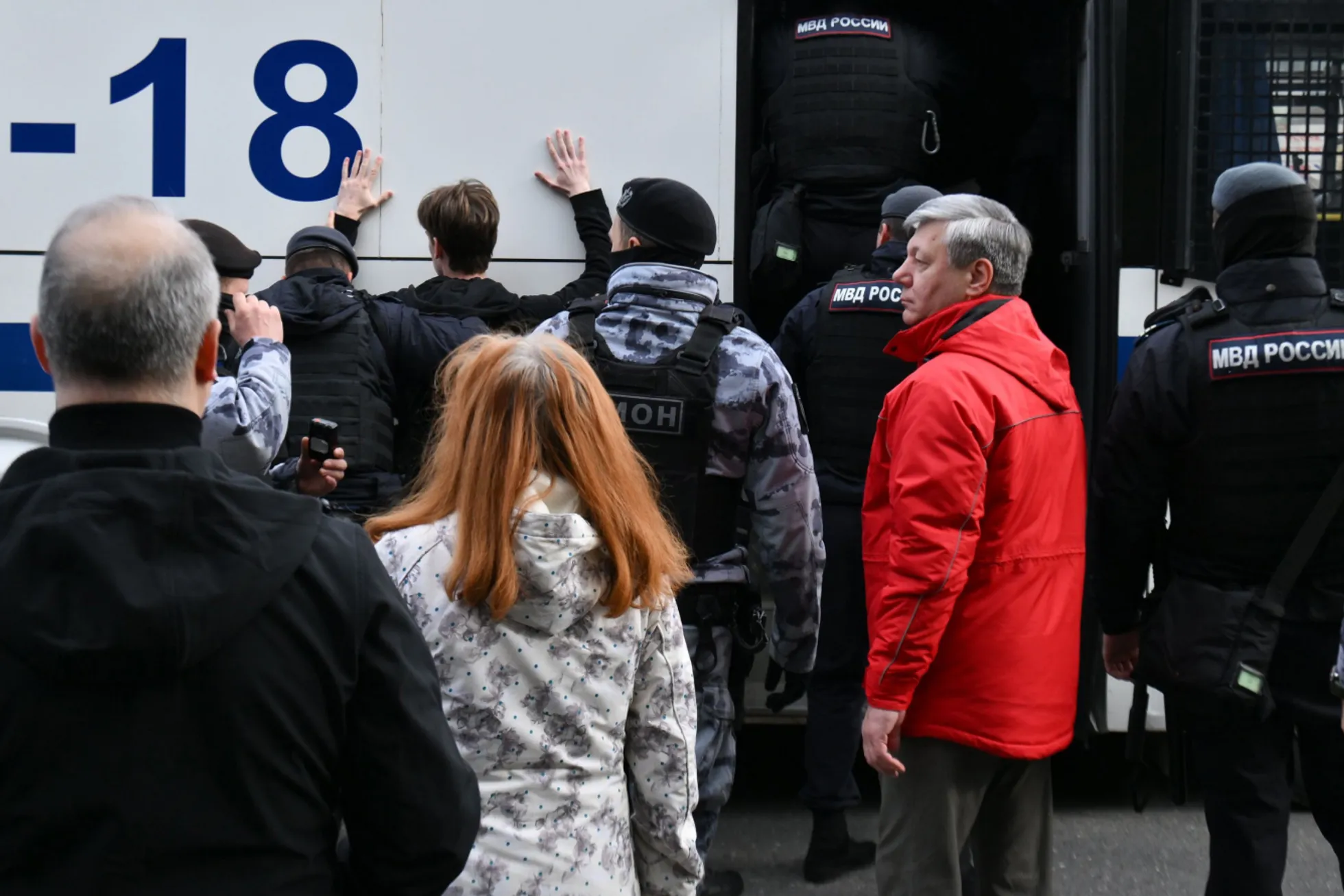
Young anti-war protesters turn a sanctioned Communist Party rally in Moscow into a protest of their own. Police detain more than 60 people.
Source: Meduza
KPRF
On October 4, the Communist Party of the Russian Federation (KPRF) held an authorized rally in central Moscow to mark the anniversary of the shelling of the White House. Besides the Communists themselves, young people unaffiliated with the KPRF unexpectedly turned out, including members of left-wing political groups and Yabloko supporters. Organizers said 65 people were detained at the demonstration, where the young participants chanted sharply critical political slogans. Meduza spoke with Anna (not her real name), a law student at a Moscow university who marched in the youth contingent.
Warning: This article contains profanity. If that’s unacceptable to you, please don’t read it.
— Why did you go to a KPRF rally?
— It’s one of the few authorized rallies these days. As far as I know, the KPRF leadership had a verbal agreement with City Hall to allow a separate group of smaller [left-wing] parties, including the RRP. Yabloko supporters joined us.
The main group was up ahead — maybe they were just walking faster. They had their KPRF banners, and some people carried Soviet flags. We weren’t allowed to carry anything at all: The Communist Party leadership asked us to put away every symbol except those of the KPRF and the USSR.
There was a plant in our group who would walk up to protesters, point someone out, and that person would get detained. Our group had the most people detained. Three police vans followed us.
At first, they weren’t supposed to have a problem with us as long as we didn’t chant slogans [that the KPRF hadn’t approved]. But it didn’t work out that way. We chanted them. So our group got the most attention [from the police].
— Was there some sort of verbal agreement with the KPRF leadership about a separate group for the smaller parties?
— Yes. The KPRF had an agreement with City Hall, and the smaller parties had one with the KPRF.
— And under that agreement, you weren’t supposed to chant slogans?
— The approved slogan was “No to political persecution!” All the slogans allowed at the rally are listed on the KPRF website. But we were chanting about repression.
That was all just a formality, though. They were grabbing people who hadn’t chanted anything — people who were just going to lay flowers [at the Memorial Cross]. They detained someone holding up a copy of Pravda. They were pulling people straight out of the crowd.
More about the elections
— Can you tell us which political party or movement you belong to?
— I’d rather not. The party isn’t registered yet.
— Roughly how old were the people at the rally?
— There were lots of young people in our group. Overall, the rally had young people and old people.
My friends and I got to Ulitsa 1905 Goda metro station by 11 a.m. We were meeting people so we could walk together to the monument. The official part of the rally began there at 11:30, and people stood holding portraits of those who were killed [defending the White House]. People our age and younger came up to us. Mostly college students, though.
— How did the older KPRF supporters react to your group? Were they surprised to see so many young people?
— Yes, they were surprised. One really reactionary guy heard the slogans “Free Morozov” and “Support Bondarenko” and started shouting that “Russia supports Putin.” Another woman did her absolute best to drown out our chants with official KPRF slogans as we marched.
— Tell us how the rally went.
— Zyuganov gave a speech at the monument, followed by Kharitonov. We listened to pompous speeches about how great Russia is and how Ukrainians are “neo-Nazis.” Then Zyuganov said a few words about the elections — that they were rigged because everyone he knows personally voted for the KPRF. Funny.
I agree that the election results don’t reflect the actual vote, but Zyuganov’s speech was the same as always… It’s “Ziganov” [a play on Zyuganov’s name and the Nazi salute “Sieg Heil”] — you know what I mean.
At 1 p.m., the part with the speeches and portraits [of the White House defenders] ended, and we headed toward the [Memorial Cross], where people laid flowers. Unfortunately, not everyone made it there.
Related reading

— Where did most of the detentions happen?
— They started detaining people on Krasnaya Presnya Street, about half an hour into the march. By then, the main KPRF group had moved ahead — they were standing at the memorial, and nobody was bothering them. For the most part, they left the older people alone.
— How do you feel about the KPRF in general?
— The KPRF is somewhere between being part of the system and being in opposition. The authorities generally have less of a problem with it [than with opposition parties outside the system]. At the same time, Zyuganov is willing to say that the elections were rigged and that blocking the internet is bad.
Obviously, none of these parties except Yabloko is against the war, and on that point, the KPRF can’t offer what young people want. But if you join the KPRF or find yourself among its supporters, you don’t risk getting fired from your job or kicked out of your university or college.
That’s much less likely with the KPRF than it is for Yabloko supporters or people who took part in rallies supporting Navalny — all of that was much more dangerous than turning out on October 4. This rally was officially approved, and at first the police weren’t dispersing anyone. They just watched.
So even though the old guys in the KPRF are shady characters who should’ve retired long ago, it’s still one way to protest. Obviously, just showing up at this rally doesn’t solve anything, but it is what it is.
— Why did you go anyway?
— To show that we exist. There were lots of young people at the rally. I heard chants of “Down with Roskomnadzor [Russia’s internet regulator],” “No to war,” “Down with the gray moth [Putin],” and “Down with the tsar.”
At the memorial, after they started dispersing everyone, people began shouting, “Fuck United Russia.” Basically, people used an approved rally to chant unapproved slogans.
I know lots of people who campaigned for the KPRF, served as the party’s election observers in the parliamentary elections, and go to rallies like this.
— It seems paradoxical to me that someone would go to KPRF rallies while fundamentally disagreeing with the party’s position on the war.
— I think people just want some action. There’s nothing going on, but you want to get involved. You want to get at least something done while you still can.
— Do you know anything about how the KPRF leadership reacted to what your group was doing?
— No. I was busy helping the people who’d been detained.
— When did they start detaining people, and why? There were reports that most of the detentions began after protesters started chanting “Down with the tsar.” Is that true?
— No. They were already detaining people at Ulitsa 1905 Goda metro station. They grabbed someone with a North Korean flag there, and someone else with a white-blue-white flag.
Then, during the march, they took away the person with the copy of Pravda. As we approached Kropotkinskaya, they grabbed someone with anarchist symbols. They were picking people out of the crowd, whoever caught their eye. Then they started detaining people en masse on Druzhinnikovskaya Street — they filled all three police vans right there.
Detentions at the KPRF rally in Moscow, October 4, 2026
Meduza News
— What set it off?
— Hard to say. It looked more like they were trying to stop something before it started. Because the slogans weren’t all that bloodthirsty yet. We hadn’t started chanting “Down with the tsar.” That was when several people I know got detained. Someone shouted, “Let’s get out of here, they’re taking people away over there,” and I ran with the others toward Krasnaya Presnya Park. There were just over 20 of us.
After that, I went back to the rally — to the people I knew. We tried to find out what was happening to the people who’d been detained and whether they’d be released. But it turned out they didn’t release everyone.
— You said there were more young people at the rally. Does that include the main group?
— I didn’t see it up close. But the youth group was several times bigger than the official one.
— What were people talking about in your group?
— Something happened that says a lot. A girl came up to me at the rally and asked, “How do you feel about Zyuganov?” I told her, “Fuck that Zyuganov guy,” and she shook my hand. Then a bunch of Yabloko supporters came up to me and said, “Listen, do you know if there’s some way we can join your group? So we don’t get detained right away.” And we agreed to let them join us.
— Yabloko itself said its members didn’t take part in the rally.
— There were lots of new Yabloko supporters who hadn’t even joined the party yet. These are really fired-up young people who want regime change and an end to all of this [the war].
— How did the police behave when they were detaining people?
— They didn’t hit anyone. They just intimidated people — surrounded them so they knew that was it, there was no getting out. Then they’d take hold of one shoulder, almost like putting an arm around you, then the other, and press down on your shoulders so you couldn’t break free.
Outside the courthouse, there were some unpleasant characters [officers from the Tagansky police precinct who had arrived in the police vans] who wouldn’t let a lawyer near the van. They wouldn’t even let the lawyer get within two meters [about six feet]. They kept people in the van for four hours, until 6 p.m. As I understand it, they did that deliberately to keep members of the public out of the courtroom [while the judge imposed jail terms for administrative offenses]: The court officially closes after six.
But the ruling in the case of Vladimir Bodyashkin, who’d been detained, came at 1 a.m.
— What do we know about the people who were detained?
— Altogether, more than 60 people were detained. Their cases were heard in three courts. One of the lawyers who went to Krasnoselsky Court told me that many got off with fines. One guy was jailed for 14 days.
At Tagansky Court, two people got fines — their lawyers argued that they hadn’t taken part in the rally at all and were on their way to the zoo. They were released at 11 p.m. Those proven to have taken part in the rally got jail terms of 10 and 15 days.
The judge there was Alexandra Anokhina. As [human rights advocates] told us, she’s one of the main judges handling political cases and cases involving “foreign agents.” So if anyone walks out of her courtroom with just a fine, that’s a godsend.
KPRF
— Were protesters able to organize help for those who were detained?
— During the rally, people went up [to the police] and asked whether they’d be releasing anyone. Older KPRF supporters also came over and tried to help somehow. One even shoved a police officer so people could get away — and about five did.
After the detentions, friends and family of those who’d been detained went to the police stations.
— Did the KPRF provide legal help to the people who were detained?
— They say it did. But nobody from the party showed up at Tagansky District Court, either on the day of the rally or the next day.
Otherwise, people organized themselves and went to the police stations. Fewer made it to the courts. There were 15 people outside Tagansky Court: friends, fellow activists, parents of those who’d been detained, and a couple of Yabloko supporters who just came to show support.
— You mentioned the rallies in support of Navalny.
— I didn’t take part back then because I didn’t know anyone who shared my political views. I lived in a small town, and my parents asked me to be careful.
— How did you get interested in politics? What set that off?
— A couple of years ago, in high school, I met like-minded people who were interested in politics. Before that, I was pretty apolitical and really worried about my own freedom — being able to walk down the street. Though somewhere deep down, I was unhappy with what was going on.
My friend was among the first sent to fight in the “special military operation” [Russia’s term for the war in Ukraine]. Before it began, he was serving as a contract soldier in the border areas. I lost touch with him then, and when the official announcements started, I put it all together and got really scared for him.
I spent a year worrying like that, until they finally sent him home for treatment. The war was a turning point for me.
— You said you used to be afraid of losing your personal freedom. What about now?
— Much less now. Emotionally, it would be easier for me to end up in the same police van as the others.
— Do you think there’s a way to express opposition to the authorities peacefully in Russia?
— It seems like you can, but you’ll be punished for all of it. They’ll keep track of everything, and at some point that’ll lead to proceedings for administrative offenses — and possibly criminal ones. But going to rallies isn’t the only thing you can do. You can join Yabloko, go to evenings where people write letters to political prisoners.
You can do activism that’s less political, like something to do with the city’s infrastructure. There’s a lot you can do — if you’re prepared to do time for your ideals and sacrifice your personal freedom.
— Are you prepared to do that?
— Up to a point. If we’re talking about an administrative offense, then yes. Anything more than that, I’m afraid I’m not ready. I’m studying law, and I’d like to be able to practice law.
— How dangerous do you think it is to be in opposition now?
— It’s dangerous. But if you do nothing, things will get worse. When you think things can’t get any worse, they do.
— Are young people in Russia politically engaged today?
— Young people are apolitical, but they want to live without websites and apps being blocked. They want more comfortable lives, more personal freedom, and fewer sanctions — that’s about as political as they get.
Though, judging by conversations with my fellow students, people are getting more political. But it’s hard for me to judge, because about 10 years ago I was in school playing “My Little Pony,” sorry.
At Meduza, we are committed to transparency about our use of artificial intelligence in the newsroom. The story you’re reading was written by one of our living, breathing journalists and translated from Russian using an AI model configured to follow our strict editorial standards. This translation process is the result of extensive testing and refinements to ensure our English-language coverage is timely and accurate. A Meduza editor reviews every draft before publication.
If you find any errors in this translation, please contact us at [email protected].
To read Meduza’s exclusive content in English, please subscribe to our newsletter.
Interview by Yelizaveta Antonova