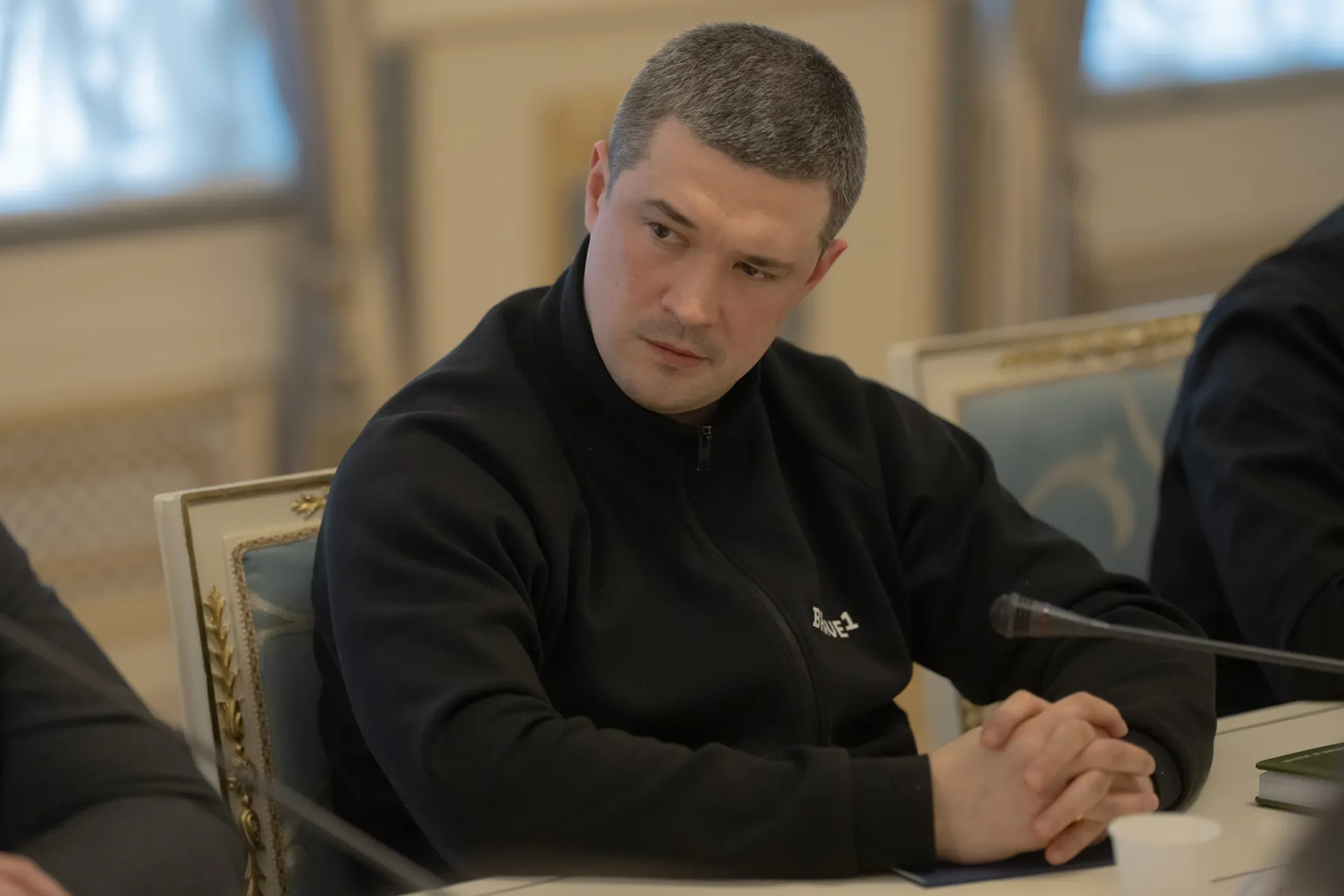
‘Why do ministers get rotated more than soldiers?’ Kyiv protesters ask, after Zelensky pushes out the defense minister they didn’t want to lose
Volodymyr Zelensky has dismissed the cabinet led by Yulia Svyrydenko — after just one year in office. But Ukrainians are more concerned about the fate not of the prime minister but of the defense minister, Mykhailo Fedorov. His dismissal has already triggered street protests, the resignation of military commanders, and bewilderment among Ukraine’s Western allies. The Verkhovna Rada has already confirmed a new cabinet lineup: it no longer includes any prominent political figures; the emphasis is instead on loyal managers. The defense portfolio will go to a former head of the Security Service of Ukraine (SBU). At Meduza’s request, Ukrainian journalist Kostiantyn Skorkin explains the latest chapter of the government crisis in Kyiv.
Yulia Svyrydenko had to govern amid a corruption crisis that damaged the government’s reputation
Before she was appointed prime minister, Yulia Svyrydenko was first deputy prime minister and deputy head of the presidential office. When she took over the government in July 2025, the Ukrainian press immediately described her as a protégée of Andriy Yermak, the head of the presidential office.
During her year as prime minister, Svyrydenko acted first and foremost as a crisis manager: during that time, a criminal corruption case was unfolding in the highest echelons of power in Ukraine.
No major reforms took place under Svyrydenko. She did, however, make progress on Ukraine’s European integration: this summer, Brussels opened two of the six negotiating blocs — also known as clusters — to Kyiv for EU accession. Svyrydenko had planned to open all the “clusters” by mid-July, but did not manage it in time.
On July 13, Zelensky told Svyrydenko he had decided to dismiss her and replace the cabinet. According to sources cited by the Ukrainian news agency Interfax-Ukraine, the president offered the prime minister the post of Ukraine’s ambassador to the United States, which Olha Stefanishyna had just decided to leave — reportedly for personal reasons. This was logical: Svyrydenko is well regarded in Washington, and it was she who played the key role in the difficult spring 2025 negotiations over a minerals deal with the Trump administration.
Ukrainska Pravda and Suspilne, Ukraine’s public broadcaster, citing their own sources, report that Svyrydenko turned Zelensky’s offer down — and, according to Ukrainska Pravda’s source, did so with a message along the lines of “go to hell.” The former head of the government has not yet made any statement about her plans.
The day after Zelensky and Svyrydenko met, the Verkhovna Rada — with the votes of Servant of the People lawmakers — approved the prime minister’s resignation, along with that of the entire cabinet. The decision drew sharp criticism of the president from Ukrainian political analysts and journalists, who said he had seriously overstepped his authority. Under the Constitution, only parliament can decide to dismiss the government.
Defense Minister Mykhailo Fedorov clashed with Oleksandr Syrsky, the commander in chief of the Armed Forces — and was gaining popularity among Ukrainians
Another of Zelensky’s decisions — replacing Defense Minister Mykhailo Fedorov — drew even sharper criticism, though the president was fully within his rights to dismiss him.
Fedorov is a 35-year-old reformer who, before his appointment to the Defense Ministry, oversaw the digitization of government and administrative services as a member of the cabinet. He was appointed to the Defense Ministry in January 2026 — precisely to modernize it. In a short time, the young defense minister managed to accomplish a good deal:
- Ukraine reached a deal with Elon Musk’s company SpaceX to block Starlink satellite terminals not on Ukraine’s “white list.” As a result, the Russian army lost the ability to use those terminals;
- Ukraine’s drone forces were strengthened, which allowed the Armed Forces to strike Russian oil refineries and touch off a fuel crisis;
- work began on a military reform that provided for expanding contract recruitment, clear rotation schedules for troops on the front line, and increased combat pay for service members.
What Fedorov could not do was find common ground with the generals of the General Staff and with Oleksandr Syrsky, the commander in chief of the Armed Forces, who was appointed to the post in February 2024. Immediately after his dismissal, Fedorov said at a press conference that “in the army no one is accountable for anything, commanders are constantly being replaced, those who are disloyal are isolated, and major projects are blocked.”
The former defense minister says he proposed that the president dismiss Syrsky and Andriy Hnatov, the chief of the General Staff. When Zelensky refused, Fedorov, by his own account, promised that he would “learn to work with him”:
But Syrsky is not ready to talk about problems. He schemes. He issued an ultimatum: it’s him or me. Instead of figuring out how to defeat Russia, he figured out how to split the country. Syrsky saved our country in 2022, but the war has changed completely, and we must change.
Zelensky cited the conflict between Fedorov and Syrsky as grounds for his decision to dismiss the defense minister:
I cannot allow the Defense Ministry and the General Staff to be at war with each other in a country that is at war. Ideally, both [Fedorov and Syrsky] should be replaced. But I cannot do that simultaneously.
As early as the start of the summer, though, it emerged that Zelensky was dissatisfied with Fedorov for another reason: inside the presidential office, the defense minister was suspected of growing political ambitions. In June 2025, polling showed that public trust in Fedorov had reached 50%. By comparison, the same poll put Zelensky at 61% and Syrsky, the commander in chief, at 52%.
Mobilization was another point of tension between the president and the defense minister. In early July, during the detention of a draft evader in Lviv, residents attacked recruitment center staff: according to the Prosecutor General’s Office, about 200 people took part in the unrest, and the crowd smashed and overturned a recruitment center vehicle.
A week later, Zelensky blamed the Defense Ministry for the problems with mobilization. Fedorov, for his part, believes the whole issue lies in the “absence of a new social contract and recruits’ fear of incompetent commanders.” He names Syrsky, the commander in chief, as responsible for the failure of mobilization.
In addition, shortly before the high-profile incident in Lviv, the outlet Babel published an investigation into the inhumane treatment of soldiers by the command of one of the Armed Forces’ assault units — treatment that led to the deaths of 26 enlisted men. Syrsky, the commander in chief, who is considered the “father” of Ukraine’s assault forces, was forced to defend himself publicly.
According to Fedorov, Syrsky was convinced that the defense minister had commissioned the investigation. (Fedorov denied this, and Syrsky did not comment on Fedorov’s remarks.) A few days after the text was published, searches were conducted at the home of Babel co-founder Oleksiy Babenko.
Fedorov commented on his dismissal in measured terms. He said it had been “a great honor to serve the Ukrainian people,” and thanked his team. Fedorov’s close associates left the ministry along with him — Pavlo Yelizarov, the deputy commander of Ukraine’s Air Force, and ministerial advisers Serhiy Beskrestnov and Serhiy Sternenko.
Residents of Kyiv, Odesa, Ivano-Frankivsk, Dnipro, and other major cities across the country came out to protest the dismissal of the minister, who was popular among Ukrainians.
New Prime Minister Serhiy Koretsky must prepare the country for “the hardest winter in Ukraine’s history.” He may, however, be implicated in that same corruption scandal
After Yulia Svyrydenko’s dismissal, a government source cited by Ukrainska Pravda and the lawmaker Yaroslav Zheleznyak named four contenders:
- Denys Shmyhal, the first deputy prime minister and energy minister (he had already headed the government — from 2020 to 2025 — but Zelensky dismissed him, wanting a more proactive prime minister);
- Mykhailo Fedorov, the former defense minister;
- Ihor Terekhov, the mayor of Kharkiv;
- Serhiy Koretsky, the head of the state company Naftogaz of Ukraine.
Zelensky met with all the contenders and on July 16 chose Koretsky.
Serhiy Koretsky came to government work from big business. In April 2025, he became chairman of the board of the largest state fuel company, Naftogaz of Ukraine. That experience supposedly played the decisive role in his appointment as head of government: the day before the appointment, David Arakhamia, the leader of the Servant of the People parliamentary faction, said that the new prime minister must prepare the country for “the hardest winter in our history.”
The Verkhovna Rada promptly supported Koretsky’s candidacy and the cabinet he presented.
Who joined Serhiy Koretsky's cabinet?
The most notable changes in the government:
- Vitaliy Kim, the former governor of the Mykolaiv region, who became one of the most popular regional politicians in Ukraine in the first year of the war, took the post of minister of veterans affairs;
- Oksen Lisovyi left the education minister’s post; plagiarism was found in his doctoral dissertation in 2024. He was replaced by Andriy Butenko, the former head of the National Agency for Higher Education Quality Assurance;
- Oleksiy Kuleba, the minister for territorial affairs, whose undeclared Kyiv apartment anti-corruption authorities seized in June, was replaced by Vitaliy Bezhin, a Servant of the People lawmaker who took part in developing the local government decentralization reform;
- Oleksandr Kravchenko, the managing partner of the Ukrainian office of the consulting firm McKinsey, became economy minister.
The following retained their posts in the government:
- Denys Shmyhal, first deputy prime minister and energy minister;
- Tetyana Berezhna, deputy prime minister for humanitarian policy;
- Serhiy Marchenko, finance minister;
- Viktor Liashko, health minister;
- Matviy Bidnyi, minister of youth and sports;
- Denys Uliutin, social policy minister.
Several internal reshuffles took place:
- Taras Vysotsky, a deputy economy minister, became minister of agrarian policy;
- Oksana Ferchuk, a deputy defense minister, took over the digital transformation ministry;
- Mykola Kalashnyk, the head of the Kyiv regional administration, became minister of reconstruction and transport;
- Ivan Vyhivsky, the National Police chief, took over the Interior Ministry.
As early as 2025, however, Oleksiy Honcharenko, a lawmaker from the opposition European Solidarity party, warned that Koretsky might be implicated in embezzlement in the state energy sector — specifically, in fraudulent dealings involving Ukrnaftoburinnya, a former company of Ihor Kolomoisky’s, which is mentioned in audio recordings of conversations between Tymur Mindich and his circle. In 2023, that firm’s assets were seized and transferred to the management of Ukrnafta, which Koretsky headed at the time. Honcharenko calls Koretsky the “main executor” of the company’s seizure.
”[Koretsky] is 100% Mindich’s man. It was to him that control of the company was handed. All of Koretsky’s actions were coordinated with Mindich. Which means Zelensky knew about all of this too. Koretsky literally lived in Mindich’s apartment; he visited it almost every day,” Honcharenko says.
Now the mobilization problems will be handled by Yevhen Khmara, the former head of the SBU
In political circles, there was no doubt that the new defense minister would be Ihor Klymenko, who was still interior minister at the time. Zelensky said publicly that thanks to his experience, Klymenko would be able to bring order to mobilization and put an end to “busification” — the practice of forcibly hauling those subject to mobilization to recruitment centers, during which clashes frequently occur between recruitment center staff and the Ukrainians they have caught. Corruption also flourishes in the “buses” — the recruitment center vehicles — where detainees are released if they can buy their way out on the spot.
At the last moment, however, either Zelensky reconsidered or Klymenko turned down the post of defense minister. In the end, the president appointed another security official as acting head of the Defense Ministry — Yevhen Khmara, the acting head of the SBU.
Khmara previously headed the Alpha special operations center, which takes part in operations behind Russian lines (the SBU has spoken openly about the role of that center’s fighters in Operation Spiderweb) and in long-range strikes on military targets on Russian territory.
Even though many in the Rada, including lawmakers from the ruling Servant of the People party, had spoken out in defense of the dismissed Mykhailo Fedorov, on the evening of July 17, Serhiy Koretsky announced that Andriy Sybiha, the former ambassador to Turkey, had been appointed acting foreign minister, and that Yevhen Khmara would take the post of acting defense minister.
Mykhailo Fedorov hoped that Zelensky might still reconsider his decision.
At Meduza, we are committed to transparency about our use of artificial intelligence in the newsroom. The story you’re reading was written by one of our living, breathing journalists and translated from Russian using an AI model configured to follow our strict editorial standards. This translation process is the result of extensive testing and refinements to ensure our English-language coverage is timely and accurate. A Meduza editor reviews every draft before publication.
If you find any errors in this translation, please contact us at [email protected].
To read Meduza’s exclusive content in English, please subscribe to our newsletter.
Kostiantyn Skorkin