Russia reclaimed its occupied Kursk borderlands a year and a half ago. Meduza visited the region to find out why many refugees still can’t go home and why some locals watch drone attacks like a show.
In early August 2024, Ukraine invaded Russia’s Kursk region. Despite officials’ promises to drive Ukrainian forces out within months or even days, a substantial part of the region remained under Ukrainian control until the following spring. Russia had not experienced occupation since World War II, and life in the Kursk region still has not returned to normal. Refugees remain, and the border villages where some — though not many — are trying to return are uninhabitable. A Meduza correspondent traveled to Kursk to see what life is like in one of the Russian cities hit hardest by the war.
‘Drones and air defenses put on quite a show for us’
In central Kursk, the huge Central Park mall houses a familiar lineup of Zara and Uniqlo lookalikes, a movie theater, and a Vkusno i Tochka fast-food restaurant. Locals call it “an attraction for young people.”
Next to the mall, the Northern Market draws an older crowd. I walk in around noon. Just then, a siren starts wailing overhead. I immediately turn toward the mall’s underground parking garage, where I can see a sign reading “Shelter,” but notice that no one else is heading for the exit. People at the market keep checking prices, haggling, smoking, and strolling past the stalls.
Kursk’s historic center. March 26, 2025
BearPhotos / Shutterstock.com
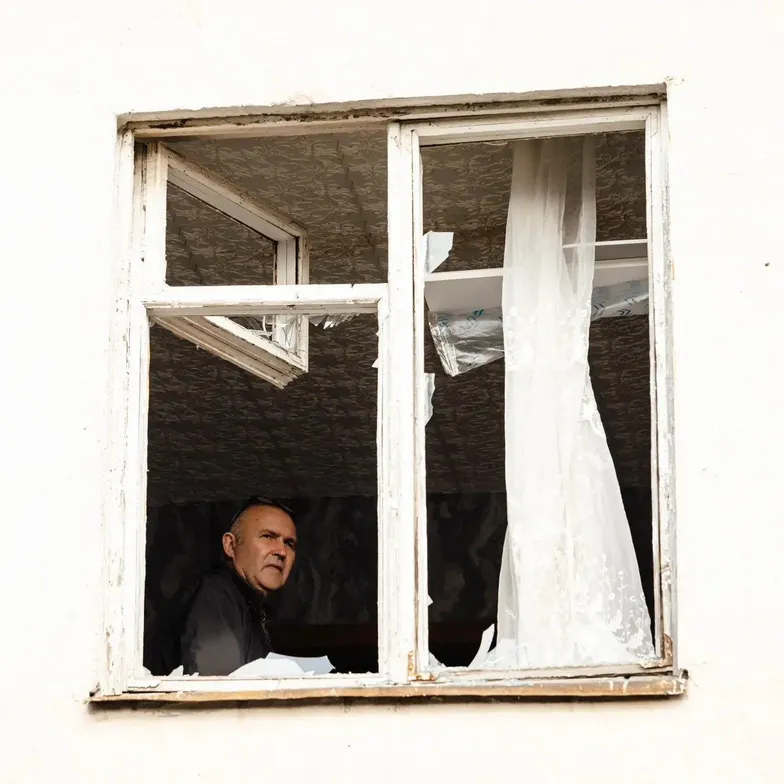
The aftermath of what was reportedly falling drone debris. Kursk, October 5, 2026
Pepel ➜ Kursk / Telegram
A young clerk at a nearby bookstore shrugs when asked why the people at the market aren’t reacting to the siren. “Nobody’s scared,” he says. “Yeah, the city center rarely gets hit. But that’s no guarantee. Does anyone give a fuck? Nope.”
Another local says: “Drones and air defenses put on quite a show for us. A buddy and I were sitting in a café here. Suddenly we hear this buzzing. So we start watching to see where it’s going, whether they’ll shoot it down. And we’re not the only ones who do that.”
The Kursk region was one of the first parts of Russia to experience the war firsthand. It is also the only one to have come partly under Ukrainian occupation, which lasted from August 2024 to April 2025.
There are still no final figures for those killed and injured during that period. In early August 2024, officials reported 12 people killed and 120 wounded. In January 2026, nearly a year after the region was liberated, Alexander Bastrykin, the head of Russia’s Investigative Committee, said 445 residents had been killed. By August, that estimate had risen to 640.
Today in Kursk, as in any other Russian city, the most visible reminders of the war are endless billboards advertising contract military service and urging people to “help defend the skies over Kursk.” There are few bomb shelters, and from the outside they all resemble shabby public restrooms. At the entrance to one hangs an ad from an earlier era, before the age of AI — which, by coincidence, began in 2022: “Term papers and theses written for you. Fast, high-quality work.”
In the square outside the train station, several military supply stores cater to contract soldiers passing through Kursk. There is also a monument to Operation Pipe, an operation celebrated by Russian propagandists that enabled Russia to liberate the region: Soldiers made their way behind Ukrainian lines through an out-of-service main gas pipeline. The monument itself is a section of pipe 1,420 millimeters in diameter — ostensibly from that very pipeline, though perhaps just an identical one.
Operation Pipe. March 11, 2025
RIA Novosti / Sputnik / Profimedia
The Operation Pipe monument
Kursk Seychas / Telegram
The Kursk residents who spoke to Meduza barely mention the operation. But they are still discussing how Ukraine managed to seize a piece of Russia in the first place. A man of about 50 offers the most common explanation: “There were no fortifications. They pocketed the defense money. Basically, they sold us out. But we’re used to it.”
This is hardly a conspiracy theory. Even the Russian Prosecutor General’s Office estimates that more than 3 billion rubles, or about 33 million euros, were stolen from the fortifications budget. Local lawmakers and businesspeople have been convicted in the so-called fortifications case, and former Governor Alexey Smirnov was sentenced to 14 years in prison.
His predecessor as governor, Roman Starovoit, who also served as Russia’s transport minister and against whom Smirnov testified, died by suicide in the summer of 2025, a few months after Russia fully liberated the Kursk region.
‘Everyone here is like family. Fights every day’
When Ukrainian units entered the Kursk region, more than 130,000 people fled the border districts. One local resident who spoke to Meduza said they fled under fire: “We could hear it whistling right over our heads. It was scary to run. But staying was scarier.”
Many refugees initially stayed in temporary shelters, then rented apartments or rooms in Kursk — or continued on to Moscow, St. Petersburg, and other major cities. Some tried to return to their hometowns and villages, despite the risk of being killed.
The aftermath of falling drone debris. Kursk, October 5, 2026
Pepel ➜ Kursk / Telegram
Kursk in October 2026
Tatyana Simonenkova / TASS / ZUMA Press / Scanpix / LETA
Meduza has detailed information about one case in which two retirees returned from Kursk to their village on the Ukrainian border. They describe life after the region’s liberation this way: Almost no buildings were left intact; the village continued to come under fire almost every night; during the day, Ukrainian drones hovered overhead as Russian soldiers tried to shoot them down. The retirees nevertheless have no intention of leaving, because “it’s home.”
In Sudzha, a town that served as a stronghold for Ukrainian troops, the situation is even worse. It has yet to return to anything resembling peacetime life. Refugees from the area who spoke to Meduza say “there’s nothing left to restore.” “It would be easier to rebuild [the town] from scratch,” one says.
Some refugees still live in temporary shelters. Meduza previously published a detailed report from one in the Tula region, where residents faced eviction. There are no plans to evict refugees in Kursk, but some tension with the city’s residents is palpable.
One Kursk resident told Meduza that apartment prices have nearly doubled since 2024 — a claim backed up by other reports — primarily because of people relocating from the combat zone and the growing number of military personnel in the region.
There are other problems, too: Refugees have significantly increased demand for services at government service centers, hospitals, and other public institutions, which clearly cannot keep up.
As a result, both refugees and Kursk residents say, displaced people live “separately” from the rest of the city: Their lives largely revolve around the temporary shelters.
One such shelter is in a former hotel in central Kursk. Three stars adorn the façade. At the entrance lies a dirty carpet worn through in places; at the reception desk sits a pile of empty humanitarian aid boxes.
Delivery couriers keep coming into the building. Refugees take packages from them and quickly disappear inside, almost at a run. A man over 50 tells Meduza he has just returned from a stint working away from home. He takes whatever work he can get: “I can’t afford to be picky. There’s no other work for me [as a refugee].”
The shelter’s security guard is also a refugee, “originally from the [self-proclaimed] DPR,” or Donetsk People’s Republic:
I live here with my family, like everyone else. My wife, two kids. My sister, too — she’s a single mom with three kids. We’re from the DPR, but we lived in Kharkiv for several years, up until 2022. A big, beautiful city. Honestly, Kursk feels provincial compared to it. We don’t plan to stay here. But for now, it is what it is.
The guard says that before leaving the Donbas, he served in the DPR “militia” and even claims to have fought, albeit with a hunting shotgun. That did not stop him from moving to Kharkiv. There, he started his own candle-making business: “It started as a hobby. Then I got into it. My dad joined me. That’s how I built up my little workshop. Mostly I made candles for churches in three regions — Donetsk, Luhansk, and Kharkiv. I made [candles] in different shapes, too. My work came to a halt in 2022, as you can imagine.”
He starts smiling and takes out his phone. He shows me photos of carefully painted candles shaped like the Snow Maiden and Grandfather Frost, angels, and animals. He says he has already rented a small space in Kursk and resumed production.
He is less eager to talk about how things work at the shelter: “Everyone here is like family by now, everyone knows each other. It’s like living in a dorm: Visitors have to leave by 10 p.m. There are fights over that almost every day. I call the National Guard, they come and break it up.”
Every couple of months, officers from the Federal Security Service, or FSB, visit the shelter. The guard says they go from room to room and check phones, looking for “people who support Ukraine.” He practically whispers those last words and instantly turns serious.
A bomb shelter in Kursk
Pepel ➜ Kursk / Telegram
The aftermath of a drone attack in the Kursk region’s Belovsky district. August 31, 2026
Pepel ➜ Kursk / Telegram
For the next half hour, he gives a rambling but utterly confident account of events in Ukraine. It consists mostly of propaganda clichés, quotations from Putin, and conspiracy theories.
It all began in the 2010s, when “specially trained” Americans and Britons started “turning Ukrainians against each other.” That led to Euromaidan and the conflict in eastern Ukraine, followed by the full-scale war — which Russian troops would have ended long ago with a crushing victory, except that, for some reason, they still haven’t received the order. Why the order has never come remains a mystery. But Putin is definitely doing everything right.
‘You’re doing it for the money’
A long apartment building with six entrances. Across from the sixth entrance, an older woman beats dust out of a rug in a steady, determined rhythm. A sharp shout comes from the other side of the building.
“Who the fuck’s shooting over there?” the woman says sarcastically.
Crude humor is a common way of “normalizing war in residents’ everyday lives,” or treating it as a given, according to independent sociologists who worked in Kursk.
A researcher who visited the city in late 2024 gave this example:
I asked the bartender to pour me a cider. They’d finished the open container of cider, so the bartender had to open a new one. She struggled with it for a while, and as she finally got it open, it started making funny, loud noises. The bar manager said, “Missile alert!” Someone laughed.
Locals told the researchers that “having a sense of humor about life” amid constant shelling and drone attacks was the only way to avoid “ending up in the nuthouse.”
Over the past two years, Kursk residents’ attitudes toward the war seem to have changed little. I witnessed a similar scene at a local bar.
The bartender — black T-shirt, two earrings in each ear, a daughter in first grade — readily tells customers about a recent attack:
I was coming home late from work, already in the courtyard outside my building. I hear the damn thing buzzing. But I can’t see it. I start counting: If there’s no shooting within five seconds, it must be one of ours. I didn’t even finish counting before gunfire erupted to my left. The bastard’s buzzing away. I turn on my phone camera, start filming. They didn’t shoot it down. Still buzzing.
Fuck, they missed. Can’t shoot for shit.
The bartender says soldiers serving in the war in Ukraine often come in. They are easy to spot by their appearance. He struggled to say exactly what gives them away, but offered an explanation that would make sense to people in Russia: It is much like being able to pick out a police officer in a large group.
Refugees also come to the bar, including some from Sudzha. A young woman who escaped from there told Meduza that her house was completely destroyed during the occupation. As compensation, the authorities gave her a voucher to buy a new home.
The aftermath of the July 19, 2026, drone attack
Pepel ➜ Kursk / Telegram
A mobile anti-aircraft crew from the BARS-Kursk volunteer brigade
Sergei Bobylev / RIA Novosti / Sputnik / IMAGO / SNA / Scanpix / LETA
The amount is calculated using a simple formula: The floor area of the destroyed house or apartment is multiplied by an officially set standard price per square meter. Not everyone has received these vouchers yet — other compensation payments have also been delayed — and the standard price is 20% to 30% below market housing prices.
The woman who spoke to Meduza was able to buy an apartment in the Leningrad region to replace her house in Sudzha: She did not want to stay in a region near the front. She doesn’t seem especially upset when she talks about the occupation. And with the humor typical of locals, she recalls spending her first refugee assistance payments on a new computer, while an acquaintance spent his on mephedrone.
The region formally remains under special counterterrorism rules. In Kursk, though, their effects are barely noticeable, mostly limited to more frequent ID checks, particularly on the roads.
There is even nightlife here. At the bar I visited, people partied late into the night. As dawn approached, several customers fell into a familiar exchange:
“Did you serve? No? Then shut your mouth.”
“I’m going to [serve]. Soon.”
“What do you mean? Oh, in the ‘special military operation’? That doesn’t count as military service. That’s just for the money.”
From Meduza’s archives
Russian authorities move to evict war refugees from temporary shelters south of Moscow. Many have nowhere else to go.
A pipeline surpriseMeduza reviews Russia’s reported breakthrough against Ukrainian forces in Kursk
Pushback in KurskUkraine risks losing its foothold across the border as Russian troops advance toward Sudzha
At Meduza, we are committed to transparency about our use of artificial intelligence in the newsroom. The story you’re reading was written by one of our living, breathing journalists and translated from Russian using an AI model configured to follow our strict editorial standards. This translation process is the result of extensive testing and refinements to ensure our English-language coverage is timely and accurate. A Meduza editor reviews every draft before publication.
If you find any errors in this translation, please contact us at reports@meduza.io.
To read Meduza’s exclusive content in English, please subscribe to our newsletter.
Meduza, Kursk