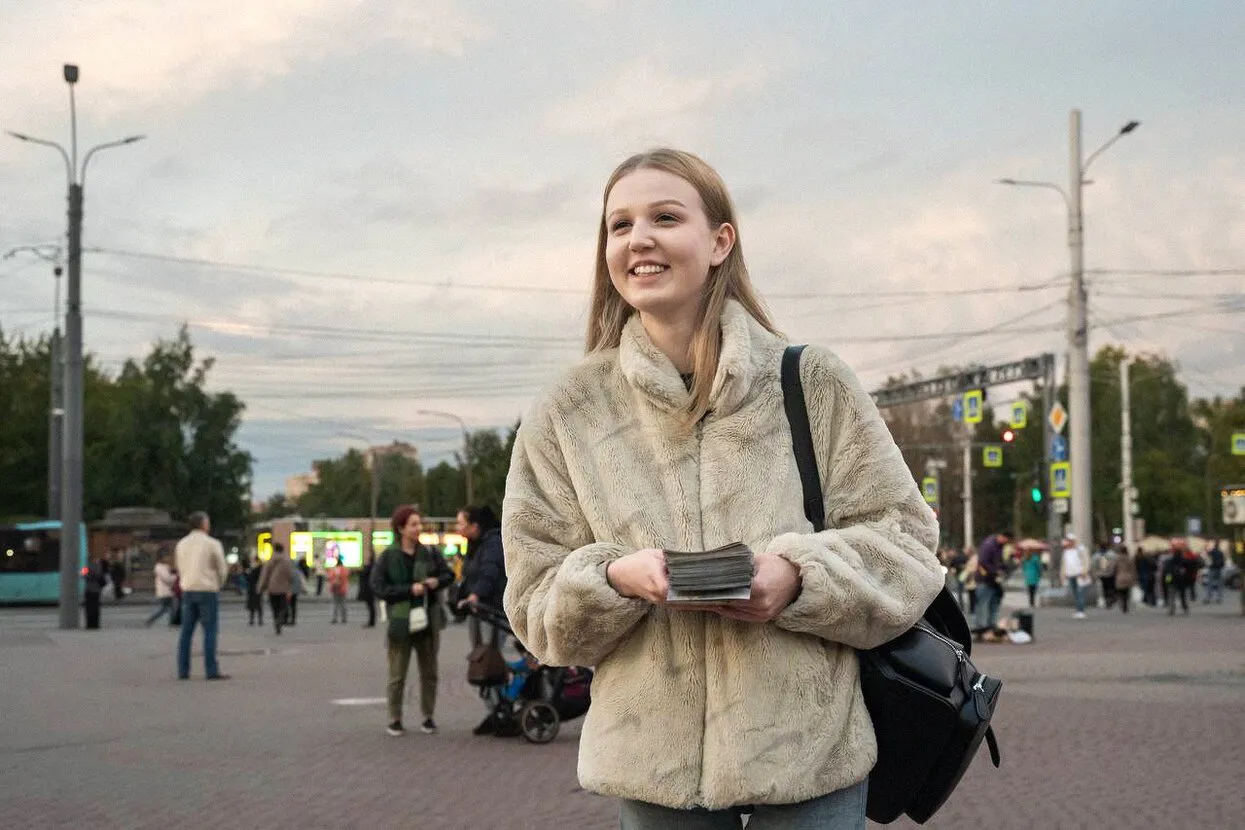
A 21-year-old candidate for Russia’s antiwar Yabloko party documented her campaign for the St. Petersburg legislature
Russia’s elections are over, and Yabloko faced unprecedented pressure throughout them. The party’s federal list was removed from the ballot back in the summer, and its regional lists followed. Only one survived, in the Novgorod region. Yabloko candidates running for regional legislatures in single-member districts complained of pressure, and several were removed from the ballot. The outlet Bereg has published the diary of Marina Peslyak, a 21-year-old antiwar candidate for St. Petersburg’s Legislative Assembly who managed to defend her place on the ballot. For more than a month, Peslyak recorded the election commission’s absurd demands, pressure from law enforcement, and the everyday work of running a campaign. Meduza is translating the diary here.
Bereg shortened and lightly edited Peslyak’s diary and added a timeline of the pressure on Yabloko to her entries.
August 11, thirty-eight days until the election
The day before, on August 10, the Supreme Court removed Yabloko from the State Duma election. Yabloko would have been the only party on the ballot calling for a ceasefire with Ukraine as soon as possible.
The district election commission (DEC) got in touch: one person’s donation doesn’t meet legal requirements, even though he filled in all his details correctly. I’m annoyed. One more formality I have to deal with.
Every message from the commission is insanely stressful. I’m afraid they’ve found another reason to kick me off the ballot.
Spent two hours sorting things out with Sberbank — even the staff don’t know how to return a payment like this. But I got it done. It seems like a small thing, but after two hours on one transaction, you just want to shut everything down and not do anything else today.
In the evening, The New York Times reached out. They asked me to comment on my campaign, my motivation, and Yabloko’s list being thrown out. It’s a really strange feeling: a few hours ago I was dealing with the bank, and now the NYT is writing to me.
August 12
I arranged to speak with the NYT journalist, but I’m worried about the possible consequences. Yabloko’s headquarters ignored my question about whether I should agree to the interview.
I wouldn’t want to be answering for the whole party when I’m a candidate for the city legislature. I’m anxious. I want to speak honestly, but I keep thinking about where my personal views end and where I start speaking on behalf of the party.
Lyudmila Vasilyeva wrote to me. She’s asking how she can help.
Gave the interview. It seems like it went fine, but I still have the feeling that now I’m going to replay every sentence [and worry].
August 13
Woke up in the night with a panic attack, thinking I might have said too much in the interview. I’m scared they’ll kick me off the ballot. Scared law enforcement officers will break into my home. Scared for my mom and my sister, who are staying with me right now. At night it all felt completely real, but by morning it was clear how badly I’d worked myself up.
Still, I just have to get up and keep going. I’m writing to everyone who signed up to volunteer.
Talking with the BBC about filming a documentary on my campaign. I don’t even know yet what there is to film: there are hardly any people involved, there’s no money either, and I can’t even get the campaigning off the ground. It’s awkward: it’s supposed to be a film about a campaign, but there’s practically no active campaign.
August 14
Yabloko appealed the Supreme Court’s decision to bar it from the election.
Met with Yabloko’s people in my district, and we talked about our next steps — what we can pull off with the resources I have. For the first time in several days, I felt a little calmer. It’s starting to feel like we at least have some kind of plan.
Messaging volunteers, setting up a meeting. Late at night, I’m writing a post asking for donations. It’s a little awkward to ask people for money again, but without it there’s nothing to run this campaign on.
August 15
Police issued warnings against taking part in unauthorized rallies to several people who had come out to support Yabloko outside the Supreme Court in Moscow on August 10.
Meeting with Lyudmila Vasilyeva and a BBC cameraman, taking photos, talking about the campaign’s problems. I’m filmed for an interview. Of course, she didn’t tell me anything new, but I was glad to see her two years after we last met. Back then I was collecting signatures for her myself, and now I’m the candidate.
It’s uncomfortable to sit in a café next to a metro station and film a conversation about what’s wrong in the country and what’s ahead for us. In a public place, on camera, we’re talking about things people don’t usually say out loud.
August 16
Yabloko found more than a billion rubles in donations to parliamentary parties from donors with foreign ties and demanded that those parties be removed from the election. One of the grounds for removing Yabloko itself was 16,900 rubles “from certain citizens who allegedly received funds from abroad.”
Taking part in a Yabloko photo shoot.
August 17
Russia’s Supreme Court rejected the appeal by Yabloko’s lawyers against the ruling that removed the party’s federal list. During the hearing, police outside the court detained more than 85 people who had come to support the party.
The same day, a court in Pskov sentenced Lev Shlosberg, Yabloko’s 63-year-old deputy chairman, to 11 years and one month in a penal colony in a case over repeatedly “discrediting” the Russian army and spreading “fake news” about the military.
The BBC film about my campaign isn’t happening: the cameraman suddenly left Russia, and the active phase of my campaign started pretty late.
Working on notifying the territorial election commission (TEC) about my printed campaign materials.
August 18, one month until the election
Three Muscovites who had come to the Supreme Court to support Yabloko on August 10 were detained a week later and accused of taking part in an unauthorized rally that obstructed traffic. They were jailed for 10–15 days for administrative offenses.
Yabloko was taken off the ballots. Central Election Commission head Ella Pamfilova said that Russians who “left and betrayed the country” should be stripped of the right to vote.
The ballot draw.
When I handed over my passport at the ID check at the entrance to the city election commission, a commission member said: “Oh, you’re the one we reinstated! Make sure she gets in, and everyone should know her face. Other complaints are citing her case now.” Funny.
August 19
Apple Savior Day. Went to a meeting at Yabloko’s city headquarters and handed over the results of the drawing so they could sign the contracts with media outlets.
August 20
Eight thousand people applied to join Yabloko after it was removed from the State Duma election, Kirill Goncharov, the head of its Moscow branch, told Bereg. At that point, the party had half that many members.
Going over legal issues with volunteers. Signing contracts with TV companies, writing the script for a video to air on TV. To get the video into the airtime slots the channels assigned me, I’ll have to hand it in in just a few days.
Yabloko can’t record videos for all its candidates: State Duma candidates get priority. We’ll try to do it on our own.
August 21
The Rodina party filed a lawsuit with the Pskov Regional Court demanding that Yabloko’s list be removed from the election for the regional legislature.
We’re trying to find a video editor. Not many responses so far. The price people are asking is sky-high [for the campaign’s budget] — 15,000 rubles.
August 22
Out of nowhere, they wrote to say Yabloko’s headquarters had found time to shoot the video. I need to be at headquarters at 5:00 p.m. and send the script by 3:00.
In the end, everything gets postponed because of bad weather: they were planning to shoot outside.
August 23
Drafting and signing a contract so I can use a special font developed by Yabloko [in my campaign materials]: the party is worried about copyright lawsuits.
August 24
Signing a contract to pay for the finished website, running to the St. Petersburg TV channel to hand over the video recorded at the Yabloko office, then to the TEC to hand in all the contracts and the video and audio materials.
By law, I only have to give the commission a cover letter and the campaign material itself, but they’re demanding every single contract for every transaction that went through my campaign account, the acceptance certificates, the payment orders…
A TEC staffer complained that I supposedly criticize them all the time in the media or on social media, even though they’re trying to help me “out of kindness”: “You seem like a smart girl, you should have known about requirements like this.” I’m not even angry. I’m tired of being surprised.
August 25
Yabloko was removed from the ballot for the Pskov regional legislature election.
Videos made for St. Petersburg’s State Duma candidates are being pulled en masse. Almost all the candidates got letters from TV channels saying their videos had been found to contain “extremism” and “discrediting the armed forces.” The St. Petersburg Election Commission sent them similar letters.
My video has different content, and the script is my own. So far, they’re leaving it alone.
August 26
The St. Petersburg TV channel calls and begs me to withdraw the video voluntarily. They say, “It’s not up to us.” Supposedly the St. Petersburg Election Commission sent them a notice to that effect. I didn’t get any letter from the St. Petersburg Election Commission.
VGTRK also sends a letter about pulling it from the air.
We’re shooting a second video. Since the first script was as toothless as possible (on purpose), the only things that could bother them are the party slogan and the call for peace. I’m sitting here crossing the words “peace,” “freedom,” and “life” out of my own script. I feel angry.
The worst part isn’t even that the video got pulled. What bugs me more is that I have no idea who’s making this decision. The TV people say one thing, the St. Petersburg Election Commission says another, and the TEC says nothing at all.
In the evening, the cameraman and I go to Nikolai Rybakov’s meeting with supporters. To be honest, I expected more. A routine speech in an intimate setting.
August 27
Filing a complaint with the Central Election Commission over the St. Petersburg Election Commission pulling my video.
I contact a print shop and realize I haven’t raised enough to print even 5,000 flyers. They cost 14,658 rubles. For a big campaign, that’s probably not a huge amount. But when you’re raising the money yourself, you feel every expense like that. I decide to put 30,000 rubles of my own into the campaign.
August 28, three weeks until the election
A court removed Yabloko from the elections for the Sverdlovsk and Kaliningrad regional legislatures. VKontakte cut off Yabloko’s broadcast “Mirny strim” (“Peace Stream”), during which the party was raising money for its election campaign.
Spend half the day writing the text for flyers and posters and send edits to the video editor. At first, I really didn’t like the video at all. It came out more creepy than hopeful, and hopeful is what I wanted despite the censorship. I really want to lift people’s spirits somehow, not make yet another unsettling video.
Heading to a meeting with supporters.
August 30
Finally sorted things out with the print shop (there wasn’t enough money, so in the end I paid for it myself). Going around to the TV companies again — this time to submit the censored video.
August 31
In a single day, Russian courts removed three Yabloko candidates running in single-member districts from the ballot — in the Tula region, Tatarstan, and Bashkortostan. In Moscow, Yabloko candidate Artyom Snegovsky was detained over alleged “discrediting” of the army.
Hi, I’m N.
I report for Meduza from inside Russia. I could go to prison for my work. To stay safe, I have to follow strict security protocols. I know my lawyer’s phone number by heart. And, of course, my articles are published anonymously.
Working for an independent news outlet while still living in Russia feels like something out of a spy film. My friends know me by one name. My colleagues and sources know me by another. But sometimes there’s a glitch. At a close friend’s birthday party, someone I don’t know reaches out to shake my hand. “Hi, I’m Lyosha.” It takes me a few seconds to decide how to introduce myself. Do I use my real name or my pseudonym? I’m trying to figure out whether this is someone I might one day end up writing about.
What I do is journalism in exile, even though I’m not in exile myself. I have the rare opportunity to do uncensored, on-the-ground reporting in Russia. Please support Meduza so I can continue this work.

September 1
Handing in the new video and an audio recording for radio to the TEC. Broadcasting starts tomorrow.
September 2
In the end, none of my video or audio materials were allowed on the air.
Going to the TEC again — they called me in to discuss the design of the campaign boards. The commission chair says three more donations were made in violation of the rules (I didn’t find any violations), so the money went to the state. And apparently I’m also supposed to reimburse the donors for those amounts. The law doesn’t say a word about this. I guess I’m supposed to do it out of my own pocket.
At the TEC, they say “the prosecutor’s office has taken an interest” in me. The best part is that all these transfers were made in accordance with the law.
I’m really nervous. I reread the law the TEC cited. It finally sinks in that they’re just trying to slow me down and keep me from running my campaign in peace. There’s very little time left as it is.
September 3
Get a reply from the St. Petersburg Election Commission saying they have nothing to do with my video and audio materials being kept off the air and that I need to go to the TEC (DEC). Then I don’t understand why the TV channels are telling me something else.
Get a letter from VGTRK saying my new video contains “extremism.” The channel’s management cites a demand to that effect from the St. Petersburg Election Commission.
It hurts that the new video won’t air either. So I’ll post it myself.
September 4, two weeks until the election
Two more Yabloko candidates were detained in Moscow: Anna Shatunovskaya-Byurno (Preobrazhensky single-member district) and Grigory Grishin (Leningradsky single-member district).
We’re setting up a group chat for volunteers. Going to the TEC again with booklets and all the contracts, which I spend a couple of hours filling out, copying, and signing every time before I submit them. Writing posts to explain the situation to my supporters.
September 5
Brought my flyers to Yabloko’s headquarters.
Marina Peslyak’s Telegram channel
September 6
Brought flyers to supporters, and we’re also looking for volunteers. We don’t have enough people, though I’m grateful to every single one. The same day, we start canvassing neighborhoods.
September 7
In Yekaterinburg, six Yabloko candidates were detained. All of them were cited for displaying “extremist” symbols. A penalty for that administrative offense bars a person from running in elections for 12 months.
I’m officially invited to take part in a debate. I meet with my opponents, and we discuss safety: three of the participants, including me, have already faced attempts to get them removed from the ballot.
The conversation was surprisingly constructive, even though our main rival [United Russia candidate Alexei Kulkov] refused to take part in the debate. After all the trouble with commissions and paperwork, it’s nice to just have a normal conversation with other candidates.
Today’s my birthday. I’d like to keep at least the evening for myself.
September 8, ten days until the election
In the morning I get a bunch of calls. Turns out they’re from the prosecutor’s office. There’s a letter from them in my inbox too, dated September 7. Very ironic — thanks for the present. The letter came in the afternoon and went to spam, but I’m supposed to show up today at 5:00 p.m. I answered the call at four.
At the prosecutor’s office, they spoke to me politely and calmly. The staffer who took down my statement listened carefully and, as far as I could see, wrote down what I said without distorting it.
I came away feeling that even they didn’t fully understand why my video counted as a violation. The staffer saw it for the first time herself during our conversation and called the words in the video “prophetic.”
They gave me an official warning and told me to be more careful. They said several times that they were “forced” to issue the warning. Naturally, they didn’t open any case, because there’s nothing to open one over.
At first the whole situation scared me, but then the fear gave way to calm: I’m not the first person in Yabloko summoned to the prosecutor’s office over a video. After that, I mostly found the whole thing funny because it was so surreal.
It also turns out someone reported me for missing the deadline for submitting campaign materials. Supposedly I brought the video to the commission after it had already been distributed.
September 9
Media requests are coming in: Bumaga, SOTA Vision. Campaigning in my district.
In the evening, I go to Yabloko’s headquarters, sign papers related to election monitoring, and bring the flyers that were missing. Recruiting observers is hard: people whose official residence is outside a candidate’s district can’t serve as observers anymore.
By the way, nobody told me the flyers had run out until I asked. I don’t really get why people at Yabloko keep blowing me off. Is that normal for them, or am I just the lucky one?
Coming home, designing posters.
September 10
Handing out flyers in my district. There was a horrible downpour, and only one other person showed up besides me.
The Central Election Commission sent a brush-off reply saying it found no fault with the St. Petersburg Election Commission for pulling my video off the air. It took the Central Election Commission two weeks to answer.
September 11
Yabloko’s list was removed from the election in the Tomsk region. Only the Novgorod region is left.
Groundhog Day. I get up and head out to the district. Campaign, get home by 11:00 p.m. Almost every day looks the same now, and I can physically feel the exhaustion piling up.
In the afternoon, I was messaging with the print shop. There’s not much time left, and the posters still aren’t ready. I’m worried I’m some kind of “half-candidate.”
September 12
Picking up the posters and going straight to the TEC to submit the campaign materials. Then to the district to campaign.
September 13, five days until the election
Before, I felt like I was mostly carrying the campaign on my own. And then suddenly people showed up — on their own, too. It’s probably the first time in the whole campaign I felt like this matters to someone besides me. I’m really tired, but after that it got a little easier.
Actually, I got really lucky with my district — in terms of how people react. Everyone’s pretty positive about me as a candidate and about the party I’m running with. Although today, for the first time in the whole campaign, we met people who were “not going to” talk to Yabloko.
Writing a post about how we campaign. Asking people to help.
September 14, four days until the election
Still campaigning. The flyers ran out — turns out 5,000 isn’t that many. Urgently writing to the print shop. Panicking a little over how much there is to get done.
September 15, three days until the election
In St. Petersburg, Yabloko-appointed election commission members received summonses to report to the military enlistment office on the first day of voting.
Waiting for my flyers. Going to the district. Waiting for my flyers. Going to the TEC. Going to the district.
Going to Nikolai Rybakov’s meeting with supporters. Out of nowhere, they handed me the mic. They had introduced the candidates at the start, but I was late, so I decided to use the chance to introduce myself and ask people to help me. They handed me the mic so suddenly that I didn’t really know what I was saying. There were a thousand people in the room, and the stress was awful. Surprisingly, the appeal worked — quite a lot of people came up to me after the meeting.
Physically, I feel terrible. I haven’t eaten properly in more than a week. I can feel myself starting to get sick from the stress.
September 16, two days until the election
The debate is today. The first one of my life.
Honestly, it didn’t go very well for me. I was nervous. Sometimes I didn’t manage to say what I wanted; other times I could have answered better. But just taking part matters. At least now I know what a live debate is like and what I need to do differently next time.
The main topics were the environment, transportation, urban development, and how the campaign was going. It was more like a discussion than a debate. I got lost amid my opponents’ loud slogans. On top of that, I’d felt awful since morning, and the tension before the debate took its toll.
Yuri Kulikov, Yelena Belyaeva, Ivan Changli, and I attended the debate. Mikhail Amosov and Alexei Kulkov didn’t show up.
I think I got sick after the debate. Slept at home for an hour, and I’m back to campaigning. Stopped by Yabloko’s headquarters to drop off a batch of flyers, then brought campaign materials to Yabloko activists in the district. We’re going to hand out flyers and canvass apartment buildings.
The last few weeks of the campaign were almost identical: I get up at 10:00, leave the house at noon, and get back around midnight. I’m physically and emotionally drained, but I keep going anyway.
September 17, one day until the election
In the Rostov region, where early voting had started, police officers in balaclavas detained Yabloko observer Boris Miklyukov.
Last day of campaigning. I want to sleep for several days straight, but I have to keep going. We need as many people as possible to come out [to campaign] today — we’ll be handing out the last 2,000 flyers.
In the morning, voting members of one of the precinct commissions wrote to me asking for help if something goes wrong. I’m trying to set up a chat for observers, write a post, answer everyone who’s written to me, and get ready to go campaigning, all at the same time.
By now I’m so used to stress that it’s become my normal state. It’s scary, it’s hard, I’m tired, but I still get ready and go. Honestly, I have almost no strength left. But I feel it’s my duty to see the campaign through to the end myself.
Even if I don’t win, I’ve gained a tremendous amount of experience. I had the chance to speak out for peace legally, in times like these. I can do it, and I’m doing it.
September 18, first day of the election
Polling stations in Sochi suspended voting because of the threat of drones.
Yabloko chairman Nikolai Rybakov asked Central Election Commission head Ella Pamfilova to intervene over the pressure on Yabloko’s observers, who were being kept out of polling stations. In total, nearly 1,300 observers from the Communist Party and Yabloko were barred from polling stations.
My assistant and I bought water and snacks and went around to our observers and voting commission members so they wouldn’t go hungry. All day I went from one precinct commission to another, talked with commission chairs, and checked on how things were going at polling stations where we don’t have observers.
Something funny: one precinct commission complained that they didn’t have enough gifts for first-time voters. Usually the state provides commissions with those gifts. The chair asked me to “buy them gifts.” He said they’d be very grateful and would tell everyone who voted for me that the gifts were from me: “We’ll be able to see who voted for you, after all.” Is it stupidity or what? I don’t know. Surreal. Maybe United Russia people came by and did that…
Overall, the commission chairs were pretty polite with me. They all said turnout at their polling stations was about 30%.
September 19, second day of the election
Yabloko observers are still being kept out of polling stations. And at Precinct Election Commission No. 3104 in Perm, a Communist Party observer was turned away along with a Yabloko representative.
In St. Petersburg, police used force while detaining a Yabloko observer, and he lost consciousness. He was later cited for “disobeying” the police, and the commission chair accused him of “attempting to disrupt the election.” The observer’s name wasn’t released.
Still making the rounds of precinct commissions. The Communist Party got in touch — we’re trading news. Lots of their observers weren’t allowed in. Mine, thankfully, were.
September 20, last day of the election
A St. Petersburg precinct commission member named Darya (her surname wasn’t given) was detained over a complaint of “discrediting” the army filed by the precinct commission chair, according to Yabloko’s St. Petersburg branch. The complaint was prompted by her use of the word “war” in a private conversation. Darya believes the real reason may have been to remove her from the polling station. A Yabloko observer was taken to the same police station over filming that the commission considered illegal.
At one precinct commission, the chair (a participant in the “special military operation”) clashed with one of my observers. She was accused of talking to a voter — according to her, she said hi to her mom, who had come to vote. The observer was given a warning.
At another precinct commission, something strange happened. My observer stepped out during the vote count — as she said later, she felt unwell. One of the voting commission members later told me that the ballots were swapped at that moment. It’s hard to verify.
I ask commission chairs about turnout, and they give roughly the same figure: 50–60% over the three days.
Really tired. Late in the evening, I stopped by Yabloko’s headquarters on Shpalernaya Street and talked with other candidates.
Around 3:00 a.m., an acquaintance from one precinct commission sent me the tally sheet with the preliminary results for the precinct. The result was disappointing, of course. I was in second-to-last place, with just over 30 votes. The United Russia candidate [Alexei Kulkov], who didn’t campaign at all, had around 150. And [incumbent deputy] Amosov had around 300.
September 21, results
According to the Novgorod region election commission, with 96.86% of ballots counted, Yabloko is set to win representation in the regional duma with 6.2% of the vote. The Novgorod region is the only region where Yabloko was allowed to run in the regional legislative election.
According to preliminary data, I came in last. Considering that at almost every polling station I visited, another 400 votes appeared after voting ended, I’m not surprised. At one precinct commission, they told me I originally had 90-something votes, and then they falsified the count down to 40-something. According to preliminary data, the United Russia candidate came in second and Amosov first.
Above all, what mattered to me in this campaign was speaking up for peace — and showing people they’re not alone. This whole time, my team and I were able to talk with people about their real problems. Having the chance to speak out is very important to us.
At Meduza, we are committed to transparency about our use of artificial intelligence in the newsroom. The story you’re reading was written by one of our living, breathing journalists and translated from Russian using an AI model configured to follow our strict editorial standards. This translation process is the result of extensive testing and refinements to ensure our English-language coverage is timely and accurate. A Meduza editor reviews every draft before publication.
If you find any errors in this translation, please contact us at reports@meduza.io.
To read Meduza’s exclusive content in English, please subscribe to our newsletter.
What was the complaint?
The commission cited Part 1 of Article 62 of the St. Petersburg law of February 17, 2016, No. 81-6, complaining that the donor had not listed all his passport information. Peslyak says the information was correct and suspects the issue was the abbreviation “gr.” rather than the full word “citizen.”
Lyudmila Vasilyeva
An 85-year-old St. Petersburg resident who survived the siege of Leningrad as a child.
She regularly holds antiwar demonstrations and has been detained repeatedly as a result.
In 2024, she planned to run in the St. Petersburg gubernatorial election but couldn’t collect enough signatures to register. In March 2026, she recorded a video message calling for a quiet protest.
What’s this about?
On July 31, the St. Petersburg Election Commission reinstated Marina Peslyak’s registration as a candidate for the city legislature. The commission agreed with Peslyak that her exclusion had been unlawful and ruled that TIK No. 11‘s decision was illegal.
The commission found that the TIK had missed the deadline for notifying Peslyak about deficiencies in her documents, and that it should have taken into account the corrected documents she submitted — which it never did.
What meeting?
Yabloko chair Nikolai Rybakov met with supporters at the party’s St. Petersburg headquarters. According to organizers, more than 1,200 people attended the event.
Yuri Kulikov
Candidate for the St. Petersburg legislature from the sixth district, running for the New People party.
Yelena Belyaeva
Candidate for the St. Petersburg legislature from the sixth district, running for A Just Russia.
Ivan Changli
Candidate for the St. Petersburg legislature from the sixth district, running for the KPRF.
Mikhail Amosov
Incumbent lawmaker in the St. Petersburg legislature from the sixth district, representing the Green party.
Alexei Kulkov
Candidate for the St. Petersburg legislature from the sixth district, running for United Russia.
What drawing?
The drawing allocates free airtime and print space for campaigning by candidates for the State Duma and the city legislative assembly.
Why?
It’s one of the new provisions in election law: only people who have the right to vote in a particular election can now serve as observers in it. That means that while any citizen can still be an observer in presidential and State Duma elections, only Muscovites can observe Moscow City Duma elections — and in municipal elections, only people from the specific Moscow district in question. This has made recruiting observers more difficult.
What debates?
On September 16, 2026, candidates for the St. Petersburg legislature from the sixth district held debates on a voluntary basis in the conference hall of the Grand Hotel. Besides Marina Peslyak, the participants were Yuri Kulikov of the New People party, Yelena Belyaeva of A Just Russia, and Ivan Changli, a representative of Russia’s Communist Party, or KPRF. United Russia’s Alexei Kulkov and incumbent lawmaker Mikhail Amosov of the Green party did not attend.
With whom?
With Yuri Kulikov of New People, Yelena Belyaeva of A Just Russia, and Communist Party representative Ivan Changli.
Concerning what?
It’s a warning against violating the law, as the document itself states (Bereg has a copy). It says that the prosecutor’s office for St. Petersburg’s Vasileostrovsky District, “on the basis of information received” (it doesn’t say from whom), had determined that Peslyak was planning to run a campaign video in the media “whose content contradicts the requirements of federal law.” Specifically, the office had identified “signs of extremism” in the video, as well as “signs of discrediting the Russian Armed Forces.” The document, signed by the district’s deputy prosecutor, reads: “I warn … candidate Marina Peslyak against violating the requirements of federal law.”
What statement?
Peslyak appeared at the prosecutor’s office and gave an explanation regarding her campaign video, in which the office had found “signs of extremism” and “discrediting the Russian Armed Forces.” In her explanation (Bereg has reviewed the document), Peslyak said the point of her campaign materials was to inform voters about her candidacy, and she quoted the text of her video.
A violation of what?
In the view of prosecutors, the content of Peslyak’s second video “contradicts the requirements of federal law.” Specifically, they found “signs of extremism” in it, as well as “signs of discrediting the Russian Armed Forces.”
Why?
The commission cited Part 1 of Article 62 of St. Petersburg Law No. 81-6 of February 17, 2016. Its objection was that not all of the donor’s passport details had been listed.
What’s the difference?
The videos for Yabloko’s State Duma candidates all followed the same template: Grigory Yavlinsky appeared on camera saying the country needs peace, and each video ended with an image of the candidate and a call to vote for him or her. Peslyak, by contrast, filmed her video herself, using her own script, in which she spoke about herself as a candidate and also said, “Yabloko stands for peace, freedom, and a life without fear.”
How does that work?
According to Peslyak, every day at every precinct, the vote count kept by observers didn’t match the number the commission chair announced that evening. By the end of voting, the discrepancy at each precinct reached roughly 400-500 votes. (St. Petersburg has no remote electronic voting.) Peslyak says she doesn’t know exactly how these “added” votes were distributed: whether the roughly 400 votes went toward ballot stuffing or toward padding the appearance of turnout.