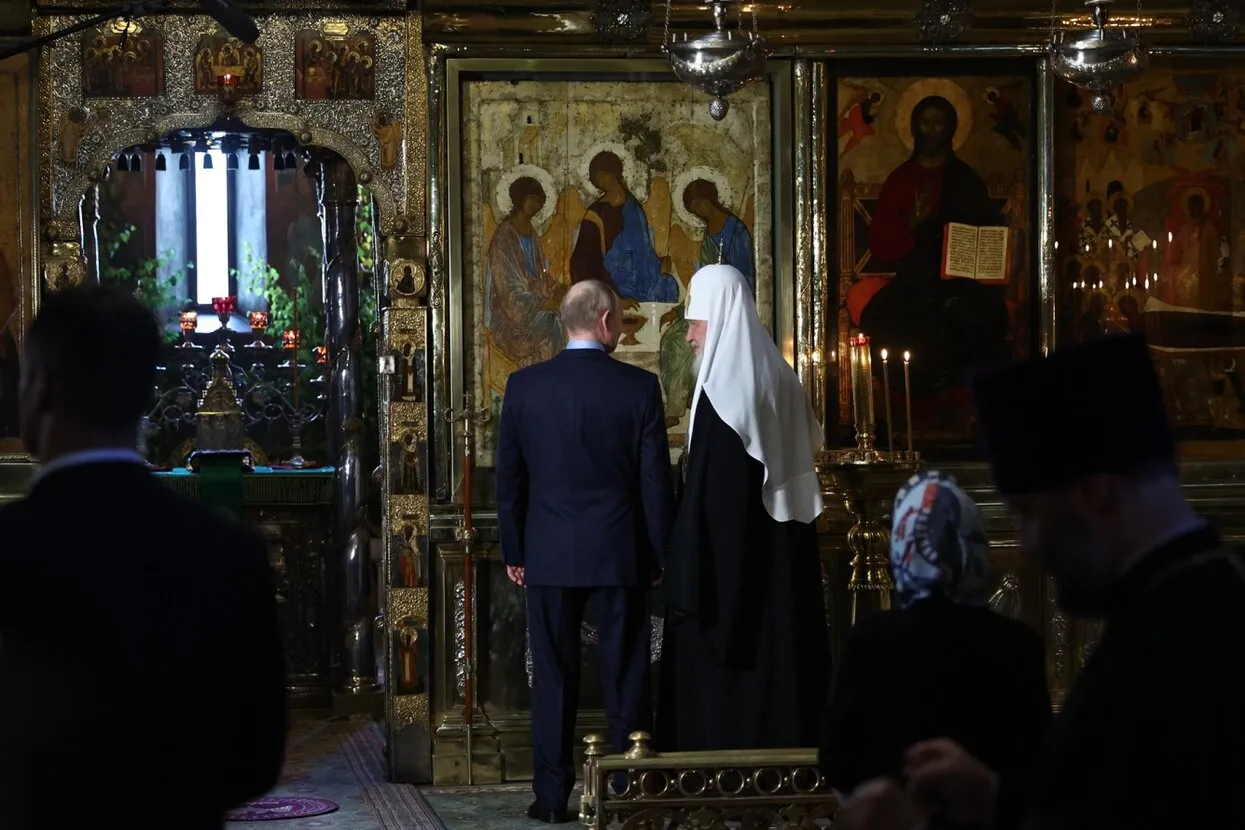
Museum experts warned that moving Andrei Rublev’s fragile Trinity icon to a Russian monastery could destroy it. Three years later, its condition is reportedly critical.
On September 12, Ekho reported that Andrei Rublev’s Trinity, housed for the past three years at the Trinity Lavra of St. Sergius rather than in a museum, was in critical condition after its climate-controlled display case broke down. The next day, the Moscow Patriarchate said Tretyakov Gallery staff would examine the icon. Journalist Ksenia Luchenko writes that the Culture Ministry “came down on” the Lavra for concealing the problems with the Trinity. Here is what is happening with the icon.
“What people have been warning about since 2023 is happening. Andrei Rublev’s Trinity is dying,” journalist Ksenia Luchenko wrote on her Orthodoxy and Zombies Telegram channel on September 12 in response to Ekho’s report.
In 2023, the Tretyakov Gallery transferred the Trinity — one of the best-known works of Russian art — to the Trinity Lavra of St. Sergius, the monastery for which Rublev originally painted it. According to Patriarch Kirill, Vladimir Putin personally decided to return the icon to the monastery “in response to numerous requests from Orthodox believers.” Museum experts warned at the time that the Trinity — an extremely old and fragile work dating to the early 15th century — could be destroyed without the controlled conditions of a museum. Three years later, in September 2026, evidence emerged that the icon’s condition had become critical.
On September 12, Ekho cited an anonymous source familiar with the situation as saying that the climate-controlled display case built into the iconostasis where the Trinity is kept had been out of order for several months. The humidity inside was 80%, rather than the required 50–55%, the standard cited in 2023 by Elena Pronicheva, then director of the Tretyakov Gallery.
Installing the climate-controlled display case in the Trinity Cathedral at the Trinity Lavra of St. Sergius, a 15th-century architectural monument, required drilling holes in the building’s walls. But the temperature inside the church proved to be the main problem: the display case was designed for a museum, where the temperature is kept at a relatively low 19 degrees Celsius, not for a church.
When the display case broke down, a specialist from Germany came to the Lavra to repair it — but the equipment failed again as soon as he left. The specialist cannot return, Ekho’s source said, “because of difficulties in international relations.”
The same source said returning the Trinity to the monastery had endangered not only the icon but also another historic work: the Trinity Cathedral’s iconostasis. Unlike the Trinity, the Lavra’s icons were “accustomed” to the conditions inside an active church. When Rublev’s icon was temporarily moved to the monastery in 2022, portable air conditioners were installed in the cathedral to maintain the necessary conditions. As a result, the iconostasis began “behaving very badly” and creaking, the source said.
The Trinity was painted on three wooden panels. Ekho’s source said the humidity had caused them to swell, making the paint layer buckle and effectively “curl up into a tube.”
After Ekho’s report, Oleg Voskoboinikov, a medievalist and the Stradarium project’s academic director, posted a photograph on Facebook showing a detail of the Trinity with a substance clearly visible along the seam between the panels. On the Orthodoxy and Zombies Telegram channel, Ksenia Luchenko confirmed that the image was authentic and said it had been taken in August. She said the substance was glue that the swelling panels had forced to the icon’s surface. In the same post, she cited anonymous sources as saying: “The Culture Ministry came down on the Lavra for concealing the icon’s condition, and that’s what set off the scramble.”
Oleg Voskoboynikov
The “scramble” did indeed begin: On September 13, the Moscow Patriarchate said the icon had been removed from the iconostasis and Tretyakov Gallery specialists were conducting a “routine inspection.”
On September 14, the Tretyakov Gallery’s press office told TASS that the Trinity was undergoing restoration and confirmed that museum staff would examine the icon’s condition. Formally, the Trinity remains part of the Tretyakov Gallery’s collection: In 2023, the Russian Orthodox Church received the right to use the icon free of charge for 49 years, with an option to extend the arrangement, rather than acquiring ownership of it.
As Ksenia Luchenko told Meduza in an article about two other museum pieces transferred to the Church — the Vladimir and Don icons of the Mother of God — Russian law does not allow works to be removed from a state collection. Luchenko also suggested at the time that the museums remained responsible for the condition of these fragile works.
According to TASS, citing the Trinity Lavra of St. Sergius, the icon was expected to be returned to its previous place “soon”: “There is nothing unusual about removing it from the iconostasis.”
At Meduza, we are committed to transparency about our use of artificial intelligence in the newsroom. The story you’re reading was written by one of our living, breathing journalists and translated from Russian using an AI model configured to follow our strict editorial standards. This translation process is the result of extensive testing and refinements to ensure our English-language coverage is timely and accurate. A Meduza editor reviews every draft before publication.
If you find any errors in this translation, please contact us at reports@meduza.io.
To read Meduza’s exclusive content in English, please subscribe to our newsletter.