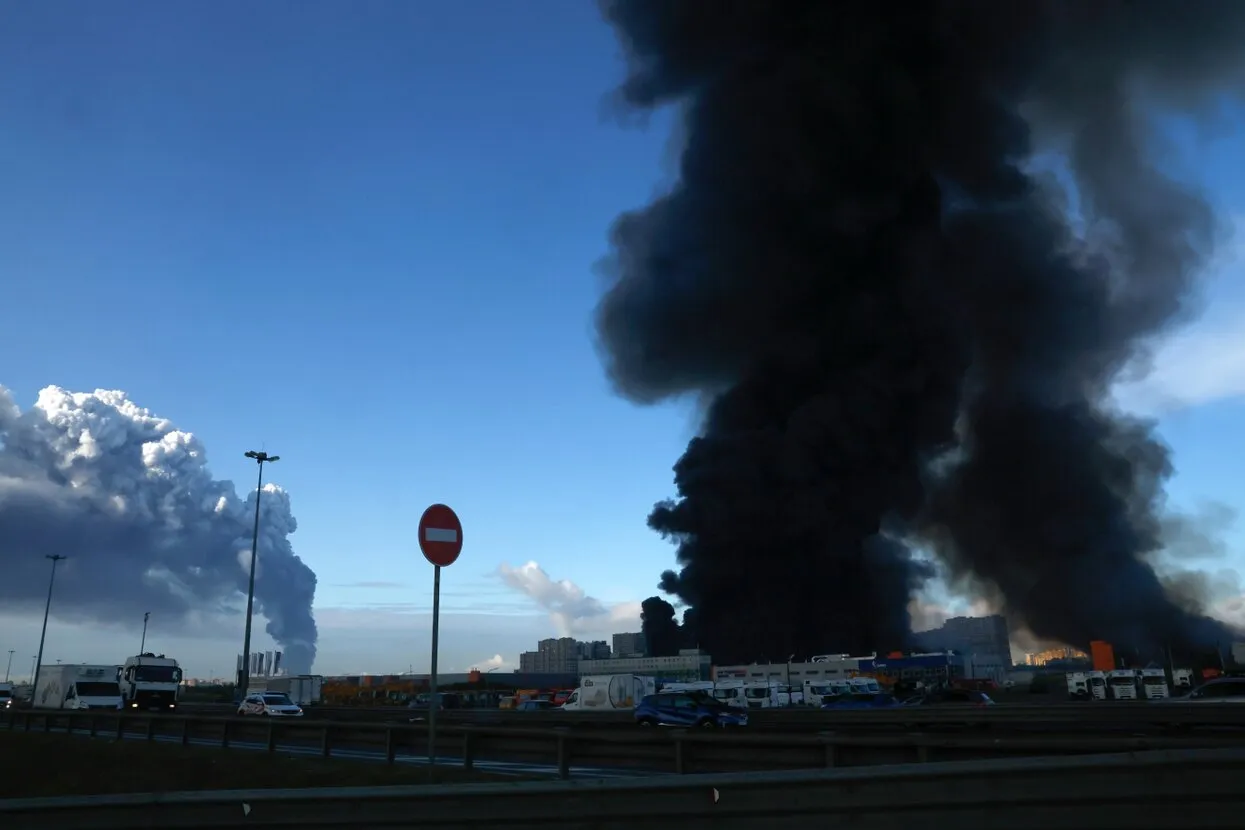
After Ukrainian drones hit a Wildberries warehouse in St. Petersburg, one eyewitness spoke to Meduza about the fire, the road closures, and the workers left waiting
Early on the morning of July 24, Ukrainian forces attacked more Wildberries logistics centers — this time in Crimea, the Leningrad region, and St. Petersburg. In Russia’s northwest, drones damaged two separate warehouse complexes, in Shushary and Utkina Zavod. Authorities did not report any injuries. Nikolai (name changed), a St. Petersburg resident who was near the site of the drone strike in Shushary, told Meduza what happened after the attack.
Warning! This text contains statements that some readers may find offensive (but they are important for understanding the story’s context).
St. Petersburg had no mobile internet all night — the usual pattern: a drone attack, and they cut the internet. People here have grown used to it; drones fly, so what. I was still up, waiting for a friend whose flight from Istanbul to Pulkovo Airport was diverted to Moscow
Around 5 or 5:30 a.m., I decided to turn in. I went for a glass of water first, and as I passed the window, I caught an odd-looking cloud out of the corner of my eye. My apartment happens to face Shushary. I looked out and understood what had happened: with a column of smoke rising, the Wildberries [warehouse] had obviously been destroyed
There were booms through the night, but I’ve grown used to something rumbling somewhere every so often. I heard what sounded like rolling thunder, though I couldn’t tell whether it was air defenses firing. You just think, “Okay, something’s happening. Well, unfortunately there’s nothing I can do about it.”
It never occurred to me that it could be anything but the Wildberries warehouse. If they hadn’t been pounding [Wildberries warehouses] those past few days, I would have assumed some strategic site had been bombed — but these are the circumstances now: everyone understands it’s WB.
People had expected this and said so openly: “It’s strange that we haven’t been hit yet.” If Wildberries was under attack, then all the big logistics centers would be destroyed, St. Petersburg’s included. It was only a matter of time.
I decided to go [see the fire]. I got into a taxi. We drove straight toward the column of smoke, and the driver started talking [about his impressions] himself. He said he hadn’t heard a thing, even though he lived nearby, and that he’d been certain St. Petersburg would be hit first. He was astonished it had taken so long.
The driver said he didn’t understand why [Ukrainian forces were targeting] Wildberries. I started explaining: first, there might well be military gear stored there; second, it’s a blow to the economic system, because Wildberries is hardly a poor company and has a big influence on the country’s economy.
The driver told me, “That’s all bullshit.” In his view, [the military] buys drones, body armor, and helmets from factories or army supply stores, and Wildberries has no effect whatsoever on the Russian economy.
He went on about how he didn’t understand when it would all end, and about what a shame it was that people on both sides were dying — though in 2022, he said, he would have gone there gladly. “It fell through, it didn’t work out.” He wouldn’t elaborate.
I asked him why he’d wanted to go to war. He said everything had been framed so beautifully back then: take the self-proclaimed Luhansk and Donetsk “people’s republics,” liberate the people there. I told him, “There was no one to liberate — they were doing just fine without us.” He started dragging in Mariupol, saying people there hadn’t been allowed to speak Russian. All in all, it was a mild debate with a hint of BDSM.
He asked whether I supported this whole “disgrace” (his word). I said I didn’t.
The driver dropped me off about four kilometers (2.5 miles) short of the [warehouse] gate — we couldn’t drive any farther; everything was blocked off. A traffic police car and several officers stood across a two-lane road on Moskovskoye Highway. Only emergency vehicles were being let through toward Shushary: police, Russia’s Investigative Committee, Russia’s National Guard, and firefighters.
Only one helicopter was in the air — very strange for a fire like that. All the fire trucks were on the warehouse grounds.
People were walking away from the warehouses, some with branded Wildberries bags, others with something else [carrying a logo]. They were clearly coming off the night shift — not exactly bright-eyed.
Further reading
I looked closely, thinking someone might show signs of [the attack] — soot. But no: everyone was clean, just exhausted. One guy told me, “Don’t bother going there, it’s all closed off anyway, they won’t let you in.”
An endless stream of people moved along both sides of the road. The ones walking toward the warehouses were clearly employees — nobody walks four kilometers in the morning just to watch a fire. In St. Petersburg, people prefer to watch that sort of thing on YouTube. There were very proper-looking women who could have been from accounting, and ordinary guys in T-shirts and flip-flops.
Nobody was sad or upset, and nobody was happy either — except for a group of guys having a very loud good time. When I took a photo of [the fire], they noticed and shouted that I was sending a report to someone.
I never made it to the warehouses themselves — everything there was burning fiercely. Two cars stood at the gate along with two scrawny young guys who had to keep explaining that nobody could go in. Everything behind them was on fire, and people kept trying to push into the danger zone anyway.
The employees wanted to know whether they’d be able to collect their things and whether they’d have a workday at all. Another very pressing question: would today count as a shift?
Even with police officers standing right there, people weren’t shy about discussing how the drone had hit the roof. Everyone had a different version — apparently everyone had seen and heard something different. They discussed it all very loudly, without a trace of embarrassment.
Nobody asked, “What kind of drone was that?” — everyone understood it was the Ukrainian military. Nor did anyone discuss why [the attack happened].
Some complained that the air defenses weren’t up to the job. Someone older answered that they weren’t designed for this: drones fly low, they’re hard to intercept, and our air defense system is bad in general. Someone else said, “Look how many drones they shot down, and how many were flying! Let’s not badmouth the air defense system.”
I didn’t see anything horrifying. People were just watching and waiting for someone to tell them something — for Wildberries representatives to get in touch, for their employers to show up. But nobody gives a damn about them. No one came, no one called, no one explained anything.
There was no panic; everyone was very calm. There was no aggression at all.
Getting a taxi back was impossible, even though the internet had started coming back by the time I left. The app first showed a 15-minute wait, then 35.
There were plenty of buses, but some were packed. I had to wait about 30 minutes. Inside, the mood was grim. Some guys were sitting there saying very loudly, “Fucking Ukes, what the hell are they doing? They need to be wiped out.” One of the women, a bit older, shot back, “So why are you sitting on a bus?” They had nothing to say to that. But phrases like “wipe them out” are rare in St. Petersburg these days.
People in this city adapt fast to just about any problem. When the internet shutdown happened last year, everyone was furious and complained. Then they got used to it very quickly: “Fine, whitelists it is. Fine, VPNs it is. We’ll each buy 300,000 VPNs and find the best one.”
Then came the gasoline crisis: at first people were horrified, and now it’s eased off. The same thing is happening with Wildberries: the fire in Elektrostal caused a sensation; it was some kind of super-event. But now everyone is very calm about it.
The deeper questions worry people far more: whether martial law will be imposed, whether there will be a mobilization. I can’t say people are out on the street talking about it on every corner, but you hear these conversations when you’re sitting in a bar or someplace like that. It worries men and women alike. Some are already making plans — voting, for instance, and then leaving the country right away, just in case.
At Meduza, we are committed to transparency about our use of artificial intelligence in the newsroom. The story you’re reading was written by one of our living, breathing journalists and translated from Russian using an AI model configured to follow our strict editorial standards. This translation process is the result of extensive testing and refinements to ensure our English-language coverage is timely and accurate. A Meduza editor reviews every draft before publication.
If you find any errors in this translation, please contact us at reports@meduza.io.
To read Meduza’s exclusive content in English, please subscribe to our newsletter.
Meduza
Shushary
A settlement in St. Petersburg’s Pushkin district, in the south of the city.
What is this about?
Ukrainian President Volodymyr Zelensky addressed the attack on Wildberries logistics centers in the Moscow and Tambov regions, which took place on the morning of July 18. He said the marketplace’s warehouses had become a target for the Ukrainian military because they stored drone components, and that Russia had used them to secure supplies of sanctioned parts for drone production and navigation equipment. Neither Wildberries nor Russian authorities commented on the statement.
At the same time, the marketplace does in fact sell drone components, including fiber-optic spools and cargo-drop systems.
Is that true?
Yes. In 2025, the marketplaces Wildberries, Ozon, and Yandex Market together sold almost 11 trillion rubles worth of goods — more than 5% of Russia’s GDP.
Is that true?
No. Ukraine, and Mariupol in particular, had laws requiring the use of the state language, Ukrainian, in government agencies, schools, and official paperwork. Citizens, however, had the right to address the government in Russian. Everyday life and private business were not regulated at all.
How many?
We don’t know. Leningrad Governor Alexander Drozdenko reported only the number of drones shot down: 59. St. Petersburg Governor Alexander Beglov gave no figures at all, saying only that the city had come under attack and that “air defense systems are operating.”
Why is he anonymous?
Russian authorities could treat a comment or interview published by Meduza as participation in the activities of an “undesirable” organization. A first “violation” can result in a fine of five thousand to 15 thousand rubles. A second “violation” committed within a year can carry criminal liability — up to four years in prison.