stories
Moscow’s alternative teens have made a downtown nightlife district their weekend hangout. Drunken fights are driving customers away — and police are targeting the teenagers for how they dress.
Source: Meduza
In the summer of 2025, media outlets first reported on the “nefors” of Kitay-Gorod — teenagers in unusual clothes who hang out in this central Moscow neighborhood. Around the same time, local café and bar owners noticed they were getting fewer customers: The rowdy young members of alternative subcultures had scared them off. A year later, police began rounding up the “nefors,” handling teenagers roughly as they detained them, sometimes without explanation. Police go mainly by how they look. Sometimes, though, there are grounds for police intervention: The “nefors” get drunk, shout, and fight, or lie on the ground after overdosing on drugs. Some also hold far-right views. Bereg, a cooperative of independent journalists, spent two nights in Kitay-Gorod — one in the summer and another after the school year began. Meduza is translating its report in full.
Caution: This article contains extensive profanity, as well as xenophobic statements (which are important to understanding the story’s context).
Chapter One
August
‘Back in our day, it was six nine’
Late in the evening, several teenagers sit on the sidewalk in a quiet lane in Kitay-Gorod, in central Moscow. They’re dressed in black, their once brightly dyed hair now faded and grown out. One girl, wearing ripped fishnet tights and a short skirt, looks for something to prop her smartphone against as she gets ready to film a TikTok. Another, in an oversized hoodie, talks loudly on a video call. Several boys nearby roar with laughter.
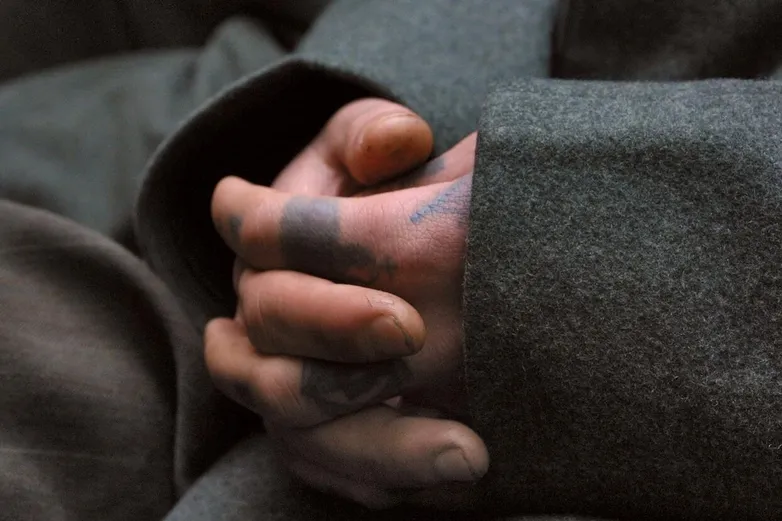
Girls with bright makeup and faces whitened with unnaturally pale foundation or powder; boys with bob haircuts or long bangs; many in tall platform shoes, some with extensive piercings and tattoos, including on their faces and necks — people who look like this are called “nefors.”
Those particularly fond of them often use the affectionate diminutive “neforyata” — many are under 18. They belong to a range of youth subcultures and often look very different from one another, making any general description difficult. One thing is certain: They stand out from other Muscovites.
Bereg
Since the spring of 2025, Kitay-Gorod has become the main hangout for young “nefors.” Nowhere else in the city has so many of them. Groups of teenagers from different subcultures, immediately recognizable by their distinctive clothes, emerge from subway stations and fan out through the neighborhood.
Two boys turn into a courtyard near the Moscow Choral Synagogue on Bolshoy Spasoglinishchevsky Lane. Both wear black T-shirts; one has a keffiyeh wrapped around his head and mismatched sneakers.
“Fuck!” one of them blurts out. There’s a police car in the courtyard they were heading for, and an officer is smoking a little farther away.
Since the summer of 2026, police and the Russian National Guard have been patrolling Kitay-Gorod more frequently. They used to focus on fining people for drinking alcohol where it wasn’t permitted. Now they may turn a blind eye to people carrying beer bottles. They pay much more attention to teenagers.
Patrol cars are a frequent sight on the streets, with police vans here and there. From Friday through Sunday, the number of police vehicles in the neighborhood rises noticeably. Officers may drive past the same spot several times in an hour.
Red barrier tape is strung across the entrance to a courtyard with several bars and cafés. Two athletic-looking men stand nearby, both in civilian clothes and balaclavas. They barely pay attention to adults, even those arriving with large backpacks. But the moment they spot “nefors,” they spring into action, blocking the entrance, ready to demand ID. The “nefors” aren’t eager to engage with the guards: They quickly turn around and leave.
— So they’re only keeping schoolkids out? a man of about 40 in a white shirt asks one of the bar’s patrons.
— Yeah. If they can see you’re normal, they let you through.
The man nods knowingly: All last summer, teenagers in unusual clothes crowded around the bar, and customers were “not thrilled” with them.
Other customers felt uncomfortable around the “nefors,” who got drunk, shouted, and sometimes threw up right beside the benches where they hung out. The schoolkids didn’t go into the bars themselves, except to look for a bathroom. They brought their own alcohol and snacks: There are plenty of liquor stores nearby, and locals say the staff sometimes don’t ask customers for ID.
The patrons keep discussing the teenagers, mostly dismissively. They joke that you don’t need ID to tell how old “kids like that” are — just ask them to read an analog clock or finish a line from the song “Nu gde zhe ruchki” (“Where Are Those Hands?”).
— Or that meme, “six-seven”! If [someone] does this — that’s it, fuck off, says the man in the white shirt, moving his hands up and down like a scale to demonstrate the signature gesture.
— I know that meme too, and I’m almost 40. So what? another patron replies.
— But you wouldn’t do that with your hands.
— No. Back in our day, it was six nine!
In the bar next door, the conversation is also about teenagers and screening people at the door. The bartender and his customer reminisce about their youth: There were subcultures back then too, but they “stood for something.” Now, they think, teenagers are simply being obnoxious.
“I was actually pleased once when I heard a Deftones track, ‘My Own Summer’: Wow, they’re starting to learn the basics!” the bartender says. “Turns out it’s just some short video that went viral on TikTok and has nothing to do with Deftones! They’re just [milking] it, and nobody’s planning to learn [to play guitar] or even find out what it is.”
The customer recalls recently seeing a teenager on the subway wearing an Aria band T-shirt, with a skateboard under his arm and a fresh scar on his face, probably from falling off the board. The bartender decides the younger generation isn’t a lost cause — there’s just “something wrong” with the “nefors” who come to Kitay-Gorod to have fun.
‘All of Kitay-Gorod can see people constantly having it out, drinking, smoking, doing drugs, and screwing’
“People have become afraid to come to Kitay-Gorod, because before 9 [p.m.] it’s one crowd, and afterward it’s a completely different one,” Albert (not his real name) tells Bereg. He owns a business in the neighborhood and is now in his second year of watching the crowds of teenagers who hang out here.
At first, Albert says, there were no problems: Teenagers in unusual clothes gathered in the courtyards, but they behaved “perfectly reasonably” and people were simply curious about them. Gradually, the alternative crowd grew to include people who got drunk and behaved indecently, for instance relieving themselves in the street. By the middle of the summer of 2026, Albert says, this behavior had become the norm for them.
“They like to shout and act really obnoxious. Their favorite pastime is pepper-spraying each other. They get into fights every day,” Albert says. Although this “aggression” wasn’t directed at bystanders, the bar’s customers felt unsafe and stopped coming to Kitay-Gorod.
“Customers told us straight out: We love you, we appreciate you, we respect you, but we’re scared to come into your neighborhood on Fridays and Saturdays, because things are totally out of control here,” Albert says. In the summer of 2025, his business’s revenue was 40% lower than the year before.
When teenagers fought or used pepper spray, Albert, his employees, and other Kitay-Gorod business owners called the police. Sometimes they had to call several times in an evening. But their complaints went nowhere: The police would arrive and shrug.
Albert says officers told business owners that “dealing with minors is a pain in the ass,” especially since there were dozens of them here and, as he understood it from what the officers said, only one patrol car. The bar owner believes getting away with it only encouraged the teenagers.
Bereg
Bereg
Everything changed after March 20, 2026. That evening, several unidentified people attacked students leaving the Moscow Choral Synagogue. “Across the street is Gorka Park. People who look pretty rough gather there every day, especially on Fridays. They’ve had a few drinks, and sometimes they go looking for trouble,” the synagogue’s communications director, Dmitry Drigailo, said of the attack.
Whether any “nefors” were among the attackers is unknown. But several Muscovites who often spend time in Kitay-Gorod tell Bereg that this was when the National Guard and OMON riot police began patrolling alongside the police.
The roundups of “nefors” began after that. One of the largest took place on July 3, when officers detained and beat dozens of people, including teenagers. “Suddenly I was hit on the back of the neck, forced to my knees, grabbed by the arms, punched in the face, and then hit in the leg,” one person detained that day told Bereg.
“All of Kitay-Gorod can see people constantly having it out with each other, drinking, smoking [marijuana], doing drugs, and screwing,” Albert says:
All of Kitay-Gorod is turning into a public toilet — I look [at the sidewalk] and realize the toilet is here now, and here, and here. Things have gotten out of control. If it hadn’t gone this far, I wouldn’t even pay attention to these teenagers. But I’m certainly not going to make excuses for these kids, because I’ve seen all this over and over.
In the evenings, especially on Fridays and weekends, broken glass is scattered throughout Kitay-Gorod, and the air smells of urine.
Police raids forced the teenagers out of the parks and small public gardens where they used to hang out and into the lanes and courtyards. Albert says “now it’s other people’s problem,” and he “doesn’t envy them.”
Intensive care ambulances driving past are a sign to pedestrians that teenagers are still partying nearby. Bereg’s correspondent spotted several of these vehicles in Kitay-Gorod, including ones marked “pediatric intensive care.” Albert says that “at least 20 times” he has seen teenagers overdosing and watched as ambulances were called for them.
Albert says there have always been young people who “show off for each other” and try to express themselves through unusual clothes and bright makeup — and that’s normal. But the bar owner struggles to sympathize with the “nefors”: He has witnessed their “out-of-control behavior” too often. “These aren’t the sweet, innocent kids they’re made out to be on Instagram,” he tells Bereg.
Albert says their behavior is the only reason he feels negatively about these teenagers. “I hope they figure out what they love as soon as possible and find the confidence to pursue it,” he says. “And above all, I hope they have the sense and instincts to avoid stupid mistakes and not ruin their lives for no reason.”
‘There were these loud chicks right there — they left them alone and picked on us’
It’s easy to find where the “nefors” hang out in Kitay-Gorod — just follow someone in unusual clothes. You can also find specific spots through Instagram and TikTok videos; sometimes the creators even post GPS coordinates in the comments under their videos.
The most popular places have names: the “drunk courtyard,” the “puck,” and several “zigas” — “upper,” “lower,” and “old.” One of the first “zigas” is near the rock merchandise store Zigzag.
The teenagers call Danilovskaya Alley the “old ziga.” It’s a tiny park with a Soviet-era playground, screened from the road by rows of trees. Apparently counting on that cover, the people at the “old ziga” don’t even try to keep the noise down. All you have to do to find the visibly intoxicated young people is follow the sound.
Several groups have gathered in the courtyard, surrounded by empty bottles, cigarette butts, pill blister packs, and other trash. A rental e-scooter lies in a puddle beneath the pull-up bars.
A tall blonde girl in wide-mesh fishnet tights and a long-haired boy sit down on a bench. Both look about 16. They discuss their search for the places in Kitay-Gorod where groups of teenagers gather. Both are annoyed: Their acquaintances gave them only vague descriptions, so they had to figure it all out themselves. They don’t like the police raids either, but their desire to be part of the scene outweighs their fear of getting caught in a roundup.
“The riot cops are the worst — there’s no reasoning with them at all,” the boy says. “Whether you’ve got connections or not, nobody gives a fuck: They’ll just beat you up, and that’s it.” He can’t understand why officers behave so differently at big events, such as soccer games.
— I went to a Spartak game — everything was fine, they were polite there. Here, though — it’s just fucking insane, they’re murderers and fucking psychos.
— Like the country’s got no other problems — so they come to Kitay-Gorod, his companion says with a smirk.
— That’s what I’m saying. Don’t they have anything better to fucking do?
The girl says she ran into a raid a few hours ago but managed to get away while police were checking her friends’ IDs. “There were these loud chicks right there — they left them alone and picked on us,” she says. The boy doesn’t seem impressed by her story — he smirks and says he witnessed a “real roundup” that same day:
Today, near the “puck,” in the courtyards, I went up to a group. I said, “Guys, a paddy wagon just pulled up.” They go, “What’s a paddy wagon?” Then bam — five seconds later, a whole bunch of cops in body armor come in. Everyone’s yelling, “Pigs, fucking run!” And I slowly stepped aside, pressed myself against the fence — and they left me alone.
The boy says that when he’s sure there’s nothing to detain him for, he tries to act as though nothing’s happening — and it works. “I get the fuck out when I’m either high or drunk,” he says. Right now, he’s “a little drunk.” But even if he were sober, he thinks he could still get in trouble if detained:
The booze doesn’t fucking matter, but weed takes two weeks to clear your system, and if they take me to the station and test me, I’m fucked. If they find anything — drug treatment clinic, injections, parents. But if you’re sober and they definitely won’t find anything, just act normal and pray.
A loud belch comes from the far end of the courtyard, followed by a burst of laughter.
— Bless you! a male voice calls out.
— I need to puke, another replies.
— Well, go over there, in the bushes.
The courtyard goes quiet.
— What’s your name again? I forgot, the long-haired boy asks the girl sitting beside him on the bench.
— You never asked.
The boy is surprised that she’s perfectly comfortable hanging out with him when she doesn’t even know his name. She admits she “knows everything about him”: Before they met in person, she looked up his Telegram username with a bot that searches for personal information. Their conversation makes it clear that Telegram is where they met.
— You were willing to spend 200 rubles on that?
— I bought a bunch of searches at once a while back — about 15 rubles each.
— I think doxxing is cringe now.
— Well, I mostly use it if I need to call someone urgently and don’t have their number. Or if I forgot their name.
The teenagers move on from roundups, drugs, and personal data searches to complaining about their parents. The boy boasts that he managed to get his mom to let him stay out until 1 a.m. But his “bros” have “strict parents,” so he has to find new people to hang out with. “I want to get drunk, unwind — and they’ve got to be home by 10,” he says.
The group on the next bench is planning to keep the night going at someone’s apartment. They discuss how to get there (the subway has already closed) and what cover story to tell their parents.
— Business [a Business-class taxi — Bereg] or the bus? asks a short girl with red hair.
— I need to get drunk, or there’s no point taking the bus, another girl’s voice says with a laugh.
A phone rings. “Got any pepper spray?” the same voice asks into the phone. “Yeah, bring me some.” The girl moves the phone away from her ear, and the screen lights up her face. She’s blonde, with many facial piercings.
— Got anything on you? someone asks the blonde cryptically. It’s too dark to see the speaker’s face.
— No, not even any vodka left, bro.
— A lighter?
— Definitely got a lighter. A fancy one, too.
The girl takes out a lighter shaped like a gold bar.
— That’s cool! a boy says admiringly.
— Check it out, check it out! her red-haired friend says.
“Ah, who gives a fuck, we bought a pack at Sadovod for 600 [rubles] — there’s like 20 in there, for fuck’s sake,” the blonde brags. “We said we’d bring [the money] later.”
— So, did you?
— No! It burned down, fucking Sadovod.
The teenagers roar with laughter. When Bereg’s correspondent asks whether they feel safe in this courtyard, they say “the pigs never come here.” Soon the group leaves in a taxi.
A couple — a boy and a girl — comes running up to take their place. It’s too dark to make them out.
“Holy fuck, why are there old people sitting here?” the male voice mutters irritably, referring to Bereg’s correspondent.
The couple moves over to the playground merry-go-round, where their friends are already sitting. The teenagers discuss concerts and festivals and swap gossip about performers.
A high-pitched male voice sings:
- You jerked me off with your hands,
- My dick wouldn’t get hard.
- Fucking sick of all the calls,
- This way and that.
People in another part of the courtyard pick up the tune and sing along. Nearby, a boy in a hoodie sits on a playground slide, leaning on his knees with his head hanging down. He’s clearly unwell, but he refuses Bereg’s correspondent’s offer of help. The singing teenagers pay him no attention.
A few minutes later, a National Guard vehicle drives past the courtyard. It stops nearby, but no one gets out. After waiting a little while, it drives away.
Bereg
Bereg
* * *
By the end of August, officers had finally turned their attention to the “old ziga.” Local residents say there was a fight “involving knives,” after which forensic specialists came to the playground. Residents saw them taking fingerprints from bottles scattered around the courtyard. Bereg could not confirm through publicly available sources that such a fight had occurred.
In September, the playground entrance was closed.
Chapter Two
October
‘Cops aren’t our bros!’
It’s been pouring all evening. But the teenagers pay no attention, walking around without umbrellas or their hoods up. Despite the start of the school year and the nasty weather, they still gather in Kitay-Gorod on Fridays.
Two dark-haired girls in thick-soled shoes enter Gorka Park between Bolshoy Spasoglinishchevsky and Petroverigsky Lanes and head confidently down a path. A few minutes later, they emerge onto a playground. At least a hundred young people in “nefor” clothes are there, ranging in age from about 12 to 20. This place is called the “new ziga.”
“Maybe we’ll find someone we know after all,” a girl of about 14 says hopefully to her friend. Her friend shrugs. Even if there are familiar faces here, finding them will be hard: Parts of the courtyard are packed, and most of the teenagers keep moving around.
Several people are shouting and tossing someone into the air — light-colored sneakers flash above the crowd’s heads. It’s very loud, with music playing from all directions: everything from Kai Angel and 9mice — teen favorites the crowd sings along to — to, for some reason, lezginka dance music.
— You sober? a boy in a black hoodie asks me and a girl standing nearby.
— Yes.
— Pfft, he snorts, walking away as he laughs loudly and exchanges glances with his friends.
Different boys approach Bereg’s correspondent and other girls with similar questions several more times. They react much the same way when told the girls are sober. Some don’t bother speaking: They simply lift the edge of a girl’s sweatshirt hood, look into her eyes, and walk away disappointed. They’re checking her pupils: If they’re unnaturally dilated, she’s probably under the influence of synthetic drugs or psychiatric medication. These boys aren’t interested in sober girls.
— So, how do you like the zoo? a curly-haired teenager in baggy black jeans and a leather jacket asks, stopping in front of me. Apparently, my age and “normie” clothes make me stand out.
— Why a zoo?
— Just look at them, he says, spreading his arms and swaying a little.
He says you can sometimes find “normal people” here, and “there’s always something going on.” Mark (not his real name) is 16. He says he spends every weekend here and recognizes many of the “new ziga” regulars. Right now, he’s trying to find the “bros” he arranged to meet, but they aren’t answering.
“Give me back the vodka, for fuck’s sake!” a short girl with long dark hair screams behind him. She looks no older than Mark. Boys have crowded around her and are playing keep-away, tossing a vodka bottle to one another so she can’t get it.
— I’m telling you, it’s a total zoo! You can’t stand being here drunk or [sober].
— But you’re here anyway.
— Well, I’m on a bender — my girlfriend dumped me.
The bottle flies over Mark’s head, narrowly missing him, and lands in the bushes. The girl who was trying to catch it runs screaming after it.
Mark says he plans to party all night and go home in the morning once he’s sobered up. He says his parents don’t mind him spending weekends in Kitay-Gorod. “They get that I’m 16, I want to hang out,” he says. “What am I supposed to do, sit at home on TikTok? That’s boring.”
As a child, Mark practiced martial arts, often won competitions, and was passionate about it. But then he was injured and had to quit. On top of that, conflicts with classmates escalated into bullying, and he began having mental health problems.
Mark says he spent time in a psychiatric hospital and calls himself “suicidal”: Several times, he stood at the edge of a roof, but something stopped him each time. Once, for instance, his mom called, and the call made him change his mind — Mark was afraid his death would “really traumatize her.”
Now Mark wants to train as a surveyor. “First, the pay’s good; second, you basically don’t do anything at work; third, I really like math,” he says. “And it’s a cool job: If I do well in school and get hired somewhere building tunnels, someone’s life will depend on my calculations.” He says that “as someone who’s suicidal,” he understands “the value of life.”
“Something’s keeping me here, apparently,” he says, continuing to recall his attempts. “Maybe I’ll be some really great family man, maybe I’ll have some really great kids — I don’t know, but there’s got to be a reason for all this.”
While Mark reflects on his purpose in life, the teenagers around us start to get restless. He raises his head and peers into the distance. “Oh, cops,” he says matter-of-factly. “Let’s get the fuck out of here, because shit’s about to go down.”
Someone bolts and starts climbing the fence, but most of the teenagers walk confidently along the path toward the exit. The path narrows, and in the crowd it starts to feel as if we’re leaving a concert or some other big event — everyone is packed in practically shoulder to shoulder, but they try to stay calm and avoid pushing.
— What are they gonna do to us, anyway? a male voice asks behind me.
— Beat the shit out of us! another replies.
— For what?
— Everything.
— We’re not even drinking!
Mark offers to show me the “puck” — that’s where the “nefors” go after officers drive them out of the “new ziga.” He says they try to take different routes to avoid attracting police attention. “Cops aren’t our bros!” he says with a smile.
“Sieg Heil! Sieg Heil! Sieg Heil!” someone in the crowd chants loudly. It’s unsettling. The only response from those around us is to joke that the riot police might come after the “nefors” too.
I ask Mark if it’s true that gatherings here often end in fights. He nods emphatically. “There was even shooting here a few days ago!” he says excitedly. “It’s the kind of [round] that could easily go right through someone, but luckily they fired into the air.”
Mark says he himself was once “grabbed for fighting” in Kitay-Gorod. According to him, there was no fight — he was just teaching a girl he knew how to wrestle. They had to tell the officers they knew each other and were just practicing. Police checked their IDs on the spot and didn’t take the friends to the station. “We got lucky, that rarely happens,” he says.
One such fight, he says, ended in a death. He says he watched a crowd beat a 19-year-old man to death as punishment for raping a 13-year-old girl. The Telegram channel Podslushano Kitay-Gorod was among those that carried accounts of the incident; Bereg could find no other corroboration. Mark thinks the “nefors” “did the right thing.”
On the way to the “puck,” Mark keeps spotting friends and greeting them by name. He says this is what teenagers value about Kitay-Gorod — “it’s easy to connect with someone for a bit, but you can find good friends too.” Mark’s test of a good friend is whether they’d be willing to get him home when he’s “absolutely shitfaced.”
‘They take you in for looking alternative — you have to explain why you’re dressed like that’
Twenty minutes later, we’re at the “puck.” It’s a tiny courtyard on Pokrovka, with a huge circular flower bed in the center, edged by a wide curb. Menu booklets from a nearby café are neatly arranged all along the curb.
Within minutes, the courtyard fills with teenagers. Three boys notice the menus, grab the booklets, and try to tear them up, but can’t — the pages are laminated. Instead, swearing loudly, they rip pages out of the booklets and start throwing them in all directions. After destroying several menus, they settle down and move over to a bench.
Bereg
I take out my cigarettes, and teenagers immediately surround me. Among them is a short boy in a beige jacket. Mark says he’s 12.
The teenagers boast to each other about what cigarettes they usually smoke — the stronger the cigarettes, the cooler you seem. Mark, too, smokes the strongest ones in his brand’s lineup: “I’ve smoked so much, nothing gives me a buzz anymore,” he says. Asked how he buys alcohol and cigarettes as a minor, he says he gets older friends to help.
“I can tell you’re kind people, good souls. Can you spare a cigarette?” A boy with peach-colored hair appears out of nowhere. He looks at least 18.
Beside him is a friend dressed in black, with long dark hair, tattooed hands, and a large silver-colored pendant around his neck. “Sorry, that was the last one,” I say truthfully, showing him the empty pack.
Mark starts making excuses, and the boys laugh at him.
— What’s with the flashy fit, bro? the boy in black suddenly asks, his expression changing as he looks at Mark’s jeans, which are covered in white marker drawings.
— I did these myself, can you believe it?
“You did?!” the boy shrieks, reaching out to shake his hand. “Get [over] here, you fucking designer! Fucking designer shit!”
— I’ll do your jeans for a pack of cigarettes! I’ve got acrylic markers with me.
— Damn, no, I don’t want to mess these up, they’re my brother’s — my brother died, I wear his jeans.
The boys discuss whether it’s a good deal and ask what exactly Mark can draw; it’s hard to tell whether they’re joking.
— Can you slap a fucking swastika on there?
— On the ass, sure.
“By the way, this is my personal bodyguard,” the boy in black says, abruptly changing the subject and turning to his peach-haired friend. “Man, show us what you’re packing! Kid, get that shit out.”
His friend unzips his jacket and takes a signal pistol out of an inside pocket. Half the cylinder is already empty.
A siren gives a low-pitched warning blast from the street. Everyone at the “puck” turns to look: A police car is escorting a motorcade of several black foreign-made cars. “Whores!” one of the “nefors” shouts at the police car, to approving cries from the crowd.
At the far end of the courtyard stands a man in a bright orange jacket. He looks about 40 and stands out sharply from the teenage crowd. From time to time, teenagers approach him, exchange a few words, shake hands, and walk away.
“Some guy, a bro of mine, tried to sell me Lyrica today, can you believe it? One blister pack — 2,500 [rubles] cash,” Mark suddenly says, catching my eye. The peach-haired boy is interested in the offer. Their conversation suggests it’s a good deal: The drug usually costs much more on Telegram channels.
— My bro works at a hospital. They write prescriptions in old people’s names, then sell the stuff, Mark says.
“Any way to hook up with them and start dealing?” asks the boy in black. “I’ve got zoliki, tramadol, alprazolam, shit like that — I’ve got everything.”
— So do they.
— Seriously, any way to hook up with them and build a drug-dealing empire?
— I don’t know, ask him!
The boys get the contact information and leave to buy beer. Someone is holding a half-liter (17-ounce) plastic bottle of some cheap fruit-flavored cocktail; a group of boys nearby drinks liqueur from 200-milliliter bottles (about 7 ounces) and discusses where else to go in Kitay-Gorod.
— Remind me, what’s the name of that fucking sleazy dive you love so much? a boy with short hair and a black track jacket asks his friend.
— Klub Klub. But they’ve renamed it Knizhny [Book] now.
— Book club? Does anyone actually read there? the boy in the track jacket laughs.
Mark complains that he’s starting to sober up. He excuses himself and walks over to the lawn, where he throws up on the grass. When he returns, he says he won’t drink any more — at least not today.
A short girl with long black hair, a pale face, and burgundy lipstick enters the courtyard. She looks no older than 16. She’s carrying a yellow “Caution: Wet floor” sign, the kind usually put out in shopping malls during cleaning. She proudly says she stole it from the nearest “McDonald’s” (now Vkusno — i Tochka, the chain that replaced McDonald’s in Russia), then runs into the teenage crowd, declaring, “I’m the fucking coolest person here.”
A tall, thin young man with very short hair and a black windbreaker stands out in the crowd. He invites various groups back to his place, but says that “unfortunately, there’s no mephedrone” at home. He’s a local TikTok celebrity who calls himself Lyokha Neforyuga. He’s 19.
Lyokha used to have long hair and belonged to PMC Redan, but at the end of the summer he decided to give up his alternative look. He cut his hair, switched to more neutral clothes, and began saying he was now a “normie.” Lyokha has repeatedly been detained and held in jail for drinking in public and fighting. He also says he is registered as a patient at an addiction clinic, which he claims is why the military enlistment office refused to let him enlist as a contract soldier.
Teenagers nearby discuss Lyokha Neforyuga, saying “half of KG [Kitay-Gorod — Bereg] wants to smash his fucking face in.”
— What for? one boy asks another.
— He does stupid shit: yells at everyone, gets drunk.
— Well, let him drink. So he drinks — big deal.
— And yells!
— Nah, the yelling’s not cool.
Right now, Lyokha is very drunk. He looks as though he’s taken drugs as well: His movements are jerky, and he grinds his teeth and bites his lips.
— Lyokha, what did they cut your hair off for? the boy in the track jacket calls out to him.
“Who are you?” Lyokha replies suspiciously. “I got it cut myself, bro. How do you know me?”
— You’ve got a TikTok.
“Oh, yeah, I’ve got 2.5 million [views],” Lyokha says, relaxing and starting to smile. “Damn, he actually knows me!”
Someone distracts Lyokha, and he heads back into the crowd. Another siren blasts a warning from the street. Several police cars are patrolling the neighborhood, and the officers inside can be seen scrutinizing the people at the “puck.” The cars drive past, but a few minutes later they return and pull over. Several officers get out of each car.
“They take you in for looking alternative — you have to explain to the cops why you’re dressed like that,” a male voice tells someone behind me.
— We’re leaving! Mark commands.
— Stay put, stay put, stay put, I don’t think they’re here for us, the boys on the next bench say, trying to reassure everyone.
— No, they’re definitely here for us, I tell the boys, meaning everyone in the courtyard.
— But you’re at least 18, aren’t you? one of them asks, puzzled. It turns out this is his first time here, and he doesn’t yet know that police can detain anyone.
Bereg
Mark suggests heading to Chistoprudny Boulevard. He says “nefors” gather there too, but usually no one gets detained. Other teenagers follow his lead, but as before, the crowd splits up: Some walk down Pokrovka, while others cut through residential courtyards. We’ve barely left the “puck” when someone in the crowd lights a joint.
— Was anyone at the “puck”? asks a boy in a white T-shirt with light, wavy hair who has been at Chistye Prudy this whole time.
— Yeah, the cops just showed up.
— Were there even any people there?
— Thirty, at least.
— Ah. Well, I guess most of the others are at Ustinsky Square. There are skins there now, though. Other than that, nothing interesting.
Less than a minute later, next to the boy who complained about skinheads, a group of boys starts discussing how many times each of them has beaten up migrant workers from former Soviet countries. The boy in the white T-shirt gives them a sidelong glance and moves farther away.
“I’m right-wing too,” a fair-haired boy with a short haircut says, approaching the group. He boasts about his experiences in detention. He says he recently got out of a pretrial detention center — though it’s unclear whether he’s confusing it with a temporary police holding facility or a jail for administrative offenses.
“No fucking way!” “Fuck, for real? You’re the man!” “What a guy!” “White pride!” — the boys shout over one another, shaking their new acquaintance’s hand and clapping him on the shoulder.
“Glory to Rod, death to the freak!” shouts the boy who recently “got out of a pretrial detention center,” raising his right arm. The group takes up the slogan and gives Nazi salutes too.
A bottle shatters nearby, and I start to feel uneasy — almost everyone here has talked about fights involving weapons, and there have been repeated stories about broken bottles used as weapons too.
The rain gets heavier, and I decide it’s time to go home.
— Haven’t there been fewer people in KG since the school year started? I ask Mark as we say goodbye.
— Yeah, there have. But I still get drunk every day.
— How’s school going?
— Loving it! I can do both.
— So if there are fewer people, it’s not because school’s started and their parents won’t let them out anymore?
— Oh, that’s only how it works for dumbasses. People who want to get drunk come here to get drunk. We’ve got goals.
Related reading

At Meduza, we are committed to transparency about our use of artificial intelligence in the newsroom. The story you’re reading was written by one of our living, breathing journalists and translated from Russian using an AI model configured to follow our strict editorial standards. This translation process is the result of extensive testing and refinements to ensure our English-language coverage is timely and accurate. A Meduza editor reviews every draft before publication.
If you find any errors in this translation, please contact us at [email protected].
To read Meduza’s exclusive content in English, please subscribe to our newsletter.
Bereg