
stories
Ukrainian strikes on Yandex’s data centers could set back Russia’s AI development by years. Never a rival to the U.S. or China in AI, Russia may now fall behind Kazakhstan, too.
Source: T-invariant
Ksenia Ivanova / Alamy / Scanpix / LETA
Ukrainian attacks on Yandex’s data centers have hit key growth areas for Russia’s leading IT company: search and AI. All three Yandex supercomputers — Chervonenkis, Lyapunov, and Galushkin — likely suffered serious damage from fire and smoke. Soot may have reached their electronics through cooling systems that use outside air. Cleaning could take months, while replacing damaged NVIDIA chips could take years because of equipment shortages. Before Russia’s full-scale invasion of Ukraine, Chervonenkis ranked 19th on the list of the world’s top 500 supercomputers. Now Russia risks falling behind Kazakhstan in the AI race as early as November. T-invariant spoke to computing specialists about the potential consequences of the Ukrainian military’s attacks for Yandex, both as a business and as Russia’s IT leader. Meduza is publishing the article in full.
All three Yandex supercomputers are out of service indefinitely following drone attacks on the company’s data centers. The first attack came on the night of October 7–8 in Sasovo, in the Ryazan region. The facility houses Chervonenkis, the most powerful of Russia’s publicly disclosed supercomputers, as well as Lyapunov, which ranks third. The following night, Ukrainian forces attacked the data center in Kaluga — Yandex’s largest and one of the largest in Russia. On the night of October 10–11, an attack hit the data center in Vladimir, which houses the Galushkin supercomputer.
Four specialists interviewed by T-invariant are convinced that the company’s computing capacity has suffered serious damage. In their view, the main reason the equipment is vulnerable to drone attacks and the resulting fires is that it relies on direct free cooling, which uses outside air. Intake fans draw the air through filters before it passes through server racks.
Even if the flames did not reach the supercomputer racks themselves, soot- and ash-filled air could have reached the server boards, depositing tiny particles on the circuit board laminate. Much also depends on the condition of the filters. Carbon conducts electricity, and the conductive traces on these boards are so closely spaced that the particles act as conductive “bridges” between contacts, causing widespread short circuits and burning out motherboards. Combustion products can also corrode conductors and electrical connections.
In the summer of 2026, Yandex said it was beginning to introduce liquid-cooling systems:
To integrate the technology into existing data centers that use free cooling, the company’s engineers developed a specialized solution: sidecars. These are additional racks equipped with liquid-to-air heat exchangers. They allow liquid cooling to be introduced without extensive, costly building renovations. Combining air and liquid cooling effectively regulates the temperature of heavily loaded racks and allows infrastructure to adapt more quickly to the needs of internal services and external partners.
The experts interviewed by T-invariant said liquid-cooling components offer better protection in a fire, but Yandex is unlikely to have completed the conversion at all its data centers.
One expert who works for a global AI giant was skeptical of the technology Yandex uses to cool its supercomputers. “Nobody in their right mind has used free cooling for ages,” he told T-invariant. Liquid cooling is the main choice, used by NVIDIA, among others. Immersion cooling is less common.
The specialists estimate that cleaning smoke residue and soot from supercomputer components could take up to six months. If components need replacing, including expensive and, above all, scarce NVIDIA chips or their equivalents, restoring the computers to full operation could take one to two years.
Yandex has not commented on the condition of its supercomputers since the attacks. T-invariant asked leading Russian supercomputing specialists, both those working in Russia and those who have left to work for global AI giants, for a detailed assessment of the situation and the risks and challenges facing Yandex. All asked to remain anonymous.
Read more
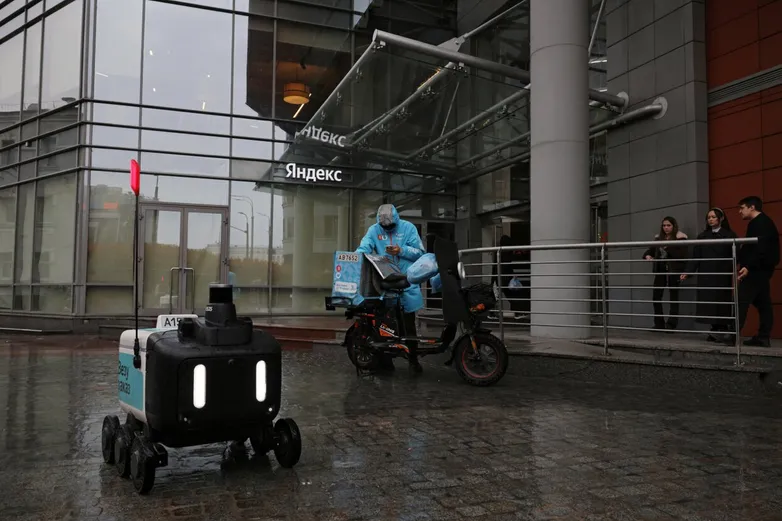
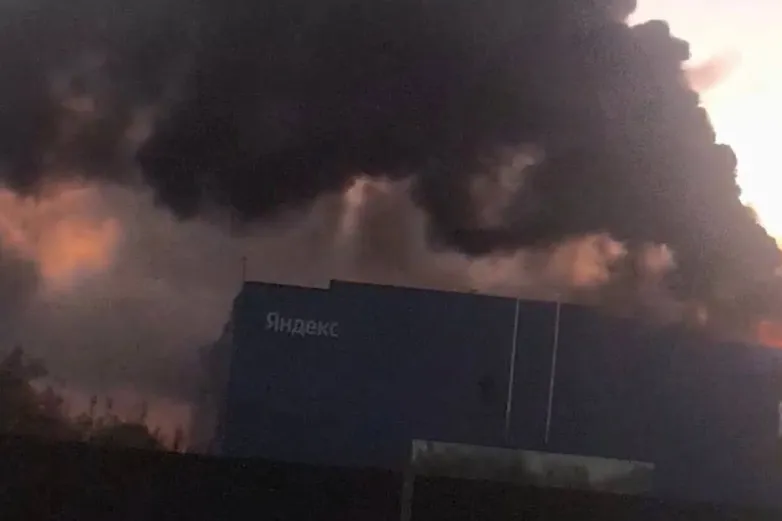
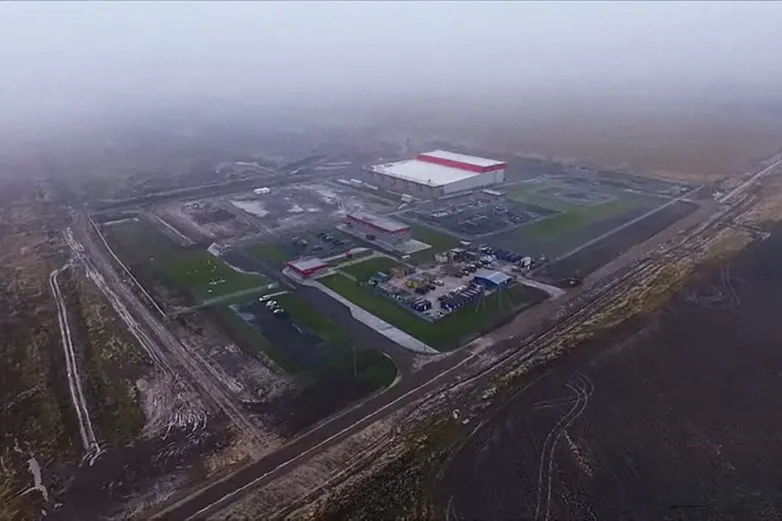
Why the supercomputers’ condition is the most pressing issue right now
The strike on Russia’s IT leader has sent shock waves across the Russian internet. For more than a week, Russian users have faced disruptions to services run by Yandex’s many cloud partners and other business customers, as well as outages affecting its own services, particularly Yandex Disk and Yandex Pay. The Russian internet is full of videos from users who have lost access — perhaps temporarily — to their data or money.
For Yandex itself, however, the main problem following the Ukrainian military’s attacks on its data centers is the partial or total loss of computing capacity. This matters for at least two reasons. The disabled data centers will hurt Yandex’s market capitalization, but more importantly, these problems could set back its AI development, on which its core business depends, by months or years.
After the first drone strikes on Yandex’s data centers on October 8 and 9, many investors remained moderately optimistic about the company: cloud services account for a small share of revenue, and workloads can be redistributed among data centers. At one point, its share price fell by a few percent. The third attack and the prospect of further Ukrainian drone strikes prompted more pessimistic financial forecasts.
Yandex does not report AI results separately in its financial statements, so its “Search and AI” segment provides the best indication. It has the highest adjusted EBITDA margin of any segment Yandex reports: 46.3% in the second quarter of 2026 and 44.8% for the first half of the year. By comparison, the “Urban Services” segment had a margin of 16%, while the entire B2B segment, including Yandex Cloud, contributes substantially less than search and AI. “Search and AI” also generated the most adjusted EBITDA in absolute terms.
The financial statements show that AI is already making a measurable contribution to advertising revenue growth. According to the company, its ARGUS recommendation technology accounted for nearly half of that growth in the second quarter of 2026. Although Yandex does not disclose the profitability of its AI products separately, its reporting shows how important AI is to the company’s finances.
“Yandex remains among the first companies worldwide to expand trials of AI advertising for businesses through Alice AI in search, on the website, and in the app. These formats take a fundamentally new approach to audience targeting. The algorithms consider not just the query but the full context of the conversation with Alice AI. This makes it possible to identify a user’s potential interests before they formulate a specific query.
“Advertising on AI platforms is already delivering measurable results: the cost of acquiring a customer is comparable to that of advertising in search. In chats with Alice AI, the advertising system has already displayed ads from more than 460,000 advertisers — three-quarters of all advertisers on the platform.
“Alice AI remains the most popular AI tool among Russians. In the second quarter, the number of users who complete tasks and chat with Alice AI each week rose 39% from the previous quarter to 33.2 million. The number of active Alice smart speakers each month increased 31% year over year to 22.5 million. Users are also increasingly using multiple devices: the number of people who own two or more speakers rose 44% to 4.7 million,” Yandex’s financial report says.
The main risk clearly concerns AI. The three supercomputers at two data centers power the development of the company’s neural networks and other parts of its AI ecosystem. If computing operations have to be suspended to clean up the damage from fire and smoke, the infrastructure responsible for nearly half of the growth in advertising revenue will be out of action for months. If the supercomputers are even partially damaged, development will be slowed for years.
One reason is sanctions restricting shipments of NVIDIA A100 accelerators to Russia. Obtaining them is extraordinarily expensive and difficult, as the operation to build the top-secret MGU-270 supercomputer at Moscow State University demonstrated. Another is the global shortage of advanced NVIDIA chips: supply contracts are booked two to three years ahead, according to both a T-invariant source at NVIDIA and another specialist at a global AI giant who asked that the company not be named.
As a result, development of YandexGPT and Alice AI has been suspended indefinitely. Yet demand for them is growing rapidly: according to Yandex B2B Tech figures cited on the Finam website, token consumption in Yandex AI Studio increased 18-fold over six months. Yandex’s service status reports currently list Yandex AI Studio as unavailable.
Why Yandex’s data centers were unprepared for war
“Yandex built its data centers and supercomputers in peacetime, for peacetime. All that development was geared toward normal everyday life. It never even crossed anyone’s mind that drones would come crashing through the roof. You don’t expect earthquakes or other natural disasters in the Ryazan, Kaluga, or Vladimir regions, so nobody thought about spending money on physical protection for the buildings,” said one of T-invariant’s experts in the supercomputing industry.
Public descriptions of Yandex’s infrastructure, particularly an article the company published in 2020, show the thinking behind the design: energy efficiency, backup power, simple and inexpensive cooling, and the ability to redistribute workloads among sites.
A source told BBC News Russian that Yandex regularly practiced taking one data center offline and shifting its workload to others. But the loss of several major sites in succession was probably never rehearsed. The source also said that services may have relied on two separate buildings in Vladimir, each serving as a backup for the other: losing both at once was considered impossible.
“In Russia, they usually build fairly basic ‘boxes’ to house data centers. There are no substantial walls or barriers, nothing like that, almost no liquid cooling, no sophisticated fire-suppression systems, even though advanced technology is available, including Russian technology. That’s all considered outrageously expensive ‘capex’ for Russian businesses. Nobody could afford it. Then there’s the extreme concentration of facilities. Around 70–80% of all data centers are located around Moscow and St. Petersburg,” said a supercomputing expert.
The first public calls in Russia for better data center security came just a couple of days before the first attacks. “One of the main tasks now is figuring out how to move computing capacity and all the IT workloads it handles farther away from Moscow, St. Petersburg, and the Moscow region… somewhere beyond the Urals, where, fortunately, strikes haven’t reached yet,” Deputy Digital Development Minister Yevgeny Filatov said at the Digital Solutions forum on October 6. On the evening of October 7, just hours before the first attack, RBC reported that representatives from the IT industry and the Digital Development Ministry were discussing the possibility of locating AI data centers in “friendly countries.”
BBC News Russian reported that Russian forces had already been striking data centers in Ukraine by then. From September 23 to 28, they damaged at least six such facilities. The attacks left people without internet access and disrupted television broadcasts. Russia’s Defense Ministry even posted an image on its social media accounts reading “Digital detox… by force.” As early as October 4, two days before Filatov’s remarks, Volodymyr Zelensky had warned of retaliatory strikes: “Do they really think we won’t respond?”
Other attacks in 2026 also showed that data centers are among the priority targets in wartime. Civilian data centers were hit by drones and missiles during the U.S.–Iran conflict. Amazon data centers in Bahrain and the UAE have been attacked several times since Washington began its bombing campaign against Iran. The company advised customers to move their data to sites outside the region because it was unclear when the facilities would resume operations. Iran’s Islamic Revolutionary Guard Corps also threatened to destroy the OpenAI Stargate data center completely.
“In Germany, I studied the Leibniz Supercomputing Center near Munich. It’s a windowless cube surrounded by a moat so you can’t ram it with a car. You enter by crossing a small suspension bridge. The cube itself is essentially a building within a building, a Faraday cage [an example of architectural radio-frequency shielding]. So they really have taken serious measures to protect it, physically and in other ways.
“And this supercomputer ranked below Yandex’s Chervonenkis in the top 500. But the Germans invested heavily in protection. That kind of protection won’t stop ballistic missiles, but it can certainly stop drones. We also know of some incredible underground data centers in Norway and Finland. Another example is Alibaba’s supercomputing center in China. Almost all the leading supercomputer operators in the top 500 spend freely on [capital investment], installing sophisticated liquid- or immersion-cooling systems. Russia’s IT leaders cut costs on all of that,” the expert said.
In Norway, Lefdal Mine houses its server rooms in a former mine, about 700 meters (2,300 feet) inside the mountain from the entrance. The site provides physical protection and uses cold fjord water for cooling. Some of the supporting infrastructure, including generators, remains on the surface.
The Finnish facility The Rock, in the Pori area, uses nine chambers in tunnels originally excavated for military purposes. The underground facility covers about 8,500 square meters (91,500 square feet), is protected by the surrounding rock and is divided into security zones. Its specialized infrastructure includes direct liquid cooling.
Who will end up getting a ‘digital detox by force’?
Of Russia’s six largest supercomputers, only Sber’s two machines are at a site relatively well protected against drone attacks. Christofari and Christofari Neo are in Skolkovo, which has better air-defense coverage. MTS’s GROM supercomputer is in Lytkarino, in the Moscow region. Yandex’s remaining data centers are also in the Moscow region, in Mytishchi and Ivanteyevka. All these towns near Moscow regularly face large-scale Ukrainian drone attacks.
“Getting supercomputers of this caliber back up and running simply isn’t possible now or in the near future. It’s not even a question of having the money. The main problem isn’t even sanctions — it’s the shortage of chips and other components. There’s a huge waiting list for them worldwide. But the costs of gray- and black-market imports are also very high. So things really suck these days,” said a supercomputing specialist who spoke to T-invariant.
The next update to the global top 500 supercomputer ranking will be published in November. Chervonenkis currently ranks 101st, while Kazakhstan’s Alem is 104th. Kazakhstan’s second machine is 122nd, ahead of every other Russian supercomputer. T-invariant’s experts have no doubt that the Ukrainian military’s retaliatory “digital detox by force” will leave Russia behind Kazakhstan as early as this fall when the countries’ leading supercomputers are compared in the top 500 ranking. Competing with the United States, China, or Japan is out of the question: Russia already trails them by two orders of magnitude.
As T-invariant previously reported, the Netherlands is also among the countries ahead of Russia in the top 500. Two machines operated by former Yandex head Arkady Volozh’s company Nebius are listed under the Netherlands: ISEG, which ranked 12th when it was launched, and ISEG2. Together, they have a peak performance of about 425 petaflops. According to the government’s plan for developing the mathematical sciences through 2036, the five Russian machines in the top 500 have a combined peak performance of less than 100 petaflops. That gives Volozh’s company alone more computing power than all the Russian systems on the top 500 list combined.
At Meduza, we are committed to transparency about our use of artificial intelligence in the newsroom. The story you’re reading was written by one of our living, breathing journalists and translated from Russian using an AI model configured to follow our strict editorial standards. This translation process is the result of extensive testing and refinements to ensure our English-language coverage is timely and accurate. A Meduza editor reviews every draft before publication.
If you find any errors in this translation, please contact us at [email protected].
To read Meduza’s exclusive content in English, please subscribe to our newsletter.
T-invariant