
stories
Yelena Morgunova, wife of Russian performance artist Pavel Krisevich, describes two arrests, threats against her family, and an ultimatum to leave Russia
Source: Meduza
Yelena Morgunova
Ekaterina Mamontova
On October 10, protest artist Pavel Krisevich said his wife, Yelena Morgunova, had managed to leave Russia after a series of “back-to-back” arrests. Police detained Morgunova in the Ryazan region on August 28 after she returned to Russia for a brief visit with relatives. Krisevich and Morgunova had been living in France since late 2025 — they left on a humanitarian visa after the artist served two jail terms for administrative offenses. In an interview with Meduza, Morgunova spoke about her detention, life in a Paris squat, and her relationship with former Pussy Riot member Rita Flores, who recently admitted to cooperating with Russia’s Federal Security Service (FSB).
Warning: This article contains profanity.
‘What if they gave you some assignment — to bring in explosives?’
— Where are you now?
— I’m in Europe now, on my way to Paris to join Pasha. The problem is, I can’t fly because Céline [Morgunova and Krisevich’s dog] has a short, brachycephalic snout, and there’s a risk that the pressure inside her skull could rise on a plane. So I’m taking trains.
It’s quite an experience. I used to think of France and Germany as some other planet. But when you travel like this, you see how close everything is.
— How are you feeling?
— I’m okay, in a sort of survival mode where you have to hold it together and can’t fall apart. I had to hold it together in the detention center. Then I got out, and right away I had to figure out where to stay, how to get [to France with the dog]. I still haven’t had a chance to settle anywhere.
— What are your plans now?
— We’ll apply for family reunification so I can get a [French] residence permit and permission to work [Morgunova previously had a French humanitarian visa, but it expired]. Then I’ll look for work so I have some money and can help my family. If I can’t see them, at least I can help them that way.
Unlike Pasha, I didn’t apply for asylum at first. I wanted to be able to visit my parents in Russia from time to time.
— Why did you have to go to Russia now?
— I wanted to visit my family. And everything sort of came together: I had nowhere to live in Paris. Maybe if I’d had somewhere to stay, I would’ve gone after the elections, once everyone had calmed down. But I was already emotionally exhausted, and I wanted a little break somewhere familiar. Besides, I had my own place in Moscow.
Pasha and I were living in really difficult conditions in France, in a squat — an abandoned office. Russian-speaking artists and other creative people occupied one part of the space. They’re wonderful people, and we’re friends. They’re helping us however they can now, even though they’re barely scraping by themselves. Our half was pretty cozy, and there was a kitchen. But it was still hard to live like that. We lived in a coatroom; we didn’t even have a window.
People from Arab countries occupied the other half. Many were just passing through and didn’t clean up after themselves. Someone might just pee in the hallway. That was a bit of a shock for me.
Yelena Morgunova and Pavel Krisevich in their “room” in the squat. It used to be a coatroom
Ekaterina Mamontova
We thought it would be temporary, but it dragged on. We arrived in France on June 3 — I remember because it was my name day — and lived there for almost three months. The paperwork took longer than we’d expected. At first, we hoped they’d give us housing together, because France has a law against separating families. People advised us to try [to get housing together], because everything in France is so random — maybe they’d accommodate us.
And at first, they really did try to accommodate us; they asked us for more documents. But in the end, despite a pile of recommendation letters and all the required paperwork, they told us only Pasha could get temporary housing in a dormitory [for refugees], and that he’d be better off taking it.
He got housing. I stayed for a couple of weeks in the apartment of some people I knew who were on vacation, then went home [to Russia] to my mom.
I looked for work in France. But it’s almost impossible to get a work visa while you’re already in the country. It’s much easier for local companies to hire people who already have permission to work. That’s why I kept getting turned down. And when a job opportunity came up, I went to Russia. I thought I’d wait there and, if I got an offer, apply for a work visa. Then I’d return to France on that visa.
— When you flew to Russia, did you consider the possibility that you might be detained?
— I’d planned from the start to keep visiting Russia. All my social media accounts were private, I kept a pretty low public profile, and I didn’t take part in Pasha’s protests. I didn’t think I was at much risk — it seemed like there was a rule that, for the most part, they left people’s loved ones alone. Besides, after Pasha left Russia, I lived in Moscow for about another six months, and I had no problems.
When I arrived in Russia, they checked my passport at the border — everything was calm. I spent two days in Moscow. Then my aunt invited my mom and me to the Ryazan region to see my nieces and help her dig up potatoes. My mom, the dog, and I set off for Skopin. I wasn’t feeling well, but I decided to go even though I had a fever. We never made it there, though.
The squat in Paris where Morgunova and Krisevich lived
Ekaterina Mamontova
— How did they detain you?
— My mom and I were on the bus, almost in Skopin. Suddenly, the bus stopped and two police officers got on. They came over to us and said they were conducting some kind of operation: checking the passports of people who’d returned from “unfriendly” countries.
They took us off the bus, and we went to the local police station. At the station, they asked me, “Your husband wouldn’t happen to be a ‘foreign agent,’ would he?” I said, “‘Foreign [agent].’” They said, “Then we have to check your phone.”
I didn’t want to unlock my phone. I told my mom to prepare herself: I’d be spending time in jail [for an administrative offense]. They kept me at the station for a while. Then they took me to the station chief, and he asked, “Will you hand over the phone, or will you put up with what’s coming?” I said I’d put up with it.
Then they took me to court. The court record said I’d supposedly failed to show my passport. I thought maybe they’d mixed something up… I thought, great, maybe I’ll serve a jail term for an administrative offense and get out with my phone. Pasha had given me that phone and said, “Please don’t lose it or let anyone steal it.”
I didn’t admit guilt in court, but when they gave me the record, it said I had. I asked the judge’s assistant, “Why does it say that? I didn’t admit anything.” She said nothing.
I wrote that I agreed with the record. It was clear anyway that once they’d detained me, they weren’t just going to let me go [and I’d have to spend some time in jail for an administrative offense].
— Had you faced any administrative or criminal proceedings before?
— I faced administrative charges four times over rallies and pickets in 2020 — back when we still believed we could change something.
My first rally was over the “Network case.” But I’d never been held in a detention center. And I’d always passed every security check when applying for jobs.
— On what grounds did they detain you?
— They took us to the station because I’d “recently been in an ‘unfriendly’ country.” And once we were there, they arrested me for supposedly failing to show my passport, which wasn’t true. By then, my cold had given me a fever and a terrible headache. I could barely stand.
I signed the court record — I thought, who cares anymore, a lawyer isn’t going to come anyway, and there won’t be an appeal. I thought they’d take me to the detention center, I’d lie down, and I’d quietly serve out those days.
But they took me to another office. There were six FSB guys in plain clothes. Two were definitely from Moscow; the others were local, as far as I could tell. They all had different roles.
One was hysterical and aggressive, shouting, “Who do you think you are? I’m not going to address you politely; you haven’t earned it.” I told him I was used to being shouted at — I’d grown up with it — and it wouldn’t work on me. Then he started threatening my mom and my dog, who were still at the station. That really floored me, because I hadn’t expected anything like it. I’d been detained illegally before, too, but in Moscow they’d been more or less polite.
Actually, the interview with Rita [Flores] that I’d watched the day before helped me. She said they’d used her mom to pressure her, too. And the lawyer Dmitry Zakhvatov told her that the real threat was most likely criminal prosecution for “fake news,” rather than anything happening to her mom.
I don’t remember exactly how he threatened to kill the dog, but at one point I said, “Are you officers or animal abusers?” After that, he just kept saying they’d throw her out on the street and other dogs would tear her apart.
A drawing Yelena Morgunova made in detention on a cardboard tea bag box. It shows an officer looking into the cell through an opening in the cell door (the “food hatch”)
Morgunova and Krisevich’s dog, Céline
A drawing Yelena Morgunova made in detention on a cardboard tea bag box. It shows an officer looking into the cell through an opening in the cell door (the “food hatch”)
Morgunova and Krisevich’s dog, Céline
When they started threatening to arrest my mom too, put her in the next cell, and make me listen to her screams, I figured they were bluffing. So I always gave the same answer: I give you permission to take my phone for inspection; let’s write up the paperwork. I sounded like a broken record.
There was another FSB guy, apparently from Moscow — a real dandy with slicked-back hair. Tanned, with shiny skin. He was calm. And there was a young guy from Skopin who kept telling me, “I really feel sorry for your mom and your dog. But this is all your fault.” It went on for a long time, several rounds. They all took turns talking. “What if you’ve been recruited? What if they gave you some assignment — to bring in explosives?”
‘I knew that if this continued, I’d grab a pen off the desk and keep hitting my wrist with it so they’d think I was unstable’
— When were you detained the second time?
— When I got out of the detention center. It’s all in the same little courtyard: the detention center and the police station’s duty desk. They took me into an office with a giant DPR flag and a poster with cringey quotes from Dzerzhinsky: “Your clean criminal record isn’t your achievement — it’s our failure.”
An officer there said, “I think you take drugs.” I asked him where he thought I’d taken them, given that I’d been in the detention center. Never mind that I don’t take them at all. He said my pupils were dilated and my cheeks were red.
They called in witnesses to observe the procedure. In front of them, he asked whether I was refusing a medical examination. I kept saying they should let me see a lawyer first, because accusing me of taking drugs was serious. I was afraid that without a lawyer, they’d take me somewhere and anything could happen there.
He said, “Do you like it abroad? Your husband is a political prisoner.” I said, “My parents are here.” Then he started asking whether I supported my husband’s protests. I said, “Let’s not have these conversations. Only with a lawyer.”
I was shocked by what was happening, and I still had a fever… And this song kept running through my head: “If they’ve picked you up, take a deep breath… […] I don’t know anything. I’m a housewife, I listen to love songs.” I really love it. I kept saying I didn’t know anything and couldn’t remember anything.
From Meduza’s archives
— You told the Telegram channel No Future that you were arrested because you’re Pasha’s wife.
— Yes. They wanted to send me for a medical examination to check for drugs, and they wanted me to go without my phone. I got scared because I didn’t know where they’d take me or what they’d do there. Besides, I knew a lawyer was waiting just outside the door, and I asked them to let her in. Of course, they didn’t.
When I was sentenced again, instead of taking me to the detention center, they took me back to that office. There were two men there again: the “dandy” and, apparently, his boss. The boss said, “What’s your name?” And for me, the scariest and most unpleasant part was these conversations outside any formal legal procedure.
I said, “You don’t know my name? Ask your colleague.” He said, “I’m not asking my colleague. I’m asking you.” I introduced myself. He said:
— Do you know why you’re here?
— Explain it to me.
— Who’s your husband?
— My husband is Krisevich.
— And you’re here because you’re his wife. Do you like living this way?
And he asked, “Why do you look so sad? Did something happen? This will keep happening over and over, over and over.” I asked:
— What do you want?
— We want you to leave as quickly as your husband did. Understand?
— I understand. But I won’t be able to leave that quickly.
— How many days do you need?
And they gave me three days to leave.
— Do you think they were trying to figure out whether they could recruit you?
— I think they were testing the waters. That’s what the lawyer thinks.
— Your lawyer, Nataliya Tikhonova, said they suggested you “leave” Pasha. What exactly did they say?
— They said, “What do you need Pasha for? He got you into this. You’re here because of him; he ruined your life. You could be working in peace right now.” I think they were testing the waters, looking for a rift they could then use to put pressure on me.
Hi, I’m Katya.
I’ve been running Meduza’s crowdfunding since 2021. Today, supporting Meduza is a crime in Russia. You can be sent to prison just for donating. We’re still able to do our work thanks to thousands of our Russian readers who now live abroad. But even they’re no longer safe.
Imagine you’ve left Russia, but then your mom becomes seriously ill. It could be your last chance to see her, so of course you go home. At the border, you’re interrogated. Officers hack into your phone and search for any trace that you’ve donated to Meduza.
The Kremlin is counting on that fear, and it’s working. People are afraid to donate. I’m afraid for our supporters, because any one of them could end up in prison. And I’m afraid for Meduza. Without crowdfunding, we simply can’t continue. So if you live outside Russia and don’t have to worry that donating to Meduza could keep you from going home to your family, I’m asking for your help. Please support our work.

— Did you end up handing over your phone?
— [Even before the first arrest,] they interrogated me, and I kept giving the same answer. They took me to the detention center and said, “Be tougher on her.” I spent some time there, and then they called me back to their office.
I walked in, and my mom was already sitting there with [our dog] Céline. As I found out later, they’d pressured my mom too, insulted her, and so on.
Céline was trying to get to me. They started pressuring me again, and I kept giving the same answer again. The dog lunged toward me. And then my mom couldn’t take it anymore and started crying. That high-strung officer started pulling the leash out of my hands. I unclipped it from the harness. Then he started pulling on the harness: he pulled one way, I pulled the other. Céline pressed herself against me. I dug my fingernail into his hand so he’d let go — without thinking, it was just my reaction. And he said, “Keep digging your nails in, and you’ll go to prison under Article 318.”
My mom is very naive. They told her that if I gave them my phone password, I’d be out on Monday. I said, “Mom, that’s not going to happen.” And I watched her get up from her chair, walk over to them, and say, “Please don’t, please don’t.” I was afraid she’d have heart trouble or her blood pressure would [shoot up]…
And I gave them the phone password. They unlocked it. Then they let my mom and the dog go. But I also had a passcode on Telegram, which they hadn’t noticed.
I went back to the detention center. After a while, they called me in again and said, “Tell us the Telegram passcode.” I said, “I don’t remember; the stress has wiped my memory.” I didn’t have the strength to actively resist anymore, so I just started trying to trick them. I entered the wrong passcode several times. I don’t know how long all of this lasted.
They took me back to the detention center. Then they called me in again at night and said, “Do you know Nadya Tolokonnikova?” I said, “No.” They said, “You’re fucking lying. We hacked your Telegram.” They brought in my phone — and Telegram was open, with my messages with Nadya. So [Pavel] Durov’s security is really unreliable; he gets a thumbs-down from me.
When it was finally over, one of the FSB guys said, “Go get some sleep. If you want to get out early, ask for me.” It was Friday, and they didn’t work on weekends. And those days were the scariest for me — I was afraid they’d come back and these conversations would start again.
Sound carried really well in that place: you could hear everything happening in the hallway, every phone call, every word, every whisper. You’d jump at every sound. But I already had a plan. I knew that if they kept this up, I’d just grab a pen off the desk and keep hitting my wrist with it so they’d think I was unstable. Knowing I had a backup plan calmed me down.
The lawyer came on Saturday. We talked everything over and agreed to go public so this recruitment attempt, if that’s what it was, would stop. After that, they didn’t come back.
I also had a PTSD episode because they all addressed me with the informal “you.” My aunt sent me shampoo in the detention center, and I was reading the instructions, which said, “Your hair will shine,” using the informal “you.” I thought, damn, why is this shampoo talking to me like a cop?
A drawing Yelena Morgunova made in detention
— What else stands out from your time in detention?
— I remember that despite all of this, there were humane, kind people there, too. But I can’t go into more detail, because I don’t want anyone to get into trouble for acting like a human being.
I also remember my cellmate Lena, who I spent three days with. When I first arrived, they told me I was lucky: Lena wasn’t there. They said she threw fits and attacked people. They only put her in with me during my second jail term.
At first, I’d sometimes hear detention center officers walk past her cell and taunt her. For example, she was due to get out on August 20, but they’d tell her, “You’ll get out on the 30th,” and she’d start crying really hard.
She was in for violating court-ordered supervision, and before that, I think she’d been convicted of causing serious bodily injury and robbery. But most likely she’d just taken the blame for those crimes — she was a little crazy.
Once, I heard her crying again, and some friends had just sent me a pastry, so I said [to the guards], “Give it to Lena.” They did. The next day, I heard her refusing all food, saying she only wanted black bread. My aunt had sent me a care package then. I put together some things from it for her and said, “Give it to Lena,” and they did that, too. Then the next day, the guards came and said, “The chief says you need to be moved into a cell with Lena. There’s just one problem — she smells.”
Lena turned out to be an absolutely lovely woman. She’s about 57, and she told me her stories. Even though she’s a little crazy, she understood a lot of things better than other people. For example, she’d say we should give them [the guards] and their children the food they fed us, and see how they liked it.
She also told me why they didn’t pick on the others: the others had relatives who’d complain if something happened — but she was an orphan, and there was no one to stand up for her. I kept telling her she’d serve exactly as much time as the judge had ordered, and no one could change that.
When Lena and I were put in separate cells, I heard an officer come back and start tormenting her again, and she told him, “I’ll serve exactly as much time as the judge ordered.” I thought, “Oh, she learned that from me!”
Another time, I heard a different officer go into her cell and start speaking to her rudely: “When you go to the shower, you’ll be washing in your own piss.”
I told him, “If you keep mistreating her, I’ll file a complaint. She’s behaving herself, and you should too.” After that, they stopped.
I don’t understand that kind of humor. Maybe working there for a long time warps you somehow.
— How did your mom cope with all of this?
— It was really hard for her. In the detention center, I tried to tell her I was fine so she wouldn’t worry so much. But when they said I had to leave like that, it was hard. I’m an only child, and I never wanted to leave for good. We spent those three days together. Mostly we dealt with paperwork and arranged powers of attorney.
— So they got access to your phone and your messages. Do you think they could have learned anything from them?
— I think everyone had time to delete their messages with me, because Pasha found out I’d been detained.
Pavel Krisevich and Yelena Morgunova in the squat in Paris
Ekaterina Mamontova
— You mentioned Rita Flores. Do you think the security services’ interest in you could be connected to her recent interview?
— I don’t know how much it could have to do with the interview. They asked me about Nadya [Tolokonnikova], Rita, and [Marat] Gelman. Those were the people they were interested in.
— What did they ask?
— Whether I was in touch with Rita. And they asked about Nadya — she put Pasha in touch with Babel, which published his book. They asked where Pasha got his money — I laughed at that question. They asked about Gelman, how Pasha was connected to him [Pasha had stayed at his artist residency]. I told them things that were already public knowledge.
I think my detention was more likely connected to the elections — and to the fact that I went to Skopin. Apparently, the local FSB guys in Skopin are a bit unhinged. I even think that if I’d stayed in Moscow, maybe things would’ve been more civilized.
The Moscow FSB guys knew Pasha well. And they’d had time to prepare. They knew my father had had three strokes and wouldn’t survive finding out I’d been detained. They knew Rita’s and Nadya’s patronymics.
— Why do you connect your detention to the State Duma elections?
— I think it was some kind of preventive measure, because they let me go the day after the elections. They were playing it safe and doing what was expected of them — to show their bosses they’d done everything they could.
‘Even Artyom Kamardin asked in every letter from prison whether Pasha and Lena had left. But we didn’t want to leave’
— Do you believe what Rita Flores said in her interview?
— I do. We really were in touch when Pasha was detained, and she really did try to persuade us to leave. The only problem was that it was impossible to persuade Pasha.
But when Pasha was designated a “foreign agent,” we considered leaving as a backup plan — it’s just hard for “foreign agents” to comply with the law. We started looking into visa options even then. We just didn’t think it would become so urgent.
Pasha and I talked on the phone [when he was in prison], and I told him lots of our friends were advising us to leave. Even Artyom Kamardin asked his wife Sasha in every letter whether Pasha and Lena had left. Artyom was really worried something might happen to us. But we didn’t want to leave, because we had a more or less settled life.
Pasha had a job, too. He worked at a Yandex warehouse as a self-employed contractor. When all his shifts disappeared after the “foreign agent” designation and he couldn’t book new ones, his boss started looking into what had happened. It turned out Yandex’s head office had blocked him.
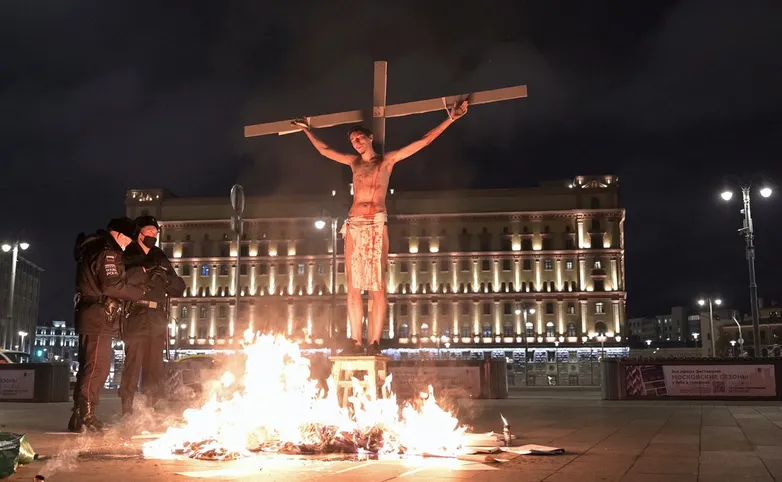
Pavel Krisevich’s protest outside the FSB building. Moscow, November 5, 2020. During the performance, Krisevich stood on a stool, tied his arms to a cross, and simulated a crucifixion. Other activists, wearing coats marked “FSB,” piled up and set fire to volumes of criminal case files labeled “Boris Nemtsov case” and “Khachaturyan sisters case” (the authorities’ investigations into both cases drew public criticism; whoever ordered Boris Nemtsov’s murder has not been found, and the three Khachaturyan sisters, who killed their father, who had been raping them, remain under arrest). The protest was held in support of political prisoners. Afterward, Krisevich was jailed for 15 days and expelled from RUDN University, where he was studying
Georgy Markov / AP Photo / Scanpix / LETA
— In her interview, Rita Flores said she tried to drive a wedge between you and Pasha, and that she supposedly told you Pasha didn’t think about you at all.
— That happened. Pasha and I really did have a falling-out when he went to jail for a protest I’d asked him not to stage. We had a huge fight. I was hysterical, and Rita happened to message me then and ask, “How are you?”
I needed to get it off my chest, and I wrote to her that I was really hurt, because I had a new job and was struggling, and he’d gone to jail. Though of course he hadn’t planned on going to jail either. Anyway, I wrote all that to Rita, and she just supported me.
Maybe she wrote what she actually thought, but I figured she was just the kind of friend who always takes your side. And I didn’t make much of it. I just don’t believe anyone can drive Pasha and me apart.
Rita and I keep meaning to call each other, but it never works out. Either I’m busy or she is. I hope everything turns out okay for Rita.
— During your second jail term, did you expect them to let you leave?
— When I was getting out after the second jail term, I didn’t know what was waiting for me. Would there be more, or would they let me leave? At that point, they didn’t give me my phone back, and they took me to an office where there was an investigator.
He was like, “How’s it going?” I said, “Fine.” He said, “Well, in our line of work, the main thing is not to lose your optimism. What are your plans?” I said, “Well, as we agreed — I’ll leave.” And he was like, “Okay.” Then I knew that was it, they weren’t going to keep me there. When I left the detention center, they gave me my phone back.
— Why do you think they let you leave?
— I think it’s because they let Pasha leave. We do live in a very sexist society, after all. There were some really horrific stories recently involving Kynev and Morozov; apparently, they don’t get that brutal with women. I think, yes, it’s because I’m a woman. And if they didn’t put Pasha in prison, maybe they thought putting his wife in prison wasn’t something a real man would do.
— I take it you won’t be going back to Russia?
— Not anytime soon. It’s really hard. It feels like I’ve been torn away from my life in Russia. It breaks my heart that I can’t see my mom. But I’m trying not to fall apart and to set some new goals here.
At Meduza, we are committed to transparency about our use of artificial intelligence in the newsroom. The story you’re reading was written by one of our living, breathing journalists and translated from Russian using an AI model configured to follow our strict editorial standards. This translation process is the result of extensive testing and refinements to ensure our English-language coverage is timely and accurate. A Meduza editor reviews every draft before publication.
If you find any errors in this translation, please contact us at [email protected].
To read Meduza’s exclusive content in English, please subscribe to our newsletter.
Interview by Yelizaveta Antonova