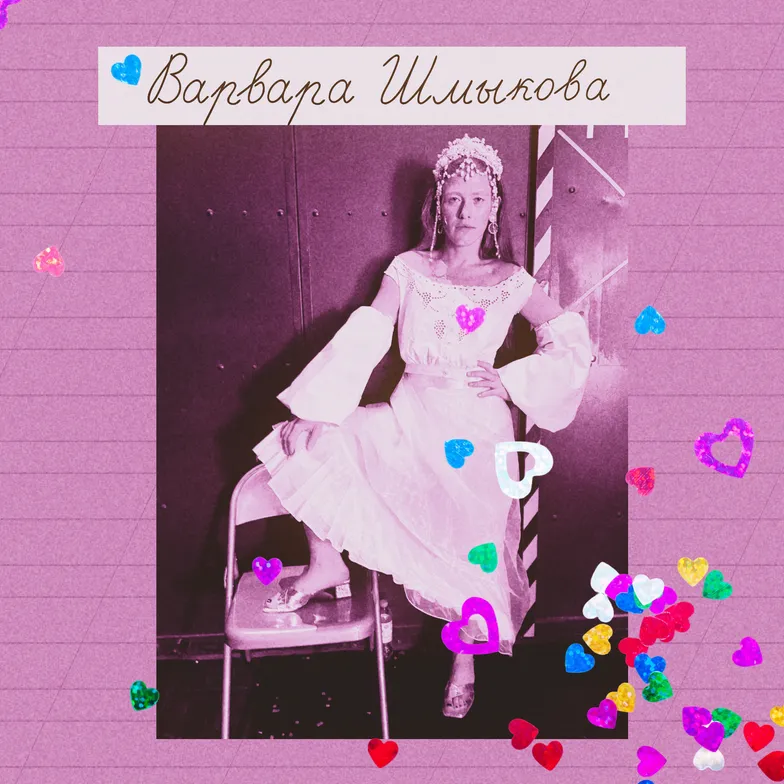
Actor Varvara Shmykova speaks to Meduza about life in Berlin, German bureaucracy, food, and losing touch with Russia
For the latest installment of our “Emigrant Questionnaire,” we sent our questions to actor Varvara Shmykova in Berlin. Unlike our previous participant, Zina Pshennikova in Barcelona, she doesn’t miss Russia. But she does have a sense of home that isn’t tied to any particular place.
This is the fifth installment of the “Emigrant Questionnaire.” Previous participants include Monetochka, journalist Vladimir Rayevsky, and English teacher Elmira Drau.
Warning: This article contains adult language.
More on Russian émigrés
‘London and I are a perfect match.’ Journalist Vladimir Raevsky talks about his adopted city for Meduza’s new series of questionnaires with Russian émigrés.
How do you start over in a foreign country with $500, no job, and a cat to feed? Elmira Drau, a Russian émigré who teaches English, tells the story of her flight to Armenia and the life she built.
Life in exile: Russian singer Monetochka thought Vilnius would be a stopover. Four years later, she says she may stay forever.
What’s your name?
Varvara Shmykova
Where do you live, and how long have you lived there?
I’ve been living in Berlin for four years.
What do you love most about your new country?
I always wanted to live in Russia. I’m a Muscovite, and I love Moscow like crazy. But when I first came to Berlin about seven years ago, I thought, “Oh, it would be cool to live here for a while.” Out of nowhere, for some reason.
It was winter, it was cold, I was walking around in a fur coat and boots, and there was this light snow falling. But that didn’t put me off the idea. As they say, be careful what you wish for. I don’t know about living happily ever after here, but I’m grateful to Berlin as a temporary base.
I probably love the community here most of all. In all four years, I haven’t once come across indifference. There have always been people to help me figure out which piece of paper I need, how to fill it out, where to submit it. And of course, there’s Kirill & Friends — a company that’s more than just a GmbH. It’s an important part of my life and of cultural life in Berlin and Germany as a whole.
Varvara Shmykova’s personal archive
What was hardest to get used to in your new country?
The weather! It’s amazing: When we were kids, it would get down to minus 30 Celsius [minus 22 Fahrenheit], and we’d go to school — that was completely normal. But my first winter here, I was shocked by how cold I felt. It barely even got below freezing, really, but you feel like you’re freezing to death. I still can’t get used to it.
And of course, the bureaucracy is a disaster. When I moved, all I knew about Germany was Ostermeier and Eidinger. Then I started sorting out our residence permits and learned about all these faxes, the mail, the deliveries you never know whether you’ll actually get. You can literally be lying around at home and get a text: “We couldn’t find you at home, so we didn’t deliver your package.” And you think, “Well, where did you find me, then, if not at home?”
Another thing I still can’t get used to is that everything here revolves around Ordnung — order. Everything has rules. A creative person turns things upside down, thinks big, gets a little audacious, comes up with ideas along the way. Here, it doesn’t work like that. For example, we were putting on an opera with Kirill Semyonovich [Serebrennikov] in Berlin, and the rules said to take a 15-minute break every hour or so. And it didn’t matter whether we were rehearsing onstage or Kirill Semyonovich was speaking — everyone got up and left. Just walked out. And we Russians are thinking: How is that possible?
We go too far the other way: We’re used to working our fucking asses off. From the moment you’re born, it’s everyone for themselves — what you get depends on how much work you put in. And I just don’t think you can put the creative process on a schedule. If inspiration is flowing, or a rehearsal is finally getting somewhere — it’s simply a sin to stop it.
But those same rules are why you see happy families out on the street, see dads out having a great time with their kids. You see moms sitting down for coffee with their girlfriends while the dads put the kids to bed. I’m getting used to all of this, trying to find a happy medium.
What’s your favorite place in your new city?
Vabali! I love Vabali: I’ve been to the one in Düsseldorf and the one in Berlin. I’ve been about a hundred times. My husband even once gave me a pass for 12 free visits. I love bathhouses; I’ve been going since I was about 4.
Another bonus is that you have to leave your phone in a locker and forget about it for four and a half hours. It’s good for me to switch off for a bit: My phone is where I network, work, and entertain myself.
My son and I sometimes argue about it. He says, “You’re always on your phones.” I try to explain: Here I’m arranging who’s going to take him to a tournament; here, who’s going to do my makeup for my upcoming concert in Paris; here I’m putting up a post. Most of my life really does happen on my phone. But I have to say, Berlin has taught me to put it down, partly because of Vabali and partly because life here is generally slower than in Moscow.
What’s your favorite local food?
The food here is total crap, honestly. We’re not exactly regulars at restaurants, bars, and clubs. We mostly cook at home — my husband cooks. It’s actually funny: When people come to visit Berlin and ask where they can go for a big night out, I don’t know what to tell them. All I can think of is playgrounds and parks where you can run around.
I have a hard time imagining someone who seriously loves German food. I have a friend who’s a performer, and he loves that sandwich with raw ground meat and onions. It’s just awful, and he eats it at 10 in the morning before rehearsal. We could kill him.
I just want soup: homemade noodle soup, cabbage soup, borscht, cream of mushroom or vegetable soup. Unfortunately, there’s none of that here. There are Bavarian sausages, cabbage, meat, and potato salad.
Have you taken up a new hobby?
I’ve started recording poetry readings for Instagram. It gives me a way to connect with people watching from different places, and just a chance to express something. I love singing. It’s part of my profession, but I treat it as a hobby because I’m not a professional singer.
Have you managed to make new friends? How?
Yes, I have. Mostly people I meet through work. I do an opera or a film, and I end up with a bunch of friends. Russian speakers, Germans, and people who aren’t German. We all keep in touch, and some of us are even neighbors.
But that’s the kind of person I am: If I had a dog, I’m sure I’d make new friends at the dog park. Like a kid in a sandbox: Wherever you put me, that’s where I’ll make friends.
My sandbox is the arts. I’ve never finished a project and just said goodbye to everyone for good. No. I end up having this great connection with everyone. Some of us keep working together. I’m also finding amazing creative people here who left Russia too — people I didn’t know before, but we met here and have become very, very close.
Varvara Shmykova’s personal archive
Do you have enough money to live in your new country? How do you deal with financial difficulties?
During our first year in Germany, our local tax guy [meaning a tax adviser] said, “If you thought you were coming to live in wealthy Germany, you picked the wrong country.”
There really is a huge problem here with the lack of a middle class: People are either superrich or below the middle class. In Russia, I think I was always comfortably middle class: I never complained about not having money; I had enough of everything.
But the system here is: The more you earn, the more tax you pay. And at some point you think, “To hell with it, I’m not going to work at all. I’ll do what I enjoy.” Financially, we’re more or less okay. And I’m also the kind of person who’s honestly scared of all those tax returns, papers, documents.
I don’t know how to do any of that, I don’t like it, and I don’t want to. But here I’ve had to figure some things out: Now I know exactly what goes where. I’ve got some pretty serious bookkeeping going on in my head.
In my profession, you depend on other people quite a lot, and there’s no stability. I don’t get a paycheck once a month, and that can be scary. This summer, for example, was a total disaster: Some big projects had finished, and the new ones hadn’t started yet. At one point, all I had left in my account was enough for one rent payment. I was terrified.
Of course, I know August is coming and there’ll be projects ahead. But right now, none of that work is here yet. So I’m learning to be more careful with money. I’ve never really lived extravagantly — buying pointless bags and shoes, that sort of thing. I’ve always been sensible and bought what I need. Of course we treat ourselves: We travel, and my husband and I surprise each other with gifts. Even so, I think we’re pretty frugal about everything. Germany teaches you to live even more mindfully. You sort your trash, return bottles, use fewer bags. Or, for example, lots of people in our circle are having babies, and there’s already a whole chain of who passes what on to whom: strollers, toys, books. It’s a wonderful way to keep things in use.
Varvara Shmykova’s personal archive
What are you doing to learn the new language?
I started studying the language when we began working on the production of “Metel” (“The Blizzard”) by Kirill Semyonovich [Serebrennikov]. It’s based on Vladimir Sorokin’s novella, and we perform it in German. That’s when I started using Duolingo. I know it sounds funny, but it has given me something of a foundation.
When I first started learning my lines, I had no idea what I was saying — to me, it was just one enormous audio track. A year later, I realized I could make out the individual words. I tried to figure it all out. And our German colleagues helped too, with pronunciation and explanations. They were warm about it, with no snobbery.
When I talk to native speakers, I always feel a bit awkward — and apologize a hundred times. But usually they say, “What are you talking about? You’re doing great.” And I’ve noticed I do the same thing: I have German colleagues who are learning Russian or have studied it before. When they start speaking it, I’m thrilled, and it never occurs to me for a second that they mispronounced “buterbrod” [the Russian word for sandwich] or got a verb conjugation wrong. I’m happy to encourage them, and I’m really interested, and I realize that’s probably how people feel about me too.
So I need to be less self-conscious and speak more. These days, I often speak German with taxi drivers, with women working in stores. That’s my level for now.
If you have children, would you like them to become locals?
I feel like kids can do anything! My older son, Korney, has completely settled in socially: He already speaks both English and German. And my younger son, Lukosha, is getting both English and German at preschool too. His friends are German, Turkish, and other nationalities. So as far as I’m concerned, the more they can absorb, the better.
Varvara Shmykova’s personal archive
How do you cope with intense homesickness? Do you feel it at all?
I don’t. I definitely care about what’s happening there. My family lives there, and as long as that’s true, my thoughts will keep me connected to Russia. And however many years I live elsewhere, wherever that is — France, America, Germany — I’ll always be a Russian actor. I don’t reject that. In fact, I’m proud of it.
And I believe I have the right to talk about what’s happening in Russia: to watch from the outside as these shameful elections, appalling laws, and endless corruption unfold — corruption that seems to have reached an incredible scale now. I can learn about it, discuss it, and debate it, because it’s my homeland.
So I’m still curious, still endlessly interested, but I don’t feel any longing or miss anything. I’m not really someone who misses things, because there’s always something here and now — something to do, to sort out, to come up with. Maybe if we’d ended up completely alone, I would be homesick, but there’s a great community here and lots of friends.
I have girlfriends who left Russia 10 years ago. They look at how quickly we’ve managed to achieve things (when you think about it, going to Cannes with a film or putting on a play in German within four years is pretty incredible) and say they certainly didn’t have anything like that; they were practically on their own. Now everyone’s turned up and started filming, creating, putting on shows. So there’s practically none of that nostalgia — the people we feel at home with are all close by.
We even have a poster at home: “Zuhause ist, wo du bist.” Home is wherever you are. And I’ve realized that’s pretty much always been my approach: My home is wherever my family and I are.
Do you feel you’re losing touch with your homeland? Is it possible to keep that connection?
Unfortunately, I’ve pretty much completely lost touch with Russia. We live in two different realities, with different problems — even everyday ones. Here, I have problems with delivery drivers, the pipes at home, the [far-right Alternative for Germany] AfD party, and all that fun stuff, and they have completely different ones. The only place our lives intersect is on some sort of creative level. But even there, there’s a big difference.
Someone recently asked me whether I follow what’s happening in the arts in Russia now. I follow it through Instagram, and obviously that gives me a tenth of the real picture. But even so, I can see that theater there is already much smaller than it used to be. And in film, everything is like a fairy tale, made up — all the stories are either fantasies or set in the past. Viewers are being pulled out of the here and now. Analysis, context, the experience of the moment are all pushed aside, with fairy-tale plots and a return to “great” ideas to distract people. Unfortunately, all of this is far removed from reality.
Are you happy living abroad?
I think happiness is a momentary feeling you can create for yourself. You can’t always control it, as we found out on February 24, 2022 — but you can do everything in your power.
It doesn’t take much to be happy, and happiness means different things to different people. I don’t have a car, an apartment, or a suitcase full of money. But everyone’s alive and healthy — that alone is happiness.
Varvara Shmykova’s archive
How do you imagine returning home, if you imagine it at all?
I’m not thinking about returning to Russia at all. I’m a realist, and I think things there will be very bad for the next 15 years or so. I don’t want to act in fairy tales. I don’t want my children going to “Conversations About Important Things” [Russia’s mandatory weekly patriotic lessons], marching, and assembling assault rifles at age 9.
At Meduza, we are committed to transparency about our use of artificial intelligence in the newsroom. The story you’re reading was written by one of our living, breathing journalists and translated from Russian using an AI model configured to follow our strict editorial standards. This translation process is the result of extensive testing and refinements to ensure our English-language coverage is timely and accurate. A Meduza editor reviews every draft before publication.
If you find any errors in this translation, please contact us at reports@meduza.io.
To read Meduza’s exclusive content in English, please subscribe to our newsletter.
Meduza
What is it?
A theater company founded in Berlin in 2023 by director Kirill Serebrennikov.
GmbH
The German equivalent of a Russian limited liability company (OOO). It stands for Gesellschaft mit beschränkter Haftung, meaning “limited liability company.”
Who are they?
Director Thomas Ostermeier and actor and director Lars Eidinger are one of the best-known creative duos in contemporary European theater. They work together at Berlin’s Schaubühne theater.
Faxes? Really?
Fax machines are still widely used in German government offices, hospitals, and courts.
Ordnung
German for “order.”
Which one?
“Don Giovanni / Requiem” is an opera production directed by Kirill Serebrennikov at the Komische Oper Berlin that combines Mozart’s “Don Giovanni” and his “Requiem.”
Vabali
A popular chain of spa complexes in Germany.
Which concert?
Varvara performs at concerts by the band Bi-2.