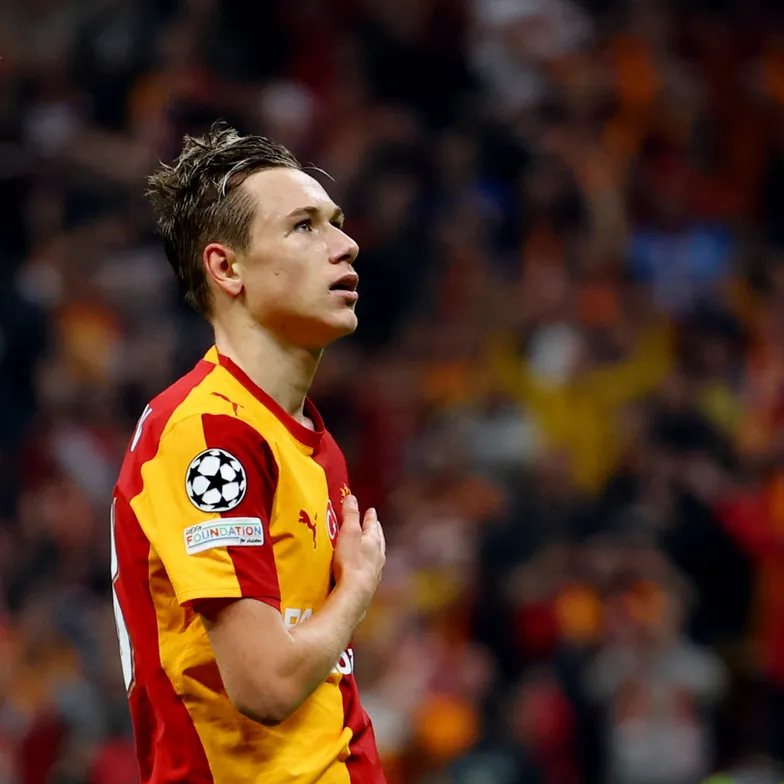
21-year-old Russian soccer star Aleksey Batrakov is tearing up the Champions League for Galatasaray. Turkish fans are even serenading him with ‘Kalinka.’
Aleksey Batrakov moved from Lokomotiv to Galatasaray at the end of the summer. Although he had long been hailed in Russia as a generational talent, few expected him to become a star in European soccer in just a couple of months. Turkish fans chant his name and dedicate banners and songs to him, while social media is flooded with memes and AI slop featuring the Russian midfielder. Batrakov gets recognized on the streets of Istanbul, his teammates applaud him in the locker room, and he has been named to the Champions League Team of the Matchday. Here’s how he won over Turkey and became the talk of European soccer.
Goals by Russian players in the Champions League have been extremely rare in recent years. Russian clubs are barred from the competition, and players from Russia rarely move to top European clubs: both the Russian league’s isolation and difficulties making payments to Russia stand in the way. So when Batrakov scored for Galatasaray against Barcelona on October 13, it was immediately big news.
But Batrakov didn’t stop there. He scored again against France’s Lille in the next match, then scored both of Galatasaray’s goals within three minutes in a 2–0 win over Germany’s Stuttgart. After four Champions League appearances, he has four goals — as many as Andrey Arshavin scored in Europe’s premier club competition in his entire career. That puts Batrakov level with Galatasaray greats Wesley Sneijder and Gheorghe Hagi, though the Dutchman needed 23 matches to reach that tally and the Romanian needed 25.
Batrakov also became Galatasaray’s youngest player to score twice in a Champions League match. He was the first player in the club’s history to score two goals in the opening 15 minutes of a match and the team’s first midfielder to score in three consecutive Champions League games. It’s a rare achievement for Russian soccer, too: The last Russian to score twice in a Champions League match for a foreign club was Roman Pavlyuchenko, who converted two penalties for Tottenham against Twente in 2010.
Batrakov quickly settled into the Turkish league, too. Just 10 minutes after coming on in his debut, he made the pass before the assist on the winning goal. By November 8, he had made nine appearances in the Turkish Süper Lig, scoring two goals and providing three assists. In the most recent game, against Amedspor, Batrakov scored in the 59th minute to help Galatasaray win 4–3. Including the Champions League, he already has six goals and three assists for his new club. Galatasaray trusts him to take free kicks and corners — duties usually reserved for the team’s leading attacking players.
Batrakov’s achievements are all the more striking given Galatasaray’s squad. Turkey’s most decorated club and a regular in European competitions, it has plenty of seasoned stars: Leroy Sané and İlkay Gündoğan, who have both won the Premier League and the Bundesliga; 2023 African Footballer of the Year Victor Osimhen and Rafael Leão, both Italian Serie A champions; and Lucas Torreira, a La Liga champion and FA Cup winner.
This might never have happened: Batrakov’s summer move to Galatasaray nearly fell through.
Boris Rotenberg, the son of a friend of Putin’s, handled the player’s sale to Turkey. Batrakov’s agent accused him of unprofessional conduct
Before joining Galatasaray, Batrakov had an outstanding season at Lokomotiv, scoring 17 goals and providing 12 assists in 36 matches. He won the Russian Premier League’s best young player award for the second year running and was named Russia’s best player for 2025.
Leading European clubs were interested in Batrakov, including Champions League winner Paris Saint-Germain, where Russian national team goalkeeper Matvey Safonov already plays. But Galatasaray made a firm offer of 25 million euros to Lokomotiv. Galatasaray president Dursun Özbek and head coach Okan Buruk spoke to Batrakov personally about the role they envisioned for him on the team.
Batrakov’s arrival in Turkey
Saffet Azak / Anadolu / Getty Images
The main obstacle was Lokomotiv’s stance. Its main sponsor, Russian Railways, had cut the club’s budget in 2026. Club CEO Boris Rotenberg — a former Lokomotiv player and the son of Vladimir Putin’s friend Boris Rotenberg — wanted 30 million euros for Batrakov.
Negotiations were difficult. According to the sports outlet Championat, Batrakov, who had clearly outgrown the Russian league, twice asked Rotenberg personally to approve the move. The dispute went all the way to Russian Railways. Oleg Belozerov, head of the state monopoly, sided with the player, and Lokomotiv agreed to 25 million euros.
According to Batrakov’s agent, Vladimir Kuzmichev, Lokomotiv unexpectedly changed its demands after the two sides had reached an agreement and completed the paperwork. Kuzmichev did not specify what had happened, but sports lawyer Anton Smirnov later said Lokomotiv objected to the sell-on clause in Batrakov’s deal: The original document entitled the Moscow club to 10% of the proceeds, but Lokomotiv wanted 15%.
Batrakov himself ended up paying the price. According to Championat, he had to agree to an increase in the release clause in his own contract, from 50 million to 55 million euros.
After the transfer, Kuzmichev said the episode had seriously damaged his relationship with the club and with Rotenberg himself, who had “acted improperly.” Lokomotiv’s CEO, however, rejected the accusations and called the deal “100% professional.”
In Turkey, Batrakov has become the star of AI memes and fan fiction. Now every Galatasaray fan sings ‘Kalinka’ (‘Little Snowball Berry, Little Raspberry’)
Batrakov’s transfer to Galatasaray immediately became a spectacle. HT Spor TV broadcast his flight to Turkey live, drawing 7,000 viewers. Fans and Özbek greeted him at the airport.
Batrakov came out to meet the fans wearing a club scarf and joined in their chant. The next day, he visited a clinic treating children with cancer, signed autographs, and gave the patients jerseys.
The first big moment in his relationship with the fans came on September 19. Galatasaray lost 4–0 to Trabzonspor, with Batrakov coming on as a substitute in the 68th minute. After the final whistle, the team headed to the locker room, but Batrakov stayed behind to applaud the away section, walking backward toward the exit so he wouldn’t turn his back on the fans. Supporters called his gesture the evening’s only bright spot. He has done the same after every game since.
At later matches, banners bearing his portrait and the slogans “Russian Paradise” and “The Chosen One” appeared in the stands. On social media, fans dubbed him the “Moscow Messi” and “BatraGOAT.” One Turkish commentator even compared him to Diego Maradona.
Before long, members of ultrAslan, the club’s main supporters’ group, came up with a chant for Batrakov to the tune of “Kalinka-malinka.” After the derby against Fenerbahçe, they kept singing it for another half hour after the other spectators had left. Soon, the tune began playing over the stadium speakers whenever Batrakov scored.
During the Stuttgart match, when Batrakov scored twice, “Kalinka” played twice. After the game, the whole team brought him over to the stands to lead the üçlü — a traditional call-and-response chant with the fans. That has now become a tradition, and people sing “Kalinka” outside stadiums, too. In late October, a video went viral showing several dozen Galatasaray fans gathered in a circle, singing the chant and bowing.
Aleksey Batrakov | Galatasaray–Stuttgart
Galatasaray Bülteni
Another sign of fans’ adoration for Batrakov is the AI slop. Fans depict him as a Soviet marshal, Lenin, or an emperor, generate videos in which former club stars sing his praises, and make skits featuring him that mean little to the uninitiated.
Much of the fan fiction focuses on his partnership with Osimhen: The two are portrayed as brothers and inserted into memes mocking opponents. Fanatik, a popular Turkish soccer website, released a video featuring Batrakov and Osimhen set to the track “Alors on danse,” recreating a meme with musician Stromae and comedian Jamel Debbouze.
Fans have come up with other rituals, too. One supporter, for instance, pinned a nazar — a blue amulet meant to ward off the evil eye — to Batrakov’s clothes.
Batrakov has even won over staff at other clubs. After the match against Gençlerbirliği on October 19, he thanked the Galatasaray fans, then gave his jersey to a member of the opposing team’s staff who had asked him for it on the field.
After his two goals against Stuttgart earned him the player of the match award, journalists caught up with him as he was walking and persuaded him to unwrap the award on camera. Turkish media dubbed the evening “Kalinka Night” and compared him to former team stars Dries Mertens, Alex de Souza, Sneijder, and Hagi — all rolled into one.
Alongside the adoration comes a growing fear of losing him. The news outlet Fontanka noted that after reports of interest from Arsenal, Liverpool, Barcelona, and PSG, fans joked about ways to hide Batrakov from scouts: They suggested spreading rumors that he had drinking and gambling problems or personally convincing foreigners that he was a poor player.
Galatasaray has also begun considering Batrakov’s future. Just two and a half months after the transfer, Turkish media reported that the club wanted to offer him a new contract, raise his salary, and increase his release clause to 100 million euros.
In Istanbul, Batrakov has also had to adjust to a new level of fame. In an interview, he said he could walk around Moscow undisturbed without a cap or sunglasses, while in Turkey people recognize him everywhere. “People come up and take pictures with me practically every minute,” he said.
Jersey sales bear out his popularity. According to Championat, by the Barcelona match, Batrakov ranked third in the club’s jersey sales, behind Osimhen and Leão. About 400 jerseys bearing his name sold on the day his transfer was announced, and 60 to 70 a day after that.
By early November, Batrakov had become the first Galatasaray player whose jersey was available with his name in either Latin or Cyrillic lettering.
Batrakov moved to Istanbul with his wife, Irina Podshibyakina, a former player on Russia’s women’s national soccer team. She left her life in Moscow and her job at Lokomotiv to support her husband. Batrakov is now working hard on his English, the main language used within the team, and plans to learn Turkish.
Europe’s top clubs are already pursuing Batrakov. His success in Turkey could set an example for other young Russian players.
Russian players have all but stopped moving to European clubs. During Russia’s full-scale invasion of Ukraine, every such transfer becomes a political event as well as a sporting one. After Batrakov joined Galatasaray, Ukrainian journalist Mykhailo Spivakovskyi reported that Ukrainian striker Matviy Ponomarenko had refused to consider an offer from the Turkish club. Another account, however, attributed the decision to financial disagreements: Galatasaray had offered significantly less than the release clause in Ponomarenko’s contract.
Another controversy erupted after the 4–2 win over Lille. Batrakov provided an assist and scored, but Osimhen received the player of the match award. Turkish journalist Ali Naci Küçük said the award had originally been intended for Batrakov, but alleged that UEFA representatives had intervened because of his nationality. No official confirmation of that account has emerged.
Galatasaray celebrates Batrakov’s goal against Stuttgart
Kemal Aslan / Reuters / Scanpix / LETA
Players and coaches have offered Batrakov nothing but praise. Before facing Galatasaray, Barcelona head coach Hansi Flick called him an excellent player and a good signing for the Turkish club.
Osimhen praised his teammate’s understanding of the game, accurate passing, and ability to create chances for strikers. Former Fenerbahçe defender Alexander Djiku called Batrakov a strong all-around player. Turkish pundit and former player Nihat Kahveci praised his forward passing, shooting, and ability to find teammates in dangerous positions. By November, Batrakov had attracted the attention of scouts from Arsenal, Liverpool, PSG, and other clubs.
Batrakov’s success at Galatasaray could help other Russian players secure moves to Turkey. CSKA Moscow midfielder Matvey Kislyak could be next. According to Batrakov’s agent, Turkish clubs have already expressed interest in Kislyak, Batrakov’s teammate on Russia’s national team. Beşiktaş reportedly offered as much as 30 million euros for Kislyak in the summer, and a member of the club’s management traveled to Moscow for talks in late October.
Kislyak and Batrakov will soon be reunited: Both have been called up for Russia’s matches against Uzbekistan, away on November 12, and Venezuela, in Krasnodar on November 17. For Russian fans, it will be a rare chance to see the Galatasaray star play in person.
Russian soccer
At Meduza, we are committed to transparency about our use of artificial intelligence in the newsroom. The story you’re reading was written by one of our living, breathing journalists and translated from Russian using an AI model configured to follow our strict editorial standards. This translation process is the result of extensive testing and refinements to ensure our English-language coverage is timely and accurate. A Meduza editor reviews every draft before publication.
If you find any errors in this translation, please contact us at reports@meduza.io.
To read Meduza’s exclusive content in English, please subscribe to our newsletter.
How big?
Before Batrakov, the last Russian to score in the Champions League was Magomed Ozdoev, who scored for Zenit against Chelsea five years ago
The pass before the assist?
This is the pass that comes before the one that directly sets up a goal. Standard statistics don’t count it as a goal contribution, but it is often the pass that creates a scoring chance.
What is Batrakov’s role?
In Turkey, Batrakov plays as a “No. 10” — the creative hub of the attack. In a 4–2–3–1 formation, he plays centrally behind the striker, between midfield and attack. From there, he plays passes that threaten the defense, finds open space, and gets forward to help finish attacks.
Release clause
A standard provision in soccer contracts. It sets an amount another club can pay to sign a player. Release clauses typically protect a club financially if it expects demand for the player from clubs in stronger leagues.