Russia’s answer to Starlink has lost another satellite. Could the setback derail its plans for battlefield communications?
A second satellite from Russia’s “Rassvet” constellation, developed by the Russian company Bureau 1440, has fallen out of orbit and burned up in the atmosphere, the Ukrainian outlet Defence Express reported. Independent trackers that rely on data from the U.S. NORAD space catalog confirmed the loss as well.
The satellite, called “Rassvet-3-17” (NORAD 100083), was launched July 19, 2026, from the Plesetsk Cosmodrome along with 15 other similar spacecraft.
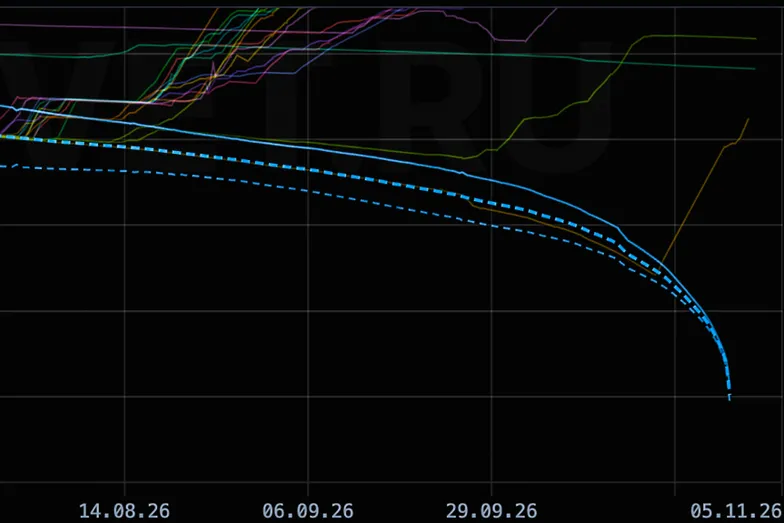
The satellite’s orbital altitude started at about 300 kilometers (186 miles) but declined over several months due to drag in the upper atmosphere. By October, the decline sped up, and the spacecraft disappeared from space catalogs. The last records are dated October 29, when the spacecraft apparently burned up in the atmosphere. Publicly available orbital tracking data indicate that the satellite never successfully fired the engine intended to raise its orbit. Like the other “Rassvet” satellites, it was initially supposed to reach an intermediate orbit at an altitude of 500 kilometers (311 miles).
According to the published historical orbital data, another satellite from the batch launched this summer, “Rassvet-3-23,” likely came close to meeting the same fate. The two satellites’ orbital altitudes declined almost in lockstep. In this case, however, Bureau 1440 managed to resolve the propulsion problems. After October 20, “Rassvet-3-23” began rapidly gaining altitude and has now climbed several kilometers above its original 300-kilometer orbit.
In early June, “Rassvet-3-4,” part of the spring batch of 16 satellites, fell out of orbit in similar fashion. As a result, the main “Rassvet” constellation now has 30 spacecraft remaining, with the vast majority having already reached the 500-kilometer (311-mile) orbit. Only four are still climbing: “Rassvet-3-23,” along with satellites numbered 14, 26, and 11. Once all of them reach their target, the constellation should begin a synchronized maneuver to reach final orbits at an altitude of about 800 kilometers (497 miles).
A chart showing altitude gains for “Rassvet-3” satellites launched in March and July 2026. Most have already reached the intermediate 500-kilometer (311-mile) orbit. Screenshot from the website that visualizes orbital parameters using NORAD data
findrassvet.ru/Viktor Bulybenko
This relatively high altitude — unusual for this type of satellite — sets the “Rassvet” satellites apart from their American prototype, SpaceX’s Starlink communications satellites. Starlink’s operational orbits sit at about 550 kilometers (342 miles), which minimizes communication latency while keeping atmospheric drag low. The low altitude also helps maintain strong signal strength on the ground. But both advantages come at the cost of needing many satellites in orbit, since full coverage requires thousands of them. Almost 10,000 Starlink satellites are currently operating in orbit.
SpaceX can afford this strategy of a lower orbit and more satellites because of its low launch costs. Bureau 1440, which developed the “Rassvet” satellites, chose a different approach: higher orbits that cut the number of satellites needed from thousands to hundreds, at the cost of weaker signal strength and greater latency.
It’s unclear how many satellites Russia will need to make the constellation fully operational. Even individual satellites can provide partial ground communications, though with significant interruptions. Russian Deputy Prime Minister Dmitry Grigorenko said in 2025 that the constellation should have 292 operational satellites by 2027. So far only about 30 of those are in space, and none has reached its target orbit.
Fast satellite communications are critical to combat operations in the Russia–Ukraine war. Starlink terminals give troops broadband access and also allow remote control of drone guidance through signal-receiving terminals installed on the drones.
After Ukraine succeeded in getting Starlink access cut off for Russian forces using smuggled terminals, the Ukrainian military gained a significant communications advantage. But that advantage extends only to Ukrainian territory, not to Russia’s internationally recognized territory. At least for now. According to FT sources, Elon Musk has already expressed willingness to let Ukraine use Starlink-equipped drones to strike Russian targets. Musk said this in a conversation with former Ukrainian Defense Minister Mykhailo Fedorov, according to FT, though it is unknown when the conversation took place. Ukrainian President Volodymyr Zelensky had also asked Donald Trump in July to allow such strikes.
Putting the “Rassvet” satellites into their working orbits and bringing the constellation to full operation threatens Ukraine with the loss of its strategic communications advantage. If Russia’s equivalent to Musk’s satellites can maintain comparable communication quality — so far there is only extremely unreliable evidence of communication tests via the “Rassvet” satellites — it would mean expanded and more precise Russian strikes on Ukrainian infrastructure, both along the front line and deep in the rear. As the Ukrainian outlet Defence Express writes, “as for the Rassvet constellation as a whole, its condition, unfortunately, is not bad, although deployment is proceeding extremely slowly.”
At Meduza, we are committed to transparency about our use of artificial intelligence in the newsroom. The story you’re reading was written by one of our living, breathing journalists and translated from Russian using an AI model configured to follow our strict editorial standards. This translation process is the result of extensive testing and refinements to ensure our English-language coverage is timely and accurate. A Meduza editor reviews every draft before publication.
If you find any errors in this translation, please contact us at reports@meduza.io.
To read Meduza’s exclusive content in English, please subscribe to our newsletter.
Is this the orbit’s apogee or perigee?
This refers to the orbit’s semi-major axis, though the distinction matters little since the satellites’ orbits are nearly circular.