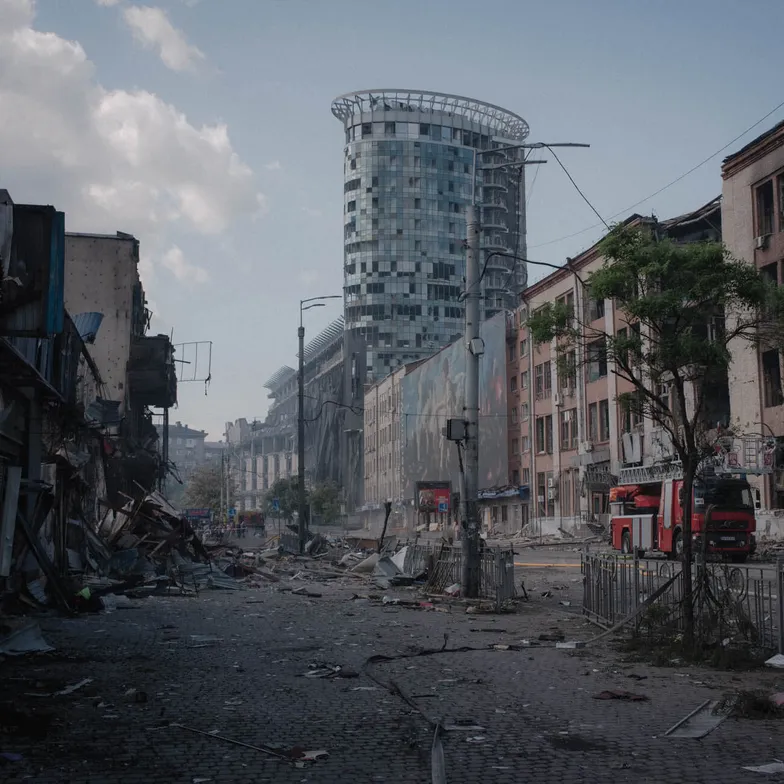
Russian strikes on the same factory in Kyiv’s Lukianivka neighborhood have battered nearby streets. Meduza documents the damage and residents’ efforts to carry on with ordinary life.
Kyiv has faced regular Russian air attacks since February 2022, and Lukianivka, a historic neighborhood in the Shevchenkivskyi district just a few minutes’ drive from Maidan Nezalezhnosti (Independence Square), has come under constant attack. The Russian military’s main target in Lukianivka is the former Soviet Artem factory, now called the Aircraft and Missile Engineering Company. Meduza followed residents’ everyday routes through Lukianivka to see what life is like at the center of the attacks. Residents described how they’ve learned to plan their days around constant air raid alerts — and why they can never get used to living in constant fear.
How and why Russian forces attack Lukianivka
In spring 2022, Russian forces began launching missile strikes on the Shevchenkivskyi district, home to manufacturers including the Artem engineering plant, part of the Ukroboronprom defense conglomerate, and the Kyiv Automation Plant. Russia regularly struck these large industrial facilities and nearby sites. On July 8, 2024, one missile destroyed the nearby toxicology building and dialysis unit at Okhmatdyt National Children’s Hospital.
A study by the independent Ukrainian project Texty found that Shevchenkivskyi was one of the four Kyiv districts hardest hit by Russian attacks from 2022 to 2025. Residential buildings near the Lukianivska metro station, for instance, have repeatedly been damaged; some apartments have been hit several times.
Russian officials and military authorities regularly claim to have carried out “high-precision strikes on rocket and space industry facilities” and say the Artem factory produces ammunition for the Ukrainian armed forces. Ukrainian authorities have not commented on that assertion.
By 2026, attacks on Lukianivka had intensified. Overnight into May 24, Russian forces destroyed the historic Lukianivskyi market and the Kvadrat shopping center. A missile strike that night also caused an entire stairwell section of a five-story apartment building on Dehtiarivska Street to collapse.
On July 19, an attack destroyed the pedestrian underpass by the Lukianivska metro station. Kyiv Metro said this was the 10th time Russian attacks had damaged the station since Russia’s full-scale invasion of Ukraine began.
Valery
Shoemaker; moved to Lukianivka in 2022
Before the war, the stretch from Lukianivka to the Golden Gate was a hub for young, trendy people. There were all kinds of scenes, little cafés, communities. It had this big-city buzz: everyone drinking almond milk lattes, zipping around on bikes and skateboards, running little businesses. And at the same time, there are single-family homes in this neighborhood, especially in Tatarka, where people keep goats and roosters… You’re a half-hour walk from the Maidan, but you feel like you’re in a village.
A café patio 170 meters from the Lukianivska metro station and the Artem factory. September 2026. Many cafés in Lukianivka have been damaged repeatedly in attacks, but their owners have repaired their premises and kept working. For Kyiv residents, visiting cafés in Lukianivka has become a way to support small businesses and resist aggression.
Meduza
A TikToker in front of the destroyed Louvre business center, within 100 meters of the Artem factory.
Meduza
A Ukrainian service member near the Louvre business center, 100 meters from the Artem factory and the Lukianivska metro station
Meduza
A beauty salon on Sichovykh Striltsiv Street, 912 meters from the Artem factory
Meduza
Andrey (name changed)
Schoolteacher; lived with his wife on Kopernyka Street near the Lukianivska metro station starting in summer 2022. Moved in May 2025 for his family’s safety
The neighborhood connects downtown with Podil and its youth scene. Podil is about a 20-minute walk away — that’s where you’ll find our favorite movie theater, Zhovten. My wife and I used to go there for film festivals. This neighborhood also means a lot to me because I spent my college years in a dorm on Lukianivska Street.
The Kyiv Small Opera building, damaged in an attack, 500 meters from the Lukianivska metro station and the Artem factory. May 24, 2026
Meduza
Pharmacist Oleksandr Belskyi’s mansion, built in 1893, in a park on the grounds of the Institute of Pediatrics, Obstetrics, and Gynecology. 960 meters from the Lukianivska metro station and the Artem factory. September 2026
Meduza
Ivan Kotliarevskyi Park, 800 meters from the Artem factory
Meduza
Valery
Lukianivka is a historic neighborhood. There’s a famous cemetery here, for example, with these amazing names on the gravestones: Afanasy, Matrona, Praskovya. On Dmytrivska and Pavlivska Streets, ornate wooden houses contrast with landowners’ mansions. Next to an old Art Nouveau tram depot, you’ll see Khrushchev-era apartment buildings and Soviet prefabricated concrete blocks.
A few more historic places in Lukianivka
A Stalin-era neoclassical apartment building at 2 Kudriavska St.
Meduza
The same building in the 1950s
Ukrainske Baroko
The surviving portion of Ivan Nechui-Levytskyi’s mansion at 8B Variazkyi Lane (formerly Bekhterevskyi Lane). Built in the late 19th century, the mansion later hosted film screenings and served as a filming location for several movies. Just over a kilometer from the Artem factory and the Lukianivska metro station.
Meduza
Pharmacist Oleksandr Belskyi’s mansion, built in 1893. It later became known as “Khrushchev’s Dacha”: after Kyiv’s liberation in 1943, Nikita Khrushchev moved into the mansion, first as a member of the First Ukrainian Front’s military council, then as head of the Ukrainian SSR’s government, and later as first secretary of the Central Committee of the Communist Party (Bolsheviks) of Ukraine.
Meduza
The Kyivska Rus movie theater, just over 300 meters from the Artem factory
Meduza
The Kyivska Rus movie theater after its opening. It was built for Kyiv’s 1,500th anniversary celebrations in 1982. In 1990, it hosted a British film festival attended by Margaret Thatcher and Princess Diana.
O. Perminov / V. H. Zabolotny State Scientific Architecture and Construction Library
A bas-relief on the Kyivska Rus movie theater. September 2026
Meduza
A Kyiv resident in Ivan Kotliarevskyi Park, about 800 meters from the Artem factory
Meduza
Lyudmila
Psychologist; has lived since 1998 in Tatarka, a historic neighborhood 1.2 kilometers from the Lukianivska metro station
Lukianivka is very densely built up, like all of downtown. It’s a busy neighborhood, nothing like the residential districts on the outskirts. Before the war, it was bursting with life. I live in Tatarka — a real green oasis in the middle of the city. There aren’t many places in Kyiv with as much greenery as we have.
Valery
Lukianivka is on a hill, one of the highest points in Kyiv. I’m on the seventh floor, and the view is incredible: I can see the whole left bank — and whatever’s flying over us or heading farther away.
The destroyed Kvadrat shopping center near the Lukianivska metro station and the Artem factory
Meduza
Lyudmila
It was clear from the very first day that Lukianivka was dangerous: the city center is always in the crosshairs.
Anna (name changed)
Works at Okhmatdyt Children’s Hospital, 1.5 kilometers from the Lukianivska metro station. Has lived near the Kyivska Rus movie theater since 2019
The very first bombing was in March 2022, and it really stuck with me: I felt as if the building next door was collapsing in on itself.
The aftermath of one of the first strikes on Yuriia Illienka Street near the Lukianivska metro station and the Artem factory. March 15, 2022
Marcus Yam / Los Angeles Times / Getty Images
Igor
Priest; has served at one of the neighborhood’s churches since 2009
I remember the first strike near our church as if it were yesterday. I was at home, getting ready to go to the service. I heard missiles fly right over us, heading downtown. There were three explosions, and my heart lurched: I had a feeling they were coming from the direction of our church. And when I got there — sure enough. They’d already cordoned off the area. Smoke, fire, destruction… Horrifying. It’s hard to describe those first moments.
Lyudmila
The first heavy attacks on Lukianivka, and Tatarka in particular, came in 2023 and 2024. Tatarska Street was hit then, and it’s still being hit today. There’s a small clinic there where pediatricians and primary care doctors used to see patients. They don’t even repair it anymore: they boarded up the windows, and it’s just sitting there closed. Yet they’d only just finished a full renovation at the start of spring: put in new windows, painted everything, reopened. Then a missile hit in the summer and smashed it all up again.
Sometimes a strike comes before the siren goes off. Zircon missiles fly insanely fast, and the blast waves are terrifying. All of Tatarka shakes.
At the start of summer, when Biloruska and Dehtiarivska Streets were badly hit, we just cried. So many damaged buildings… It’s very hard to talk about.
A residential building on Tatarska Street, about 300 meters from the Artem factory
Meduza
A residential building near Dehtiarivska Street, 1.1 kilometers from the Artem factory
Meduza
Destruction at the Artem factory. August 2023
Meduza
Anna
The Russians aim at the Artem factory but miss — and then the missile hits Tatarka, where people live, or a kindergarten. The closest strike was two buildings away from us, about 200 meters.
Valery
In 2024 and 2025, we had swarms of Shahed drones flying over us. They’d come in at night, 10, 20, 30 at a time. It usually started at 3 a.m. and went on until dawn. Sleep was out of the question. The ground shook. I’d hear dozens of explosions a night — right nearby.
Meduza
McDonald’s employees head down into the Lukianivska metro station during an air raid alert
Meduza
Ukraine’s first McDonald’s, which opened in 1997, shares a building with the Lukianivska metro station. Since 2022, the building has come under attack several times, including overnight into May 24, 2026, when it suffered severe damage. Just three days later, however, McDonald’s reopened. “By your side for 29 years. We keep going,” the company said of the reopening. The McDonald’s is 100 meters from the Artem factory.
Meduza
Meduza
McDonald’s employees head down into the Lukianivska metro station during an air raid alert
Meduza
The destroyed Kvadrat shopping center seen through a McDonald’s window
Meduza
Lyudmila
If something hits Obolon, or especially Podil, the walls shake. If it hits Solomianka, the blast wave reaches us too. It doesn’t seem that close, but you can see and hear absolutely everything because Tatarka is on a hill. Blast waves keep hitting the windows; they really rattle. We live on the second floor, and I’m scared even to imagine what it’s like on the eighth or ninth.
Valery
Night is when the “demons of war” draw near, and back then I’d watch “star wars” from my window at night. Air defense fire sometimes looks like laser beams in the sky, and I have to admit, it’s quite a sight. The most terrifying moment is when the drones start diving right over the roof. You can barely make them out at night; you just hear them. A drone keeps coming, then right over our building the sound changes, it suddenly speeds up and dives. You know it’s coming down somewhere right here.
That’s when I bolt into the hallway, putting two walls between me and the outside. A dull thud, an explosion. Our nine-story building is made of concrete panels and seems sturdy enough, but the concrete vibrates, and the whole building starts wobbling like Jell-O — waves run through it, and it shakes as if in an earthquake. You run out into the hallway five to seven times a night.
And every morning after those nights of “star wars,” you step onto the balcony or go outside, and everything around you is smoky. There’s always something burning within a kilometer or two. It’s the same every time: dawn, the whole sky blackened, thick plumes of black smoke hanging over the rooftops…
The Lvivskyi Kvartal residential complex on Hlybochytska Street, 350 meters from the Artem factory. Radio Liberty journalist Vira Hyrych was killed here in a strike on April 28, 2022. This building has been hit at least four times.
John Moore / Getty Images
A residential building on Drevlianska Street damaged in attacks. About 1.1 kilometers from the Artem factory.
Meduza
Women take shelter at the entrance to an underground parking garage during an air attack on Drevlianska Street, 1.1 kilometers from the Artem factory
Meduza
Anna
In 2022, I told everyone who was trying to persuade me to leave that I wasn’t leaving my husband. Since then, I’ve developed a disability. Now my husband could leave the country with me. We sat down as a family to talk it over: “Kids, would you be okay with us staying abroad?” The kids said no.
We can’t afford to rent a place in another neighborhood. I want to stay in my own home, not live somewhere else in a state of constant anxiety just because the Russians have decided to hammer Lukianivka with attacks.
Igor
A little over six months ago, a fragment of a Shahed drone struck our church. It struck the roof over the narthex, the entrance area. It didn’t go all the way through; it got lodged there, so we had to repair the roof afterward. There was no fire. The fragment was made of some special alloy. I held it in my hands: small, but incredibly heavy.
Valery
Several relatives of our parishioners were killed in one of those strikes. We regularly hold memorial services at the church for everyone who’s been killed. But that week was especially hard. You could really feel that people were mourning, that so many loved ones had just been killed here, close by.
Residents of a building on Tatarska Street, about 200 meters from the Artem factory
Meduza
Andrey
There were a few moments that really brought home what it meant to live in Lukianivka. The first was when Okhmatdyt was hit. My wife wasn’t home; a friend had come over, and we were sitting in the kitchen. First we heard an explosion, a very loud one [the missile strike on the hospital], and then another four or five missiles hit the Artem factory. It happened right in front of us — my windows look straight out onto the factory. The explosions were so powerful that plaster started falling inside our apartment.
The second time that sticks in my memory, Artem was hit again. My wife went down to the basement, but I stayed in the apartment with a friend who was visiting us. And again, two missiles hit right in front of us, and it was super loud.
Around the time Okhmatdyt was hit, the Russians started sending a lot of drones into our neighborhood. The nights were unbearable. I could hear more than 10 explosions a night somewhere very close to us.
Rescue workers in the ruins of Okhmatdyt after a Russian attack. July 8, 2024
Alex Babenko / AP / Scanpix / LETA
The same location in September 2026
Meduza
Another Okhmatdyt building seen from inside one damaged in the July 8, 2024, attack.
Evgeniy Maloletka / AP / Scanpix / LETA
Anna
I wasn’t at Okhmatdyt that day, but I read in the news that the hospital had been hit and went there because they needed help.
One doctor told me she’d seen a colleague of ours get killed. The missile struck the resuscitation room — thank God, no one was inside. But in the next room, five children were on dialysis. The doctor who died was Svitlana Lukianchuk. She was just going into that room, the dialysis room, and was standing in the doorway [when the strike hit]. It’s literally just across a little hallway from the intensive care room.
The blast wave hurled her and the debris all the way to the window, where she was buried under the rubble. At first she was still alive, moaning, “Help me, help me!” But they couldn’t get to her through the debris. A minute later, she was gone.
Another colleague was lying a little closer, also buried in debris. At first they even thought she was dead. But it turned out she’d just lost consciousness.
One other person died — a grandfather waiting for his granddaughter to come out of surgery. He was outside.
A lot of people were injured and taken to the hospital. A doctor I know was slammed into a wall by the blast wave so hard that he broke a rib. Some doctors needed to take sick leave, but they kept working: “Yes, I’ve got a concussion, but there’s nobody to replace me.” To me, they’re heroes.
Okhmatdyt Children’s Hospital in September 2026. About 1.3 kilometers from the Artem factory.
Meduza
Part of an Okhmatdyt building in September 2026
Meduza
A sculpture by Oleksii Stepanov near Okhmatdyt. September 2026
Meduza
Andrey
In December 2024, we found out my wife was pregnant. I even have these surreal videos of her sitting in the hallway [sheltering from an attack], watching clips about natural childbirth and motherhood, with explosions in the background.
That winter was hard. The building wasn’t ready for heating outages, it was cold, and above all, the power kept going out. And we were on the 12th floor. That’s why we decided to move.
Lyudmila
We went to the shelter in the building next door a couple of times. It seems decent enough, two floors underground, but it’s terribly damp. Sit there for five or six hours, and it’s like being in a steam room — you come out soaking wet. The damp immediately sets off a choking cough. We only go down there when they warn of a massive attack.
Valery
There’s a shelter near my building, in a kindergarten. It’s in the basement, a properly equipped space. After warnings of a massive attack, if the window’s open, you can hear the gate clicking every so often — people trickling in, crowding together like the animals in the folktale “The Mitten.”
I go out onto the balcony and watch mothers arriving with little kids, or young couples holding hands, or a whole group of young people running in, or people on their own. Everyone has emergency bags, camping mats, or sleeping bags.
I take shelter in the church basement. It’s a little farther away, but everyone there is like family to me. I go out of obedience. If Mom calls and says, “Valera, you need to go today,” I can’t say no.
An air raid alert near the Lukianivska metro station
Meduza
Lyudmila
We go out [into the hallway] when the windows start shaking. There’s no point running to a shelter: Tatarka simply doesn’t have any proper ones. A proper shelter should be made of reinforced concrete and extend at least two stories underground. What we have are either basements partly above ground, with windows, or basements in schools and kindergartens. They don’t come close to being shelters.
You could still find shelters in older buildings. Our building had a wonderful one. We went down there on the first night of the war. We swept away thick black cobwebs with a broom and used a flashlight to see where we were going. Lots of rooms, but everything covered in dust, sand, fallen plaster. A few months later, we found the basement locked and the word “Shelter” erased from the wall. You can see why: first you’d have to haul out truckloads of debris, then bring in just as much building material to get it into shape.
Yulia
Stay-at-home mother of several children from the Zhytomyr region; traveled to Kyiv in mid-July to study. Spent two nights in Lukianivka, where she experienced a massive attack
Friends let me use their apartment for two nights. I was alone. They told me there was a kindergarten across the road with a shelter. The first night, I just heard the air raid siren. The second night, I actually needed the shelter.
It was summer, warm, and I’d opened the balcony windows. The siren went off, and very soon — about five minutes later — there was this huge bang somewhere nearby! That sound… I’d never heard anything like it. It was terrifying. I was in an absolute panic.
Telegram channels were saying it was the heaviest attack of the entire war. The missiles came in twos: one hit after another, then a pause, then explosion after explosion again. Sometimes there’d be a huge bang, then this sound, almost like sizzling, and then another hit.
July 19, 2026. Rescue workers at the site of a missile strike on an apartment building in Kyiv. According to Ukrainian authorities, Russia attacked the country with 41 missiles and 125 attack drones overnight into July 19.
EPA / Scanpix / LETA
A street market in Lukianivka after the July 19, 2026, attack
Sergey Dolzhenko / EPA / Scanpix / LETA
The pedestrian underpass near the Lukianivska metro station after the overnight attack. July 19, 2026
Serhii Okunev / AFP / Scanpix / LETA
What struck me was that nobody in the shelter was swearing. There was no aggression, no anger. People just sat, waited, checked the news: what had been hit where, where fires had started. One woman said, “Right, next time I need to write a little note: last name, first name, address — and put it in my pocket just in case, so they know who I am and everything if they find me.” Some people were so scared they were shaking; others sat calmly. But nobody was hysterical. I was surprised at how used to it people were… or maybe just how well-mannered.
That night, I understood the saying: “You don’t know how to pray until you’ve been to sea.” I prayed. The fear receded, loosened its grip, and I felt better. Fear is a horrible state to be in; it coats you in this sticky slime. But what’s the point of being afraid if you can’t change anything?
I got back to the apartment at 4 a.m. — it hadn’t even been 2 a.m. when I left. I fell asleep, but another alert woke me at 7 a.m.
Later, I learned that the nearest missile strike had been a 10-minute walk from us. I saw the crater in the ground, right at an intersection, and the blackened buildings.
They were clearing rubble near the metro; the station was closed. Ambulances were arriving there. Telegram channels were reporting that the metro station had collapsed.
The underpass on Yuriia Illienka Street near the Artem factory. September 2026
Meduza
Andrey
We moved in May 2025, when my wife was seven months pregnant. We found a place outside Kyiv, near the school where I work, and rented out our apartment for 40% below the market rate. The tenants said they knew all the risks. They lived there for a year, but in the summer, when the market and the Kvadrat shopping center were hit… It was stressful for them. And they said they were going to move out.
Anna
Our favorite shopping center, Kvadrat, was right across from the Artem factory. They sold clothes, stationery. There was a Silpo supermarket and a little café upstairs where the kids liked to get pastries. A convenient place. And now it’s gone — our Kvadrat burned down.
Igor
I really liked the Lukianivskyi market. I knew some of the vendors; we were friends. I’d stop by their stalls, and they’d come to our church. I usually bought vegetables, herbs, and seasonal fruit there. I’d stop by the fresh cheese and meat counters to pick up ingredients for a home-cooked meal.
A makeshift street market near the Kvadrat shopping center, 120 meters from the Artem factory.
Meduza
There was a Puzata Khata restaurant on the fourth floor of the Kvadrat shopping center. On Saturdays, when I conducted morning and evening services, it was convenient to stop there for a bite between services instead of going home. The food was delicious. I always got beet salad or dressed herring. And always a chicken cutlet. Those memories still warm my heart.
When the market and Kvadrat burned down, I couldn’t believe it at first. My first thought was: That can’t be. It’s not a military site at all!
The ruins of the Lukianivskyi market near the Kvadrat shopping center, 110 meters from the Artem factory
Meduza
At the informal market near the Kvadrat shopping center
Meduza
Ukrainian-bred “Rose of the Southeast” watermelons. The sign on the crate reads “very sweet,” 25 hryvnias.
Meduza
Soon afterward, I made a point of going inside the burned-out market and walking through those aisles, past the stalls where I’d bought groceries for years — as a kind of tribute to the place.
I still go to the [informal market that sprang up nearby], out of habit — and now even more so, as a matter of principle. Between the burned-out market and the shopping center, people have set up little stalls right on the street.
The informal market near the Kvadrat shopping center
Meduza
On weekdays, our liturgy always starts at 7 a.m. When missiles were coming in at dawn — from around 5 to 7 a.m. — we had to cancel. We’d post a message in the parishioners’ Viber group: The service is canceled for your safety. On weekdays, we canceled services altogether; if there was an attack on a weekend, we started an hour later. We still do that if there’s a red-level alert. We don’t cancel services for yellow alerts.
It’s a difficult situation: there’s a strategic facility very close to the church. God forbid a fragment, a Shahed, or a missile should hit the church when it’s full of people.
If an air raid siren sounds during a service, parishioners can take shelter, but the priest stays until the service ends. Just as a captain is the last to leave the ship, we can’t interrupt the service.
An improvised market at the Lukianivska metro station and the Kvadrat mall
Meduza
Lyudmila
Now, when a yellow-level alert is announced, I immediately check the group chats that track incoming attacks. If they say, for example, “Shaheds are flying over the Kyiv region, coming in along the edges of the city,” then I go to work without worrying. But if they’re heading through downtown, I won’t set foot outside. Even if I just need to run across the road to the store.
My husband and I hardly go anywhere anymore except work. We have a garden plot outside the city, but we’ve neglected it this year.
Older people and children have it worst — I work with them and see it every day. Older people simply don’t have the physical strength to cope. And children can’t see any future at all. Adults can’t answer their questions.
A stopped street clock near the Kvadrat shopping center
Meduza
Children in a courtyard on Dehtiarivska Street, 520 meters from the Artem factory
Meduza
A courtyard near Variazkyi Lane, a kilometer from the Artem factory
Meduza
An elderly Kyiv woman sells flowers near the Lukianivska metro station, 100 meters from the Artem factory. September 2026
Meduza
Anna
The hardest thing is going to work after an attack when you haven’t slept. I wish there were a law saying that after a massive attack, people are entitled to a day off.
Valery
My sleep schedule is all messed up: you can’t sleep at night because of the attacks, and during the day you’re sleepy and sluggish. But something else worries me more — I’m losing my compassion. You don’t feel each strike on an apartment building as acutely anymore, even when 20 to 30 people have died, including three or four children. You become numb to all of it, as if you’re losing the ability to feel for people.
Kyiv residents sleep in the Lukianivska metro station lobby. September 2026
Meduza
Meduza
Meduza
Lyudmila
It takes at least a week to recover after a strike. You can’t think clearly, organize what you’re doing or get your thoughts in order.
Anna
My daughter has a very strong reaction to the siren: her arms and legs start shaking. In the summer, on July 2, I think, there was another massive attack. The kids happened to have appointments for checkups at the clinic. My husband took both of them to the doctor — and the siren went off again while they were right there. My daughter was crying her eyes out, absolutely terrified: she’s 17, a child, and she’s panicking because she’s afraid she’ll be killed. The staff at the clinic saw her in that state and took her straight to a neurologist. The doctor examined her and said she needed a psychologist and a psychiatrist. Now my daughter is on antidepressants.
Lyudmila
Wherever we move, whatever place we rent, wherever we try to hide — I doubt we’ll be able to get away from it.
A Kyiv woman waits for a bus at a destroyed stop on Yuriia Illienka Street, beside the Artem factory wall. September 2026
Meduza
Andrey
We’re staying with people we know in the Kyiv region now, but it’s temporary. My commute is 50 kilometers each way. We’re thinking about how to get through this winter. It’s clear it’ll be hard. My wife and child may go abroad, while I stay in Ukraine.
Igor
Of course, I could ask the metropolitan’s office for a transfer to another parish or diocese — these things happen. But I don’t want to. I’ve grown so attached to this place that I’ll probably stay until the very end. If the church is destroyed, then yes. But as long as the church is standing, we’ll stand by it and continue holding services, no matter what. We pray and hope the Lord will grant us the peace we’ve waited for so long.
Valery
I understand what things are like in Sloviansk, Kramatorsk, Zaporizhzhia, Dnipro, or Kharkiv — places within range of glide bombs and FPV drones, where buses, ambulances, and cars are blown apart on the streets. That’s real danger. In Kyiv, it’s more like Russian roulette. The cylinder is loaded, but it has so many chambers that the chance of getting hit is still small, though it’s there. It’s roulette where the odds are very much in your favor.
Yulia
I don’t regret going to Kyiv. I realized I want to study, I want to do something. You realize life could end at any moment, and you need to make time to live fully, rather than just exist.
Yuriia Illienka Street near the Lukianivska metro station
Meduza
A man sells carp near the Lukianivska metro station
Meduza
An informal market near the Lukianivska metro station
Meduza
At Meduza, we are committed to transparency about our use of artificial intelligence in the newsroom. The story you’re reading was written by one of our living, breathing journalists and translated from Russian using an AI model configured to follow our strict editorial standards. This translation process is the result of extensive testing and refinements to ensure our English-language coverage is timely and accurate. A Meduza editor reviews every draft before publication.
If you find any errors in this translation, please contact us at reports@meduza.io.
To read Meduza’s exclusive content in English, please subscribe to our newsletter.
Photos: Meduza
Text: Irina Olegova
Aircraft and Missile Engineering Company (formerly Artem)
A factory near the Lukianivska metro station, founded in 1892 as an iron foundry and machine workshop. Since the latter half of the 20th century, Artem has specialized in manufacturing air-launched missiles, instruments and ammunition. Since the start of the full-scale invasion, the plant has repeatedly been targeted by Russian missile attacks.
“The Mitten”
A Ukrainian folktale. In the story, an old man loses a warm mitten in the forest in winter. Forest animals move into it one by one — a mouse, a frog, a hare, a fox, a wolf, a wild boar, and a bear — and the mitten becomes their shared home.
What does that mean?
Valery uses the monastic term “obedience,” meaning unquestioning obedience to someone a monk trusts as a spiritual mentor.
Translation
Shelter.
Is that true?
Overnight on July 18–19, 2026, the blast wave from a missile strike on Kyiv damaged the aboveground entrance hall of the Lukianivska metro station: all the windows were blown out, the exterior cladding was damaged, and part of the ceiling collapsed.
Silpo
One of Ukraine’s largest supermarket chains.
The attack on the Kvadrat shopping center and Lukianivskyi market
Lukianivskyi market and the Kvadrat shopping center burned down overnight on May 23–24, 2026, during a massive Russian missile and drone attack on Kyiv.
Guided aerial bomb (UAB or KAB)
This refers to an aerial bomb fitted with a Universal Gliding and Correction Module (UMPK), Russia’s equivalent of the American Joint Direct Attack Munition (JDAM) kit. The kit adds GPS guidance and wings to conventional bombs, allowing them to glide accurately for dozens of kilometers. The U.S. has been fitting its free-fall bombs with such kits since the 1990s.
What are they?
FPV stands for “first-person view.” Although nearly all drones transmit video, pilots of FPV models have to rely almost exclusively on that feed, without assistance from automated systems such as satellite navigation. This makes the drones cheaper and more resistant to electronic warfare systems.
Что это значит?
В начале сентября правительство Украины изменило системы оповещения о воздушной тревоге, чтобы «адаптировать работу государства, бизнеса и инфраструктуры к новой тактике российских воздушных атак». Воздушные тревоги разделены по уровню опасности. Желтый уровень — атака дронов, красный — угроза ракетного или комбинированного удара.
What attack was this?
Overnight on July 18–19, Russia attacked Ukraine with 41 missiles and 125 attack drones. Yuriy Ihnat, head of communications for Ukraine’s Air Force Command, called the attack on Kyiv one of the largest. A direct missile hit completely destroyed the pedestrian underpass near Lukianivska station.
Texty
An independent Ukrainian online publication founded in 2010. It specializes in data journalism, investigative reporting, large-scale data visualization and research into Russian propaganda and disinformation.
What are the other three?
Sviatoshynskyi, Solomianskyi, and Holosiivskyi.
What does that mean?
In early September, Ukraine’s government changed its air raid alert systems to “adapt the operations of government, businesses, and infrastructure to Russia’s new air attack tactics.” Air raid alerts are categorized by threat level. Yellow means a drone attack; red means the threat of a missile strike or a combined attack.