Can Serbia’s student protesters stop Aleksandar Vučić from becoming prime minister? The country’s longtime leader has called an early election to extend his hold on power.
Just over a month ago, Serbian President Aleksandar Vučić addressed the nation on television. He lamented the difficult circumstances but said that, despite everything, the country had “managed to preserve stability.” To ensure that Serbia could continue “to develop and maintain its internal unity in the face of external threats,” Vučić announced that he would dissolve parliament and call early elections for October 25, 2026. He resigned shortly afterward. Vučić needs the election to stay in power: His presidential term would have expired soon. But he may not succeed. His main rival is the “Student List — Students Win” movement, which formally emerged a month ago but became known around the world during mass protests across Serbia in 2024. We explain why Vučić called the election now, what the main parties are campaigning on, and who is most likely to win.
Why Serbia’s election matters
Aleksandar Vučić joined the Serbian Radical Party as a young man and became known as an ardent Serbian nationalist. He became prime minister in 2014 and was elected president three years later. With the backing of the Serbian Progressive Party (SNS), Vučić built a regime that political scientists abroad describe as authoritarian.
As early as 2019, the U.S. nonprofit Freedom House downgraded Serbia’s status from free to partly free. That same year, the European Parliament said Vučić and the SNS were blocking parliamentary debate on bills they opposed, accusing their critics of betraying the country, and suppressing independent media.
Five years later, Freedom House said the ruling party was undermining political rights and civil liberties and putting pressure on independent media and civil society organizations. In 2024, V-Dem, an independent Swedish research institute that studies democracy worldwide, called Serbia an “electoral autocracy.” This year, the German think tank Bertelsmann Stiftung classified it as a moderate autocracy, citing the concentration of power in Vučić’s hands.
Other indicators also show the problems facing Serbian democracy. Between 2014 and 2026, the country fell from 54th to 104th place in the annual press freedom index compiled by the international organization Reporters Without Borders.
Transparency International ranked Serbia 78th in its Corruption Perceptions Index in 2014 and 116th in 2025. A survey conducted last year by Transparency Serbia found that 22% of respondents considered corruption the country’s biggest problem — the highest share in a quarter century.
All this makes the coming election especially consequential. It will determine whether Serbia continues on the authoritarian course it has followed over the past decade and a half under Vučić and the SNS, or gets a chance to democratize if the Student List, the main opposition group, wins.
How the electoral system works
Serbia is a parliamentary republic. Parliament, officially known as the National Assembly, elects the government and holds it accountable.
The constitution limits the president’s powers: He commands the armed forces, signs laws, and nominates a prime minister for parliament’s approval. He can also dissolve the Assembly — for example, if it fails to approve a government within 90 days. But the president cannot dismiss the government or hold other positions while in office. Vučić disregarded the latter rule: From his first election as president until May 2023, he also led the ruling party.
The Assembly has a single chamber with 250 members. Under the constitution, elections are held every four years, but early elections have effectively become the norm since 2000. Only the 2012 and 2020 elections took place on schedule.
Voters cast ballots for party lists; there are no single-member districts. Parties must clear a 3% threshold to enter parliament, but this requirement does not apply to ethnic minority parties. The current Assembly includes parties representing Hungarians, Bosniaks, Croats, Albanians, and even Russians. If the ruling party or coalition needs a few more votes to secure a parliamentary majority, ethnic minority lawmakers can wield disproportionate influence.
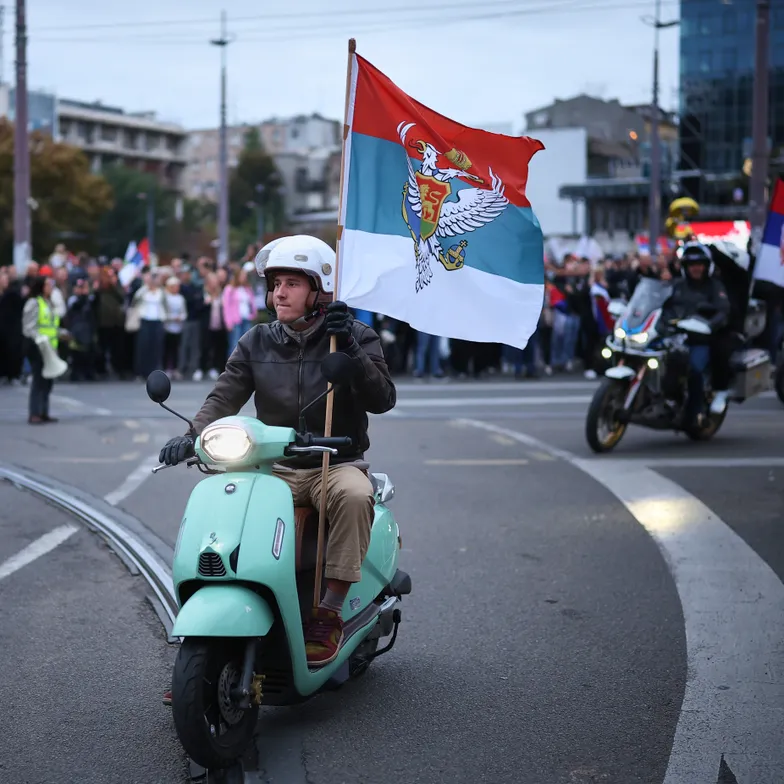
Serbia has seen sustained anti-government protests over the past three years
The previous parliamentary election, held on December 17, 2023, was marred by serious irregularities, including the so-called Bulgarian train ballot-swapping scheme, busing in voters from Republika Srpska, and vote-buying. These practices helped the SNS win nearly 47% of the vote and a parliamentary majority, while the opposition Serbia Against Violence coalition had to settle for 23.7% and 65 seats.
The vote-rigging triggered mass protests, but they had petered out by the end of December 2023. New grievances soon emerged. In July 2024, thousands took to the streets against a project to extract lithium at the Jadar mine in western Serbia. Events in Novi Sad, Serbia’s second-largest city, prompted a far larger response.
On November 1, 2024, a canopy at the city’s railway station collapsed, killing 16 people, including children. The irony was that renovations at the station had been completed just four months before the disaster. Two Chinese state-owned companies had carried out the work under a contract awarded by the Serbian authorities without competitive bidding.
Officials initially denied any responsibility. Pro-government media and Goran Vesić, the construction, transport, and infrastructure minister, repeatedly said that the station canopy had not been part of the renovation. The Transport Ministry refused journalists’ requests for financial documents relating to the work.
All this raised suspicions of corruption and sparked large protests in Novi Sad and other cities. Many students joined and became the protests’ main driving force. The largest demonstration, on March 15, 2025, drew up to 325,000 people — an enormous number in a country with a population of just over 6.5 million. In addition to calling for the release of documents relating to the station’s renovation and for increased spending on higher education, protesters demanded the government’s resignation and early elections.
The government could hardly ignore the protests. Vesić resigned in November 2024 and was behind bars a few weeks later. He and 12 other officials faced charges, but these were later dropped for lack of evidence. Prime Minister Miloš Vučević resigned in January 2025.
Vučić, meanwhile, suggested that unnamed foreign powers were instigating the protests. Pro-government media accused protesters of betraying their country and committing crimes and called for their arrest and lengthy prison sentences.
Police treated demonstrators harshly. Participants in a mass demonstration in Belgrade in March 2025 said a sound cannon had been used against them. During protests in Valjevo in August, police beat 25 demonstrators with batons. In Belgrade, police arrested, beat, and humiliated 15 protesters and threatened women with sexual violence.
Why did Vučić call the election now?
Protesters have been demanding new elections for the past two years, but Vučić did not dissolve parliament to accommodate them. He has his own reasons. His second presidential term was due to expire in May 2027, and Serbia’s constitution bars him from running again. But Vučić does not want to relinquish power.
He is well positioned to hold on to it. He has the backing of the SNS, which has come to dominate Serbian politics over the past decade and a half. The party enjoys substantial political advantages through its access to state institutions and directly or indirectly controls all the country’s major television channels. These advantages helped it secure a decisive victory in the 2023 election. On October 25, it hopes to repeat that success and preserve the current regime.
Aleksandar Vučić at a rally of his supporters. Belgrade. October 22, 2026
AP / Scanpix / LETA
Under these circumstances, Vučić’s calculation is clear: He wants to move from the presidency to the prime minister’s office. That post would give him considerable powers. Under the constitution, the prime minister determines domestic and foreign policy, can introduce bills in parliament, oversees the state administration, appoints and dismisses ministers, and can even initiate the dissolution of parliament.
The election date is no accident. First, Vučić has sought to deny the students time to build a stronger political organization. Their movement is not even a party, and it has yet to establish an extensive network of local branches to mobilize voters. Second, the election was scheduled for the earliest date legally possible after parliament’s dissolution: 46 days later. That gives the students as little time as possible to campaign, while Vučić and the SNS have been promoting themselves for months.
Serbia will elect a new president in December, and Vučić will try to install a loyalist. One possibility is Ana Brnabić, the Assembly’s speaker and now acting president. She has already proved her loyalty to Vučić: During her years as prime minister, she effectively ceded all real authority to the president. Another candidate is Miloš Vučević, the SNS leader and a close Vučić ally, who ranks second on the party’s electoral list.
The main contenders and their platforms
A total of 18 parties and coalitions, including those representing ethnic minorities, will contest the October 25 election. But the main battle will be between the Aleksandar Vučić — United Serbia coalition and the opposition Student List.
The pro-government camp
The dominant party on the government side is the Serbian Progressive Party, founded in 2008 after a split in the Radical Party. The SNS espouses nationalist, conservative, and populist views, while its economic positions lean toward neoliberalism. With around 800,000 members in 2020 — 13% of Serbia’s population — it is Europe’s largest party by membership. It is running as part of the Aleksandar Vučić — United Serbia coalition, but its partners carry little weight.
The SNS platform rests on several key tenets. These include defending Serbia’s territorial integrity — meaning refusing to recognize Kosovo’s independence — and supporting Serbs living abroad; steady economic development and efforts to combat corruption; social justice; and joining the EU while cooperating with Russia, the United States, and China. There is one problem with the platform published on the party’s official website, however: It dates from 2011 and has not been updated since.
In the current campaign, the ruling party and Vučić are focusing primarily on recent economic successes. Serbia’s GDP has indeed grown steadily in recent years. According to the World Bank, it rose by 3.9% in 2024 and 2% in 2025, while the International Monetary Fund forecasts growth of 3.3% this year. Serbia has also been actively attracting foreign investment, which reached 5.2 billion euros in 2024 and nearly 3.5 billion in 2025. This September, Vučić proudly said Serbia accounted for 62% of all foreign direct investment in the Western Balkans.
To sustain growth, the authorities are banking on large projects that can double as publicity opportunities. Work has recently picked up, for example, on the Belgrade metro, a project first launched in the 1990s. Chinese companies are now involved, and Vučić said with great fanfare that two enormous tunnel-boring machines were due to arrive in the capital in October — just in time for the election. For now, however, the spectacle of their arrival has had to be postponed: Technical problems have left the machines stuck in the Romanian port of Constanța.
But nothing is stopping the ruling party from constantly talking about Expo 2027, the world’s fair that Belgrade will host. Vučić frequently visits the construction site and says the “historic” exhibition is moving the capital and the country as a whole “forward.” The exhibition was also one of the official reasons given for calling the early election: Vučić said the vote needed to be timed so that afterward the country could focus on preparing for Expo.
The authorities also emphasize the need for stability. Serbia went through a turbulent period in the 1990s, and the authorities now use fears of a return to that era to argue that people should vote for the SNS. In their view, the main threat to stability comes, naturally, from the protesting students, who they say receive foreign funding and want to organize a “color revolution” in Serbia.
SNS lawmaker Biljana Pantić said the choice in this election was clear: On one side are the SNS and Vučić, who put “care for citizens, stability, and Serbia’s continued development” first; on the other are those “who have no concrete platform or results and have reduced their politics to hatred, violence, and attacks on everything Aleksandar Vučić does or says.”
The opposition
The students, who form the backbone of the protests, hold a wide range of views, and their ranks include both nationalists and liberals. Nevertheless, they have managed to stay united by avoiding contentious issues such as European integration, relations with Russia, and Kosovo’s independence.
On September 9, 2026, the day parliament was dissolved, they announced the formation of their own political movement, Student List — Students Win. In just a few days, the students collected the required number of voter signatures to run in the election and submitted their candidate list to the Electoral Commission, which unanimously approved their inclusion on the ballot on September 15.
The list contains 250 parliamentary candidates. None are students; instead, they include scholars, university professors, experts, and athletes. At the top is cardiologist Ilija Srdanović, a professor at the University of Novi Sad, although the students stress that they are not looking for “a new leader around whom another personality cult could form.”
The movement’s election platform is called the ”Student Plan” and consists of 11 points grouped into three sections. The first, “Serbia or the Mafia,” calls for stronger efforts to fight corruption, barring from public office officials who have broken the law and have ties to the mafia, and guaranteeing media freedom.
Belgrade. October 21, 2026
Pierre Crom / Getty Images
The second section, titled “Knowledge Is Power,” calls for adapting the education system to modern needs, introducing competitive selection for teaching positions, and subsidizing startups and innovation.
The third section, “Serbia Grows With Us,” addresses social and economic issues. Among other things, it proposes providing housing for young families and essential workers, and improving health care by standardizing medication prices nationwide and modernizing hospitals, particularly in rural areas.
The other parties
Among the other contenders, two coalitions — Stability Factor and European Serbia — have a chance of clearing the 3% threshold, according to a poll conducted by Serbian market research agency Factor Plus and published on September 21.
Stability Factor, led by Ivica Dačić, brings together the Socialist Party and partners such as the Social Democrats and the Greens. The coalition presents itself as an alliance of the patriotic left and intends to work with the SNS and Vučić. It is going through a difficult period, however, facing criticism for cooperating with the regime. On August 31, the Socialist Party expelled its vice president, Branko Ružić, for supporting the protesting students. Two members of its main council and several regional party leaders then left in protest.
European Serbia, meanwhile, consists of pro-European parties and has a detailed plan to dismantle the regime built by the SNS within 100 days and begin building a “European Serbia.” The coalition did not join forces with the students but is willing to cooperate with them after the election.
How the campaign unfolded
Although the official campaign began on September 9, Vučić and the SNS effectively started much earlier. The SNS put its own spin on the student movement’s main slogan, “Students Win!” For several months, enormous billboards reading “Serbia Wins!” could be seen across the country.
Government-controlled TV channels heavily promote Vučić. An analysis by the Friedrich Naumann Foundation found that he appeared on various channels 129 times in August — an average of four times a day. He appeared in his capacity as head of state, meaning he did not pay for the airtime.
Vučić has used other methods as well. In September 2026, the government set aside money for one-time payments of 160 to 300 euros to pensioners. Vučić also promised to raise public-sector salaries by 8% and social workers’ salaries by 12% — but only starting in December, after the election.
The students have no such resources, so they have to rely on social media and direct campaigning. They have set up booths in various Serbian cities where people can talk to candidates and learn about their platform. The students are also going door to door, trying to persuade voters to support the Student List.
Meanwhile, opposition supporters face direct pressure and restrictions from the authorities. Universities are firing professors sympathetic to the protesters, while television gives the opposition half as much airtime as pro-government parties and portrays it negatively. CRTA, an independent Serbian election-monitoring organization, says opposition candidates, observers, and activists face surveillance, insults, intimidation, and even physical attacks.
Who will win?
It is difficult to gauge support ahead of the election: Opinion polls vary widely. According to Factor Plus, 48.7% of voters are prepared to vote for the SNS and its coalition partners, and 37.1% for the Student List. European Serbia, at 3.6%, and the Socialist Party-led coalition, at 4.9%, also cleared the 3% threshold in the poll. But opposition politicians accuse the agency of bias and of working for the SNS, whose support it consistently overstates.
On September 30, Đorđe Vukadinović, editor in chief of the independent political science journal Nova srpska politička misao (New Serbian Political Thought), put support for the students at 44.4% and for the pro-government coalition at 41.7%. He did not explain the basis for those estimates. On October 15, political analyst Mirko Dautović suggested that support for the students had risen above 50% over the preceding month, but he too cited no specific poll.
Serbia faces a fierce electoral contest, but observers say tensions could persist afterward. First, there is no guarantee that Vučić would willingly step back if he lost — he could declare the results invalid. But that would risk a repeat of Slobodan Milošević’s fate: In the fall of 2000, he too refused to acknowledge defeat, only to be forced to give in after 10 days of mass protests.
Belgrade. October 18, 2026
Darko Vojinovic / AP / Scanpix / LETA
Second, the students are determined and make no secret of the bleak future awaiting Vučić if they win: He will be put on trial. In September, a student-made video appeared online showing Vučić in various settings, followed by a figure mopping a prison floor. The video achieved its aim — it infuriated the Serbian authorities.
Even setting Vučić’s fate aside, a student victory would leave the movement facing the question of what to do next. Once their common opponent is gone, their disagreements over Kosovo, European integration, and relations with Russia and China — which they have set aside for now — will surface. Maintaining a consensus will be very difficult. And winning an election alone will not be enough to eradicate corruption. As the example of 2000 shows, democrats coming to power does not necessarily mean a victory for democracy.
What the election means for Russians living in Serbia
After Russia launched its full-scale invasion of Ukraine, Serbia declined to impose sanctions on Russia while also taking in tens of thousands of Russians. By December 2024, the Serbian authorities had issued 67,000 temporary residence permits.
Estimates put the number of Russians in Serbia at 55,000 to 62,000 at the end of 2025, with more than 80% living in Belgrade. Most are young: People ages 24 to 39 account for 55%. And 66% of the Russians who have relocated to Serbia have a university education.
Temporary residence does not, of course, give Russians the right to vote, but Serbian politics is of little interest to them. A survey by the Belgrade Centre for Security Policy found that 72.8% of Russians who had moved to Serbia did not want to take part in political or civic activities. They were far more concerned about their personal safety and economic well-being.
The government’s approach to Russians who have relocated appears unlikely to change if the pro-government coalition wins. The Serbian authorities, for example, have repeatedly said they have no plans to revise the existing visa-free travel agreement with Russia.
If the Student List wins, its policy toward Russian emigrants is impossible to predict at this point: The students have carefully avoided commenting on Russia or on Russians who have moved to Serbia.
More on Serbia’s election
At Meduza, we are committed to transparency about our use of artificial intelligence in the newsroom. The story you’re reading was written by one of our living, breathing journalists and translated from Russian using an AI model configured to follow our strict editorial standards. This translation process is the result of extensive testing and refinements to ensure our English-language coverage is timely and accurate. A Meduza editor reviews every draft before publication.
If you find any errors in this translation, please contact us at reports@meduza.io.
To read Meduza’s exclusive content in English, please subscribe to our newsletter.
Alexander Dunaev
SRS
The Serbian Radical Party (SRS) is an ultranationalist party founded in 1991 by Vojislav Šešelj. Its ideology centers on radical Serbian nationalism and the idea of a “Greater Serbia”: uniting territories where Serbs live, including parts of Croatia and Bosnia. The party rejects Kosovo’s independence, opposes NATO and the EU, and aligns itself with Russia. Populism and Orthodox Christian conservatism are also characteristic of the party.
In 2008, Tomislav Nikolić and Aleksandar Vučić broke away from the party and founded the Serbian Progressive Party (SNS).
For example
For example, the European Commission noted that the ruling coalition bundled unrelated bills together for debate, making it harder for the opposition to criticize them, and introduced hundreds of pro forma amendments that diverted lawmakers’ attention and thus reduced the time available for opposition speeches.
How exactly?
In December 2018, unidentified attackers set fire to the home of investigative journalist Milan Jovanović, who had written about corruption. The former head of the Grocka municipality, an SNS member, was later charged with inciting the arson. In 2019, pro-government media branded journalist Slobodan Georgiev a traitor after he published reporting critical of the authorities, while staff at the N1 television channel reported threats of physical violence.
What is it?
The Serbian chapter of Transparency International.
More details
From 2000 through 2023, Serbia held 10 parliamentary elections, eight of them early elections.
The “Bulgarian train”
A vote-rigging scheme in which a voter receives a prefilled ballot, deposits it in the ballot box, and carries the blank ballot he was issued out of the polling station. That ballot is then filled out and handed to the next voter, and the cycle repeats. The organizer checks that each person has voted “correctly.” The name dates back to Bulgaria’s 2009 elections, though the scheme had been used earlier in other Balkan countries.
Republika Srpska
One of Bosnia and Herzegovina’s two constituent entities, alongside the Federation of Bosnia and Herzegovina. Established in 1992 and recognized under the 1995 Dayton Accords, it has its capital in Banja Luka. It occupies about 49% of the country’s territory and has a predominantly Serb population. It maintains close ties with Belgrade, which officially recognizes Bosnia’s territorial integrity. The republic’s leaders periodically raise the possibility of secession, prompting heated debate within the country, across the region, and in the West.
“Serbia Against Violence”
An opposition coalition that emerged from the 2023 protests. In May, a 13-year-old student shot and killed eight classmates and a security guard at a school in Belgrade; another child later died. The following day, an unidentified gunman opened fire from a car outside the capital, killing eight more people. Tens of thousands took to the streets, demanding officials’ resignations and a ban on pro-government television channels that aired violent content. In October, the centrist and center-left opposition parties that had participated in these protests formed a coalition and ran in the December election.
How did it turn out?
Rio Tinto planned to develop the deposit. Serbian authorities issued a lithium mining permit in 2022 but were forced to revoke it following protests. In the summer of 2024, however, the Constitutional Court ruled that decision unlawful, giving the project the green light again. In August, tens of thousands took to the streets over concerns about water and soil contamination. As a result, the project was effectively put on hold, though the company never officially announced its cancellation.
What were the charges?
Four people, including Vesić, were charged with acts that endangered public safety, while the other nine were charged with violations involving the design, construction, and technical supervision of the train station’s reconstruction.
Which ones?
Serbia has four major commercial television channels: Pink, Happy, Prva, and B92. All are owned by businesspeople with ties to political elites and largely support the government. The public broadcaster RTS, which is legally required to provide the public with objective information, also gives the ruling coalition the overwhelming majority of its airtime.
Who else is in the coalition besides the SNS?
Party of United Pensioners, Solidarity, and Justice;
Social Democratic Party of Serbia;
Greens of Serbia;
Labor Party;
Serbian People’s Party;
Serbian Radical Party;
People’s Peasant Party;
United Peasant Party;
Vlach National Party;
Bosniak People’s Party.
Western Balkans
A term used by the EU. The Western Balkans include Serbia, Bosnia and Herzegovina, Montenegro, North Macedonia, Albania, and Kosovo.
What does this refer to?
For Serbia, the 1990s were a decade of war, isolation, and poverty. Yugoslavia’s breakup led to wars in Croatia, Bosnia, and Kosovo, in which Serbia supported the ethnic Serbs living there. Bosnian Serbs carried out ethnic cleansing and the 1995 Srebrenica massacre. In response to Serbia’s support for them, the U.N. imposed sanctions that led to the hyperinflation of 1993–1994, among the worst in history: Wages lost their value within hours, medicine and fuel were scarce, and young people left the country. Milošević’s regime controlled the media, suppressed the opposition, and in 1996 refused to recognize local election results, triggering mass protests.
How many?
Under Serbian law, a political group must submit at least 10,000 signatures to the Electoral Commission to take part in elections. The students say they collected more than 69,000 signatures.
Ivica Dačić
The leader of the Socialist Party of Serbia since 2006. In the 1990s, he was Milošević’s spokesman. He later served as interior minister, prime minister (2012–2014), and foreign minister. He has announced that he will run for president but remains an ally of Vučić.
SPS
The Socialist Party of Serbia (SPS) was founded in 1990 from the local branch of the League of Communists. After Slobodan Milošević left the presidency in 2000, the party went into opposition but later returned as a major political player: It backed Vojislav Koštunica’s government in 2004, joined a coalition with the Democrats in 2008–2012, and has been a partner of Vučić’s SNS since 2012.
More about the plan
Within 100 days, the coalition intends to declassify all secret contracts in the defense and state security sectors; launch an operation to dismantle criminal networks intertwined with the government and conduct a full audit of major state contracts from recent years; carry out lustration of SNS appointees in state institutions; repeal laws that undermine judicial independence in order to restore the rule of law; and audit the national debt and create a special National Fund to recover unlawfully seized assets.
What is this foundation?
A German foundation and think tank established in 1958. It promotes liberal and democratic ideas.
Details
According to CRTA, there were 49 attacks on election observers during the first three weeks of the campaign, while online outlets published about 1,500 articles claiming that opponents of the government were prone to violence and were trying to stage a “color revolution” in the country.
How did those protests end?
Milošević stepped down, and a few months later the opposition won the parliamentary election. Opposition politician Zoran Đinđić became prime minister. But the opposition coalition soon split: Đinđić pursued pro-Western reforms, while President Vojislav Koštunica, a nationalist, criticized them and obstructed their implementation.
In March 2003, Đinđić was shot dead. Koštunica then governed the country for several years with the backing of the Socialists — effectively Milošević’s party. The Democrats returned to power only in 2008–2012.
The agreement with Russia
The agreement was signed in 2009 and allows Russian citizens to enter Serbia without a visa for stays of up to 30 days. Longer visits require a visa.
Which charges?
Four of them, including Vesić, were charged with actions that endangered public safety, and the other nine with violations in the design, construction, and technical supervision of the station’s renovation.