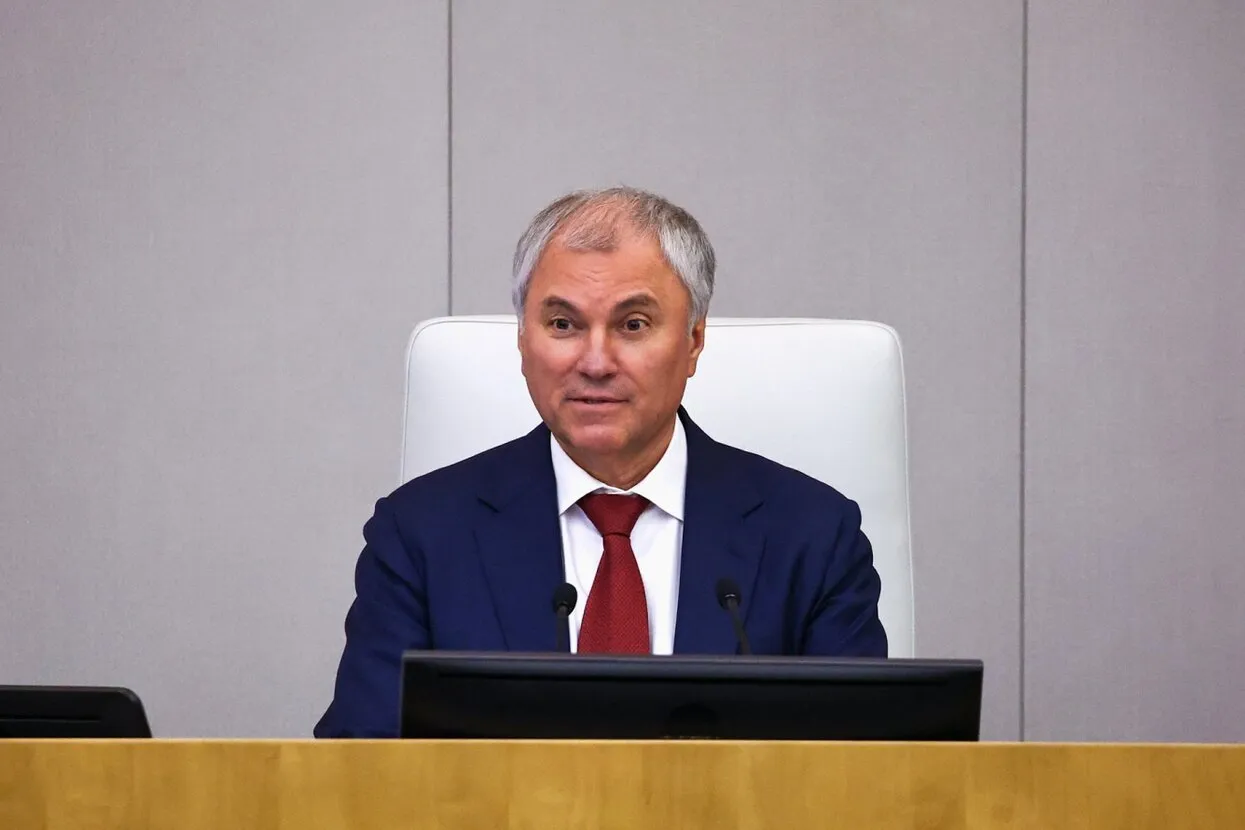
How Vyacheslav Volodin secured a record third term as speaker of Russia’s State Duma — and why Putin keeps him there
Newly elected State Duma Speaker Vyacheslav Volodin opened the new parliament’s first session with some advice for lawmakers:
History shows that our country cannot be defeated from the outside. All our problems come from within: conflict, betrayal by the elites, weak leadership. So we need to learn from this. We must not lose our country.
Volodin became speaker of parliament’s lower house for the third time, breaking Boris Gryzlov’s record. Gryzlov served twice, during the fourth and fifth parliamentary terms.
In 2021, ahead of elections to the eighth State Duma, United Russia leader Dmitry Medvedev expressed interest in becoming speaker. But Vladimir Putin did not approve putting him at the top of the party’s candidate list.
The same thing happened in 2026. Kremlin-friendly media reported that Medvedev might head the top three or top five candidates on the party’s list. Meduza’s sources said Medvedev himself was lobbying for this arrangement, but Putin had not approved it.
Medvedev was again left off the party’s national candidate list, closing off his path to the speakership. The main beneficiaries of the former president’s exclusion were Volodin and the Kremlin’s domestic policy team, which feared that Medvedev’s involvement in the campaign could further depress United Russia’s already low approval ratings.
Volodin began his political career in the Saratov region. In 1990, the 26-year-old, who held a doctorate in agricultural sciences, won a seat on Saratov’s city council as an independent, defeating a candidate from the Communist Party of the Soviet Union.
After the Soviet Union collapsed, Volodin effectively worked as a political consultant, helping Yury Kitov, a member of the Russian republic’s Supreme Soviet, become mayor of Saratov. He persuaded city council members to approve Kitov’s candidacy, even though the regional administration backed someone else.
Once Kitov took office, Volodin became his deputy and chief of staff at city hall. He soon became deputy governor of the Saratov region, then led by one of Russia’s most colorful governors, Dmitry Ayatskov.
By the late 1990s, Ayatskov had grown suspicious of his young, ambitious deputy, whose responsibilities included finances, social policy, and infrastructure. Their conflict prompted Volodin to leave for Moscow, where he began building Moscow Mayor Yuri Luzhkov’s political movement, Fatherland.
In 1999, Fatherland formed a bloc with All Russia, a movement of powerful regional governors, and secured the support of former Prime Minister Yevgeny Primakov. As a result, the Fatherland–All Russia bloc was seen as a likely winner of the State Duma elections.
Meanwhile, the Kremlin was promoting the Unity bloc and the Union of Right Forces, whose main opponent was Fatherland–All Russia. Putin, then prime minister, openly backed Unity.
The Communists won the largest share of the vote (24.3%), Unity came second (23.32%), and Fatherland finished only third (13.33%). But Volodin won a seat in parliament, where he was appointed deputy leader of the Luzhkov–Primakov bloc’s parliamentary faction and later became its leader.
In 2001, Fatherland became Unity’s ally, and two years later they merged into a single party. “Our three organizations supported the president. His last name is Putin,” Volodin told Kommersant at the time.
Vyacheslav Volodin and Vladimir Putin at a State Duma session on constitutional amendments, 2020
Vladimir Fedorenko / RIA Novosti / Sputnik / Profimedia
Volodin rose quickly through United Russia’s ranks. In 2005, he was appointed secretary of its General Council, a key governing body. “There were no other candidates,” a party source told Kommersant at the time. “He [Volodin] has an appetite for this work and the political experience the job requires.” Another source told the newspaper that Vladislav Surkov, then head of the presidential administration’s domestic policy team, was entirely happy with Volodin as a candidate. Volodin owed his appointment to Surkov.
Volodin quickly imposed his own bureaucratic order on the party. A Saratov political consultant who has known him for years told Meduza on condition of anonymity that even before his appointment to the General Council, Volodin wanted to make United Russia’s branch in his home region a model for the rest:
Everything that later became standard practice in United Russia [nationwide] was tried out in Saratov. For example, they started collecting campaign money from businesspeople — developers, retailers — through a centralized system. “Want your own lawmakers? You need to pay.” They set up centralized propaganda on local TV. I’d worked in other regions, and United Russia didn’t have anything like that there. We felt we were ahead of the curve.
A political consultant who worked with the party’s national leadership told Meduza how closely Volodin managed party affairs once he became General Council secretary:
If the party had a crisis, a scandal, or a conflict somewhere in the regions, he could fly out there the next day. By the time he arrived, he already knew everything about the region. He tried to put his own people in place wherever he could. He worked closely with the authorities in regions that had set up systems for rigging elections, [because] he wanted to spread those practices elsewhere, too.
Volodin was one of the main organizers of United Russia’s 2007 State Duma election campaign. Putin headed its candidate list that year — the only time he has done so in the party’s history.
During that campaign, the president got to know Volodin better and “took note of the party manager,” according to a source who worked with the presidential administration’s domestic policy team at the time and another who worked in the federal government. In 2010, Putin, by then prime minister, “brought” Volodin “back” into the executive branch, offering him the job of government chief of staff.
That made the politician from Saratov Putin’s chief political strategist. Ahead of the 2011 State Duma elections, United Russia’s ratings were low, and Volodin proposed that the prime minister and party leader mask the party’s role in the campaign so its stale image would not put off Russian voters. The idea was to create a pro-Putin movement that would ostensibly run the campaign, with United Russia nominating candidates for the movement. Putin liked the proposal.
The new movement was named the All-Russia People’s Front. Putin himself was its formal leader, but in practice Volodin, who had devised it, ran it.
Soon after the 2011 State Duma elections, Volodin, then a deputy prime minister, became head of the Kremlin’s domestic policy team, which ran Putin’s campaign to return to the presidency. Under the team’s direction, the State Duma passed repressive laws and later earned the nickname “the mad printer.”
After the annexation of Crimea, Volodin made perhaps his best-known declaration: “No Putin — no Russia.” Speaking at the 2014 Valdai forum, he used those words to describe the mood among Russians. A source in the speaker’s circle believes that as far back as the 2000s, Volodin “realized that [to advance his career] he needed to work for one person — the head of state”:
He doesn’t belong to any influential group, though he may, for example, have good relations with certain security and law enforcement officials. But they don’t have a shared history or any joint dealings. If you belong to a group and lose your post in the broader power structure, your patrons will find you a place within the clan. They won’t abandon you. Volodin doesn’t have that option, so he constantly makes a show of pledging allegiance to the president.
But even this extreme loyalty did not help Volodin keep his job as deputy head of the presidential administration responsible for domestic politics in 2016. Both the source in the speaker’s circle and a source close to the current domestic policy team say he wanted to stay in the Kremlin.
That was when Volodin became State Duma speaker. One account attributes his move to parliament to election turnout falling short of the president’s expectations: in 2016, it did not reach 50%. Another holds that the president was deliberately moving officials who had grown more powerful to different jobs, “taking them out of their comfort zone,” as one Meduza source close to the presidential administration put it.
In parliament, Volodin made a show of enforcing discipline while continuing to make pro-Putin statements. He repeatedly said lawmakers should support the president, and after Russia launched its full-scale invasion of Ukraine, he became one of the most prominent officials voicing ultrapatriotic views. Russians who had emigrated became one of the speaker’s favorite targets: he repeatedly called them “traitors” and demanded that they be punished.
“Volodin often goes too far. He knows why he does it — to make his loyalty more visible. But he also knows where to draw the line and doesn’t turn into Medvedev,” said the source in the speaker’s circle. On his Telegram channel, the former president regularly insults the leaders of Ukraine and European countries and threatens to use nuclear weapons.
Vyacheslav Volodin and Prime Minister Dmitry Medvedev at a meeting of the Presidential Council for Strategic Development and National Projects, 2019
Alexey Nikolsky / RIA Novosti / Sputnik / Profimedia
According to the same source, this loyalty is the main reason Volodin remains close to the president. The speaker shows it in different ways, the source said, for example by telling Putin about proposals that influential players bring to the Duma:
Often these are things that are nowhere near important enough to bring to the president — some perks buried in clauses of bills. But the speaker is showing that he’s keeping an eye on things. All he has to offer is this show of loyalty. You couldn’t say he’s interesting to talk to, for example.
The source believes Volodin retained the speakership because of his loyalty and because he keeps an equal distance from all influential groups: “That way, Putin preserved the balance.”
Once it became known that Medvedev had been left off the candidate lists, Volodin began attending meetings about committee assignments and “drawing up a legislative agenda” even before the elections, the same source said: “Who else on the lists could [be] both a public figure and a political operator?”
Another political consultant who works with the presidential administration said Volodin kept his post because of “his good relations with [Putin aide Nikolai] Patrushev and the fact that Putin has long preferred to keep people in their posts when he is happy with their work.”
A political consultant who worked with Volodin’s domestic policy team praised his “instinct for bureaucratic maneuvering” and called him a “bureaucratic animal”: “He can orchestrate intrigues and elaborate schemes, and the people involved often have no idea they’ve been drawn into anything.”
The same consultant said the speaker has no real friends. He sees the people around him as “temporary allies” or “tools for achieving his goals.”
The source gave the example of former State Duma Deputy Speaker Sergey Neverov, a longtime Volodin ally. In April 2023, Neverov proposed inviting Yevgeny Prigozhin, founder of the Wagner private military company, to the Duma. Prigozhin was sharply critical of the Defense Ministry’s leadership. In June that year, he and his private military company staged a mutiny and marched toward Moscow. Afterward, Volodin made a show of cutting ties with Neverov. A year later, Neverov lost his post as deputy speaker, and this year he failed to win a seat in the new Duma.
But the political consultant who worked with Volodin’s domestic policy team cautioned against confusing a “bureaucratic animal” with a “political animal”:
As a politician, he’s still stuck in the 1990s, in the backwaters of the Saratov region. Of course, compared with today’s party leaders — [Liberal Democratic Party leader Leonid] Slutsky and [New People leader Alexey] Nechayev — he’s a god and Michael Jackson rolled into one. But overall, he’s a pretty crude, provincial politician. Maybe that suits the higher-ups.
At Meduza, we are committed to transparency about our use of artificial intelligence in the newsroom. The story you’re reading was written by one of our living, breathing journalists and translated from Russian using an AI model configured to follow our strict editorial standards. This translation process is the result of extensive testing and refinements to ensure our English-language coverage is timely and accurate. A Meduza editor reviews every draft before publication.
If you find any errors in this translation, please contact us at reports@meduza.io.
To read Meduza’s exclusive content in English, please subscribe to our newsletter.
Andrey Pertsev
What’s Putin have to do with this?
Although lawmakers formally elect the speaker, all senior personnel decisions are made or approved by Vladimir Putin.
What was he known for?
In 1998, Ayatskov proposed legalizing sex work in the region (the idea was never implemented). In May 1998, in Birmingham, Boris Yeltsin half-jokingly introduced Dmitry Ayatskov to Bill Clinton as “the future president of Russia.” Ayatskov called Clinton “a cool guy” and said, “I envy Monica Lewinsky.” In 2000, the governor promised to fly into space.
What was it?
An electoral bloc created by the presidential administration and big business ahead of the 1999 State Duma elections. It included politicians loyal to the Kremlin and had the support of some regional governors. The top three spots on Unity’s ticket went to Emergency Situations Minister Sergei Shoigu, Olympic champion Alexander Karelin, and Interior Ministry General Alexander Gurov.
How low?
In July 2011, they fell to what was then a record low of 37.5%.
Is that true?
Probably, yes. Putin used to reshuffle officials frequently, but over time his preferences changed radically. Presidential administration chief Anton Vaino has now held his post for more than 10 years, breaking the record for the longest tenure in the job. In a few days, it will be 10 years since Sergei Kiriyenko was appointed deputy head of the presidential administration. Alexander Bastrykin has headed the Investigative Committee for 15 years. Mikhail Mishustin has served as prime minister for more than six years.