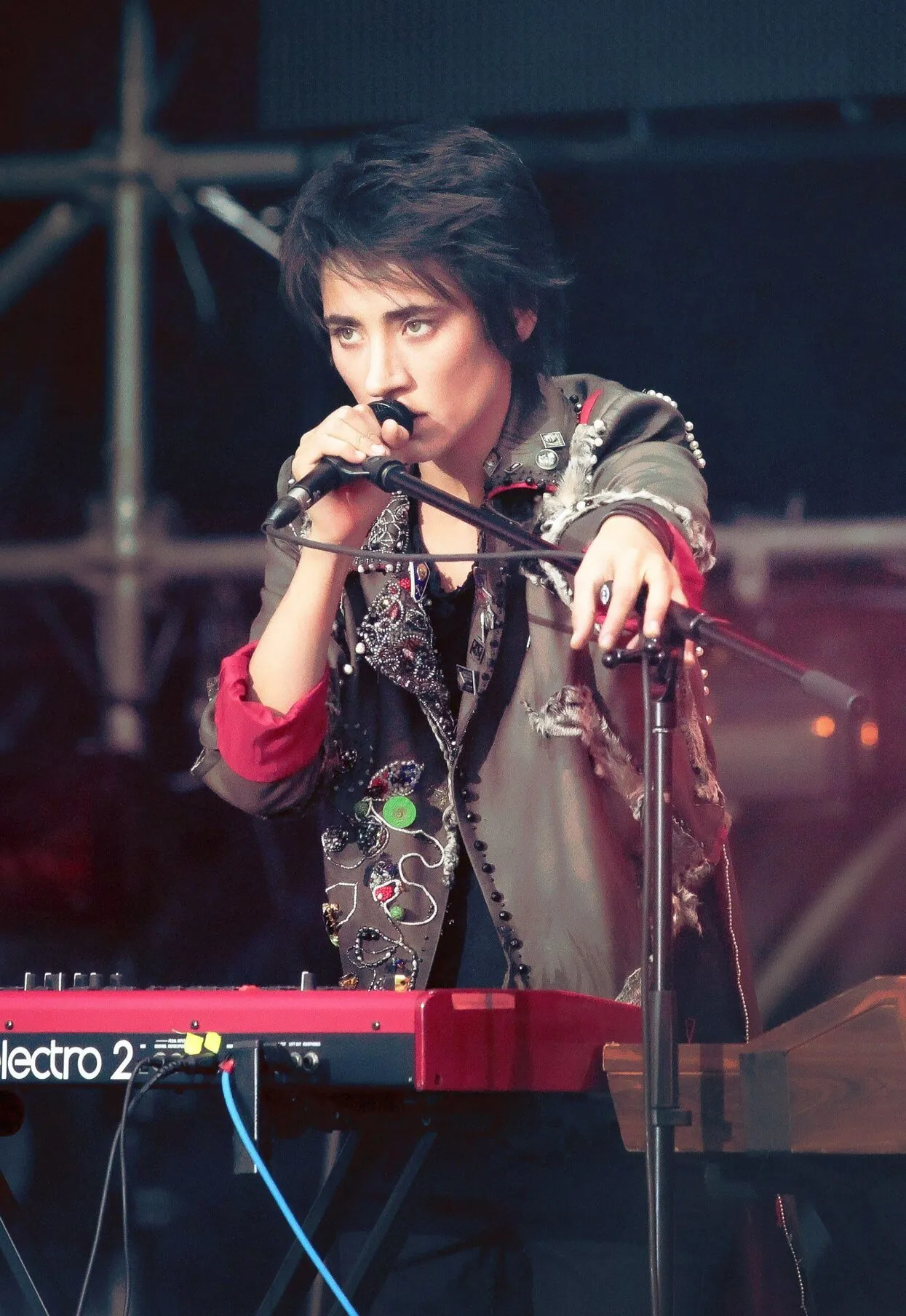
Zemfira wrote one of Russian pop’s most devastating songs about the war. She turned 50 this week in Paris, where her 2025 setlists had room for the newer songs, never ‘It’s midnight in Mariupol.’
Zemfira turned 50 on August 26. The current chapter of her work is best dated from the start of Russia’s full-scale invasion of Ukraine: in 2022, she released the uncompromising song “Myaso” (“Meat”) and left Moscow for Paris. Zemfira has recorded several more songs about the war since then, and she’s even earned Russia’s “foreign agent” designation. At Meduza’s request, music critic Lev Gankin reviews all seven of Zemfira’s post–February 2022 releases and considers what they reveal about a singer who doesn’t give interviews.
In the summer of 2026, Meduza asked Zemfira for an interview. She declined through her representatives.
Myaso (“Meat”), 2022
zemfira
“Myaso” is one of the most devastating, direct, and lucid statements on the war to come out of Russian-language pop music in the past four years.
In “Myaso,” Zemfira deliberately gives up much of what she does best — inventive harmonic movement and intriguing melodies built on non-chord tones — because the subject plainly does not lend itself to elegant solutions. In their place: a halting recitative, a strangled whisper that noticeably breaks the pattern twice — once on the line “It’s midnight in Mariupol,” where she shifts into a register of frenzied screaming, and again on the propaganda cliché “high-precision long-range missiles,” which wrenches the song out of its meter.
The EP Zemfira According to Luka, 2022
zemfira
Four songs written with Zemfira’s nephew Artur Ramazanov-Ostapenko. The war comes up directly here too (“cities burn without stopping, everyone’s afraid of the red button”; “the day after tomorrow there’s war, and we will win”), but this time, unlike in “Myaso,” the war looks like something you can escape — mainly through closeness with the people you love: “I have you, you have me, the two of us against everyone”; “no one in this world is eternal except us”; “we’ll be together till death do us part.”
Recognizing that possibility brings back Zemfira’s signature melodicism: “Aperol,” with its cinematic orchestration in the middle section, could have been a radio hit in better years — before Russia invented “foreign agents” and the rest of that vile nonsense. Even so, the distance from hope to hopelessness here is less than a single step — as the closing track, “Moy Drug” (“My Friend”), demonstrates in its two emotionally opposite halves.
Cactus with Dmitry Yemelyanov, 2023
Renata Litvinova
The soundtrack to a stage production by Renata Litvinova is 90% instrumental, but it does include one full-fledged song, the title track — a concise, affecting ballad that, unlike Zemfira’s other recent work, seems to have a single dimension: the personal.
To appreciate “Cactus” fully, you likely need to know the play and the production the track was written for. Divorced from that context, the song feels somewhat emotionally closed off despite its inviting sound — though here too Zemfira’s melodic instinct does not desert her for a moment.
PODNHA (“Homeland”), 2023
zemfira
This is Zemfira in political mode, which means a partial return to the register of “Myaso,” with melodic recitation that hangs for long stretches on a single note over a tense accompaniment. (The title spells the Russian word rodina, “homeland,” in Latin letters chosen to resemble the Cyrillic.) There are differences, all the same. “PODNHA” has a clearer structure: lines of roughly equal length, and a verse-chorus form it holds to throughout, in place of the jagged, stumbling pattern of the earlier track.
In the chorus, the rhythm thins out, and the rapid-fire patter of “We’ll teach you, bitch, to love your homeland” gives way to a clearly discernible melody built from several short, mournfully descending phrases. The most unexpected and inventive sonic touch is a flute, its thin but ringing voice set against the low-frequency power of the guitar riffs. The choice looks deliberate: the instrument in the arrangement is a Ukrainian sopilka.
Colette, 2024
zemfira
After leaving Russia, Zemfira settled in Paris. Her earlier recordings gave no hint of that turn, but “Colette” is unmistakably touched by French charm: the title is a name that was especially popular in France during the belle époque. It is probably the lightest, even the tenderest, composition in her wartime discography, though at the end its addressee — young Colette herself — is offered a stiletto blade as an “elegant remedy for troubles.”
The main theme is catchy, even hard to shake; the lyrics are slightly mannered, not without a certain coyness. The last minute and a half is given over to a tranquil instrumental coda whose harmony recalls “My Baby’s Taking Me Home” by Sparks.
Zemfira According to Luka: Dramatique, 2024
zemfira
Another piece from the Zemfira According to Luka project — but pitched in an entirely different key from the debut EP. “Dramatique” is a forceful statement in heavy “alternative” territory, with a hurried, frantic rhythm and riffs that verge on heavy metal. She has recorded tracks in the vein of “Colette” before, but we have probably never heard her in this register. The aggressive sound also suits lyrics that open with the demand “cut off my head” and end with a mantra she repeats in various tones: “there’s no happiness.”
As with the previous track, there is a separate coda here, a kind of aftertaste to the song itself. The emotional charge of “Dramatique” is fundamentally different, but the methods evidently overlap.
Jim Beam, 2025
zemfira
Zemfira’s most recent release is an update of an old song that first appeared as a bonus track on the album Vendetta. The early version of “Jim Beam” carried the subtitle “Ufa ‘97,” so it was already a nostalgia-tinged track in 2005. You might expect the new “Jim Beam,” made 20 years later and thousands of miles from Ufa, to sound even more old-fashioned. It doesn’t: the track keeps the charm of the original and gains a bolder, more sculpted, more professional sound.
Set against her other songs of recent years, this is probably not her most significant work; it seems to lack the urgency of the moment and any “big themes.” But as a greeting from happier days, “Jim Beam” works perfectly — and Zemfira clearly made the new version out of love, not as an afterthought.
* * *
Her discography in emigration is small but substantial: as in years past, she remains flatly uninterested in doing the same thing twice. Zemfira has not turned a deaf ear to the horrors of the war, but she has not allowed them to dictate what her work will be for years to come, either. A few lines from her recent songs will certainly make it into any collection of the defining quotations of these troubled times. Take this one, from “Moy Drug”: “I already think less often about my mother and more often about plans for next year.”
Bagatelles like “Colette” may well be destined for a happier fate than the songs that respond directly to events and work brilliantly in the moment. When she released that track in April 2024, Zemfira told fans it was meant for her new album, which, she said regretfully, would not be ready by that summer. As you would expect, the album still has not come out — not after a year, not after two. She did play “Colette” and “Dramatique” at her concerts in 2025 — but not “PODNHA” or “Myaso.”
The sound and lyrics of her songs are unlikely to tell us how Zemfira lives or what moves her — though we will probably keep trying to find out, doggedly and hopelessly. (The author of this piece once tried it himself, in a review of the album Borderline.) Many passages are strikingly sincere, but her work remains a closed book. New chapters, at least, keep appearing.
At Meduza, we are committed to transparency about our use of artificial intelligence in the newsroom. The story you’re reading was written by one of our living, breathing journalists and translated from Russian using an AI model configured to follow our strict editorial standards. This translation process is the result of extensive testing and refinements to ensure our English-language coverage is timely and accurate. A Meduza editor reviews every draft before publication.
If you find any errors in this translation, please contact us at reports@meduza.io.
To read Meduza’s exclusive content in English, please subscribe to our newsletter.
Lev Gankin
Belle Époque
A conventional term for European (primarily French) culture of the 19th and early 20th centuries.
Bagatelle
A light musical piece for piano.