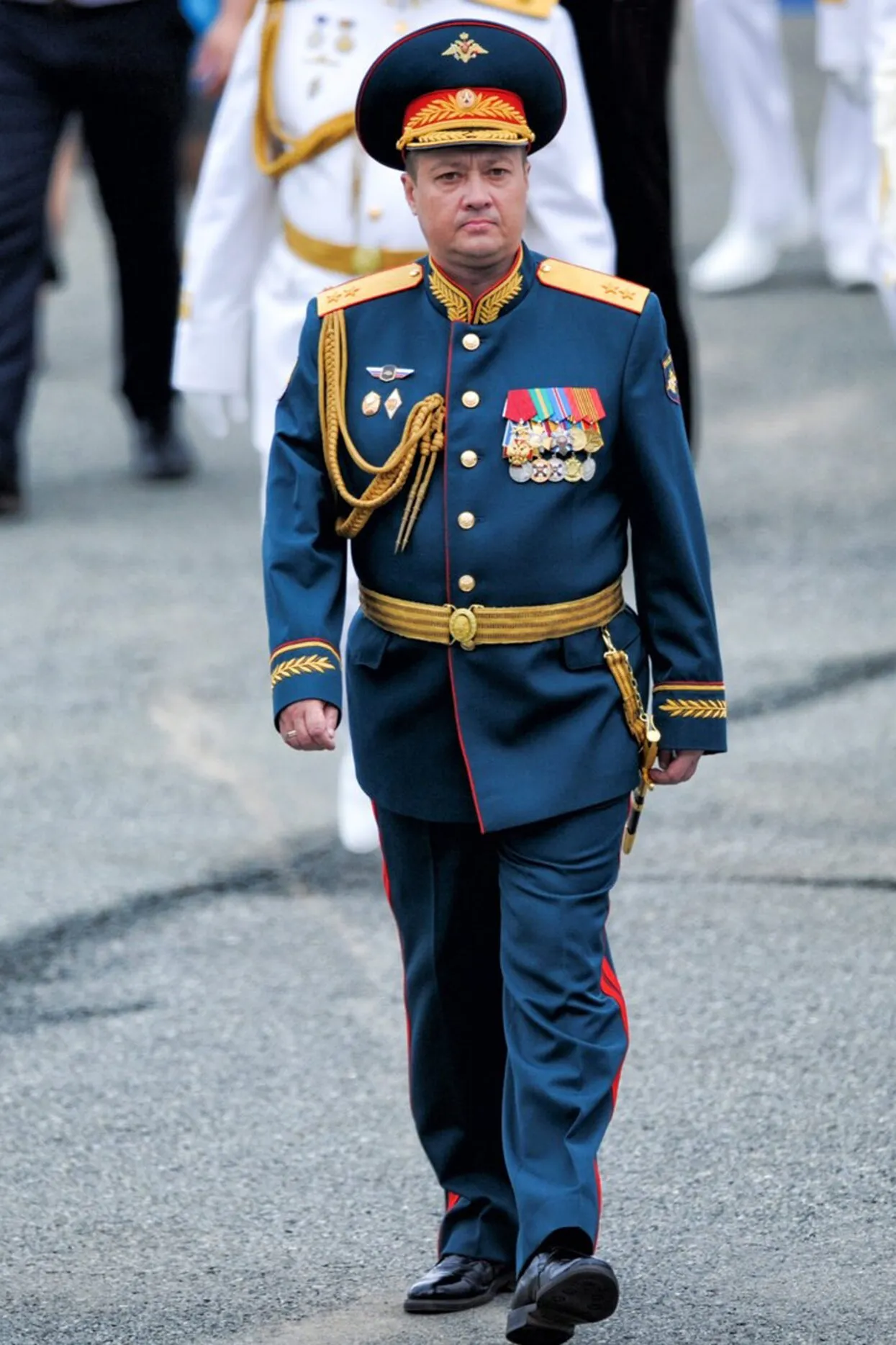
Russian General Alexander Chayko appears to have been the target of the Moscow restaurant bombing. He commanded troops who carried out the Bucha massacre in Ukraine.
On August 1, an explosion occurred in a high-rise building on Barrikadnaya Street in Moscow. At the time, a private event was underway at the Balzi Rossi restaurant on the ground floor of the building. According to Russia’s National Anti-Terrorism Committee, the attack killed three people and injured more than twenty. The explosive device was delivered to the restaurant by a courier, who was herself among those killed, as was a security guard who had refused to let her into the building. It appears the restaurant was hosting a birthday celebration for the head of Russia’s Aerospace Forces, Colonel General Alexander Chayko: he turned 55 on July 27, and the words “Alexander, 55” could be seen on a sign on the restaurant’s stage, visible in a video posted by a guest at the event. Sources at pro-government Telegram channels have also said that the celebration at Balzi Rossi was held for the head of the Aerospace Forces. Meduza reports on the general who was the apparent target of the attack.
If Alexander Chayko was indeed the target of the attack, he is one of the most senior generals to come under assassination attempt since Russia launched its full-scale war against Ukraine. Chayko was named head of Russia’s Aerospace Forces only in May 2026, but even before that appointment he held the rank of general and commanded forces in some of the most sensitive theaters for Russia: leading the military operation in Syria and, in 2022, the Russian offensive on the Kyiv region. He has been accused of numerous war crimes, is under sanctions from the United Kingdom and the European Union, and has held the title of Hero of Russia since 2020.
Syria
Alexander Chayko listens to a briefing from Bashar al-Assad alongside Defense Minister Sergei Shoigu and Vladimir Putin, January 2020
Press Service of the President of Russia
Alexander Chayko’s military biography, as laid out in open sources, is a fairly typical one. He was born on July 27, 1971, in the town of Golitsyno in the Moscow region. He graduated from a Suvorov military school in Moscow in 1988 and served as a cadet before being posted to Germany in 1992 as part of the Western Group of Forces. He later returned to Russia and served in the Moscow Military District, including as commander of the 2nd Tamanskaya Division. Chayko graduated from the Frunze Academy in 2001 and from the General Staff Academy — which trains senior military commanders — in 2012. He was promoted to major general in 2013 and commanded the 1st Tank Army until 2017. When Russian troops withdrew during the Kyiv operation, the army’s documents fell into the hands of Ukraine’s armed forces, becoming a valuable source of information on Russian military losses.
Chayko’s name has surfaced in media coverage tied to two episodes. The first is his service in Syria, where he commanded the entire Russian military grouping in the country for more than a year — from September 2019 to November 2020, and then again for several months in 2021. In that post, Chayko succeeded Colonel General Andrei Serdyukov, who had himself succeeded Sergei Surovikin.
Human Rights Watch published a report in 2020 detailing the actions of Russian troops, including Chayko’s, in Syria. The rights group found that at least 1,600 civilians were killed in the fighting while Surovikin, Serdyukov, and Chayko successively commanded the Russian force, most of them in and around the city of Idlib and the district of the same name. That toll includes hospital strikes carried out during Chayko’s time in command.
Human Rights Watch documented 46 strikes in total on sites where it recorded no evidence of enemy troops or military equipment, a pattern the organization says rules out the possibility that the attacks on civilian sites were accidental. The rights group noted, however, that it could not find specific details linking the strikes to orders given by Chayko.
Allegations of unlawful strikes on schools and hospitals were raised at U.N. Security Council meetings and at two sessions of the Human Rights Council. Russia had obtained the coordinates of the hospitals through the U.N.’s deconfliction mechanism, and struck those sites anyway. Chayko personally briefed Putin and Shoigu on the operation’s progress in January 2020, making it hard to believe he was unaware of his own troops’ actions or bears no responsibility for the repeated strikes on civilian sites. Yet Chayko’s service in Syria did not make him the subject of a judicial proceeding. It made him a Hero of Russia. Putin awarded him that title in 2020.
The United Kingdom added Alexander Chayko to its sanctions list in June 2022 for providing assistance to Bashar al-Assad’s regime, without specifying which crimes he is accused of.
Ukraine
Alexander Chayko presents awards to Russian troops who took part in the occupation of the outskirts of Kyiv, March 2022
Russian Defense Ministry / TASS / Profimedia
More is known about Chayko’s role as commander of the force that advanced on Kyiv in February and March 2022. Russian troops under his ultimate command committed the numerous war crimes against civilians documented in Bucha and other towns northwest of Kyiv, including extrajudicial killings and torture. Multiple independent investigations — including one by Meduza, which published an analysis of video footage handed over by Ukrainian troops — have established that the killings took place while Russian forces occupied these towns.
How directly Alexander Chayko was involved in what happened at the time in the occupied territory under his command remains unclear. Ukrainian prosecutors say they have no evidence that he ordered specific crimes, though it is clear the crimes were committed under his command. Here is what is known from open sources:
- In March 2022, before Russian troops withdrew from the Kyiv region, Chayko traveled to the village of Zdvyzhivka, where a command center had been set up for the forces advancing on Kyiv from the northwest. There, he presented awards to Russian troops who had taken part in the Kyiv operation. “All the units, all the divisions are acting the way they were trained to,” he said in a video dated March 24. “They’re doing everything right. I’m proud of them.”
- During the offensive, Chayko himself apparently spent considerable time in Zdvyzhivka, meaning he could have known firsthand what was happening “on the ground.” When Associated Press journalists conducted a detailed investigation into crimes committed by Russian troops near Kyiv in the summer of 2022, local residents identified the general from photographs.
- AP journalists determined that at least three people — Mykola Moroz, Andrii Voznenko, and Mykhailo Honchar — were extrajudicially killed on the grounds of a house in Zdvyzhivka that Russian troops frequented.
- The London-based think tank RUSI, which examined copies of the Russian military’s offensive plans, says the order to block and destroy “nationalist resistance” during the advance on Kyiv came from the command level, not from rank-and-file soldiers. Troops used lists compiled by Russian intelligence to carry out clearing operations, combing through neighborhoods to identify and neutralize anyone who could pose a threat. Jack Watling, a senior research fellow at RUSI who shared the battle plans with AP journalists, said the orders were drafted at Chayko’s level, meaning he would have had to see and sign them.
- In 2025, Ukraine’s Security Service (SBU) published a previously unknown audio recording of a person believed to be Alexander Chayko ordering strikes, in March 2022, on the town of Malyn and the village of Teterivske west of Kyiv. In the recording, he orders attack aircraft to “plan for 5:30 on the settlement of Teterivske. It needs to be wiped off the face of the earth.” The strike was also to involve rocket artillery — Grad, Uragan, and similar systems designed to hit area targets — in addition to aircraft.
Security Service of Ukraine
As of this writing, Ukrainian authorities have not commented on the explosion on Barrikadnaya Street or their possible role in it. In his regular video address, Volodymyr Zelensky commented only on strikes on an oil refinery in the Saratov region and Wildberries warehouses in the Samara region, without mentioning the Moscow attack.
At Meduza, we are committed to transparency about our use of artificial intelligence in the newsroom. The story you’re reading was written by one of our living, breathing journalists and translated from Russian using an AI model configured to follow our strict editorial standards. This translation process is the result of extensive testing and refinements to ensure our English-language coverage is timely and accurate. A Meduza editor reviews every draft before publication.
If you find any errors in this translation, please contact us at reports@meduza.io.
To read Meduza’s exclusive content in English, please subscribe to our newsletter.
The Explainer Desk