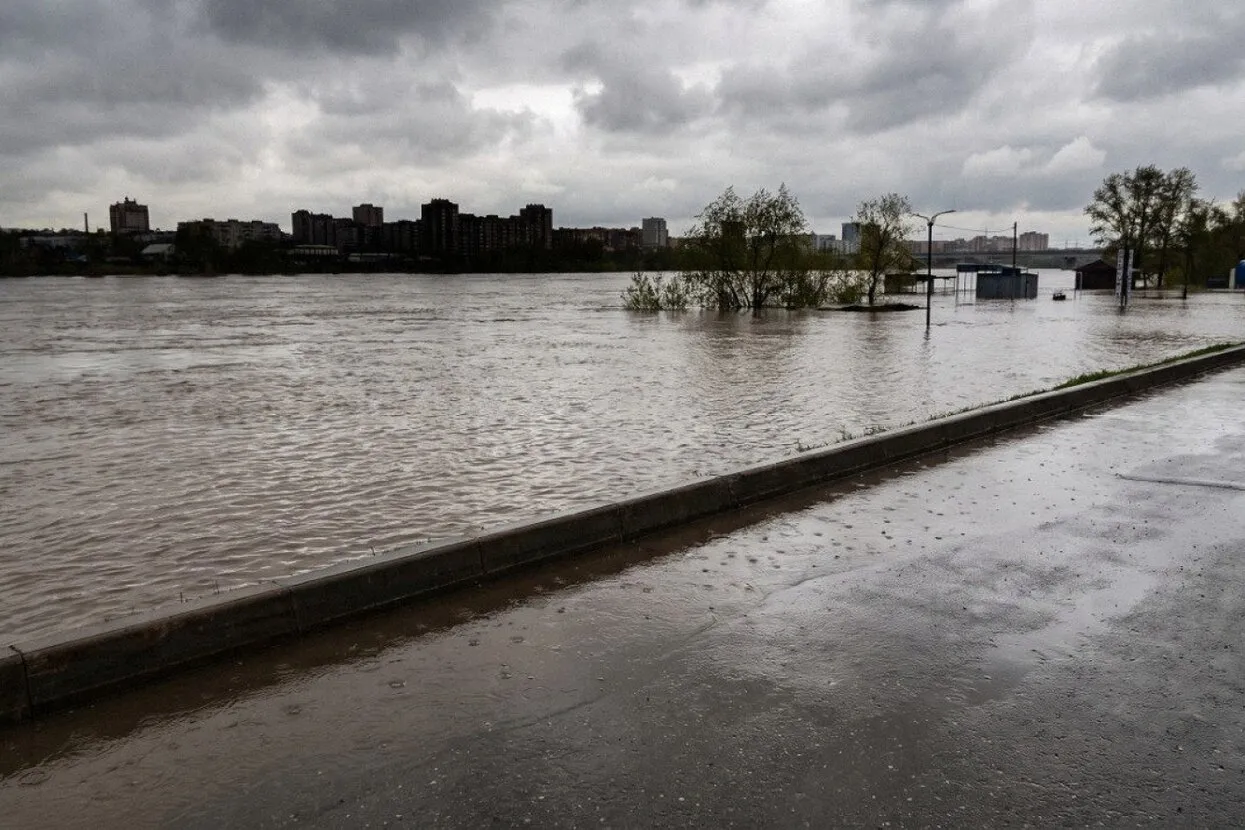
‘It reeks, pardon me, of shit’: A Siberian city spent two weeks with sewage-smelling tap water while officials insisted that it was safe
Since early July, prolonged heavy rains have raised the water level of the Tura — the river on whose banks Tyumen stands — by 2.7 meters (nearly nine feet). The water has flooded city streets and many garden cooperatives. In mid-July, Tyumen residents discovered that their tap water had begun to smell of feces and chemicals. They started posting videos on social media showing that the water was completely impossible to use for drinking, cooking, or washing. Tyumen’s authorities and the local branch of Rosvodokanal insisted for a long time that the water was safe. But on July 28, Governor Alexander Moor finally declared a state of emergency in the region over the flooding. The independent journalists’ cooperative Bereg spoke with Tyumen residents about how they are surviving in these conditions. Meduza is translating this text in full.
More on the causes of the water contamination in Tyumen
Tyumen residents’ problems with foul-smelling tap water began in mid-July. In the weeks since, amid the authorities’ silence and inaction, residents have posted dozens of videos on social media showing bathtubs filled with rusty water, jokingly comparing it to kvass, a fermented rye drink, or Coca-Cola Zero because of its color.
In their videos, residents also showed what was happening along the banks of the Tura: some saw hundreds of dead fish in the river, others the carcass of a roe deer, and one person said they had seen a dead cow in the water.
Tyumen region officials insist the water has been treated and is safe. On July 17, Rosvodokanal Tyumen said that despite the sharp drop in the Tura’s water quality caused by the flooding, the water met sanitary standards. On July 21, the regional office of Rospotrebnadzor, Russia’s consumer protection agency, reported that the drinking water was safe but recommended boiling it “as a precaution.”
On July 28, Galina Sharukho, head of the regional Rospotrebnadzor office, again said the water met all safety standards, acknowledging only that it exceeded the limits on organoleptic indicators — smell and taste. The same day, announcing the state of emergency over the flooding, Governor Alexander Moor confirmed that the water quality situation was “under constant monitoring.”
Tyumen’s water supply comes from two intake stations — the Velizhansky and the Metelevsky. The first takes water from underground sources, and it is relatively clean. The second takes water from the Tura, which is now contaminated. On July 28, officials announced an increase in the supply of water from underground wells, but so far this has not fundamentally changed the situation.
Tyumen residents wrote to the Investigative Committee (a criminal case was opened on July 24) and recorded an appeal to Vladimir Putin. About 4,000 residents are raising money for independent testing of the water. Addresses are being posted online where people are willing to share clean tap water.
The names of the people interviewed for this story have been changed.
‘It smells like catastrophe. But we’ve got songs, dancing, and celebrities’
Artyom, lives in the Vostochny neighborhood
Tyumen seems to be going about its ordinary life, and everything seems fine — until one simple act sends it all to hell. You turn on the tap, and out comes water that makes you want to recoil. The authorities pretend something is being done, but in fact we’re now in the third week, and the problem hasn’t been solved. Meanwhile, I like the official reports, which sound almost like a mantra: the water is safe, the readings are normal, monitoring is conducted daily.
Rosvodokanal Tyumen blames the Tura River, the flooding, high color readings, and falling oxygen levels — all of which produce a sharp smell and a strange tint. But the main thing is the verdict: no irregularities were found in the quality of either the tap water or the river water. So what is this, then? What is that smell? You can’t stand to be anywhere in the city near the Tura — it reeks, pardon me, of shit. And dead fish are floating along the banks. And today, in a local social media group, I even saw a dead roe deer floating by.
The water is advancing everywhere. In people’s vegetable gardens, the crops are rotting because everything has flooded. The other day I visited friends in Bereznyaki [a neighborhood in Tyumen], who have always drunk water from their own well. Now they’re scared: the water has suddenly turned cloudy and dark. My friend says he’s taken samples in for testing five times already, but they refuse to accept them. They tell him just to run the tap until it’s clear. But the water doesn’t come out any other way right now! They have their own water supply, and now even they’re hunting for water in stores.
The water utility later acknowledged that water quality in the Tura had fallen to a historic low. At the same time, it said the water piped into homes was completely safe. But for some reason doctors are reporting a rise in illness. People are complaining en masse of itching and red rashes.
You can neither boil this water nor drink it. So instead of the authorities, Tyumen residents are looking for a way out themselves: some install expensive filters, some drive to springs, some buy water from vending machines.
And the market is reacting instantly: prices at the water vending machines are climbing because demand is off the charts. So people in Tyumen pay twice for the right to drink normal water: first in taxes, then out of pocket. This reeks — really reeks — of an environmental catastrophe!
But no — we’ve got City Day [held July 25], we’ve got fireworks, we’ve got dancing, and they brought in some celebrities. What for? They spent millions of rubles. Well done — you can’t fault them. As someone born and raised in Tyumen, I find all of this infuriating.
‘Huge red blotches have spread across my body; they swell up, and they itch and burn unbearably’
Albina, lives in the area around Shirotnaya Street
What’s happening with the water in Tyumen can’t be summed up in a couple of words. A terrible smell, the entire periodic table, dead fish, and poultry-farm waste in our water. And none of this will [end] soon: it will be a very long time before any measures are taken. The consequences will be terrible — for people, for agriculture, and for the river ecosystem.
Today I had to go to several stores just to find a single 1.5-liter [50-ounce] bottle of still water. And all of this in unbearable heat, when you’re desperate for a drink [temperatures in Tyumen had been around 86 degrees Fahrenheit, or 30 degrees Celsius, in recent days].
Spend any time outside and, naturally, you’re covered in sweat and dust. You come home and try to wash. But boiling the tap water doesn’t help [get rid of the smell and taste] — dirt and stinking water pour over you. Your clothes, your hair, your skin: everything is saturated with that terrible smell. It’s a vicious circle — you try to wash, and instead you soak up a dose of chemicals. There’s no way to keep clean with water like this.
I’ve been hit pretty hard myself. Huge red blotches have spread across my body; they swell up, and they itch and burn unbearably. Doctors can’t diagnose it right away or prescribe proper treatment because they’ve never dealt with anything on this scale.
I have no idea how to treat it, or with what. Doctors say, “Try taking this, try taking that.” There are simply no dermatology appointments left because I’m not the only person in the city who’s been affected. A colleague of mine got conjunctivitis from this water and couldn’t come in to work.
The other day I was down by the embankment — there’s no air to breathe there anymore, an unbearable stench! From the dead fish, apparently. Experts explain it by saying the oxygen level in the water is supposedly critically low, and that’s why the fish are dying. And it isn’t only fish. People posted videos on social media of a dead roe deer floating down the Tura, and someone even wrote about a cow.
When will it end? Nobody knows.
‘People are buying up all the water in the stores. And of course it’s gotten more expensive’
Elizaveta, lives in the Moskovsky Trakt area
On the afternoon of July 17, everything was normal. That evening I went to wash my hands, turned on the tap — and my hands smelled of sewage for another 30 minutes. Unfortunately, the problem hasn’t gone away since. I buy wet wipes and sparkling water because there’s no still water left on the shelves.
Bottled water is very hard to come by — people are simply buying up everything in the stores. I had to go all over my district to find any. And of course the water has gotten more expensive.
No one [from the authorities] explained anything. I only found out when I went online and saw people recording videos about the smell coming out of their taps. That’s how the news reached me that the flooding is pushing groundwater up, and that’s what gives the water its “pleasant aroma.” Before that, I had no idea what was happening or why.
It’s frightening to wash yourself, and frightening to wash food and dishes too, because there’s no telling what comes next. Luckily, I have friends who invited me over to wash — they have normal water. They even brought me drinking water.
I was walking around my district recently — since the flooding, every ditch and hole is full of standing water with a green film on top. It’s frightening to imagine what might start living in it. It’s some kind of apocalypse. The water reeks, the air reeks, the city is under water. And no proper measures are being taken — as far as they [the authorities] are concerned, everything is “fine.”
‘The cat prefers to drink from the tap, but even he’s switched to store-bought water’
Anna, lives in the KPD district
I’ve lived in Tyumen for more than 40 years, and this is the first time I’ve encountered such a disgusting smell in the tap water. Taking a shower was impossible. You wash your hands, and a foul, unidentifiable smell stays on your skin, and nothing will mask it. You wash your hair, and it smells of pond scum, chemical compounds, and rot. Clothes come out of the washing machine still smelling of it, and no detergent covers it up.
It’s awful. It’s miserable — both physically and psychologically.
I was afraid to give the water to my pets. I have a cat who prefers to drink from the tap, but even he has now switched to store-bought water.
You simply can’t use this water, so I started buying water in bulk at the stores to wash with, cook with, drink, and rinse food. There was no other way.
It has gotten a little better in the last few days. I don’t know why — either [Rosvodokanal] really did start making an effort and sending us [cleaner] water, or the building management turned on some filters. At least the water is better now, and I don’t smell it anymore.
‘There’s money for a celebration, but not for water for the people’
Yevgeny, lives in the Kazarovo neighborhood
In 50-odd years I’ve never seen water problems like this. It used to come out yellow sometimes, but it never smelled of feces the way it does now. And meanwhile they’re trumpeting everywhere that there’s no problem at all. I think the issue is with the utilities and the water intake system, not the flooding.
I know a lot of people in the city, and they say that in the Novo-Patrushevo area and around Shirotnaya and Permyakova streets, people can’t wash because it’s like diving into a cesspit. A friend with three kids drives them to his parents’ place downtown to wash. And fine — you can find somewhere to wash. But cooking with it is just dangerous.
All the water vanished from the stores at once. Why isn’t the city trucking any in? Why is there money for a celebration but not for delivering water to people? They could at least step up deliveries [to stores].
I think the emergency was declared a bit late [on July 28] — people were already being flooded out. The lanes in our neighborhood were under water for a week or more. There were barely any roads to begin with, and now even those have washed out.
My basement flooded completely about a week and a half ago, and I had to buy a pump. At my neighbors’ place, water stood in the garden and on the lawn for a week. Everything is rotting, and it looks like there will be no harvest at all. And this with food prices the way they are!
We drove up the lane into our neighborhood — the water is already creeping toward the bridge and looks likely to swallow it. I don’t know how people are going to get out of that part of Kazarovo.
I’m also curious why in Russia, as usual, we wait for some kind of full-blown crisis. I remember when I was young, in 1986 or 1987, there was an outbreak of “jaundice” and hepatitis [in Uzbekistan] because of the water in the Amu Darya. It was an enormous catastrophe.
And what did the Soviet authorities do?
The authorities tightened sanitary and epidemiological controls, expanded infectious-disease hospitals, and introduced additional measures to disinfect drinking water and oversee the water supply. But because of chronic problems with the water and sewage infrastructure, they could not fully eliminate the sources of the infection’s spread, and case numbers did not begin declining until 1988. By international standards, rates remained fairly high until the mid-1990s.
It’s the same story in Tyumen now. The Tura stinks like a sewer main, with feces floating in it. Why has it come to this again? Why isn’t anything being done? The authorities’ inaction all but brought this catastrophe on. Couldn’t they head [the problem] off once in a while instead of dealing with the consequences afterward?
At Meduza, we are committed to transparency about our use of artificial intelligence in the newsroom. The story you’re reading was written by one of our living, breathing journalists and translated from Russian using an AI model configured to follow our strict editorial standards. This translation process is the result of extensive testing and refinements to ensure our English-language coverage is timely and accurate. A Meduza editor reviews every draft before publication.
If you find any errors in this translation, please contact us at reports@meduza.io.
To read Meduza’s exclusive content in English, please subscribe to our newsletter.
Bereg
High water discoloration
A measure of intense water discoloration caused by natural organic impurities, iron, or manganese and expressed in degrees. Water at this level isn’t recommended for drinking until it has been treated.
Is this true?
Not entirely. Tyumen doctors have reported a rise in enterovirus infections — which affect the skin, muscles, nervous system, and stomach — since early July, and are also recording cases of summer flu in children. But that increase began before the water problems started.
Is that right?
On July 15, authorities in Verkhnyaya Salda, a town in the Sverdlovsk region on the bank of the Salda River, a right tributary of the Tura, reported that poultry farm waste caused the pollution. Complaints about the water’s smell and mass fish die-offs in Tyumen followed soon after. Some media outlets and residents speculated on social media that the pollution had traveled from the Salda into the Tura, but Tyumen region authorities say there is currently no confirmation of that account.
Is this true?
Authorities in the Tyumen region insist they have treated the water and that it is safe. On July 17, Rosvodokanal Tyumen, the regional water utility, said that despite a sharp decline in water quality in the Tura River caused by flooding, the water meets sanitary standards. On July 21, the regional office of Rospotrebnadzor, Russia’s consumer protection and public health agency, reported that the drinking water is safe but recommended boiling it “as a precaution.” On July 28, Galina Sharukho, head of the region’s Rospotrebnadzor office, again said the water meets all safety standards, acknowledging only that it exceeded limits for organoleptic indicators — smell and taste. That same day, Governor Alexander Moor, in declaring a state of emergency over the flooding, confirmed that the water quality situation “remains under constant monitoring.”
What is this about?
In the mid-1980s, Uzbekistan experienced one of the largest outbreaks of acute viral hepatitis in Soviet history (in everyday Soviet speech, it was often called “zheltukha,” or “jaundice,” because of the yellowing of the skin it caused). The rise in cases occurred between 1985 and 1987. Later research showed that a significant share of the cases were hepatitis E, transmitted mainly through contaminated drinking water. The outbreak has been linked to the poor state of water supply systems in the Amu Darya river basin amid the broader ecological crisis in the Aral Sea region.