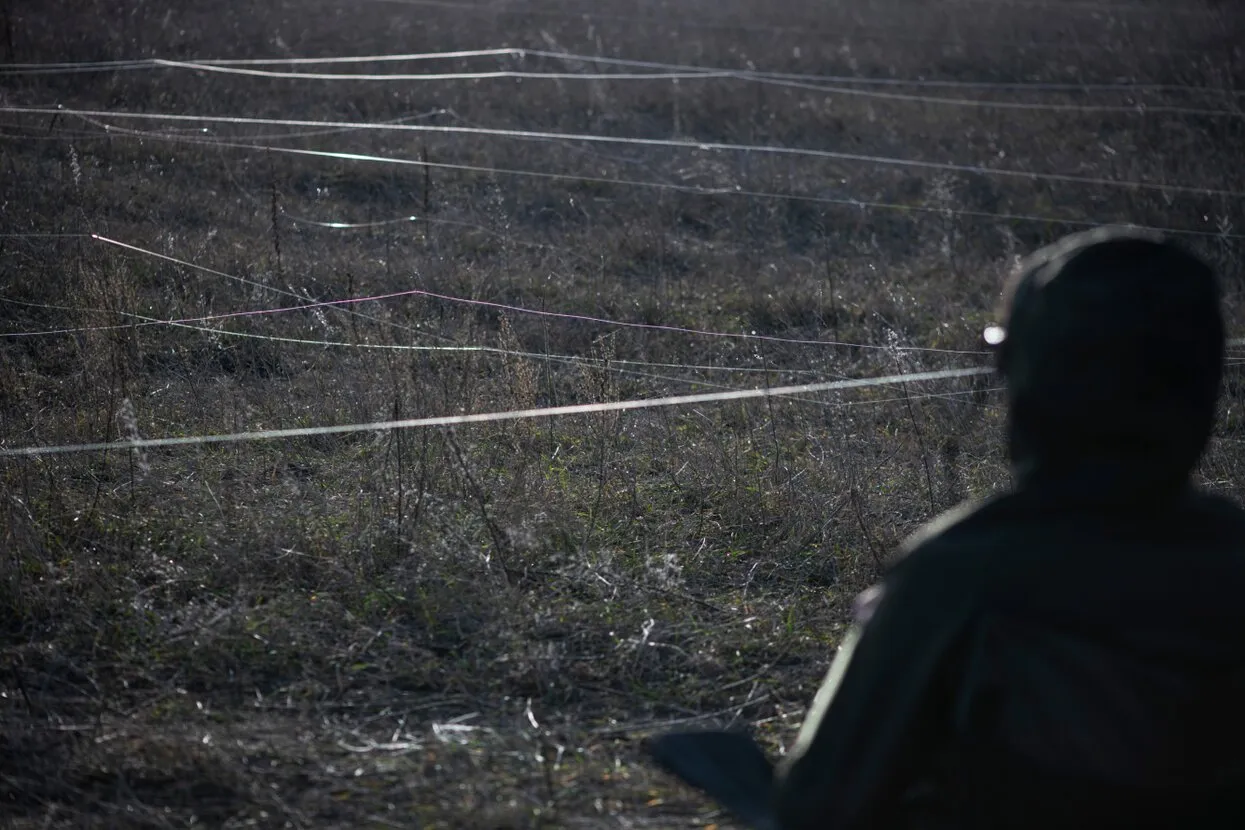
Fiber-optic cables used to guide drones are blanketing Ukraine’s front line. Researchers are only beginning to understand their environmental impact.
The Russia-Ukraine war has long been called a “war of drones.” Now, the fiber-optic cables that guide many of those drones are piling up across the front line. Impossible to clear while the fighting continues, they’ve become traps for birds and other wildlife, while the cables themselves — along with the lithium batteries left behind by destroyed drones — could have lasting consequences for the environment. Meduza explains how a transparent web has spread across the battlefield and what it could mean long after the war ends.
Fiber-optic cables from drones are already blanketing the front
Shell-shocked animals wander among charred branches and blackened stumps. Shells and trenches have torn up the land, leaving only a handful of trees still standing. Silvery strands drape over the treetops, glinting in the sun and trembling in the wind, trailing across branches, bushes, and grass until they wrap Serebryansky Forest like a cocoon. All of it is fiber-optic cable left behind by FPV drone attacks.
That’s how soldiers from the Ukrainian Armed Forces’ 63rd Brigade saw Serebryansky Forest, on the border between Ukraine’s Luhansk and Donetsk regions, in June 2025 — Russian forces now control the area. A stretch of land spanning dozens of square kilometers along the front line is almost entirely blanketed in drone fiber-optic cable. “Just imagine how many of them are flying around here. And imagine what this landscape will look like after the war,” the soldiers wrote in a post.
Footage shot by Ukrainian troops shows fiber-optic strands draped over the treetops of Serebryansky Forest
“63rd Brigade”
Russian forces describe it the same way: “A modern jungle, where cables are strung up instead of vines, and drones buzz instead of birds.” Fighting had already raged there for two years before Russian troops seized the area. Fiber-optic drones weren’t used back then, but shells were constantly falling on the forest.
“Even soldiers are surprised if there isn’t any shelling in the Serebryansky Forest for more than 10 to 15 minutes. That only happens in bad weather, when the artillery, mortars, and drones fall silent,” journalists with Ukraine’s 24 Kanal wrote in 2023.
Before the full-scale invasion, Serebryansky Forest was a green island amid the steppe, known not long ago as the lungs of the Donbas, home to endangered plants and animals. Now it’s called the “black forest” or the “kingdom of the dead” — the line of contact between Russian and Ukrainian forces ran through it in the fall of 2022.
Fiber-optic cable near Pokrovsk, in the Donetsk region
“Voennyi Osvedomitel” (Military Informer)
Fiber-optic cable settling in forests as drones fly overhead is an environmental threat humanity has never faced before. It’s piling up not only in forests but also near towns across northern and eastern Ukraine. The cable has already enveloped Lyman, the fields around Pokrovsk, the ruins of Toretsk, and parts of the Chernihiv region.
At the start of the full-scale war, drones served mainly as reconnaissance support for conventional artillery. Then came what’s known as the drone revolution — today, drones are the primary weapon for both Russian and Ukrainian forces, thanks in part to fiber-optic technology.
As long as the fiber line stays intact, the drone is virtually invulnerable — it can’t be detected or jammed in advance, and rough terrain or electronic warfare won’t affect it. It can carry out an operator’s commands and transmit information without distortion for as far as the fiber on its spool will reach. The spool is mounted on the drone itself, with the cable running from the aircraft’s onboard electronics on one end to the operator’s control unit on the other.
“It wasn’t like this in 2022. The technology advanced dramatically in just a couple of years,” said Ukrainian ecologist Oleksii Vasyliuk, an expert with the independent Ukraine War Environmental Consequences Work Group (UWEC). He studies the war’s impact on nature. According to him, the range of fiber-optic drones has increased significantly, which is why they have become one of the most effective weapons in this war.
It’s hard to imagine how many drones would have to be launched to make the landscape look as though it’s being devoured by a giant spider. We’re talking about thousands of devices, essentially all disposable. We don’t know when the war will end, how far the technology will advance, how far these drones will eventually be able to fly, or the scale of the pollution they will leave behind.
Russian forces began using fiber-optic drones on a mass scale in the fall of 2024. According to data from the state-run Novgorod-based Ushkuynik research and production center, which develops drones, monthly production of a single model — the Knyaz Vandal Novgorodsky (KVN) — reached 50,000 units by September 2025. Other models exist besides the KVN.
Just how many fiber-optic drones Russia produces overall remains unknown. According to estimates from experts at the British Conflict and Environment Observatory (CEOBS), Russia needed at least 6 million kilometers (3.7 million miles) of fiber-optic cable in 2025 alone to keep fighting. The group also believes that roughly 2,900 kilometers (1,800 miles) of cable are used for every kilometer (0.6 miles) of front line.
Drone production in Ukraine has also increased several times over. By November 2025, annual output had grown to 4 million units, the Bloomberg news agency reported, citing analysts. Ukraine had just 10 military drone manufacturers in 2022; it now has more than 500, according to Mykhailo Fedorov, the former deputy prime minister who later became defense minister before Volodymyr Zelensky dissmissed him from that post in mid-July.
In a July 2026 interview with RBC-Ukraine, Yaroslav Hryshyn, co-founder of General Cherry, a Ukrainian drone manufacturer, said: “A year ago, Russia had the upper hand in deploying fiber-optic drones. Now, the two sides have effectively reached parity on the battlefield.”
Fiber-optic cable could be cleared by hand, but only if the fighting stops before it crumbles
How spent fiber-optic cable will behave in the environment remains unknown, and researchers disagree. On the one hand, acrylic is highly resistant to natural weathering; on the other, combat and the fires caused by explosions could accelerate its breakdown into micro- and nanoparticles.
What fiber-optic cable is
Fiber-optic cable is built from three components: a core, an optical cladding, and a protective coating, together forming a thin, flexible, and extremely durable composite. The core and cladding are made of polymers or fused silica, while the outer layer consists of plastic and dyes. CEOBS researchers suggest the military is using polymer fiber-optic cable rather than glass because it’s lightweight, flexible, and less brittle.
“It’s a paradoxical pollutant,” Oleksii Vasyliuk told Meduza. “If, after the fighting stops, we manage to collect it before it breaks down into microparticles, it will be the only environmental legacy of the war that can be removed relatively quickly and easily. But once the fibers begin to crumble, the chances of cleaning them up are practically zero.”
Ukrainian activists Lyudmyla and Oleksii Antypenko published the first assessment of how much fiber-optic cable has accumulated in the border region and what it means for the environment.
Their preliminary calculations, based on news reports about drone production and fiber-optic cable consumption on both sides, suggest that more than 13,000 metric tons (about 14,300 tons) of fiber-optic waste may have accumulated in the combat zone in 2024 and 2025.
The Antypenkos caution that wartime conditions could make these figures imprecise. No equivalent calculations have been made in Russia.
The Antypenkos also analyzed “field” data — photos and videos soldiers posted from the front line — to estimate the density of fiber-optic cable on the ground. That method produced a figure three times lower than their earlier calculation: about 4,000 metric tons (about 4,400 tons) of fiber-optic waste. Researchers attribute the gap to a shortage of “field” data.
Lyudmyla and Oleksii suggest the fiber-optic cable used by both sides is polymer-based, made up of roughly 96% polymethyl methacrylate (acrylic glass) and fluoropolymers, part of a class of substances known as PFAS. Because they can persist in soil and water for thousands of years, these are called “forever chemicals” — acrylic glass takes 400 to 1,200 years to decompose, while PFAS can remain in the environment for millions of years.
By the Antypenkos’ estimate, the 13,000 metric tons (about 14,300 tons) of fiber-optic cable already scattered across the region contains 523 metric tons (about 577 tons) of “forever” polymers, which will accumulate in water, soil, and living organisms once released.
Microplastic spreads easily through wind and water, entering the bodies of insects, fish, birds, and other animals before working its way up the food chain. Its buildup disrupts ecosystems and poses risks to human health. Exposed to sun, frost, and wind, an estimated 130 metric tons (about 143 tons) of microplastic will enter the environment every year, according to Ukrainian scientists — and once in soil and water, it’s impossible to remove.
Animals become entangled in its nearly invisible strands, suffer injuries, and die
Soldiers from the Ukrainian National Guard’s 12th Special Forces Brigade “Azov,” fighting in the Toretsk direction, found a tiny bird’s nest near the front line woven from branches, dry grass, and silvery strands of fiber-optic cable.
“It’s just one of dozens of examples of how nature survives amid the flames of war — between hundreds of drones, assaults, shelling, and kilometers of scorched earth,” the soldiers wrote on their Telegram channel last summer.
Lyudmyla and Oleksii Antypenko believe fiber-optic cable may be scattered across the entire front line, over an area of 40,000 to 65,000 square kilometers (15,400 to 25,100 square miles) — about one and a half times the size of Ukraine’s Odesa region, the country’s largest. As it settles into animal habitats, farmland, and waterways, it becomes part of the landscape itself.
In January 2026, Ukrainian drone operators found an owl suspended between two trees in a forest near Lyman, frozen in midair as if someone had hit pause on a video — the bird had gotten tangled mid-flight in a nearly invisible web of fiber-optic cable. Soldiers freed its legs and wings and released it. Ukrainian troops rescued a sparrowhawk from a similar trap in November 2025.
Soldiers from the “Achilles” brigade free an owl caught in fiber-optic cable
“429th Brigade”
“Among the documented cases of birds killed or injured by fiber-optic cable, the overwhelming majority are owls. They become entangled and can’t free themselves. They just hang there,” Vasyliuk said.
Eugene Simonov, another UWEC ecologist, says fiber-optic cable could disrupt birds’ movements and, in turn, their ability to find food and feed their young.
Nature adapts to changing conditions and sometimes finds unexpected solutions, Vasyliuk says. As an example, he points to the aftermath of the Kakhovka hydroelectric dam’s destruction in June 2023, which left behind a silty desert.
“The attack on the Kakhovka Reservoir was the worst thing Russia has done to our environment. Everything that had lived in the reservoir was swept into the sea and died in the salt water. The Black Sea itself was also polluted and desalinated across an area of 35,000 square kilometers,” Vasyliuk said.
Two years later, though, a floodplain forest grew on the site of the reservoir. “We never imagined nature had a survival strategy for a catastrophe like this,” he continued. “The seeds of trees growing around the reservoir, especially poplars, managed to germinate in what seemed like an inhospitable environment.”
According to Vasyliuk, it’s impossible to predict how things will unfold in areas contaminated with fiber-optic cable.
Pollutants could threaten soil health
Agricultural land in eastern Ukraine faces a bigger problem than fiber-optic cable for now: much of it is mined or contaminated with toxic substances from exploded ordnance. Clearing the mines and shells alone will take decades.
Vasyliuk adds that, according to some estimates, fully demining Ukraine could take about 750 years. “Even if it took ten times less time, I think some areas would never be fully cleared — not of unexploded ordnance, and not of fiber-optic cable, despite how easy it might seem to collect,” he said.
Life in these areas won’t disappear entirely, but chemical soil contamination and the effects of decomposing fiber-optic cable threaten many species. Earthworms, for instance, on which soil health and fertility depend, will change their routes as fibers work into the topsoil, Vasyliuk says — with consequences for the entire ecosystem.
Fiber-optic cable on trees in Druzhkivka, in the Donetsk region, April 2026
Zoriana Stelmakh / Global Images Ukraine / Getty Images
“There’s an interesting study showing that microplastic fibers reduce soil’s ability to retain moisture. It’s also worth considering that fiber-optic cable will most likely break down into sharp, injurious fragments,” Simonov adds.
“Some experts believe fiber-optic cable won’t affect agricultural crops,” Vasyliuk says. “But I wouldn’t rush to conclude it’s harmless. It could end up in wheat or corn together with dust during the harvest. It hasn’t even started breaking down yet. We simply don’t know.”
Vasyliuk says some experts believe fiber-optic cable won’t affect crops, but he isn’t ready to call it harmless — cable dust could end up mixed into wheat or corn during harvesting. He notes that it hasn’t even begun breaking down yet, and little is still known about its effects.
The agricultural sector faces more serious risks, according to Oleksandr Vinyukov, a doctor of agricultural sciences and director of the Donetsk State Agricultural Experimental Station. He shared his assessment with UWEC.
Lithium drone batteries, piling up all along the front line mixed with other drone debris, will do the most harm to land and farms, Vinyukov says. By contrast, he believes microplastics will have “minimal” impact on field crops and vegetables because plants “absorb nutrients and other elements through their root systems.”
When drones explode, they pollute the environment not just with lithium but with other metals — copper, cobalt, manganese, and nickel.
“How many toxic elements are in each individual drone model has also yet to be studied,” Simonov says. “But one thing is clear: every strand [of fiber-optic cable] comes with a little chemical bomb attached, since a large share of drones are, after all, used only once.”
* * *
Oddly enough, Russian officials are also raising concerns about the environmental damage from the mass use of fiber-optic drones.
In the spring of 2025, Vladislav Atmakhov, deputy speaker of the Nizhny Novgorod region’s legislative assembly, visited a DOSAAF training center that, among other things, trains drone operators. Speaking there about the future of the “new territories,” he said the buildup of fiber-optic cable is already hindering vehicle movement and could complicate rebuilding efforts.
“This [fiber-optic cable] is a material that takes a long time to decompose and could harm the soil, especially farmland. We need to develop a system for its processing and disposal,” Atmakhov said. Russian authorities have yet to lay out any concrete plan for cleaning up the cable.
In early February 2026, Russia successfully tested a new uncrewed boat called Skorlupa, which also runs on fiber-optic cable and was designed specifically for combat in the Black Sea.
The boat can carry wired drones and serve as a launch platform for them, or act as a “kamikaze” drone itself. Its fiber-optic line sinks, making it far harder to detect, and the Skorlupa has already been put into serial production.
At Meduza, we are committed to transparency about our use of artificial intelligence in the newsroom. The story you’re reading was written by one of our living, breathing journalists and translated from Russian using an AI model configured to follow our strict editorial standards. This translation process is the result of extensive testing and refinements to ensure our English-language coverage is timely and accurate. A Meduza editor reviews every draft before publication.
If you find any errors in this translation, please contact us at reports@meduza.io.
To read Meduza’s exclusive content in English, please subscribe to our newsletter.
Nastya Grin
What is this?
FPV stands for “first person view.” Although nearly all drones today transmit video, FPV models require pilots to rely on that feed almost exclusively, without support from automated systems such as satellite-based orientation. That makes them cheaper to build and more resistant to jamming by electronic warfare systems.
What does it involve?
According to Ukrainian estimates, drones accounted for more than 70% of losses on both sides of the front in 2025. That
UWEC — Ukraine War Environmental Consequences Work Group
An independent group of Ukrainian, Belarusian, and Russian activists, journalists, and scientists who analyze the war’s impact on the country’s environment. It’s directed by Oleksiy Vasyliuk, head of the Ukrainian Nature Conservation Group and a conservationist specializing in protected areas and biodiversity.
Oleksii Vasyliuk
A Ukrainian conservationist who specializes in protected areas and biodiversity, he works in the animal monitoring and protection department at the I. I. Schmalhausen Institute of Zoology of the National Academy of Sciences of Ukraine. He has headed the Ukrainian Nature Conservation Group, an organization of expert biologists, since 2014.
Ushkuynik Research and Production Center
A research and production center opened in Veliky Novgorod in 2024 at the initiative of the Novgorod region government. Alexei Chadaev, a well-known former Kremlin political strategist, runs Ushkuynik. Citing Russian sources, Ukrainian drone specialists say the drones are actually manufactured in China — a claim Chadaev has not denied, acknowledging that foreign components are used in production.
CEOBS — Conflict and Environment Observatory
According to the organization’s website, it was founded in 2018 to raise awareness and understanding of the environmental and humanitarian consequences of armed conflict.
Polymethyl methacrylate
Also known as acrylic or plexiglass.
PFAS
A class of per- and polyfluoroalkyl substances — synthetic chemicals widely used in manufacturing and considered environmental pollutants.
DOSAAF
Russia’s Voluntary Society for Cooperation with the Army, Aviation, and Navy.
Кто взорвал Каховскую ГЭС
Украина и Кремль обвинили друг друга в подрыве плотины Каховской ГЭС, вызвавшей наводнение в нижнем течении Днепра. При этом никаких доказательств намеренного уничтожения плотины представлено не было. Власти США через анонимных представителей обещали рассекретить документы, свидетельствующие о причастности российских войск к этой катастрофе, но позже официально заявили, что твердых доказательств не имеют. ”Медуза” подробно разбирала сценарии подрыва плотины здесь.