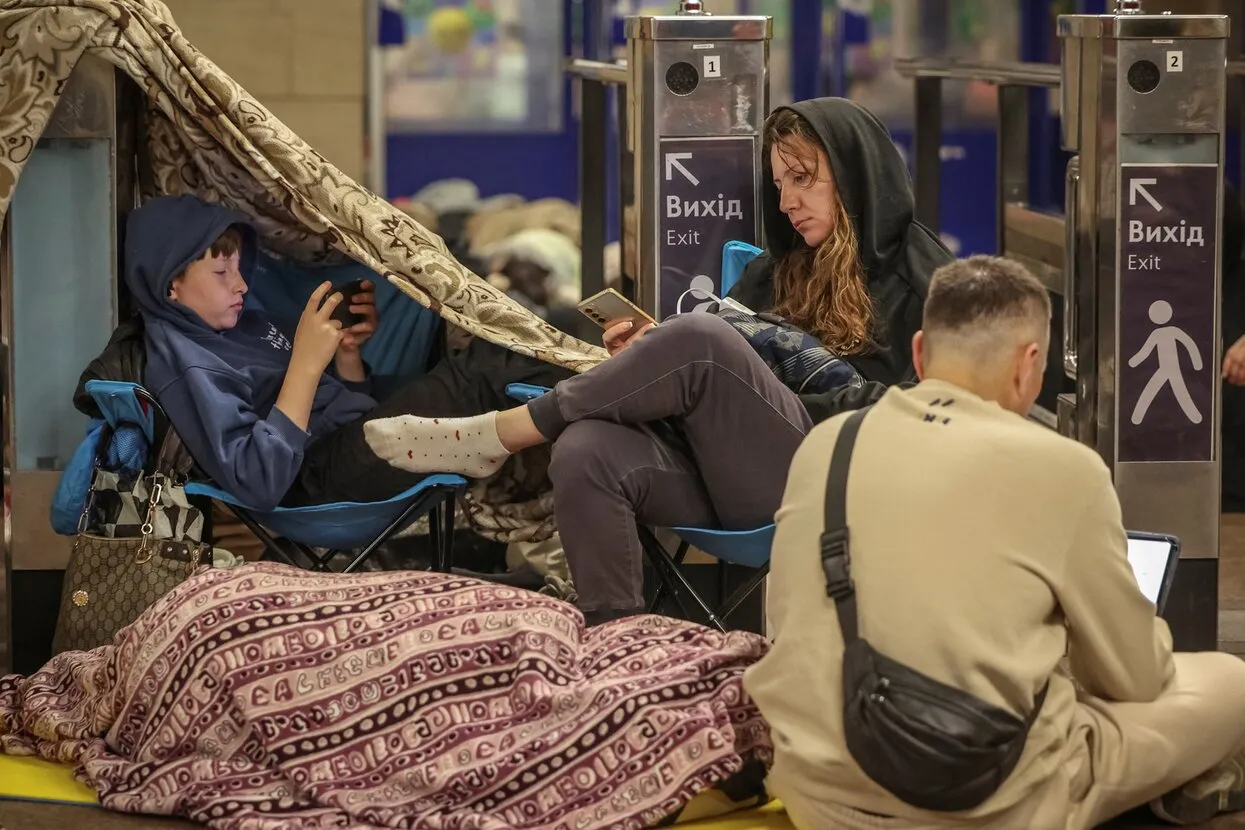
A diary of two nights in the Kyiv metro, where residents are once again sheltering as Russia intensifies its attacks
In the first half of 2026, Russia intensified its air strikes on Ukraine. And since early summer, when Ukraine’s armed forces stepped up attacks even on Russian regions far from the border — as far as Sverdlovsk, Tyumen, and Omsk regions — the Russian military has been striking Ukrainian cities even harder. Kyiv remains one of Russia’s main targets, so, just as in the early years of the full-scale war, city residents are once again taking shelter from attacks in the capital’s metro. On the evening of July 24, Volodymyr Zelensky warned Ukrainian citizens that the Russian military could carry out another massive missile strike within the next 48 hours. Ukrainian journalist Iryna Olehova spent two nights in the Kyiv subway. Meduza is publishing her diary.
Evening of July 24 to morning of July 25
22:17
I’m getting ready to head to the metro.
Russia struck a Ukrainian weapons exhibition in the Kyiv region with ballistic missiles this afternoon, killing 11 people and wounding 100. Journalists say the death toll was probably higher — and that assessment seems more plausible. A massive attack now looks possible: the Russian military tends to throw nearly every type of drone and missile it has at once. Ukrainians have even made a meme about it.
These attacks usually come within 48 hours of a warning, though Russian forces sometimes “delay” for several days — perhaps just to fray our nerves.
22:40
No air raid alert has sounded yet, but I’m already near the metro — 90 meters (295 feet) underground, it’ll be calmer tonight than outside, no matter what happens.
How has the frequency and nature of Russian air strikeschanged in the first half of 2026?
Strikes on Ukraine have grown more frequent and larger in scale. According to data from the UN, about 1,400 civilians were killed and nearly 8,000 wounded across the country over six months — a third more than in the same period last year. June was the deadliest month by casualty count since April 2022, with at least 293 people killed and another 1,990 wounded.
Beyond individual strikes, the Russian military regularly launches massive attacks combining hundreds of drones with missiles of various types, including ballistic and hypersonic missiles, which travel faster than cruise missiles and are harder for air defenses to intercept.
Kyiv remains one of the main targets of these large-scale attacks, which have grown more complex as the Russian military increasingly combines missiles with drones in multiple waves over a single night.
Overnight on July 2, Russia carried out one of its largest strikes on Kyiv since the war began, launching nearly 500 drones and 74 missiles of various types. More massive attacks followed soon after, overnight on July 6 and again overnight on July 19.
I put on warm, comfortable clothes and grabbed a sleeping pad and a hiking backpack. Inside: a blanket, a fleece jacket, a scarf in case of a draft, wet wipes, a travel pillow, a power bank with a flashlight, water, a banana, a couple of cucumbers, and a piece of bread for a snack.
22:48
Beresteiskyi Avenue, one of Kyiv’s main thoroughfares, is bustling. The air is fresh and warm after the rain. A shawarma stand near the station is still open. Two friends smoke on a bench by the metro, each with a backpack — one with a small pillow resting on top.
The metro has run on a reduced schedule since the curfew was introduced at the start of the war. Every station closes at a different time — this one stops letting passengers in around 10:30 p.m. — but for those sheltering from shelling, it stays open around the clock.
People converge on the metro alone, in pairs, in families, in groups — everyone carrying bags, backpacks, or totes, along with sleeping pads or mattresses. One group of five adults has brought a cat carrier and a large dog on a leash.
Kyiv residents at a metro entrance during a Russian attack. June 15, 2026
Alina Smutko / Reuters / Scanpix / LETA
22:55
There’s no need to go through the turnstiles — a staff member is waving everyone through the gate normally reserved for discounted passes. One escalator is running upward, carrying passengers still leaving the station; the other has stopped, so the only way down is on foot.
A young couple walks ahead of me — the man carrying a large hiking backpack, the woman carrying a 1-year-old girl with a pink ribbon in her hair.
The escalators run in two flights with a landing between them. After the first flight — 85 steps, by my count — the family stops, and the father pulls a tent out of his backpack.
Every spot on the benches and along the walls is taken. A man lies asleep on a blue air mattress, turned toward the wall and covered with a sleeping bag. Across from him, a young couple sits on a blanket with white polka dots; nearby, a young woman sits in a folding chair, book in hand.
The second escalator has another 310 steps before the platform. On the way down, a man in a hoodie passes me carrying a dog that looks just like Patron the dog.
At the bottom, next to the escalator, someone has pitched a bright green tent; a gray dog peeks out amiably from under its half-open flap. At the second escalator, a young woman reads on a bright yellow sleeping pad. The better spots are already gone.
At the large, colonnaded station, I manage to find a decent spot near the edge of the platform and lay out my sleeping pad so I can lean against a column while watching the hall and the platform across from me.
My neighbors are a young woman curled up in a camping chair, and a mother and daughter on a station bench. The mother nurses the girl, wrapped in a blanket; nearby stands a stroller covered with another blanket, this one printed with the Little Mermaid.
Kyiv residents shelter from a Russian strike at a metro station. July 2, 2026
Roman Pilipey / AFP / Scanpix / LETA
23:15
The last train pulls in. It feels strange to be lying on the floor right in front of passengers getting off, but no one moves. The platform is packed — by my count, about 500 people are spread across the lobby between the escalators and the station itself, with at least 12 tents pitched on the two platforms.
Passengers reach the exit, and the upward escalator shuts off.
People around me read, watch videos, or sleep. Others are still setting up for the night — laying out pads, pitching tents and cots, inflating mattresses. No one wanders the station without a reason.
The main lights and digital ad screens go dark, leaving only dim lighting, like an overnight train car. Oddly, it’s still bright along the tracks across the way. The display, as usual, shows the time, but instead of counting the minutes since the last train, it just shows a glowing dot. A steady hum drifts from the tunnels, as if a train were running somewhere far off, or a transformer were humming.
About 5 meters away, a middle-aged man is quietly arguing with two older women. I hear shuffling, whispering, the rustle of a bag. A baby grunts.
Besides the young woman in the camping chair and the mother nursing her daughter, I have two more neighbors — a Kyiv woman in her forties and her mother. I ask them where the bathroom is. The daughter replies: “I don’t know, it’s my first time here. I’m in shock.”
She says her mother came to visit from another city. Now she’s sitting on a sleeping pad, staring intently at her phone. It’s her first trip to Kyiv, and she’s terrified there will be a strike.
July 2, 2026
Roman Pilipey / AFP / Scanpix / LETA
23:30
The metro’s familiar smell — creosote from the treated railroad ties, machine oil, and ozone from the electrical equipment — has faded, replaced by a faint dampness. It’s getting cooler. The station no longer feels like an open-plan train car but a huge shared bedroom: clean, quiet, and unexpectedly cozy, probably because of all the blankets and sleeping people around.
Under a blanket printed with pink unicorns, a girl of about 8 sleeps in a pink sleep mask. Nearby, an elderly woman in a yellow cap has pulled her blanket up to her nose; she coughs and tosses in her sleep.
There’s enough light to make out the ads on the wall: a jewelry factory offering rings, a medical lab offering discounted tests, an instant-food brand announcing a new line of sauces.
People keep trickling down into the station. A tall, heavyset man searches for a spot on the platform, a rolled-up mattress in a bright floral print slung over his shoulder.
I lie down, and even though my neighbor’s pillow is pressing into the back of my head, personal space here feels almost inviolable.
23:42
A loud bell, like a school bell, rings twice. What it means is unclear.
July 2, 2026
Roman Pilipey / AFP / Scanpix / LETA
23:46
A low hum rises from the tunnel to my left, as if a massive train or a heavy truck were approaching. The bell rings again. The hum grows so loud and low that my ears feel clogged. I try not to think about the plot of Metro 2033, a book I read as a teenager, and not to let my imagination run wild.
Something resembling a tram with a freight trailer pulls into the station, and five men in orange work vests climb out — one holding a flashlight, another a bucket with a bottle of water inside. The workers cross to the second platform, where a similar “tram” arrives a few minutes later.
A boy of about 9 and a young woman lying on a mattress in the middle of the station watch with interest, but within a minute she adjusts her pillow and rolls over onto her other side.
These appear to be track and tunnel repair crews in their specialized vehicles. The Kyiv Metro has written that the crews only work at night, when power can be cut from the contact rail. At the start of the full-scale invasion, the metro left train cars open at stations to create more sleeping space; that no longer happens, so as not to interfere with the nighttime repairs.
00:00
I really need to find the bathroom. It turns out there’s a public restroom at the far end of the platform, near the tunnel entrance — closed during the day, so many people don’t even know it exists. Getting there means stepping carefully around the sleeping people lined up neatly across the platform, their feet toward the tracks.
00:15
I come back, take off my shoes, lie down, and check my phone. Cell service is excellent. A Telegram channel that tracks the movements of Russian military aircraft reports that the enemy is inactive, so there’s a chance tonight will be quiet for Kyiv.
A young woman nearby is eating something like baby food purée. I’m hungry too, but I’m afraid to crunch on cucumbers — what if the echo wakes everyone up? I eat a banana with bread instead. It’s enough.
00:25
Someone’s baby keeps grunting. The muffled hum from the tunnel continues — maybe it’s a giant ventilation fan?
On my thick sleeping pad, under a warm blanket, with a travel pillow under my head, I’m quite comfortable and getting ready to fall asleep.
Another family is looking for a spot on the platform. An elderly man in glasses, a middle-aged woman, and a teenage girl settle into the narrow gap between my sleeping pad and the stroller with the “mermaid” blanket, trying not to make unnecessary noise or movement.
The elderly man settles into a folding chair with a footrest to read. The young woman lies down on the air mattress and starts watching the show Tochka Zboru “Gathering Point” on YouTube, with a small white dog seated beside her. It sits right in front of my face, tongue comically hanging out, watching the goings-on in the station.
A man’s snoring echoes through the station’s cavernous space. A mother paces the platform with her grunting baby, who quiets down soon after.
July 15, 2026
Serhii Okunev / AFP / Scanpix / LETA
00:59
Telegram channels are reporting the threat of a ballistic strike from Taganrog. Missiles from there can’t reach Kyiv — it’s the south of the country at risk right now. Missiles that could reach us would come from Bryansk, Kursk, or Crimea.
01:23
The threat is called off. I fall asleep.
02:00
I wake up, cold. Good thing I brought my fleece jacket — I put it on and fall back asleep.
02:27
The “school” bell rings loudly, and dozens of smartphones announce “Attention! Air raid alert.” People stir and check their phones. A man swears. Others keep sleeping peacefully.
02:57
The all-clear sounds from about ten smartphones, and the “school” bell rings again at the station. There was no strike on Kyiv.
A cat meows — surprisingly, the first animal sound of the night. I fall asleep.
July 2, 2026
Roman Pilipey / AFP / Scanpix / LETA
04:45
Two station bells wake me. A metro employee announces over the loudspeaker that the station will soon reopen for entry and asks people to gather their belongings — just like on a train half an hour before arrival. Only a few get up; most are still asleep.
05:00
The main lights come on at the station.
05:13
My neighbor’s mother, on her first trip to Kyiv, wakes up and asks her daughter: “Did they give the all-clear?” It turns out I slept through another nighttime alert. I get up and start packing my backpack.
05:35
The escalator going down is already running; the one going up isn’t yet, and a line has formed for it.
The digital screens in the central hall are already on, playing an ad for a residential complex with the slogan “Vmykai zhyttia,” “Turn life on.”
05:40
The first passengers descend into the station. The second escalator starts up, carrying those who spent the night in the metro back to the surface. Morning begins in Kyiv.
Evening of July 25 to morning of July 26
21:11
An air raid alert sounds in the Kyiv region. Telegram channels report a drone flying toward Slavutych, 200 kilometers [124 miles] from Kyiv. The all-clear comes 14 minutes later. Russian forces usually launch a wave of drones before a massive attack. Maybe nothing will happen tonight, and I won’t have to spend another night in the metro?
22:13
A Telegram channel that monitors Russian aviation writes that there is “a medium probability of a massive strike” and “a high probability of a ballistic one.” I really want to sleep in my own bed, but I head to the station.
There’s almost no one near the metro. A bicycle is parked in the lobby in front of the turnstiles.
There are half as many people at the station as yesterday. Many good spots along the wall are free, but there’s a line by the restroom, like on a train.
I spot the little girl with the pink ribbon again, along with the big gray dog in the green tent and the mother and daughter with the “mermaid” blanket. I take up what has already become my spot on the platform next to them.
May 24, 2026
Alina Smutko / Reuters / Scanpix / LETA
23:20
There are no air raid alerts. The lights in the station’s central hall go out, but for some reason they stay on along the platforms.
Two men in their fifties chat behind a column, one on a cot, the other in a camping chair. Conversations here are hard to make out — the station’s acoustics and the constant background hum get in the way, and no one is shouting anyway. I try to piece together the topic from stray words: “candidate master of sports,” “no way,” “Poroshenko,” “the USSR fell apart.”
One of the men grows more animated and raises his voice:
When I was in college, living in a dorm… there was a world rowing championship, everyone came. There was a nonstop disco. I was dancing with this young woman. I’m 183 centimeters [six feet tall], and she was 195 centimeters [six-five] — and broader across the shoulders than I was. Can you imagine?!
Metro staff and police are rarely seen at the station. But aside from the occasional remark louder than usual, people don’t make noise — and they don’t litter.
It rained during the day, so the metro is cooler than yesterday and the dampness feels stronger. Good thing I wore warmer socks. I take out my blanket and travel pillow and try to build a “nest” to sit more comfortably. I haven’t unpacked my backpack since yesterday — I just swapped the cucumbers for a fresh banana.
23:59
A small child cries but quickly calms down. The bright light on the platform still won’t go out. I want to sleep, so I tie my scarf over my eyes — but sleep doesn’t come.
June 15, 2026
Alina Smutko / Reuters / Scanpix / LETA
00:20
Many phones loudly announce an alert in Kyiv. The bell rings at the station.
A man nearby is on the phone, speaking quietly but audibly, telling the person on the other end: “four ballistic missiles.”
I see similar alerts on Telegram. Friends from the suburbs write that they can hear explosions.
There’s a bit of movement at the station — people sit up, grab their phones, read the news. Someone’s smartphone sounds a notification about heightened danger, urging them to get to shelter as quickly as possible. Many keep sleeping.
The downward escalator switches on, and newcomers descend into the station — after some alerts, there’s still time to go down into the metro. “Ballistic missiles” are faster: only a few minutes pass between the alert and impact. That’s the case tonight.
00:24
Telegram channels report strikes on Kyiv. No explosions can be heard in the metro.
00:31
New launches of “ballistic missiles” are reported.
Three medics appear on the platform, looking around to check that everything’s okay.
00:35
Reports say smoke is rising over Kyiv.
00:36
People are still coming down into the station. A young woman in pajamas and slippers, her hair disheveled, runs up to the men who’d been talking about dancing — they seem to know each other.
Do you have any water? Could you please give me some water? I didn’t have time to grab any before I left — I couldn’t get downstairs fast enough. The air raid alert went off, and I ran down from my apartment on the seventh floor. I’d only made it to the fifth when the explosions started. Explosions everywhere. My neighbors kept telling me, “Go to the basement,” but I couldn’t — I was shaking all over. So I ran here. Do you have any plain drinking water?
They calmly hand her a bottle of water. She sits down on the floor and drinks greedily.
00:41
The news reports details of the attack — a powerful strike hit the Sviatoshynskyi district, next to the one where our station sits.
A cat meows insistently.
A new family appears in the middle of the hall, with two children, about 4 and 6 years old.
June 15, 2026
Alina Smutko / Reuters / Scanpix / LETA
00:52
“Ballistic missiles heading for Kyiv again!! Two missiles,” reports a major Telegram channel.
Channels report fires in the Shevchenkivskyi, Solomianskyi, and Desnianskyi districts.
00:54
A notification appears on Telegram: “No targets detected.” That means there’s, fortunately, no confirmed information yet about new ballistic missiles.
01:13
The air raid alert is called off. There’s no news of new strikes.
I stroll toward the restroom. The medics on duty are sitting on the steps of the stopped escalator. Most people at the station are asleep.
In the middle of the hall, a girl of about 6 lies silently next to her parents, clutching a teddy bear, her eyes wide open. In one of the passages between the columns, there’s the smell of corvalol. The downward escalator shuts off.
The young woman who asked for water sits on the floor looking at Google Maps. One of her acquaintances snores on a cot.
I decide it’s time for me to sleep too and tie my scarf over my eyes.
June 2, 2026
Tetiana Dzhafarova / AFP / Scanpix / LETA
02:49
The alert signal sounds from phones again. I open my eyes a crack and listen; there’s almost no movement in the station. I don’t want to wake up, and I drift back to sleep.
04:45
Twice, just like yesterday, an announcement plays: the first train is coming soon, and it’s time to gather your things. Today it’s a woman’s voice making the request.
I see that the all-clear was given at 3:20 a.m. There’s no news of new strikes on Kyiv.
Overnight on July 26, Russia attacked Ukraine with missiles and drones. Three people were injured in Kyiv, and at least six civilians were killed across the country that day in Russian strikes.
From yesterday I already know the first train reaches my platform at 6 a.m., so I decide I don’t have to get up yet — even though neither the blanket nor the jacket protects me from the morning cold. My sleep is fitful.
June 15, 2026
Alina Smutko / Reuters / Scanpix / LETA
05:45
I finally open my eyes when the first train arrives on the opposite platform. It’s strange to wake up at a metro station with passengers and trains already moving all around.
Many people have already packed up and left. The same cat is meowing loudly. The ad screens are running again — one clip promotes military contract service, another shows Tom Holland, dressed as Spider-Man, carrying a rescued Zendaya off somewhere.
Of those who spent the night at the station, about 20 people remain, unhurriedly packing up their things. Children run around in the middle of the hall — while the father takes down the tent, his son laughs and chases his younger sister, who runs away with a delighted squeal. Their mother asks them to quiet down, but they don’t listen.
There’s almost no one left in the lobby between the escalators — just a young woman fast asleep in a green sleeping bag and the tent where the little girl with the pink ribbon and her parents spent the night.
I go up to the street. Beresteiskyi Avenue is bustling.
July 19, 2026
Reuters / Scanpix / LETA
That evening, local channels will report that the threat of a massive missile attack remains for the coming days, and that the Russian military has already readied strategic aircraft, missile carriers, and Iskander-M and Bastion launchers for it. They’ll report that Ukraine could be hit at any moment by up to 30 Iskander-M ballistic missiles, up to six Tsirkon hypersonic missiles, up to 1,000 drones, up to 55 Kh-101 cruise missiles, and up to 24 Kalibr ship-launched missiles.
For now, people are coming out of the metro with backpacks, bags, and rolled-up sleeping pads. It’s cool out. The sky over Kyiv is blue and clear.
Morning begins.
At Meduza, we are committed to transparency about our use of artificial intelligence in the newsroom. The story you’re reading was written by one of our living, breathing journalists and translated from Russian using an AI model configured to follow our strict editorial standards. This translation process is the result of extensive testing and refinements to ensure our English-language coverage is timely and accurate. A Meduza editor reviews every draft before publication.
If you find any errors in this translation, please contact us at reports@meduza.io.
To read Meduza’s exclusive content in English, please subscribe to our newsletter.
Iryna Olehova
Read more
Since the start of the full-scale war, all 46 Kyiv metro stations have operated around the clock as shelters. Overnight on July 2, 2026, during one of the most massive Russian attacks, a record number of Kyiv residents — more than 52,000 — took shelter in the metro.
Каких именно?
За первые полгода армия РФ по Украине ударила по территории Украины сотнями баллистических и крылатых ракет, десятками гиперзвуковых ракет «Циркон», пятью «Кинжалов» и одним «Орешник». Под интенсивные обстрелы регулярно попадают Сумская, Днепропетровская, Херсонская, Одесская и Запорожская области, куда также долетают управляемые авиационные бомбы и ударные FPV-дроны.
Подробнее
Именно по Киеву и области сейчас бьют наиболее сложные для перехвата типы вооружения. Судя по всему, в этот регион российская армия направила десятки выпущенных по Украине «Цирконов» (данные взяты из сообщений уполномоченного президента по вопросам санкционной политики Владислава Власюка и Воздушных сил ВСУ). Сюда же пришлись атаки тысяч дальнобойных беспилотников.
Tochka Zboru
A Ukrainian comedy talk show about words and language, in which comedians and guest stars face off in linguistic games, improvise, and compete for prizes.
Translation
“Attention! Air raid alert.”