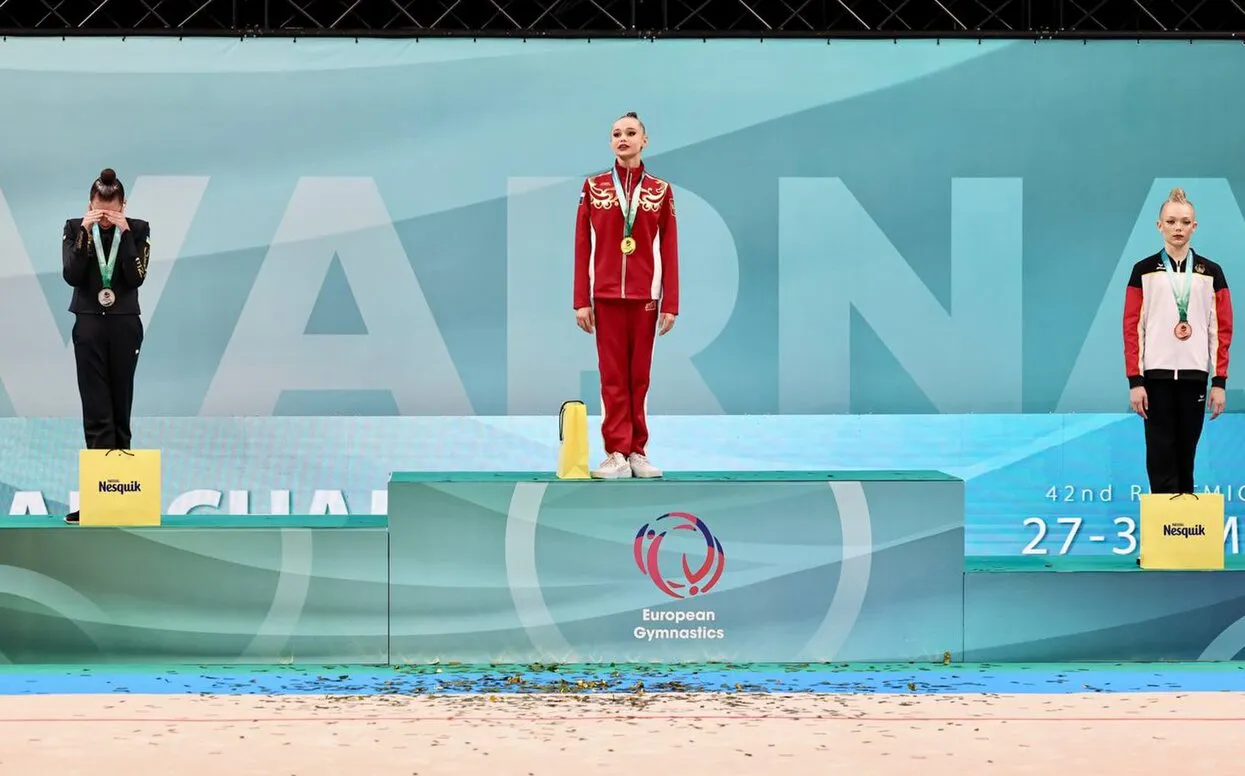
Ukrainian gymnasts protest as Russian and Belarusian anthems return to the European Championships
The Rhythmic Gymnastics European Championships in Varna, Bulgaria — held May 27–31 — marked the first international competition since 2021 at which athletes from Russia and Belarus competed under their national flags and anthems. The International Gymnastics Federation lifted restrictions in mid-May.
The restrictions had been in place since February 2022, imposed following Russia’s invasion of Ukraine and covering not only rhythmic gymnastics but also artistic gymnastics, trampoline, acrobatic gymnastics, and aerobic gymnastics. Russian and Belarusian athletes were barred from competition entirely. Starting in 2024, they were allowed to compete under neutral status — without national flags or anthems.
Ukraine opposed the decision to lift the restrictions. The Ministry of Youth and Sports called it an “official endorsement of war, murder, and genocide.” Even so, the Ukrainian Gymnastics Federation did not boycott the championship, saying it “could not afford to cede empty podiums and international platforms to the enemy for their propaganda.”
Junior gymnast Sofiia Krainska was among Ukraine’s silver medalists. The individual ribbon event final was held on Thursday, May 28, with first place going to Russia’s Yana Zaikina, who trained at Alina Kabaeva’s academy “Nebesnaya Gratsiya” (“Heavenly Grace”). As the Russian national anthem played during the medal ceremony, Krainska put on headphones and covered her eyes with her hands.
That same day, Belarus’s Kira Babkevich won gold in the ball event. Varvara Chubarova, who finished third, did the same as Krainska when the Belarusian national anthem played.
Following the protests by Krainska and Chubarova, the Ukrainian Gymnastics Federation announced the #CloseYourEyesAndEars campaign in memory of the victims of the war, calling on sports federations worldwide — regardless of sport — as well as athletes, coaches, and fans to join.
No one at Varna joined the campaign. Babkevich’s gold remained Belarus’s only one, and the Russian anthem played again on Sunday when Sofia Ilteryakova won gold in the hoop event. Silver went to Belarus’s Alina Harnasko, bronze to Italy’s Sofia Raffaeli.
Sofia Ilteryakova (center), coach Natalya Glemba (left), and Russian gymnast David Belyavsky (right) during the hoop event final
Igor Lenkin / TASS / Profimedia
Russian gymnasts finished the European Championships with nine medals — two gold, four silver, and three bronze. Belarusian gymnasts took one gold and two silver. In the overall standings, Russia placed fourth and Belarus fifth. Bulgaria led with four gold medals, followed by Germany and Spain. Ukrainian gymnasts won two silver and two bronze, finishing seventh.
Echo noted that 13 of the 15 Russian gymnasts who competed at the European Championships train at “Nebesnaya Gratsiya” in Krasnodar Krai. Sofia Ilteryakova trains in Moscow but has previously competed in events associated with Kabaeva’s academy. The only gymnast unaffiliated with the academy is junior Eva Chevtayeva.
Tatiana Sergeeva, who also works at “Nebesnaya Gratsiya,” became the national team’s head coach in February 2025, replacing Irina Viner, who had led the team since 2001. Viner previously coached Kabaeva, among others. As BBC Russia reported, a conflict between them cost Viner several senior positions in Russian sports.
The heavy representation of “Nebesnaya Gratsiya” in the national team drew criticism in a dedicated Telegram chat used by gymnasts, their parents, journalists, and coaches, Echo reported. One commenter said they had hoped things would improve under Sergeeva, describing her as a neutral coach who stood for fairness and would not play favorites, but concluded that everything now depends on what Ms. Kabaeva wants.
Russia’s Sports Minister Mikhail Degtyarev said the results “confirm the high level of the Russian school of rhythmic gymnastics, its traditions and quality of preparation” — even though Russian gymnasts had performed far better before their suspension. In 2021, they topped the medal standings at both the European Championships and the World Championships.
At Meduza, we are committed to transparency about our use of artificial intelligence in the newsroom. The story you’re reading was written by one of our living, breathing journalists and translated from Russian using an AI model configured to follow our strict editorial standards. This translation process is the result of extensive testing and refinements to ensure our English-language coverage is timely and accurate. A Meduza editor reviews every draft before publication.
If you find any errors in this translation, please contact us at reports@meduza.io.
To read Meduza’s exclusive content in English, please subscribe to our newsletter.