A mysterious group is calling on Russians to protest the Kremlin’s Internet restrictions. Is it a trap?
In the last month, accounts linked to a movement calling itself “Scarlet Swan” began appearing on TikTok and Telegram in Russia. Its members — young men and women, including minors, as the outlet Verstka has reported — are urging Russians to take to the streets on March 29 to protest the Kremlin’s intensifying Internet restrictions. However, opposition activists and journalists have warned that the project could be a setup orchestrated by Russian security services. On March 23, the movement’s Telegram channel said that one of its administrators had sold their account to associates of Vladislav Pozdnyakov, a pro-war blogger and founder of the far-right organization ”Male State” — though minutes later the same channel dismissed the claim as fabricated.
The independent outlet Bereg has compiled what’s known publicly about Scarlet Swan, what people are saying about it, and how its participants themselves describe the project. Meduza has translated their report.
Out of nowhere
In mid-March, Russian political consultant Dmitry Kisiev, who led anti-war candidate Boris Nadezhdin’s campaign during the country’s 2024 presidential election, called for nationwide protests against the authorities’ growing Internet restrictions. He proposed March 29 as the date — a symbolic reference, he said, to Article 29 of the Russian Constitution, which guarantees freedom of speech and bans censorship. Kisiev was stripped of Russian citizenship in the summer of 2025 and now lives abroad.
Following his announcement, activists throughout the country began filing requests with local authorities to hold rallies. The outlet 7×7 reported that permit requests were filed in at least 28 cities across 17 regions. Most were either rejected outright or initially approved and then quickly revoked. Authorities’s reasons for the denials ranged from the “legality” of Roskomnadzor’s actions to alleged terrorism risks.
On the same day Kisiev announced the protests, TikTok videos began circulating that called on people to go out on March 29. Some were AI-generated: in one, a voiceover declared that “the Internet is not a toy but a necessity in the 21st century”; in another, a robotic voice said, “We won’t let the old guard drag us back into the 20th century.” Other clips used archival protest footage, music by bands popular with anti-war Russians, and speeches by Alexey Navalny.
Some videos avoided direct calls to protest, using coded language instead — suggesting people go out to “look for a lost wallet” or a “runaway cat” on March 29. These clips drew thousands of views and often linked to a Telegram channel that was then titled “Scarlet Swan Rally 29.03” and has now been changed to “Scarlet Swan.”
Russia’s Internet restrictions
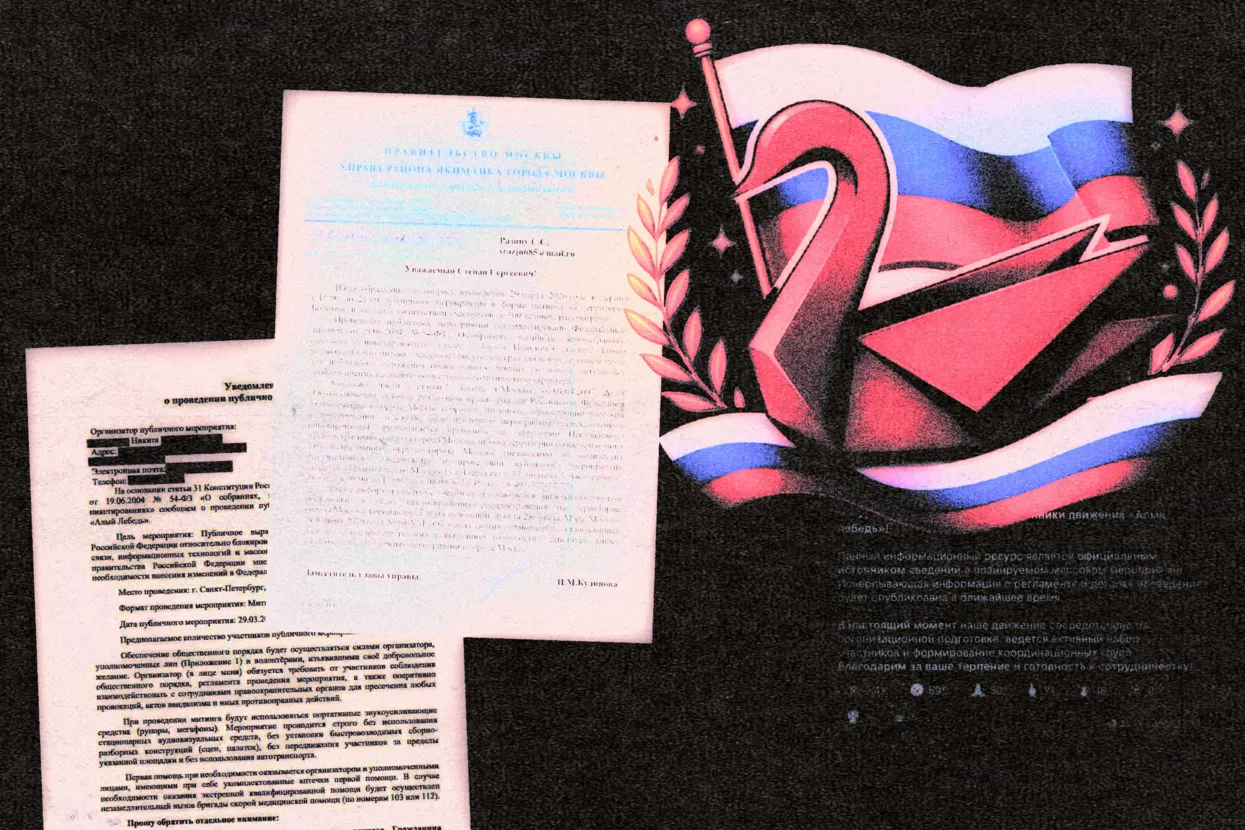
The project first appeared as a Telegram group. A day later, when Kisiev announced the protests, a channel was created. Its description calls Scarlet Swan a “voice of citizens for a free information space,” with the stated goal of defending their constitutional rights to free speech and peaceful assembly. Posts have repeatedly stressed that the movement “operates within Russian law.” From the outset, it had a distinct visual identity, with a red paper swan logo and Telegram premium emojis.
The channel urges followers to spread information about the rally and recruit volunteers to coordinate protests across different regions, while the organizers handle permit applications centrally. In its early days, the chat opened volunteer recruitment: applicants were asked to share their name, age, experience, and availability. It’s unclear how many responded. Recruitment closed on March 18; in the announcement, an anonymous “event organizer” acknowledged that they had effectively been pushing followers to participate in an unsanctioned protest.
At the time of publication, the Telegram channel had 8,800 subscribers, with 7,600 users in its chat. Organizers say they have filed permit requests in Vladimir (which they claim was approved), Moscow, and St. Petersburg.
Collecting participants’ personal data
In its first days, the movement’s founders tried to build a structured organization, Verstka reports. More than 30 people joined early on, most of them young — including teenagers aged 15 and 17. Despite this, participants publicly insist they are all adults.
Verstka also found that one member had previously taken part in events organized by the pro-Kremlin “Young Guard” youth movement, follows an LDPR youth group, and has collaborated with the “New People” party.
On March 16, the channel posted that administrators were “working out movement plans and emergency response scenarios” for rallies and were looking for medical supplies in case of injuries. It also mentioned a leader who was prepared to address protesters — but only if the Moscow rally is approved. No name was given.
That same day, the outlet Agentstvo contacted individuals who identified themselves as organizers. Speaking anonymously, they said the movement already had more than 40 volunteers and a “legal team” preparing rally applications. They added that if authorities refuse to grant permission in Moscow, the project could pivot into a youth organization similar to the state-backed “Movement of the First” — without explaining what that would entail.
You’re currently reading Meduza, the world’s largest independent Russian news outlet. Every day, we bring you essential coverage from Russia and beyond. Explore our reporting here and follow us wherever you get your news.
Hours later, one of those same sources told journalists he had left the project. In a voice message, he signed off: “Glory to Russia, glory to Putin, Z, the ’special military operation’ — I’m only for Putin.”
It’s unclear whether Agentstvo was actually speaking to real organizers; the identities of those behind Scarlet Swan have shifted repeatedly. Different names have appeared in connection with the proposed Moscow rally.
One early organizer, according to Verstka, was under 20 and said he had come up with the name Scarlet Swan as a “symbol of the struggle for freedom.” He later reported receiving threats — including demands that he record a video in support of the authorities. After publishing personal data about other organizers in the chat, he left the project.
A new figure later emerged: Stepan Gordeykin, whose Telegram profile lists his birth year as 2005. But official documents for the Moscow rally, posted in the channel, used a different name: Stepan Razin. Verstka identifies him as a 20-year-old Moscow resident.
Russia’s new Telegram block
Chat participants regularly pressed administrators for updates on the Moscow rally permit. In response, admins posted (and then deleted) scans of what they said were submissions to the Yakimanka district authorities. Posts in the channel are frequently edited or removed.
On March 19, Scarlet Swan published a list of demands, including full freedom to access and share information, lifting blocks on Discord, Telegram, and YouTube, revising Roskomnadzor’s authority, and ending what they described as the excessive promotion of the Max messaging app.
At the same time, some chat messages included calls for violence. According to Verstka, users discussed bringing weapons to protests and shared instructions for making Molotov cocktails. These messages were later deleted, and organizers introduced bot moderation, saying they did not support such ideas.
What participants said
Organizers asked members not to speak to the media and directed journalists to send inquiries by email. Bereg received no reply and instead contacted chat administrators directly. As of the morning of March 23, there were seven — four of whose accounts had already been deleted.
One administrator agreed to speak. He said the movement was created to oppose Internet restrictions, calling his involvement a “duty” and adding that he hoped to stay involved after any protests.
According to him, Scarlet Swan aims to hold rallies not only in Moscow, Vladimir, and St. Petersburg, but also in cities like Kazan — though plans remain unclear. The proposed Moscow location has changed several times. On March 18, the channel claimed authorities had refused permission for Bolotnaya Square — though Verstka noted the document actually suggested submitting the request to a different agency.
The volunteer said organizers are now considering Sakharov Avenue, where they hope to gather up to 6,000 people.
“If authorities don’t approve the rally, we’ll have to cancel it. We have no right to break Russian law,” he said. He also stressed that the movement supports the war in Ukraine and believes Russian soldiers need reliable communication with their families.
Hours later, the same volunteer contacted Bereg again, claiming that an administrator named Andrey had “sold [his] account to Pozdnyakov’s moderators.” Shortly after, the channel posted for the first time asking for cryptocurrency donations. One message warned: “Be careful — scammers and FSB provocateurs are creating fake channels. Pozdnyakov is involved.”
That same day, Novaya Gazeta Europe reported that the channel had been hacked.
Minutes later, another post appeared saying that “breakaway organizers” had fabricated the story about Pozdnyakov. The channel accused several individuals of betrayal, including a woman who had previously been brought in by police for a “preventive conversation.”
She is not the only participant to have attracted law enforcement attention. On March 19, police searched the home of Stepan Gordeykin; he later turned himself in to prosecutors.
A possible false-flag operation
From the outset, activists and journalists have raised doubts about Scarlet Swan. It remains unclear how closely the group is connected to the planned March 29 protests. Movements that call for demonstrations without clearly defined leadership or goals tend to raise red flags — and in Russia, such projects can be used by security services to identify potential protesters.
One volunteer declined to comment on any links between Scarlet Swan and Dmitry Kisiev — the first to call for protests on March 29 — saying he “simply didn’t know the details.” At the same time, according to Agentstvo, the movement’s organizers themselves claimed to be in talks with Kisiev and said he had allegedly “picked up their idea” about the rallies.
Kisiev himself denies any connection, though he also said he does not believe the project is tied to the FSB and would be willing to cooperate with its organizers.
People close to Kisiev, however, told Agentstvo they suspect a possible provocation, potentially involving security services.
Popular anger over Russia’s Internet blocks
Members of the unregistered party “Rassvet” said they received messages from people claiming to represent Scarlet Swan, asking them not to oppose the March 29 protests. They found the outreach suspicious and did not respond, later issuing a warning about possible provocations circulating online.
Representatives of the Anti-Corruption Foundation also reported being contacted. Media projects director Ruslan Shaveddinov said someone claiming to represent Scarlet Swan invited him to become the movement’s public face. The group denied reaching out and called him a “populist.”
The anonymous Telegram channel “Nezygar,” often linked to pro-government circles, suggested that Scarlet Swan could be a “simulacrum project” designed to channel and contain the protest energy of young people.
Journalist Andrey Zakharov, who covers technology, warned that participants themselves could be targets of a setup: security services might impose a structure or charter on the group, as in the “Novoye Velichiye” case, effectively turning it into what authorities could label an extremist organization. “They say they’re a horizontal organization,” he noted, “but they also understand there could be provocateurs — or already are.”
Asked about alleged ties to the FSB, one volunteer told Bereg: “If we were directly connected to the government, I wouldn’t be talking to you.”
Another insisted the movement has no links to security services, claiming that the former organizer “Andrey” sold his account under pressure and threats of criminal prosecution.
“Andrey” himself told Bereg he would answer questions — but only if the reporter helped finance the project.
Profiting from censorship
Story by Marina Antonova
Special Military Operation
The Kremlin’s euphemism for its full-scale war against Ukraine