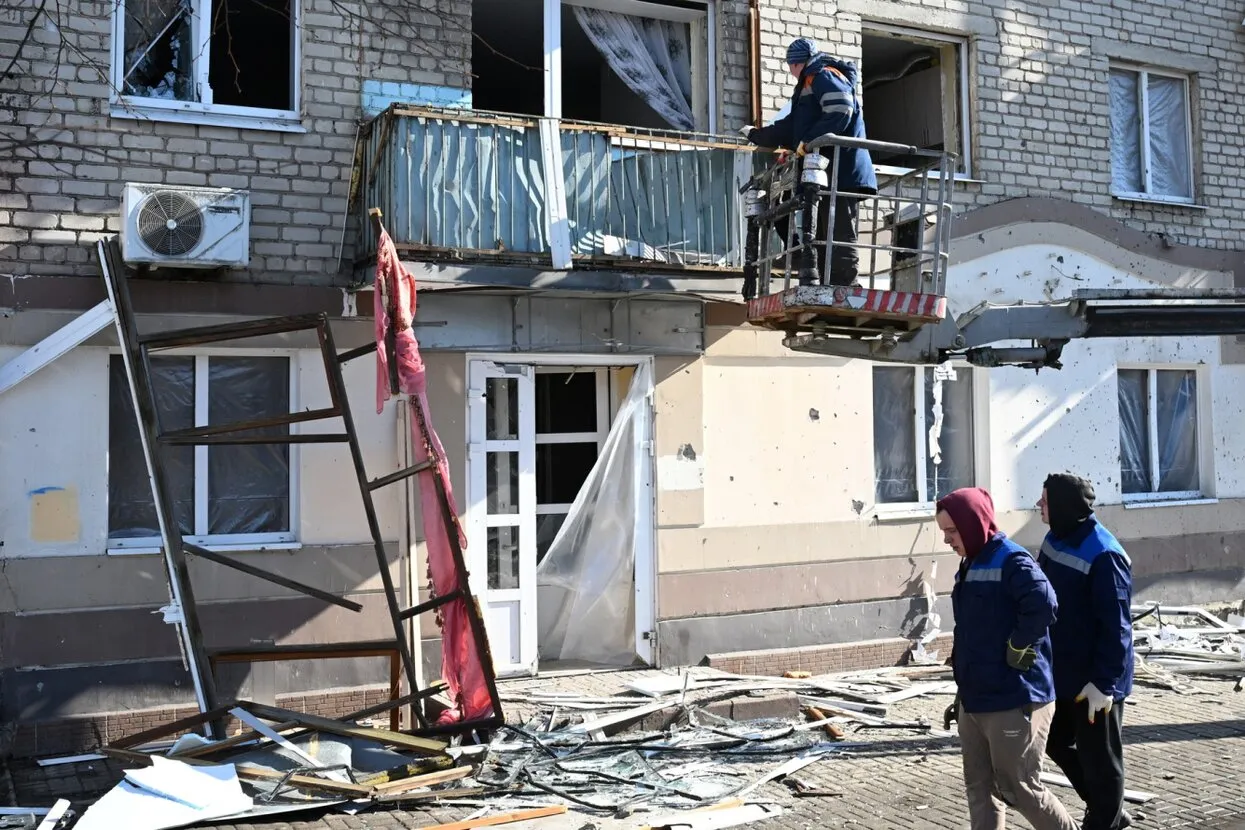
A Ukrainian attack on a Russian missile plant killed at least seven civilians. Locals say they had nowhere to hide.
On March 10, the Russian border city of Bryansk suffered its deadliest attack since the start of the full-scale war against Ukraine. Ukrainian forces struck the Kremniy El microelectronics plant, also damaging a nearby technical college and several residential buildings. According to the latest reports, seven residents were killed and 42 people were injured, 29 of whom were hospitalized. To understand how the attack unfolded on the ground, the independent journalists’ cooperative Bereg reviewed Bryansk residents’ social media posts, compiled what’s known about the attack and its victims, and spoke with one resident about her family’s experience that night. Here’s what they uncovered.
How March 10 unfolded
Late in the afternoon on March 10, air raid alerts were issued across Russia’s Bryansk region. Within a couple of hours, residents began posting on social media about powerful explosions.
The Ukrainian military had attacked the Kremniy El microelectronics plant, which manufactures missile components for the Russian military. Smoke was seen rising in Bryansk’s Sovetsky District, where the factory is located, and authorities quickly blocked off roads leading to the area. Several strikes hit the plant’s assembly shop. The outlet ASTRA, citing local residents, reported that the building suffered “serious destruction,” with people trapped under the rubble. Administrative buildings on the factory grounds were also damaged.
Meduza has condemned Russia’s invasion of Ukraine from the very start, and we are committed to reporting objectively on a war we firmly oppose. Join Meduza in its mission to challenge the Kremlin’s censorship with the truth. Donate today.
At around 7:00 p.m., Bryansk Governor Alexander Bogomaz acknowledged the attack in a Telegram post, noting that there were casualties in the city, though he gave no specific numbers and made no mention of the factory. Bogomaz warned residents about “smoke from combustion products in the Sovetsky District.”
“I heard the explosions first — powerful ones,” a user named Maks wrote in a local Telegram channel. He continued:
At first I didn’t even get up to look, but they were unusually loud and seemed very close. I looked out the window and people were running into their apartment buildings. Then there were these clouds of smoke — I thought the city center had been bombed, maybe the administration building. The column was so high and thick that it looked that close.
ASTRA also reported that the strike on Kremniy El damaged a nearby technical school, the Bryansk College of Management and Business. Eyewitness footage showed smoke rising above the college building. Photos and videos circulating on social media also appeared to show another Ukrainian missile hitting a road and a car on Krasnoarmeyskaya Street, roughly 250 meters (270 yards) from the plant. The following day, March 11, the local outlet Nash Bryansk reported that workers were “filling in a massive crater” in the road there. “Repair work is also underway in the affected residential buildings,” the outlet added.
On the evening of March 10, Ukrainian President Volodymyr Zelensky confirmed the strike on Bryansk, stating that the plant “produced control systems for all types of Russian missiles.”
Ukraine’s General Staff said the army had used long-range Storm Shadow cruise missiles and reported “target destruction and significant damage to the plant’s production facilities.” The exact number of missiles fired at Bryansk was not disclosed.
Analysts with the Ukrainian OSINT project KiberBoroshno say that at least seven cruise missiles struck the Kremniy El facility. The first hit occurred at about 5:00 p.m. — roughly seven minutes after the missiles were detected over the Bryansk region’s Pogarsky District.
Read more about the attack
According to the analysts, the missiles approached from multiple directions, though mostly from the east. Five struck Building No. 4, while two hit other production structures. KiberBoroshno said the flight path suggests that Ukrainian systems navigated around Russian air-defense coverage zones using a more complex route — behavior characteristic of Storm Shadow missiles.
Governor Bogomaz later confirmed that at least seven missiles had detonated in the city, while Russia’s Investigative Committee put the number at eight and opened a criminal case on terrorism charges.
Bryansk residents said they heard no air-defense systems firing during the attack. “Not a single missile was shot down,” one user wrote in a local Telegram channel.
OSINT analyst Kirill Mikhailov told Agentstvo Media that the lack of an air-defense response may have been related to the fact that Storm Shadows fly at low altitude, making them difficult to intercept.
Bogomaz did not say how many missiles had been shot down.
The victims
According to Agentstvo, the strike on Bryansk was the deadliest single attack on the Russian city since the start of Moscow’s full-scale invasion of Ukraine.
Seven people were killed and 42 injured, with 29 hospitalized, including one minor. Several critically injured patients were transported to Moscow, while eight intensive-care teams were dispatched from the capital to Bryansk, Bogomaz said.
Local media identified one of the victims as a 34-year-old from the town of Starodub named Denis Yevlanov. His body was recovered from the rubble on March 11, and the first report of his death appeared in the social media group Typical Starodub. It remains unclear whether Yevlanov worked at the Kremniy El plant.
The regional government subsequently declared March 11 a day of mourning.
Alina (name changed), a Bryansk resident, told Bereg that she was home during the attack, on a video call with her husband, who had just left for work:
He said, “Something’s whistling — I can’t figure out what.” He could see the missiles clearly — they were flying right over the roof, over his car. He ducked down inside the car because he thought one was about to hit. I hid the kids in the hallway and shut all the doors. The windows were rattling.
Neither Alina nor her husband heard any air defenses operating during the attack, she told Bereg. She also suggested that the real number of injured “could be in the hundreds.” A friend of hers was at the Kremniy El plant during the strike and told her the first shift had just finished and the second had arrived to replace them.
“What is Bogomaz saying now? It’s all lies,” Alina said. Before moving to Bryansk, her family had lived in a district on the Ukrainian border, she explained. “They destroyed all our villages there. Bogomaz didn’t say a word.”
Residents also took to social media to complain about the lack of air-raid shelters and the absence of warning sirens in some neighborhoods. “This time they didn’t even turn off the apartment lock systems — you couldn’t get into your building without a key. And there are no shelters,” one resident wrote on Telegram. “Where were people supposed to go? Under invisibility cloaks?” another user wrote.
Alina echoed this frustration. “Where are people supposed to hide? Everyone’s wounded or dead. Almost nobody in the media is talking about the helicopters and planes that came from Moscow to evacuate the injured.”
One of the largest Telegram channels in the city, Bryansk Online — which has about 31,000 subscribers — published nothing about the March 10 attack, Bereg noted.
Life in wartime Russia
Alina, her husband, and their three children previously lived in the Klimovsky District in the southwestern Bryansk region, but repeated shelling forced them to relocate to the city.
My daughter already knows [what happens during attacks] — she’s seen people’s legs blown off, seen a boy on a bicycle die right in front of her. She’s terrified. The boys are too young to understand. They think their crazy mom locked them in a little room away from the windows for no reason.
After the March 10 strike, Alina said she’s started thinking about moving even farther from the border, possibly to St. Petersburg. “Every rustle, every bang, and our hearts drop,” she said. “What we saw yesterday is just another thing to be afraid of now.”
Promised compensation
The Bryansk City Administration said a psychologist is working with affected civilians and that they’ve been provided with temporary housing, essential goods, and humanitarian aid.
The city authorities also publicly shared an account from a local named Ekaterina Mamatkhonova, who claimed that after the strike, affected families were housed in a hotel. According to the Bryansk resident, personal hygiene items and household supplies were delivered there, and volunteers served food and tea. “They gave us two rooms. We’re being fed for free. Some kind people gave my children toys,” she said.
Government commissions are assessing the condition of building facades, houses, and apartments in the wake of the attack. “At the moment there are more than 150 damaged apartments, but the total is expected to reach around 200,” Governor Bogomaz said.
Additionally, according to him, more than 20 cars and 33 commercial properties were damaged, including an auto repair shop, food establishments, and a dental clinic.
Bogomaz has promised to pay families of the deceased 1.5 million rubles ($18,700) in compensation. Wounded residents will receive between 300,000 rubles ($3,700) and 600,000 rubles ($7,500), depending on the severity of their injuries.