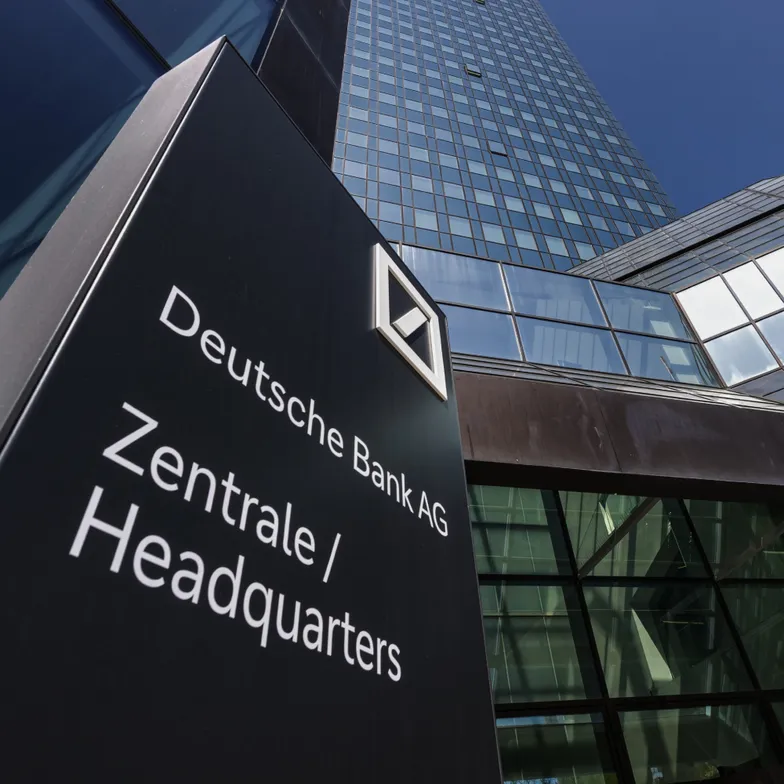
Deutsche Bank moved wealthy Russian clients to Switzerland and Luxembourg before the full-scale war, helping shield their financial records from the DOJ
Deutsche Bank began shifting wealthy Russian clients to its divisions in Switzerland and Luxembourg after 2014 to protect banking secrecy and avoid disclosing information sought by the U.S. Justice Department, according to a major joint investigation by journalists around the world based on a leak of the bank’s internal documents.
After Russia annexed Crimea in 2014, some Russian billionaires came under U.S. sanctions, and the U.S. Justice Department “began asking Deutsche Bank questions” about its wealthy Russian clients, journalists write. In 2018, the bank began moving major clients “connected to Russia” to its divisions in Switzerland and Luxembourg.
In November 2020, the bank drew up a 172-page internal document titled “Russia Strategy Review.” It found that 17 of Deutsche Bank’s 160 major Russian clients appeared on the U.S. Treasury Department’s “Kremlin list”. By 2020, those 17 clients accounted for 47% of the bank’s revenue from its Russian client portfolio, the review said.
In 2021, Deutsche Bank reached an agreement with the U.S. Justice Department allowing the department to require the bank to answer questions about sanctioned individuals and companies. After Russia’s full-scale invasion of Ukraine in 2022, federal prosecutors invoked that provision, requesting the names of sanctioned Russian clients, their account balances, and details of the steps the bank had taken to track the movement of Russian funds.
Deutsche Bank gave U.S. authorities information about its sanctioned Russian clients, but not in full: it withheld “certain client data.” A letter from the bank’s chief data protection officer said that, because of banking secrecy, it “not permitted to disclose customer data from Switzerland and Luxembourg to the D.O.J.”
The bank also excluded information about companies in which sanctioned businessmen held less than a 50% stake. In particular, that omission appears to have let it avoid disclosing some of Oleg Deripaska’s assets, The New York Times notes. As early as 2014, the bank’s internal reputational risk committee had ranked its clients by how much of a threat each posed to its image, and Deripaska topped that list.
The journalists also name billionaires Roman Abramovich, Andrey Melnichenko, Alisher Usmanov, Alexey Mordashov, and Gennady Timchenko among Deutsche Bank’s other wealthy clients.
Federal prosecutors appear to have accepted Deutsche Bank’s answers. The bank, for its part, announced it had fulfilled its obligations under its agreement with the U.S. government. In a recent comment, Deutsche Bank announced that the concentration of Russian clients in specialized hubs like Switzerland and Luxembourg was “part of its wealth management operating model,” and that Russian clients underwent all the checks required under applicable rules.
Deutsche Bank announced in March 2022, shortly after Russia’s full-scale invasion of Ukraine began, that it was withdrawing from Russia entirely and would pursue no new business there. The bank also announced that it had already begun scaling back its presence in Russia as early as 2014.
However, in 2024, the Arbitration Court of St. Petersburg and the Leningrad region froze about 239 million euros in Deutsche Bank assets over a lawsuit brought by Ruskhimalyans. Deutsche Welle explained that although the bank had withdrawn all its IT specialists from Russia, it continued serving corporate clients there. Deutsche Bank announced it was monitoring the situation “fairly calmly” because it already held a reserve of 260 million euros that fully covered the risks.
At Meduza, we are committed to transparency about our use of artificial intelligence in the newsroom. The story you’re reading was written by one of our living, breathing journalists and translated from Russian using an AI model configured to follow our strict editorial standards. This translation process is the result of extensive testing and refinements to ensure our English-language coverage is timely and accurate. A Meduza editor reviews every draft before publication.
If you find any errors in this translation, please contact us at reports@meduza.io.
To read Meduza’s exclusive content in English, please subscribe to our newsletter.
What is this investigation?
More than 200 journalists from more than 50 news outlets around the world took part in the investigation, titled Inside Deutsche Bank. It began when two sources at the bank provided a trove of documents to journalists Josy Joseph of India and Khadija Sharife of South Africa. Among Russian outlets, iStories took part in the investigation.
the “Kremlin list”
In the press, this list was also called the “Kremlin report,” a document the U.S. Treasury Departmentsubmitted in January 2018. It included, among other things, a list of senior Russian officials, heads of state-owned companies, and billionaires whom Washington considered close to Russia’s leadership, but did not call for sanctions against them.