Ukrainian drone attacks have turned Russian airports into a nightmare of endless delays, overcrowded terminals, and no information. One traveler recounts a night of chaos.
Russian airports have been paralyzed by Ukrainian drone attacks. Russian regions impose “carpet protocols,” suspending all flights, almost every day. This leads to flight cancellations and delays — as a rule, neither passengers nor airport staff can predict how long they will last. People caught in this situation before a flight are left alone with their problems: their plans are disrupted, staff give no clear instructions, and airlines try to save money on compensation. At the same time, the airports themselves were not designed to handle passengers from dozens of flights getting stranded simultaneously.
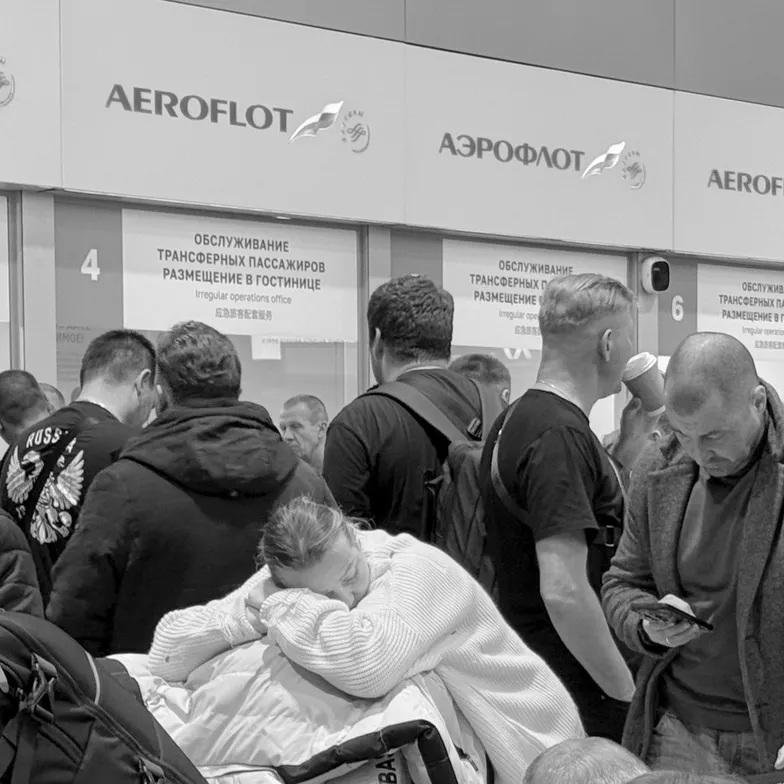
In this piece, a Meduza reader describes what she had to deal with at Sheremetyevo, where a carpet protocol was imposed for an entire night in early November. We illustrated her account with photographs from four Moscow airports, taken on days when a carpet protocol was imposed in the region.
I had already checked in at Sheremetyevo and was walking toward the gate when a text message arrived: my flight had been pushed back from 1 a.m. to 6:30 a.m. The delay appeared on the departure board at the same moment.
A crowd of passengers walked past me, having just been brought back from the airfield. Their plane had already begun taxiing toward the runway when it stopped. After two hours of waiting on the tarmac, the passengers were returned to the airport without explanation, as if everyone already understood why.
No one explained what I should do next or whether I was entitled to any compensation for the delay. A Google search told me passengers are owed water after a two-hour delay and hot food after four hours. A six-hour delay on a night flight entitles passengers to a hotel room. My flight was delayed five and a half hours, but I decided to ask anyway.
A crowd instantly formed around the information desk, staffed by a single airport employee. She could not help passengers with anything beyond issuing certificates confirming that a flight had been canceled.
Some people in the crowd had clearly been through this before and were trying to get that certificate. Others had no idea what to do. Elderly passengers asked, “Where do we go? Why were we taken off?” Some simply got in line at the desk just in case, without understanding why they were there or what they might be told.
An employee of the Russian state airline Aeroflot eventually came over and began answering questions, splitting passengers into two categories: those whose flights had been canceled and those whose flights had been delayed.
Passengers in the first group had to leave the boarding area, retrieve their luggage, and then line up to get a refund or exchange their ticket. Those whose flights were delayed had a separate line for securing a hotel room.
I checked available lodging nearby. Hotel rooms started at 8,000 to 10,000 rubles a night, so I had no choice but to find somewhere to sleep in the airport itself. But there was almost nowhere to settle: people were sitting and lying wherever they could rest their heads.
Scanning the QR code on my boarding pass brought up a list of cafes where passengers could use a food compensation voucher worth 950 rubles. I went to Shokoladnitsa, where children were asleep on all the couches. The voucher wasn’t even enough to cover one hot meal and a coffee, so I paid the difference myself.
By 2 a.m., exhausted, I headed to the business lounge. Before buying a ticket for 4,500 rubles, I asked the attendant at the entrance whether I would find a free spot. She suggested I look first and pay afterward. Inside, people were lying everywhere. They had pushed chairs together and covered themselves with their own clothes. The second lounge was the same.
At 4 a.m., another text arrived: the flight had been pushed back again, to 10 a.m. Certain now that I was owed a hotel room, I got in line and left the pre-flight zone. The airport’s main hall was decorated with ornamental flower beds featuring artificial birch trees, and people were sleeping among the birches on artificial grass.
A stand nearby advertised several Asian destinations. You could mail a postcard or pick up a prop phone to listen to the “sounds of vacation” from different countries. A nearby screen looped a commercial endlessly: “The vacation starts already on the plane.”
The departure boards were red with cancellation and delay notices. A few people loudly complained about the conditions, but most stood in line quietly or tried to sleep.
The lines for hotel rooms, compensation, and new tickets were enormous and barely moved.
Airport staff brought out a cart of free water bottles, and everyone was able to get some. I asked a man who had just finished waiting in the hotel line whether he had gotten a room. He said the rooms had run out. But Aeroflot employees weren’t announcing anything, and people kept standing in line, waiting for something.
Among those standing near me were people en route to a funeral they would now miss. Musicians in the same line said, “We’re headed to Abakan, we have a concert tomorrow evening.” Someone had already been trying to fly to Surgut for several days. The person I remember most was a young man who, because of the cancellations and delays, had not been able to fly to Vladivostok for a week.
People in line shared their experiences and passed along information from unknown sources, often incorrect. Some thought a hotel and compensation were owed only if the airline was at fault for the delay. Others complained that the nearest hotel they were offered was near Vnukovo Airport, 50 kilometers (31 miles) from Sheremetyevo.
Passengers booked on a flight to Vietnam said they had boarded the plane at 9 p.m. They sat on the runway until midnight before being sent back to the airport.
People were discussing a story about a group of Sheremetyevo passengers who had been found a hotel near Domodedovo. They were driven there, only to learn no rooms were available, and were driven back.
I tried to work out the logistics. With departure at 10 a.m., I would have to stand in this barely moving line for about two hours, then wait for a transfer. By the time I reached the hotel, I would have to be heading back to the airport.
So I decided to seek compensation instead. By 7 a.m., my turn at the Aeroflot window still hadn’t come, but I approached an employee to ask for housing compensation. Then something strange started happening.
Staff made calls, checked on something, and conferred with each other. After standing at the window for 40 minutes, I repeated that I needed compensation. The employee replied, “Maybe I can still find you a hotel room.” I said, “By now I’d already need to be leaving the hotel for the airport. It won’t help me if you find something now.”
They finally wrote me a compensation slip for 6,000 rubles — not nearly enough for a hotel near Sheremetyevo. To actually collect the money, it turned out, I had to stand in yet another line. My legs had started hurting too much to manage it.
Every seat was taken. I found one free spot, but the light glared straight into my eyes and a loudspeaker blared nearby. I gave it up.
I finally spotted an empty chair and hurried to claim it. Around me were women flying to Yakutia with seven children. They had come to Moscow for school vacation. The children sat down on the concrete floor, set a cake box beside them, and fell asleep immediately.
At 10 a.m., passengers on my flight gathered at the gate, but no Aeroflot representatives ever showed up, and no information came either. I started to feel like I was in limbo, like this would never end and there was no escaping it.
Then a text arrived saying the departure had been pushed back to 10:40.
At Meduza, we are committed to transparency about our use of artificial intelligence in the newsroom. The story you’re reading was written by one of our living, breathing journalists and translated from Russian using an AI model configured to follow our strict editorial standards. This translation process is the result of extensive testing and refinements to ensure our English-language coverage is timely and accurate. A Meduza editor reviews every draft before publication.
If you find any errors in this translation, please contact us at reports@meduza.io.
To read Meduza’s exclusive content in English, please subscribe to our newsletter.
Meduza