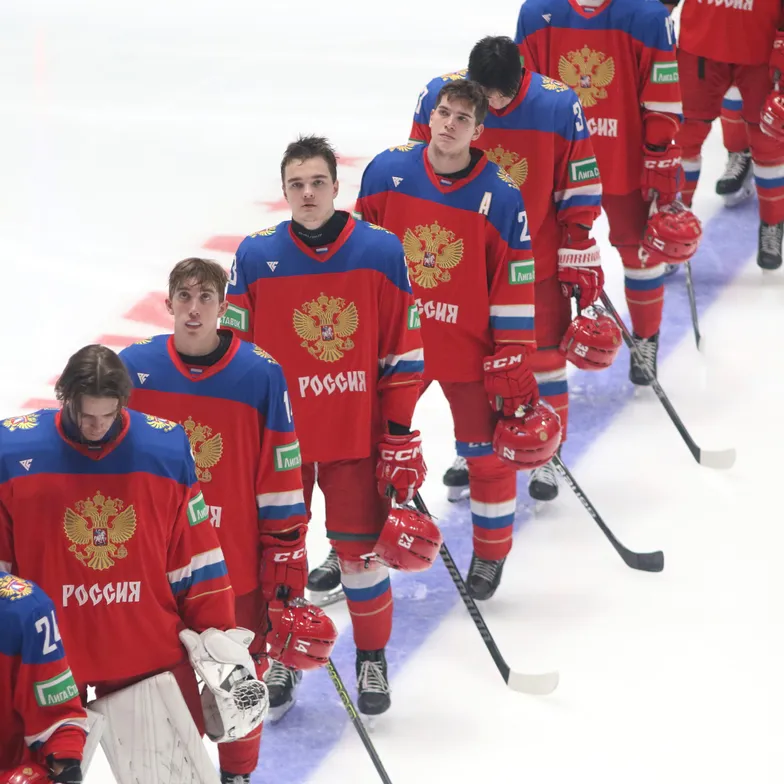
A sports court ordered Russia’s return to international hockey. Canada has other plans.
The Canadian government said it would not allow Russia’s team to compete in the World Junior Championship in Edmonton and Red Deer, despite a ruling by the Court of Arbitration for Sport (CAS).
In late October, the court ruled that there were no longer grounds to bar Russia’s team from international tournaments. The ban was imposed after Russia’s full-scale invasion of Ukraine in 2022. The ruling took effect immediately, making the World Junior Championship, scheduled to begin on December 26, the first major tournament to which the International Ice Hockey Federation (IIHF) was required to admit Russia.
The IIHF criticized the CAS ruling but said it intended to comply. Hockey federations in most of the sport’s leading countries — including Canada, Sweden, Finland, Germany, Czechia, and Latvia — also condemned Russia’s admission to the tournament, as did major sponsors. Some sponsors threatened to terminate their contracts with the IIHF.
Despite the opposition, the IIHF took steps to comply with the ruling, as promised. In early November, it formally notified member hockey federations, saying that Norway, the lowest-ranked team in the World Junior Championship, had been dropped and Russia had been given its place.
On November 11, however, it emerged that the Canadian government had formally notified the IIHF that it would not issue visas to Russian players. Unlike the IIHF, national governments are not bound by CAS rulings.
Russian officials had expected from the outset that players would be denied visas to compete in the World Juniors, so the Russian Ice Hockey Federation had prepared for that possibility. Sport-Express reported that the federation planned to field a roster made up entirely of players from North American clubs. It had even lined up support staff, down to the skate sharpeners. That plan did not work: Ottawa said these Russian players would also be unable to represent the national team because their work visas did not permit it.
As early as November 10, the Russian Ice Hockey Federation sent the IIHF a letter demanding that it either publicly announce Russia’s participation in the tournament in Canada or move the tournament to another country. The IIHF has yet to comment on the Canadian authorities’ statements, but Russia’s chances of playing in the World Juniors now appear very slim.
- Virtually no hockey-playing countries with the necessary infrastructure would agree to admit the Russian team if the tournament were relocated. The United States and Kazakhstan were virtually the only countries that did not criticize the CAS ruling.
- Organizing an event of this scale from scratch in a new country on such short notice is virtually impossible. The lower-division World Junior Championship also begins on December 6, and Norway would have to compete there if Russia were admitted to the top-level tournament. Accommodating Norway in a competition that starts even earlier would be even more complicated.
- Even if the championship were successfully moved to another country, that would not solve the problem of teams that have already refused to take the ice against Russia. Under its rules, the IIHF can simply declare those games forfeits, but with so many teams involved, that could render the tournament meaningless as a sporting contest.
According to the Russian sports outlet Sports.ru, the IIHF does technically have the authority to strip Canada of the right to host the championship. Under the regulations, the host country is required to “facilitate the visa application process.” If the federation decides that Canada is failing to meet those obligations, it can impose a fine, revoke its hosting rights, and even bar it from bidding to host future tournaments.
Under its current agreement with the IIHF, Canada hosts the World Junior Championship every other year. It is the most influential country in hockey and, among other things, has the backing of many sponsors. The Canadian publication The Hockey News predicted that the IIHF would ultimately proceed with the World Juniors as originally planned — with Norway and without Russia. The federation will likely argue before CAS that it had no choice because the Canadian government refused to issue visas and relocating the tournament on such short notice was impossible.
Whether Russia will participate in subsequent tournaments remains unclear. The next is the Women’s U18 World Championship in January in Czechia, where authorities have also said they will not allow the Russian team to enter the country. The Men’s U18 World Championship begins in the United States in late April. Russia’s chances of competing there are probably somewhat higher, because neither USA Hockey nor the U.S. government has publicly opposed the Russian team’s participation.
The year’s main international tournament, the Men’s World Championship, will take place in Germany in late May. The German government has already expressed opposition to Russia’s participation and has even suggested that Germany could withdraw as host. Two German opposition parties, Alternative for Germany and the Left, have taken the opposite position: They have already publicly called on the authorities not to obstruct the Russian team’s participation.
Russian athletes in international sport
Ukraine is back at the hockey World Championship after 20 years. A ruling in Russia’s favor could knock it out before the tournament begins.
Czech Foreign Minister Petr Macinka faces backlash from athletes and cabinet colleagues after calling hockey ‘a men’s sport’ in remarks opposing Russian players
The IOC just recommended bringing Russian athletes back to the Olympics. Here’s how Russia, Ukraine, and the West are reacting.
At Meduza, we are committed to transparency about our use of artificial intelligence in the newsroom. The story you’re reading was written by one of our living, breathing journalists and translated from Russian using an AI model configured to follow our strict editorial standards. This translation process is the result of extensive testing and refinements to ensure our English-language coverage is timely and accurate. A Meduza editor reviews every draft before publication.
If you find any errors in this translation, please contact us at reports@meduza.io.
To read Meduza’s exclusive content in English, please subscribe to our newsletter.
Why did the court find no grounds for continuing the ban?
The International Ice Hockey Federation justified the ban by citing “ongoing concerns about the safety and integrity of competitions.” The court found this argument unfounded. The court’s ruling cannot be appealed.