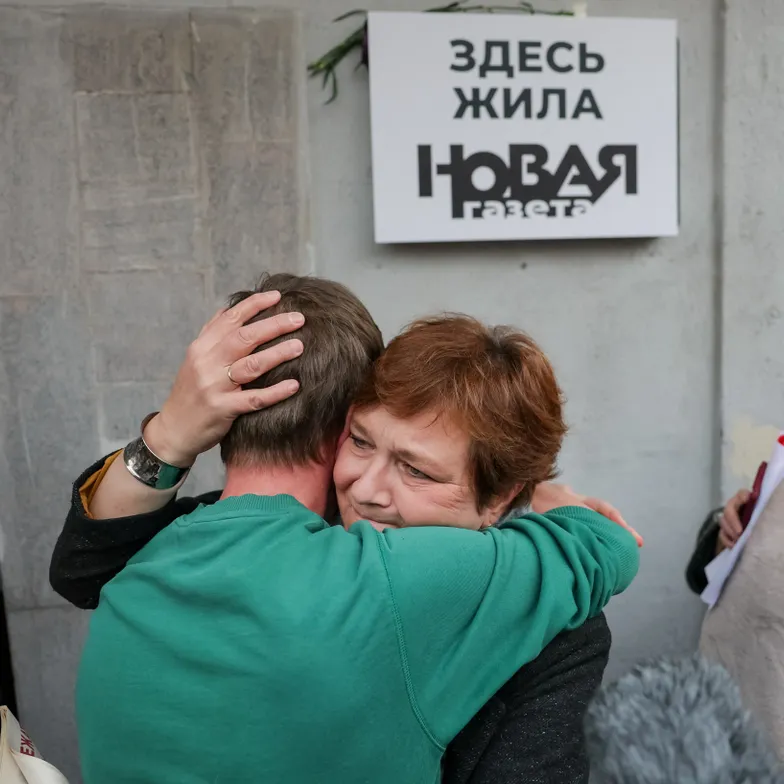
Novaya Gazeta closes after 33 years under state pressure as staff take down portraits of six murdered colleagues and leave their Moscow office to cries of ‘Thank you!’
Novaya Gazeta has shut down. It was one of Russia’s best-known independent media outlets and had continued operating inside the country after Russia launched its full-scale invasion of Ukraine. In late October, news emerged that its journalists were being evicted from their office on Potapovsky Lane in central Moscow, where they had worked for 29 years. The publication itself had been around for 33 years. Novaya Gazeta said it was closing under pressure from the authorities and the security services. The Kremlin called the closure “a normal process of turnover,” which Novaya Gazeta’s staff left the office saying that “some media outlets cease to exist, and new ones take their place.” On November 9, the newsroom held its final editorial meeting, after which Novaya Gazeta’s staff left what was now their former office to applause. This is how the newsroom’s last day unfolded.
Novaya Gazeta editor-in-chief Sergey Sokolov led the final editorial meeting on November 9 before the office closed. Those attending included Novaya Gazeta staff; Nobel laureate Dmitry Muratov, a co-founder and former editor in chief; and journalists from other outlets. Sokolov said the publication’s Telegram channel would continue to run until midnight, but Novaya Gazeta itself had already closed.
Former Novaya Gazeta editor Dmitry Muratov helps pack up the office the journalists were forced to leave
Ramil Sitdikov / Reuters / Scanpix / LETA
“For now, I want to stress, the newspaper no longer exists. But the journalists are still here. Novaya Gazeta still exists as an idea. We need to think about what form our creative work will take next. And there are far more ways to exist than the Russian authorities can handle,” Sokolov said at the meeting.
After the meeting, portraits of Novaya Gazeta staff members killed over the years were taken down from the newsroom walls. They were journalists Igor Domnikov, Yuri Shchekochikhin, Anna Politkovskaya, and Natalya Eg the journalists were stemirova, along with freelance contributor Anastasia Baburova and lawyer Stas Markelov, who also worked with the publication.
Novaya Gazeta’s final editorial meeting at its office on Potapovsky Lane. Past issues of the newspaper are on the table. Portraits of murdered journalists are being taken down from the walls
Ramil Sitdikov / Reuters / Scanpix / LETA
Novaya Gazeta’s staff left the office to applause and cries of “Thank you!” from readers and colleagues gathered outside the building. On the steps, Sokolov gave a farewell speech as the Russian rock band DDT’s song “Eto vsyo” (“That’s All”) played, saying the journalists were not saying goodbye for good. “Novaya Gazeta will return to you, our readers and our colleagues,” he said.
At noon, the journalists held their final editorial meeting, collected their belongings, and left the office. The office on Potapovsky Lane is already marked “permanently closed” on Yandex Maps
Ramil Sitdikov / Reuters / Scanpix / LETA
Muratov addressed readers and journalists outside Novaya Gazeta’s building. He urged them not to equate Russians with the Russian government waging war against Ukraine, to remember political prisoners, and to push for an end to the fighting. “We feel enormous solidarity and support for Novaya Gazeta,” he added
Ramil Sitdikov / Reuters / Scanpix / LETA
People left flowers at the newsroom and at Politkovskaya’s memorial plaque. The publication’s sign was covered with a new message: “Novaya Gazeta lived here.”
“A little sadness, a little anger that there are circumstances we couldn’t overcome. But above all, I’m incredibly proud, and I’m not ashamed of a single day of the 34 years I’ve worked at Novaya Gazeta,” editor-in-chief Sergey Sokolov said after the journalists left the office
Ramil Sitdikov / Reuters / Scanpix / LETA
Novaya Gazeta journalists outside the building where the publication had been based for 29 years
Ramil Sitdikov / Reuters / Scanpix / LETA
More on Novaya Gazeta
Can Russia’s independent newspaper Novaya Gazeta rise from the ashes a third time? Editor Sergey Sokolov discusses what comes next.
As Novaya Gazeta, one of Russia’s best-known independent newspapers, is forced to close after 33 years, three former staffers look back on its legacy
How Novaya Gazeta journalists tried to buy a nuclear warhead in 1990s Russia
At Meduza, we are committed to transparency about our use of artificial intelligence in the newsroom. The story you’re reading was written by one of our living, breathing journalists and translated from Russian using an AI model configured to follow our strict editorial standards. This translation process is the result of extensive testing and refinements to ensure our English-language coverage is timely and accurate. A Meduza editor reviews every draft before publication.
If you find any errors in this translation, please contact us at reports@meduza.io.
To read Meduza’s exclusive content in English, please subscribe to our newsletter.