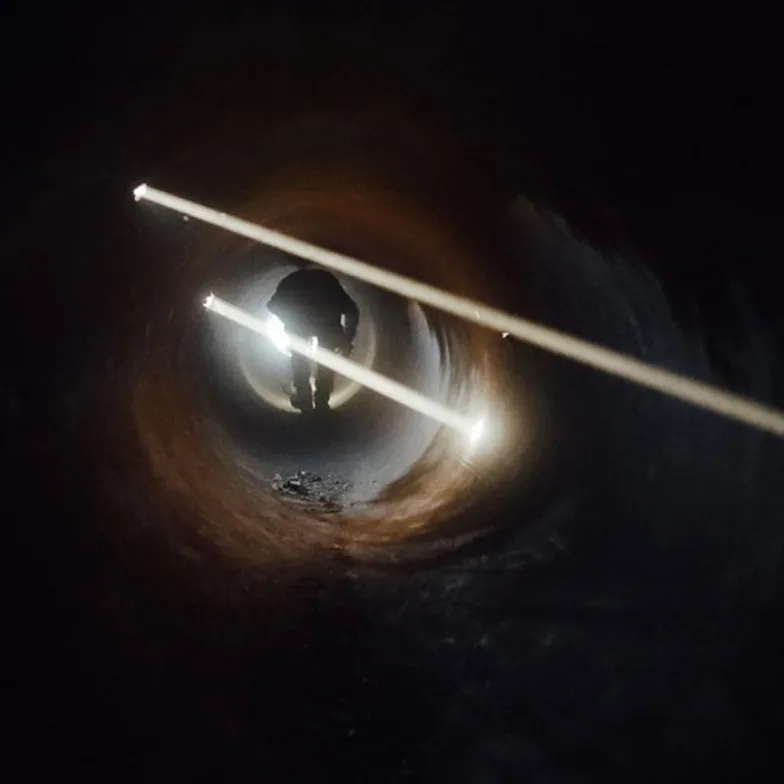
These pipelines once carried Russian gas to Europe. Now they carry Russian and Ukrainian soldiers into battle.
The Atlantic and The New York Times published reports in October on clashes between Ukrainian and Russian forces in underground tunnels beneath the front line. Soldiers travel long distances through gas pipelines to evade drone strikes and catch the enemy off guard. Meduza summarizes the key points from these reports.
“Ukraine’s newest battlefield lies inside a network of steel pipes deep below the ground, some barely wide enough for a person to crawl through,” journalist and author Simon Shuster wrote at the start of his report for The Atlantic.
These pipes carried gas from Russia to Ukraine and other European countries before Russia’s full-scale invasion of Ukraine. Now soldiers move through them, ambushing one another with machine guns and grenade launchers.
Both armies have been forced to fight underground because heavy drone activity makes it difficult to cross the so-called kill zone above ground, a stretch of no man’s land tens of kilometers wide. Drones can spot and attack any dugout, any vehicle, or even a lone soldier.
Main Intelligence Directorate of Ukraine’s Defense Ministry / Khartiia Corps
New York Times correspondent Maria Varenikova encountered a Russian drone on her way to a tunnel entrance. After their driver stopped the pickup, she, the newspaper’s photographer, and their Ukrainian military escorts jumped out and took cover along the road.
Ihor Obolensky, commander of the Ukrainian National Guard’s 2nd Khartiia Corps, told Shuster that every day “the kill zone is expanding, getting wider and deadlier.” The solution, said the commander, who leads several thousand Ukrainian soldiers, is to “go underground.” Russian commanders thought of this first, and Ukrainian assault troops are now “catching up” with the enemy, Obolensky said.
These new tactics matter to the course of the war, Shuster wrote. Ukrainian military sources told him that Russia’s army had spent the past year stockpiling supplies and building up troop numbers in preparation for a winter offensive. Ukrainian soldiers fear that Russian forces will use this operation to try to break through the kill zone and capture all of eastern Ukraine, which Russia could use as early as next year to launch another offensive toward central Ukraine and its capital. Obolensky warned that control of the gas pipeline network in the contested Donbas region could give Russia a decisive advantage in this campaign.
Khartiia Corps
Khartiia Corps
The Khartiia Corps recognized the pipelines’ importance in the spring of 2025, when Russian troops used them to get behind Ukrainian lines and launch a series of surprise attacks during the battle for Russia’s Kursk region. “They kept climbing out of the earth like devils,” Obolensky said. These attacks mostly took place in bad weather, when drones struggled to spot soldiers emerging above ground.
At first, Ukrainian forces responded with a deadly game of “whack-a-mole.” “We would try to find their exit points and cut them down when they surfaced,” Obolensky said. “But they would just keep popping up several kilometers behind our lines and attacking us.” The Khartiia commander then asked the state energy company for maps of the pipeline network. The documents revealed the scale of the threat: a labyrinth of at least 57 steel pipes running beneath the combat zone, most between one and two meters in diameter. For decades, this infrastructure carried gas from Siberian fields to customers in Ukraine and elsewhere in Europe. Kyiv did not shut down this transit route for good until early 2025.
Russian forces began using the tunnels toward the end of the months-long battle for Sudzha, a town Ukrainian forces captured in August 2024. As Ukraine’s hold on part of the Kursk region began to weaken, Russian commanders organized Operation Pipe. In early March 2025, between 100 and several hundred soldiers crawled several kilometers through a section of the Urengoy–Pomary–Uzhhorod trunk gas pipeline and emerged behind Ukrainian lines.
A Russian soldier inside a gas pipeline during the battle for the Kursk region. March 11, 2025
RIA Novosti / Profimedia
Although Kremlin propaganda clearly exaggerated the maneuver’s effectiveness, it did help Russian forces recapture Sudzha and other parts of the Kursk region.
Ukrainian forces soon began noticing Russian troops using similar tactics inside Ukraine, including in the battle for Pokrovsk in the Donetsk region, Obolensky told Shuster. His troops now operate mainly in the Kharkiv region in northeastern Ukraine, where they have spent more than a year defending Kupiansk, about 40 kilometers from the Russian border. Russian assault troops repeatedly appeared behind Ukrainian lines in this area, sometimes just one or two at a time, hiding in abandoned buildings or digging foxholes beneath tree roots. They gradually built up their forces this way — and set ambushes.
A note from Meduza’s analysis desk:
In 2025, Russian forces got behind Ukrainian lines in Kupiansk through a section of gas pipeline running beneath the Oskil River from the village of Lyman Pershyi on the eastern bank to Radkivka on the western bank. They then used the pipeline to supply their forward troops in Kupiansk. This is the local Shebelynka–Ostrogozhsk gas pipeline, which has a diameter of 1,020 millimeters, compared with the 1,420-millimeter trunk pipeline used in Operation Pipe in the Kursk region. Combat footage shows that the pipe entrance now controlled by Ukrainian forces is at a compressor station near Radkivka, a village Ukrainian troops took a year ago.
“The question kept arising: Where are they coming from?” Obolensky said. In late July, he went down into the pipes himself for the first time and emerged shaken. In a video of that moment, which the commander showed Shuster, his face is covered in dirt and his voice trembles with emotion. “The guys working down in these pipes right now, they are heroes, unlike any other warriors I have seen,” the commander says into a phone camera.
Main Intelligence Directorate of Ukraine’s Defense Ministry / Khartiia Corps
Khartiia Corps
Khartiia Corps
Other Khartiia videos Shuster reviewed show the horrific conditions on the underground front. Khartiia soldiers often spend weeks underground, traveling through the pipes on modified coal-mining carts powered by electric scooter motors.
The New York Times correspondent gave this account of her descent into the tunnels. Her description suggests she also visited Khartiia’s positions near Kupiansk:
Deep inside a forest in drone-infested eastern Ukraine, I stepped onto a small metal platform and descended into a post-apocalyptic world of modern warfare, where the only safe place is underground. […] When the elevator stopped, a vast subterranean space came into view — a logistics hub, hundreds of yards long and at least three yards high. Connected to it was a buried web of pipes that once carried natural gas between Ukraine and Russia.
The tunnels smell strongly of chemicals. When Ukrainian soldiers approach Russian positions underground, fighting breaks out. Both sides fire high-caliber rifles and launch grenades, sending shrapnel and bullets ricocheting inside the metal pipes.
Main Intelligence Directorate of Ukraine’s Defense Ministry / Khartiia Corps
Explosions suck the air out of the confined spaces, making it difficult for soldiers to breathe. They use gas masks and oxygen tanks and plug their ears to muffle the deafening blasts. To advance, Ukrainian troops often have to break through walls of sandbags erected by Russian soldiers and move forward under enemy fire. Ukrainian soldiers told Varenikova about a friend who died from smoke inhalation after a Russian bomb struck the entrance to a pipe.
Obolensky said that in October, after about six months of underground fighting, Khartiia regained control of roughly 14 kilometers of pipelines in northeastern Ukraine in an operation code-named Veles. He told Shuster it was the first successful counterattack ever carried out in such conditions. But he expects many more such operations will be needed to clear the pipeline network, which remains mostly under Russian control.
From Meduza’s archives
At Meduza, we are committed to transparency about our use of artificial intelligence in the newsroom. The story you’re reading was written by one of our living, breathing journalists and translated from Russian using an AI model configured to follow our strict editorial standards. This translation process is the result of extensive testing and refinements to ensure our English-language coverage is timely and accurate. A Meduza editor reviews every draft before publication.
If you find any errors in this translation, please contact us at reports@meduza.io.
To read Meduza’s exclusive content in English, please subscribe to our newsletter.
Meduza