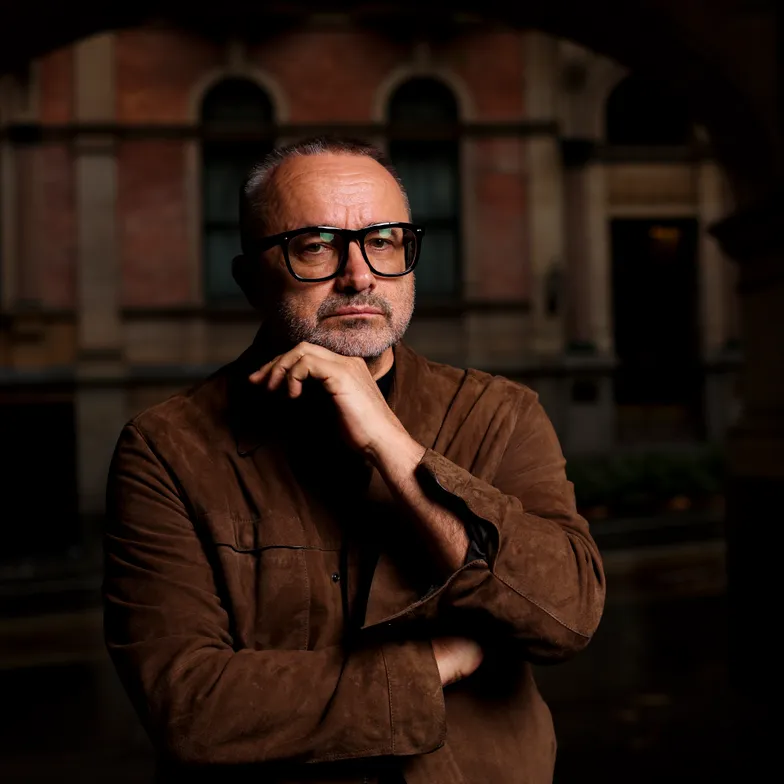
The New Yorker profiles Andrey Zvyagintsev, the exiled Russian director of the Cannes Grand Prix-winning film ‘Minotaur’
The New Yorker has published a profile of the filmmaker Andrey Zvyagintsev by Joshua Yaffa, an American journalist who has written about Russia since the mid-2000s and is the author of “Between Two Fires: Truth, Ambition, and Compromise in Putin’s Russia.” Yaffa spoke with Zvyagintsev, as well as with his producers, his actors, and the film critics who study his work. Meduza summarizes Yaffa’s article.
Andrey Zvyagintsev does not make overtly political films, Joshua Yaffa writes, but his portrayal of contemporary Russia is unsparing. His “Minotavr” (“Minotaur”) is the first independent feature film about Russia’s full-scale invasion of Ukraine made by a director from Russia. Film critic Anton Dolin told The New Yorker that if Russia were facing, say, an environmental catastrophe instead of a war, Zvyagintsev would probably still be the only person to make a film about it. “Reality is painful for him, but he’s not afraid of it,” Dolin said.
For Zvyagintsev, the most important aspect of directing is mise-en-scène — the arrangement of everything within the frame — according to Joël Chapron, a French film scholar and longtime Cannes Film Festival expert on the former Soviet countries. Iris Lebedeva and Varvara Shmykova, actresses who appeared in “Minotaur,” agree.
Lebedeva, for example, told The New Yorker about filming a café scene. In it, the businessman Gleb offers to drive his wife, Galina, played by Lebedeva, because he suspects she is going to meet a lover rather than simply have coffee. The actress said Zvyagintsev knew in advance exactly what he wanted the tree outside the café, the customers, the passersby, and even the cups to look like. That day, despite playing the lead, she felt she was “no more important in the frame than that tree.” “All of it exists in order to create a larger whole,” Lebedeva said.
Yaffa’s article suggests that Zvyagintsev is just as attentive to detail away from the set: once, when they arranged to meet at a restaurant, the director gave him detailed instructions on which table to take and why.
Yaffa met Zvyagintsev in the summer of 2026 in Jūrmala, where the director had rented a house to work on a book.
From Meduza’s archives
Yaffa found Zvyagintsev “intimidatingly well read, in the way of the Russian intelligentsia.” He recalled the director once reading Aeschylus’s tragedy “The Persians” at a party. Zvyagintsev was also considerate: “[H]e would regularly check to see if I was cold, hungry, or in need of a ride.”
Zvyagintsev did not come from the cultural elite, “unlike many prominent Russian filmmakers.” His mother taught Russian language and literature at a school in Novosibirsk. His father, who left the family early on, worked a string of jobs — sculptor, police officer, school gym teacher. When Zvyagintsev was 18, his father unexpectedly visited him and his mother. The director later learned that his parents had argued that day: on hearing that his son was studying acting at the Novosibirsk Theater School, his father had pounded the table and said, “What kind of nonsense is that?” “What a joy that this person is absent from my life,” the younger Zvyagintsev thought when he learned about the argument.
After the Novosibirsk Theater School, the future director enrolled in the acting department at GITIS, the theater arts institute. Perestroika was underway, and people felt increasingly free. Students boycotted the Marxism-Leninism course. A friend at VGIK, the film institute, got Zvyagintsev into screenings reserved for students, where he saw Western art films still unavailable to most Soviet viewers. Michelangelo Antonioni’s “L’Avventura” particularly struck him. “I understood then that a film can be incredibly rich and meaningful even when hardly any action happens,” Zvyagintsev said.
He never trained as a director — but in the new Russia, a diploma was no longer a prerequisite. Zvyagintsev found his way into directing through advertising, making commercials for the Spartak soccer club, a shoe store, and a granite workshop. On a shoot commissioned by REN TV, the young director met producer Dmitry Lesnevsky, who offered him the chance to direct an episode of the series “Chernaya komnata” (“The Black Room”). Pleased with the result, Lesnevsky commissioned two more. On that project, Zvyagintsev worked with cinematographer Mikhail Krichman, who remains his regular collaborator. A few years later, Lesnevsky produced Zvyagintsev’s feature debut, “Vozvrashcheniye” (“The Return”).
Today, though, the producer does not take credit for discovering Zvyagintsev. He told The New Yorker that people like the director “arrive to this world with their mission already defined” and eventually fulfill it one way or another.
“The Return,” a poetic film about a long-absent father reuniting with his sons, failed to impress Russian critics. Lesnevsky feared the film was destined to air once or twice on REN TV and then disappear. But in 2003, it screened at the Venice Film Festival and won the Golden Lion and the award for best debut. Zvyagintsev recalled another unexpected response: after its Russian television premiere, a woman who turned out to be his half-sister wrote to him. She told him that his father had watched the film. When it ended, he went out onto the balcony to smoke and stood there for two hours on a “frosty autumn evening.”
Hi, I’m Katya.
I’ve been running Meduza’s crowdfunding since 2021. Today, supporting Meduza is a crime in Russia. You can be sent to prison just for donating. We’re still able to do our work thanks to thousands of our Russian readers who now live abroad. But even they’re no longer safe.
Imagine you’ve left Russia, but then your mom becomes seriously ill. It could be your last chance to see her, so of course you go home. At the border, you’re interrogated. Officers hack into your phone and search for any trace that you’ve donated to Meduza.
The Kremlin is counting on that fear, and it’s working. People are afraid to donate. I’m afraid for our supporters, because any one of them could end up in prison. And I’m afraid for Meduza. Without crowdfunding, we simply can’t continue. So if you live outside Russia and don’t have to worry that donating to Meduza could keep you from going home to your family, I’m asking for your help. Please support our work.

After his success in Venice, Russian President Vladimir Putin invited the director to meet with him. The two had a brief scripted conversation, and then they went to the Mosfilm studio to meet with filmmakers. “Putin wasn’t yet what he later became,” Zvyagintsev said. “He was still mostly an unknown quantity.” After that meeting, Kremlin officials suggested several times that the director take part in various public committees or initiatives, but he always declined, considering it a waste of time. Lesnevsky told The New Yorker that this was highly unusual behavior for a Russian director: “Plenty of other directors would have pissed themselves with happiness.”
Another Zvyagintsev film Yaffa discusses at length is “Leviafan” (“Leviathan”), a social drama in which the director openly criticized the state for the first time. It was made with support from the Culture Ministry. According to producer Alexander Rodnyansky, the team needed the ministry’s protection more than its funding. When Culture Minister Vladimir Medinsky saw “Leviathan,” he summoned Zvyagintsev to his office and accused him of smearing Russia. The director replied that he was showing the country as the authorities had made it. Yaffa writes that it was after “Leviathan” that Medinsky changed his ministry’s film policy, banning support for films critical of “our elected government.” (In 2014, describing the image of Russia in such films, Medinsky used the phrase “Rashka govnyashka,” which became a meme. Yaffa translated it as “Russia is a shithole.”)
Zvyagintsev was in a German hospital when Russia’s full-scale invasion of Ukraine began. In the summer of 2021, he fell ill after receiving the Sputnik V vaccine. Doctors believed he had had an asymptomatic case of COVID-19 that the vaccination had aggravated, but Zvyagintsev still does not know his precise diagnosis. With 92% of his lungs affected, he was advised by a Moscow doctor to seek treatment in Germany. The director was taken to Hanover, where he spent a month in a medically induced coma. “A huge dark blur” is all he can remember of it. Zvyagintsev never returned to Russia: after leaving the hospital, he moved to Paris with his wife, Anna Matveyeva, and their son, Pyotr.
Joël Chapron, the Cannes expert, introduced the director to producer Nathanaël Karmitz, the head of the film company MK2. Karmitz told Yaffa that he saw a man who was still unsteady on his feet, had nearly died, had lost his home, and desperately needed work to support his family. “When he understood that he survived, he wanted to go on,” Chapron said. “Which meant making movies, the only thing he knows.”
Zvyagintsev proposed that MK2 make “Yupiter” (“Jupiter”), a film about an oligarch’s downfall that he had begun working on in Russia immediately after “Nelyubov” (“Loveless”). Roman Abramovich’s Kinoprime foundation had planned to back the project but pulled out three months before filming was due to begin. Producer Ilya Stewart suggested that people at the foundation simply “were scared.” Karmitz was not taken with the idea either: he doubted that audiences would sympathize with an oligarch.
Zvyagintsev then decided to pursue a long-held idea — a remake of a French classic — and asked Chapron to draw up a list of iconic family dramas from the 1960s and 1970s. From nine titles, the director chose Claude Chabrol’s “The Unfaithful Wife.” He recalled being drawn to the film by its title alone. It immediately gives away the secret, leaving the subtleties of the characters’ relationships to hold the audience’s attention. That idea eventually grew into “Minotaur.”
Financing the film proved more complicated than it had been for the director’s Russian productions: it required two French film companies, one German company, one Latvian company, and several private Russian-speaking investors. Karmitz said this way of making films, standard in Europe, was entirely unfamiliar to Zvyagintsev. In Russia, Alexander Rodnyansky had handled all financial matters — the director had never needed to raise money or pitch to investors. “He spoiled me,” Zvyagintsev said.
When Yaffa tried to reach Alexey Serebryakov, who played the lead in “Leviathan” and still lives in Russia, the actor declined to speak with him and then deleted their text exchange. Zvyagintsev was not surprised: “Artists have to find a way to survive.” When Yaffa told him that another “Leviathan” actor, Roman Madyanov, had supported the war, the director replied, “It’s disappointing, of course, but I don’t judge anyone.” He described actors’ situation in Russia as “a form of serfdom.”
Yaffa spoke with actor Dmitry Mazurov, who also lives in Russia but accepted Zvyagintsev’s offer and played the lead in “Minotaur”: Gleb, a businessman who will have to send 14 of his employees to war. Mazurov insisted that “Minotaur” “isn’t a manifesto” but is above all an intimate family drama, and that the mobilization storyline had little effect on his interpretation of the role. Varvara Shmykova told Yaffa that the director barely spoke about the war on set: everyone already knew where he stood.
After winning an award at Cannes — “Minotaur” received the Grand Prix, the festival’s second-highest honor — Zvyagintsev returned to “Jupiter.” He is wary of discussing details of the new film, given how difficult it has been to get the project made. Nathanaël Karmitz is again involved in the production: he no longer has reservations about the main character, who has become “more universal” in the new version of the script. The team includes production designer Andrey Ponkratov, who has worked with Zvyagintsev for many years, and Simon Lyashenko, co-writer of “Minotaur.”
They are scouting locations on the French Riviera. Yaffa recounts the team’s visit to the famous Villa Rocabella near Toulon. Zvyagintsev looked displeased: in the years since his first visit, the villa had changed hands. “It’s starting to feel a bit like a sanatorium,” he said. A pair of palm trees that once framed the view of the sea was gone. “Those palms said something,” Zvyagintsev said. “They conveyed something different about the place.”
At Meduza, we are committed to transparency about our use of artificial intelligence in the newsroom. The story you’re reading was written by one of our living, breathing journalists and translated from Russian using an AI model configured to follow our strict editorial standards. This translation process is the result of extensive testing and refinements to ensure our English-language coverage is timely and accurate. A Meduza editor reviews every draft before publication.
If you find any errors in this translation, please contact us at reports@meduza.io.
To read Meduza’s exclusive content in English, please subscribe to our newsletter.
Meduza