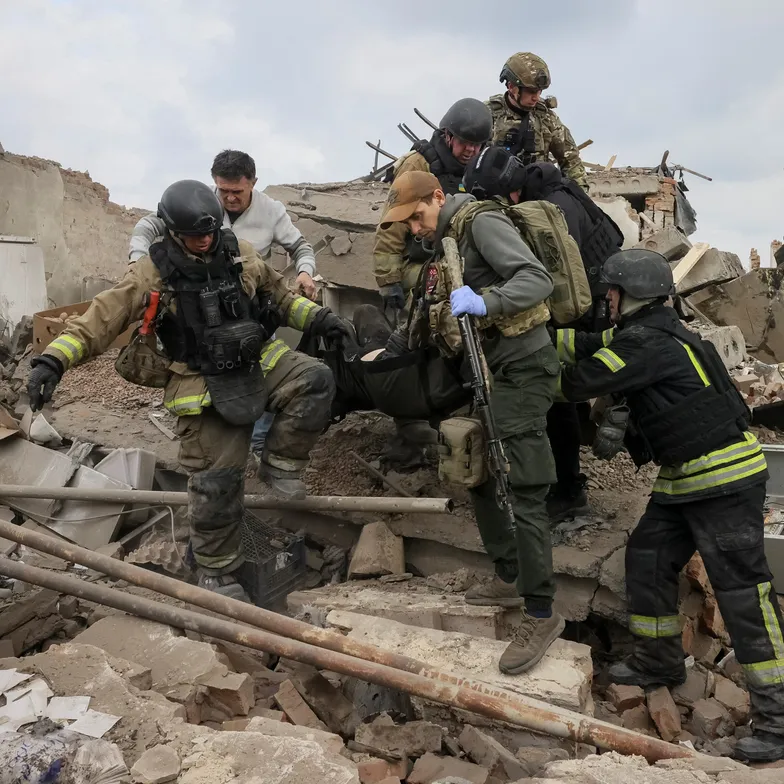
Russia bombs humanitarian aid distribution site in southern Ukraine, killing 31. More than 40 people remain missing.
The Russian military carried out two airstrikes with bombs on Komyshuvakha in the Zaporizhzhia region yesterday, killing 31 people, according to the latest official figures.
Ukrainian President Volodymyr Zelensky said the strikes hit a former school building. Komyshuvakha lies less than 20 kilometers (12 miles) from the front line, so children were forcibly evacuated from the town as early as June, and the building was being used for humanitarian purposes and as a shelter.
Zelensky said humanitarian aid was distributed at the building on Mondays, and the first strike hit as residents arrived there. “Then came a second strike: new bombs, this time directly on the shelter,” he said.
Mykhailo Semikin, head of the Zaporizhzhia Regional Military Administration, said Russian forces carried out nine strikes in total, first with FAB-500 bombs and then with more powerful FAB-3000 bombs, which are used to destroy concrete fortifications and bunkers. He said the underground concrete structure, where people were at the time, collapsed after a direct hit.
Crews are still clearing rubble at the site, and Semikin said more than 40 people are listed as missing.
Zelensky accused Russian forces directly of knowing the former school was being used as a humanitarian site, calling the incident a “terrorist strike.”
“If Russia truly sought de-escalation, now — after the events in Oleshky — would have been a good moment to continue humanitarian initiatives. We proposed this. But Russia keeps killing,” the Ukrainian president said.
November 3, 4, and 5 have been declared days of mourning in the Zaporizhzhia region.
The Russian Defense Ministry reported strikes in the Vinnytsia, Dnipropetrovsk, Odesa, and Kharkiv regions in its summary, but made no mention of the strike on Komyshuvakha.
War in photographs. Komyshuvakha
Reuters / Scanpix / LETA
State Emergency Service of Ukraine in Zaporizhzhia region / Reuters / Scanpix / LETA
State Emergency Service of Ukraine / AFP / Scanpix / LETA
Reuters / Scanpix / LETA
Reuters / Scanpix / LETA
Reuters / Scanpix / LETA
State Emergency Service of Ukraine in Zaporizhzhia region / Reuters / Scanpix / LETA
Reuters / Scanpix / LETA
Reuters / Scanpix / LETA
National Police of Ukraine in Zaporizhzhia region / Reuters / Scanpix / LETA
Reuters / Scanpix / LETA
At Meduza, we are committed to transparency about our use of artificial intelligence in the newsroom. The story you’re reading was written by one of our living, breathing journalists and translated from Russian using an AI model configured to follow our strict editorial standards. This translation process is the result of extensive testing and refinements to ensure our English-language coverage is timely and accurate. A Meduza editor reviews every draft before publication.
If you find any errors in this translation, please contact us at reports@meduza.io.
To read Meduza’s exclusive content in English, please subscribe to our newsletter.
Meduza