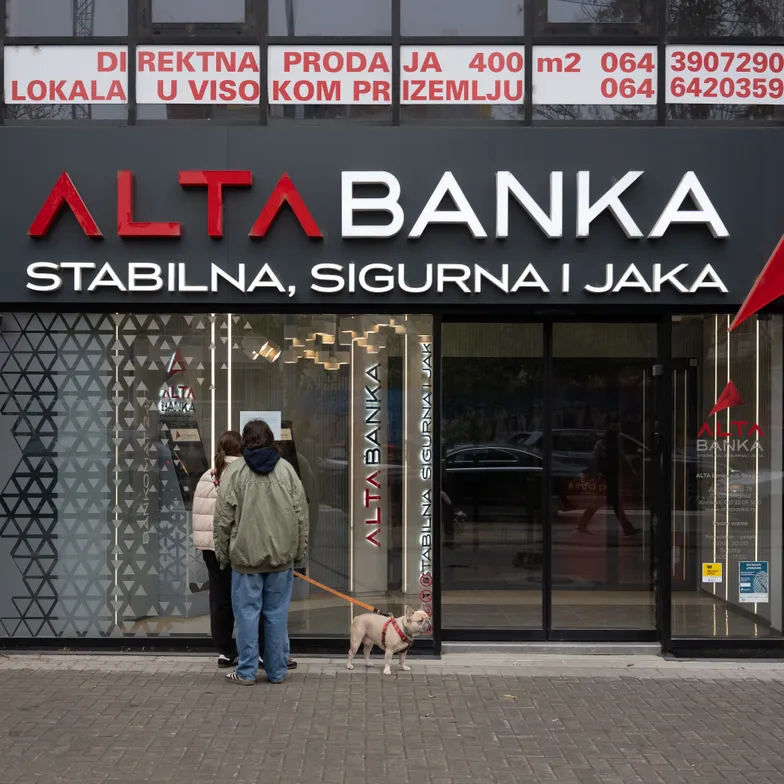
‘I have two days until the food in my fridge runs out’: Thousands of Russian emigrants left scrambling after Serbia shuts down Alta Bank, freezing their savings
On October 30, Serbia’s Central Bank revoked the license of Alta, one of the few local banks where Russians could relatively easily open an account. Clients’ accounts were frozen. Many had kept money there from selling property in Russia, while others received their salaries through Alta accounts. Authorities promised to return up to 50,000 euros for lost deposits. What will happen to the rest of the money remains unclear. Meduza spoke with affected Russians, including entrepreneurs who used Alta accounts for their businesses, about how the bank’s closure will affect their lives.
‘We went to the ATM, but it wasn’t working. A branch employee announced that it wouldn’t open. The app wouldn’t load.’
Anton, an IT specialist, whose family kept money from the sale of an apartment in an Alta account
We moved to Serbia as a family. My wife moved first, last year, for work; then our child started school, and I only moved this year. My wife works in IT, and I was in IT too, but I haven’t found anything and I’m still unemployed.
The Alta account belonged to my wife. She opened it back in the summer of last year because the bank made it easy for Russians to open accounts there. The bank was accommodating with foreign transfers, and the money from the sale of our Russian apartment was sitting in Kazakhstan.
The apartment was in the Moscow region. We sold it in 2023, when we decided we would be leaving Russia. The sale was legal, but we didn’t want to explain why the money ended up in Kazakhstan. When we transferred it there, the process of receiving it took a long time, so we decided not to repeat it here.
When we opened the account, we asked whether we would need any documents on the origin of the money for transfers from the Kazakh account. We were told that for transfers of up to 10,000 euros a month, no documents were required. So we decided not to draw any extra attention and just send the money over gradually.
We made our last transfer to Alta on October 26. We didn’t have any plans for the money yet. We had thought about buying property [in Serbia], but we couldn’t afford it without a mortgage, so we decided to hold off for now.
We had about 70,000 euros in the account. That was only part of our savings. Another part was already in a different bank in Serbia, and a third part remained in Kazakhstan.
In the morning, my wife woke up, read the news about the license revocation on Threads, and we quickly got dressed and went to the ATM. It wasn’t working. Then we went to the branch. We stood there for half an hour, and an employee came out and announced that the branch would not open that day. The app wouldn’t load either. So we couldn’t transfer or withdraw any money.
Of course we were very upset, and at first there was even panic. But then we calmed down: this wasn’t our last money, and we have a card from another bank with funds for everyday life. We then looked for information online and found out that the insured deposit amount is 50,000 euros. That covers more than half of our money, which gave us a bit of peace of mind.
While we stood in line at the branch, everyone was sharing news they had read. There were people in line whose situation was far scarier than ours: they had all their money in Alta. After talking in chats, we found people in the same boat and agreed to share information. On Monday, several people are going to consult with lawyers, and they promised to share the results with everyone.
We’re waiting for Monday, when the Deposit Insurance Agency will publish the full procedure for returning funds up to 50,000 euros: where to go, what to submit, and so on. After that, we’ll figure out how to file a lawsuit as part of the bankruptcy proceedings.
Hi, I’m Katya.
I’ve been running Meduza’s crowdfunding since 2021. Today, supporting Meduza is a crime in Russia. You can be sent to prison just for donating. We’re still able to do our work thanks to thousands of our Russian readers who now live abroad. But even they’re no longer safe.
Imagine you’ve left Russia, but then your mom becomes seriously ill. It could be your last chance to see her, so of course you go home. At the border, you’re interrogated. Officers hack into your phone and search for any trace that you’ve donated to Meduza.
The Kremlin is counting on that fear, and it’s working. People are afraid to donate. I’m afraid for our supporters, because any one of them could end up in prison. And I’m afraid for Meduza. Without crowdfunding, we simply can’t continue. So if you live outside Russia and don’t have to worry that donating to Meduza could keep you from going home to your family, I’m asking for your help. Please support our work.

‘The day before the bank closed, I picked up a complete set of documents for opening a sole proprietor account’
Dmitry, a private entrepreneur in the arts, used Alta to register as a sole proprietor
My wife and I have lived in Serbia for a year and a half. We left Russia in 2022. We wanted to leave right away, but we needed the mobilization to give us that final push.
I became an Alta client as soon as I had the energy to deal with things like bank cards, about six months after arriving. The options for non-residents are limited: the [state-owned] Banka Poštanska štedionica and Alta. The latter turned out to be more modern, with a decent app. I used the account for everyday card payments, online purchases, and to get a bank statement for my residence permit application.
The day before the bank closed, I picked up a complete set of documents after opening a business account, which is mandatory in Serbia for running a sole proprietorship.
I found out about the license revocation in the morning from a message from an acquaintance, then started reading Serbian channels. My reaction was a kind of giddy hysteria, something like, “well, the barn’s already burned down, might as well let the house go too.” After the bureaucratic adventures with visas and residence permits in three different countries, this feels like an annoying inconvenience, nothing more.
At the time the license was revoked, I had about 100 euros in the account, so we weren’t hit too hard in that sense. Our main monthly budget is in cash. We have no savings: basically everything I earn goes straight to current expenses.
Then I started digging deeper into the context. And if what people are writing is to be believed, Alta was closely tied to the SNS. After [former President Aleksandar] Vučić‘s defeat, people tried to move money out of Serbia. If anything, this feels more like good news to me, because I’m used to the state seizing or shutting down good businesses, and here it seems to have happened the other way around. After living under the Russian regime, this is very unusual.
I don’t have access to my funds right now. I tried to pay by card, but the payment didn’t go through. I haven’t contacted the bank. Everywhere it says you have to wait for information about which bank will pay out deposits. There’s no point going to the ATMs: for non-residents, all transactions went through the teller. You couldn’t withdraw or deposit money at the ATM.
Meduza
I had hoped that the whole quest of registering the company was over and that getting my residence permit would be finished any day now. We applied for the residence permit on the basis of opening the sole proprietorship, and the last step in setting everything up was opening an account for the legal entity. Two state organizations were waiting to work with me and needed my business account. Now it’s unclear where else I’ll be able to open an account. I hope that having a residence permit will at least expand my options a little.
I’m not too worried about the procedure for getting the money back, since the amount in the account is small. For now we’re just waiting. There’s been no information from the bank. What do I plan to do next? Live. We’ll manage, it’s just a bank. The main inconvenience is where and how to open a business account to keep running the sole proprietorship legally. But there are a lot of us in this situation, so something will work out.
‘My Serbian card was the only way I could withdraw money from PayPal’
Artem, a photography teacher living in Montenegro, used Alta to withdraw earnings from PayPal
I’ve been living in Montenegro for three years now. I used to be a photojournalist. Now I teach photography online, give lectures, and do consultations. My daughter goes to school here.
I opened the account at Alta because PayPal doesn’t work properly in Montenegro, and I receive payments for my work through it. As it turned out, the Serbian card wasn’t just my main option: it was the only way I had to turn my PayPal money into cash and pay for things here. Now I don’t have that option anymore.
Before that, I had a card from Uzbekistan’s Kapitalbank, which really helped me out abroad. It closed for technical reasons, and I can no longer reinstate it. That’s when I opened an account at Alta.
Actually, it had been time for me to switch accounts for a while already. I’d heard that Russians now need a Serbian residence permit to open an account at a Serbian bank, and mine is Montenegrin. So formally, I no longer qualified as a client and should have moved on this a bit earlier. But I certainly couldn’t have imagined that a bank could just slam shut like this in a single day, without warning.
My saving grace is that I don’t have any savings: I basically live paycheck to paycheck. So I didn’t have any substantial amounts sitting in Alta. But that doesn’t mean there’s no problem. My money isn’t in the bank, it’s on PayPal, and now I just can’t use it.
If I had known in advance that the bank would close, I would have at least withdrawn a few hundred euros to have money for everyday expenses: paying for my daughter’s school lunches, going to the store, paying for Serbian language classes. Now I’ll have to borrow from friends for all of that.
The problem isn’t just cash, either: I still need to pay by card sometimes. For example, I won’t be able to buy a plane ticket at all now. There are some vague options left, like transferring money through Russia in rubles and then getting cash at local exchange offices. But I don’t just need cash!
I think there are other Russians in Montenegro who used Alta cards too. And a lot of them are probably in a much worse position than me right now, since some people had large sums in the bank. As I understand it, they’re supposed to get their money back, but that involves certain complications and delays. If someone lives in Montenegro like I do, they might have to travel to Serbia to get it.
This isn’t my first year in emigration, and I’m used to things like this. But banks in other countries where I’ve had accounts have never closed this suddenly before. The only comparison I can make is the 1998 default in Russia. Back then the dollar rose several times over in a short period, prices jumped sharply, and it was a shock. But even then we roughly understood that something was going to happen. The only question was how badly things would crash. This time it was a complete surprise.
I can only guess why this happened. It seems to me that there could be political reasons behind the bank’s closure, maybe its ties to Russian structures. But these are purely amateur guesses on my part. I’m a photographer. I don’t understand any of this.
My plan now is to look for other ways to get money, other payment systems, and open new accounts. There’s Revolut, cryptocurrencies, and some other options. In Montenegro, in theory, I can open a bank account completely legally. But the problem is that I still won’t be able to work with PayPal the way I used to. For now I’m in limbo. I have two days, until the food in my fridge runs out, to find a way to get money.
I think if this situation had happened to me three years ago, or during the hardest period of my emigration — about a year and a half after leaving Russia — I would have had a panic attack. I just wouldn’t have known what to do, and the whole thing would have been very hard. But now, no, my reaction is more like, well, that’s kind of funny.
Over four years of emigration I’ve built up some experience, and I’m confident I’ll find other ways to get money.
‘I sold property, the money arrived in my account, and then this happened’
Boris, who moved to Serbia in the summer of 2026, kept money from selling an apartment in Russia at Alta
I’m part of the recent wave of emigration. I moved to Serbia at the end of summer. You remember what that period was like: rumors of a new mobilization round, severe internet restrictions in Russia, and concerns about physical safety in major cities. That’s what mainly drove the move.
Almost all of my acquaintances who moved this summer and fall ran into the same problem: nobody wants to open accounts for Russians. Banka Poštanska used to open accounts, but it stopped, and I didn’t make it in time. There were literally only a few options left, including Alta. I chose it because the terms were better and the bank agreed to open an account fairly quickly.
An Alta branch on Terazije Square, Belgrade
Meduza
But the account wasn’t opened on the first try either. It didn’t work out in Belgrade itself, and we were turned down in the suburbs too. It worked on the second or third attempt. That’s just how it is in Serbia: one day you show up and they might open an account, another day you show up and they won’t. It all depends on the employee and the branch.
I didn’t pay any bribes: I showed a lease agreement and the “white card,” a document registering a foreigner’s place of residence. These things are fairly easy to get. I moved, rented an apartment, got the lease, and that was enough for the bank.
But the real problem is that almost all the banks don’t want to open accounts for Russians, even those who have a Serbian residence permit. As I understand it, this has to do with their cooperation with the European financial system. Serbian banks have the right to choose their own clients, and it turns out that nobody wants you as a client, even if you want to deposit a decent amount of money, simply because you have the wrong citizenship. It’s a pretty discriminatory thing.
I opened the Alta account in August and started the process of moving my assets out of Russia. I sold some property, and the money had literally just arrived in the account not long before. I hadn’t even had time to do anything with it yet, and then this situation happened.
Alta was my main account in Serbia. I used it for everyday expenses alongside cash. Right now, let’s just say I’m not left with nothing, but I urgently need to register other cards and figure out how to transfer money to them, since you can’t pay cash everywhere. You need some form of non-cash payment regardless.
The problem is that the amount in the account is higher than the 50,000-euro insurance limit. I only found out that this limit even existed on the day the bank closed. Right now I’m sitting in chats, trying to figure things out, and cooperating with other affected people. There’s still a lot of uncertainty.
I found out about the license revocation from a friend. He forwarded me a message from a Serbian public page and wrote, “Hey, didn’t you have money in there?” And I said, “Damn, yeah.” My first reaction was anxiety, shock, denial. It was a real black swan event. Then I started reading what other people were writing. In the “Guide from Oleg”, a separate thread was set up right away to discuss the situation. A chat also appeared for depositors who had more than the insured amount in their accounts, and people there are now looking for lawyers.
After the news broke, I didn’t even try to withdraw or transfer money. People in the chats were writing that it was pointless: nothing works because the bank has already been banned from carrying out transactions. There’s no access to funds right now. In fact, all I have left is cash. If I’m careful, it will last about a week. If I’m not careful, about three days. I had planned some purchases to furnish the apartment, and I wanted to buy myself a new laptop for work. Now all of that will have to be postponed, for obvious reasons.
Right now I’m trying to transfer money from Russia through cryptocurrency, but that has its own risks too. Some of my friends have had their Russian bank accounts blocked over similar transactions, because crypto transfers are often used in shady schemes.
Before, I could more or less get money out of Russia through SWIFT. It somehow worked even from sanctioned banks. But now I don’t have a proper Serbian account, so I have to deal with cryptocurrency instead. Even if it’s a gray area, I still need to live somehow. I need money to get by.
What to do next about the money in Alta is still unclear. Everyone in Serbia is off until Monday. You won’t get any answers from anyone over the weekend. So we’re waiting for Monday, worrying, feeling anxious. If there are collective lawsuits, I’ll definitely join one. But as I understand it, the first step will be getting the insurance payout, up to 50,000 euros. After that, we’ll have to figure out what to do with the remaining amount.
I read that the insurance payouts might go through Banka Poštanska. I’m afraid there will be some kind of collapse there. I happened to walk past that bank before the election once, when, as far as I remember, it was handing out government payments to Serbs of 6,000 dinars apiece. The lines were unbelievable.
I assume things could be even worse now. Government payouts are one thing. A bankrupt bank is another altogether. It might take dozens of hours in these lines. But the plan is: first collect the insured amount, then deal with the rest.
Honestly, I have no idea at all why this collapse happened in the first place. I don’t know the bank’s history very well either. But it really bothers me that the Serbian regulator made such an abrupt decision, when, it would seem, nothing hinted at it beforehand.
The bank was operating normally, people were coming in, depositing money, opening accounts. Did the Serbian regulator miss the moment when the bank started having serious problems? They should have taken action while the bank could still be saved. But instead, they just say, all of a sudden: that’s it. It’s screwed, pardon my language.
A notice about the revocation of Alta’s license on the door of a branch
Meduza
The National Bank of Serbia has revoked the operating license of Alta A.D., Belgrade
At today’s meeting, the Executive Board of the National Bank of Serbia decided to revoke the operating license of Alta A.D., Belgrade. The Deposit Insurance Agency will be appointed liquidator by court decision.
The Executive Council noted that the license revocation was preceded by supervisory measures aimed at improving the bank’s liquidity. It found that the bank’s financial position had significantly worsened over the preceding period, that there was a risk of further deterioration in its financial position or liquidity, and that depositors’ interests were therefore at risk.
Given that the conditions for revoking the bank’s operating license had been met, the National Bank of Serbia made the above decision in accordance with the Law on Banks in order to protect depositors’ interests and preserve the stability of the financial system.
The Deposit Insurance Agency will ensure, within seven business days, the payout of insured amounts and depositor access to funds in accordance with the Law on Deposit Insurance.
What worries me isn’t just the situation with the bank itself, but also the attitude toward Russian émigrés in Serbia. I saw on Twitter how some Serbs were mocking Russians who came to the closed Alta branches and stood in line there.
You understand, when many migrants arrive in any country, it always provokes a reaction of irritation. Housing prices go up [because of high demand from migrants], and people start hearing a foreign language on the streets. Many newcomers don’t want to integrate into the local culture. You can feel that resentment toward Russians is growing in Serbian society.
I haven’t lived here long, but I talk to Russian friends who moved here earlier. And based on what they tell me, and my own impressions, this tension is growing.
This spills over into various posts online too. Today one Serbian public page posted something like: “Ha ha ha, look, the Russians are standing in line.” But the comments were very mixed. Some people joined in the mockery, while others defended the Russians. Someone wrote: “I’m Russian myself, put yourself in my shoes. I’m in another country, and I can’t even get a bank to open an account for me.”
There’s this kind of political discussion happening, an exchange of opinions, both good and not so good. For now we’re just waiting for Monday. First we need to understand how to get the insured amount, and then figure out what to do with the rest of the money.
‘We used the bank for everyday operations: receiving payments from clients, paying taxes and office rent, and employee salaries’
Olga (name changed), an entrepreneur, used Alta to manage her own business’s accounts
I’ve lived in Serbia since 2023. My partners and I founded a company here. We immediately opened Alta accounts for the company and the partners. Later we hired a few employees, and they got Alta accounts too. There was an option to open an account at Banka Poštanska, but our accountant recommended Alta because of its more convenient service.
We used the bank for ordinary operations: receiving payments from our clients, paying taxes and office rent, employee salaries and their associated taxes, utility bills, and fees for subcontractors.
I found out about the license revocation on the morning of October 31 and was scared at first. I imagined how much effort it would take to go through another bureaucratic cycle. I didn’t try to withdraw or transfer money after the news came out, and I didn’t contact the bank either.
In our case, things aren’t so critical. We made all our payments this month, there’s only a small amount left in the company account, and we’re not expecting any incoming payments in the next week. There’s a bit of time to get oriented. I now plan to open new accounts for the company and for myself as soon as possible, and then request a refund of the money.
‘Right now there’s panic and hysteria in all the chats’
Apollinaria, director of the human rights foundation “Freedom and Law,” helps Russians whose money has been frozen in Alta accounts
I’ve worked in human rights for many years and have lived in Serbia for a long time. So the situation Russians are facing right now isn’t foreign to me. I understand very well what people in this position are going through. Several of my own friends have become hostages to this situation, among others.
Some people had sole proprietorship accounts at Alta, others had all their savings there, money from selling apartments and cars in Russia. Some now have 50,000, 100,000, or 180,000 euros frozen. That’s simply an enormous amount of money. People were planning to live on it for a while or to buy property, and now that possibility is gone.
For example, I saw a story in the chats about people who had 180,000 euros in the bank. They were supposed to close on an apartment purchase next Wednesday. You can imagine the state these people are in right now. It’s everything you’ve saved over your whole life: a sold apartment, a sold car. And when you’ll get it back is completely unclear.
Or another story: a young woman received her salary on an Alta card, and now all her money is blocked. She has 3,000 dinars left in cash, which is less than 30 euros. It’s a tragedy for everyone, but everyone’s is different.
A closed Alta bank branch on Bulevar oslobođenja in Novi Sad
Maxim Konankov / NurPhoto / Getty Images
Alta was the only bank that opened accounts for Russians without employment contracts, lease agreements, or other paperwork. People went there not because they wanted to, but because they had no choice.
There’s one other bank, API Bank, formerly VTB. It opens accounts, but everything there is very expensive. A lot of people don’t want to go there for security reasons, because that bank has a direct connection to Russia. Now people find themselves in a situation where they not only can’t get their money, but also don’t know where to open a new account.
I believe responsibility for what happened lies with Vučić‘s former government. The bank was probably used for corrupt purposes, to move and launder money. And when the new government came in, it thought first and foremost about its own priorities, not about the Russians who had opened accounts there.
Russians are also an affected party here. Just like Serbian citizens, we paid taxes and lived here. Yes, we’re not citizens, but we’re honest people, residents of this country. We want to understand what’s going to happen to our money.
Right now there’s panic and hysteria in all the chats. The first thing I recommend is to calm down, not panic, and not take hasty action under the influence of emotion. We all remember the 2008 crisis, when a lot of people lost everything. The Great Depression is worth remembering too.
I understand how serious the current situation is, but right now it’s very important not to do anything rash. Have a glass of wine, a shot of rakija. That’s just my personal suggestion. Calm down a little, and then act. For our part, we [activists] have started preparing appeals to government agencies.
I just finished drafting a letter to the National Bank of Serbia, which we prepared together with lawyers from Kovcheg. The project’s head, Anastasia Burakova, helped a great deal. We cite Serbian law and ask that measures be taken so that Russians can exercise their right to open accounts at other banks.
The next step will be a petition. In it, we plan to address not only the National Bank of Serbia, but also the new government, students, the Finance Ministry, and other government bodies. We have several main demands. First, we want precise deadlines for returning the funds, tied to a specific date.
Second, we want a detailed explanation of the procedure for returning funds to sole proprietors and individuals who are not Serbian citizens, because right now people have no idea what to do, in what order to apply, or what documents to submit. We want official clarification and guarantees on payment timelines.
Our third demand is for urgent action to ensure that Russians can open accounts at other Serbian banks, because right now many people simply can’t continue their normal lives and work.
I’m afraid that when the Deposit Insurance Agency starts making payments, Russians won’t be first in line. Alta had a lot of Serbian depositors and registered businesses. At best, we’ll end up second. That’s why it’s important for us to get official answers.
We’re not planning simply to sit and wait. The main thing right now is for people to know what to do and when they’ll be able to get their money back.
At Meduza, we are committed to transparency about our use of artificial intelligence in the newsroom. The story you’re reading was written by one of our living, breathing journalists and translated from Russian using an AI model configured to follow our strict editorial standards. This translation process is the result of extensive testing and refinements to ensure our English-language coverage is timely and accurate. A Meduza editor reviews every draft before publication.
If you find any errors in this translation, please contact us at reports@meduza.io.
To read Meduza’s exclusive content in English, please subscribe to our newsletter.
Meduza
Mobile cover photo: Maxim Konankov / NurPhoto / Getty Images
Guide to Serbia from Oleg
A Russian-language Telegram chat with instructions and advice for Russians in Serbia.
Serbian Progressive Party (SNS)
One of the main parties in Serbia, long led by Aleksandar Vučić. In parliamentary elections, the party lost to the opposition movement “Student List,” which emerged during the country’s mass student protests.