‘I hope this project has no future’: Grigory Sverdlin on helping Russian soldiers desert and building an organization he hopes will one day be unnecessary
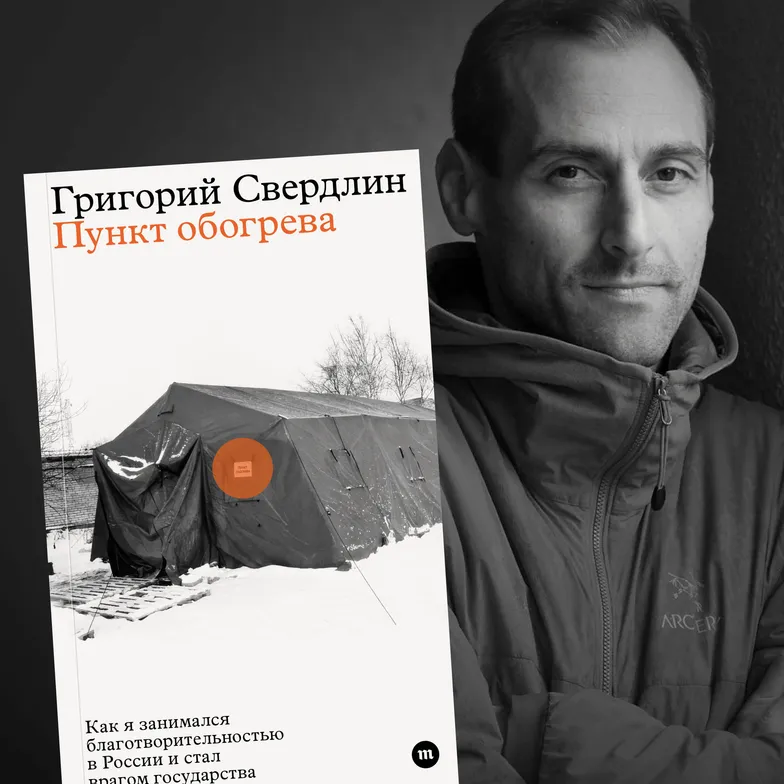
In fall 2026, the Prague Book Tower, a fair for Russian-language tamizdat, presented Grigory Sverdlin’s book Punkt obogreva: Kak ya zanimalsya blagotvoritelnostyu v Rossii i stal vragom gosudarstva (“Warming Station: How I Did Charity Work in Russia and Became an Enemy of the State”), published by Meduza’s publishing house. Sverdlin previously headed Nochlezhka, Russia’s oldest organization helping homeless people. In 2022, he stepped down as director, left the country, and, once in exile, launched the project Idite Lesom (“Get Lost”), which helps Russians desert the army and flee the country. In Prague, Felix Sandalov and Alexey Dokuchaev, founders of the StraightForward foundation, which supported the publication of Warming Station, spoke with Grigory Sverdlin about what kind of people work in the field of charity, why it’s almost impossible for projects like Idite Lesom to find financial support, and what future awaits an organization so closely tied to the war. Meduza is publishing a lightly abridged version of this conversation.
Felix Sandalov: Grisha and I first started talking about a book — not this one, but a completely different book at the time — I think around six or seven years ago, back in our time at the Moscow publishing house Individuum. The book was conceived as a kind of field guide to the work of nonprofit organizations, since Grisha already had a great deal of experience at Nochlezhka by then. But what came out now is an entirely different [book]. In its own way, it captures the difference between charity work and civil resistance. Grisha made a real “leap of faith” and founded an entirely new organization for himself, built on new principles.
Warming Station describes a kind of seasonality in the work of charities that help homeless people. When cold weather sets in, the work grows more urgent: people die on the streets, and staff have to respond quickly — it’s a genuinely difficult period for anyone working on these projects. That was certainly true at Nochlezhka. Is there a similar seasonality to the work at Idite Lesom? And given that the media keeps stirring up talk of an impending mobilization, which Russian authorities routinely deny, are you seeing a surge in requests to Idite Lesom right now?
Grigory Sverdlin: First, let me correct you a little. You’re talking about seasonality in helping homeless people, but the real seasonality is in donations. In winter, people donate more, more often, and more willingly to help the homeless, while in summer, for obvious reasons, the issue falls out of public attention. That doesn’t mean there are fewer homeless people — they don’t go anywhere. It’s a bit easier to survive, yes, but it’s still incredibly hard.
That’s exactly the pain point and the subject of discussion in the charity community that helps people who end up on the street: raising donations is incredibly hard, and the amount of work never decreases.
As for helping people who have ended up in the Russian army, or those trying to avoid ending up there, we’re completely swamped at Idite Lesom. If you’ve written to us and have been waiting several days for a reply, I want to take this opportunity to apologize. We will definitely answer everyone.
This summer we’ve gotten about one and a half times more requests than in spring, and about three times more than last summer. Right now, about 150 to 200 people contact us every day. Many people currently in Russia are, of course, panicking about a possible mobilization this fall and thinking about how to protect themselves, their children, and their loved ones.
The number of requests from people who want to desert from the Russian army is also growing. Just two days ago, we were tallying up the numbers for August: we helped almost 150 people desert that month alone.
Diana Litvinyuk / Prague Book Tower
Sandalov: You write about all of this with such vividness and enthusiasm — you can feel how obstacles energize you, how much you enjoy finding solutions to nontrivial problems. That’s always admirable.
Tell me about your method of writing the book. You describe nearly 20 years with all the vividness of someone who lived through every event firsthand. How did you reconstruct it all? How did you transport yourself back in time? How did you reconstruct the dialogue? Did you keep some kind of diaries? Or did you [reconstruct something] from letters, or do you just have a photographic memory?
Sverdlin: Thanks for the kind words. My memory is pretty poor, so I actually did some serious “pre-research” — digging up publications that are now archival, corresponding with colleagues, and interviewing colleagues from other charities who appear in the book. It’s primarily about Nochlezhka and Idite Lesom, but of course I wanted — and I hope I managed — to paint a broader picture and talk more generally about how the charity sector sprouted up through the asphalt in Russia. It didn’t exist in Soviet times, because only the state was supposed to help. Horizontal ties weren’t welcomed. They were banned.
Alexey Dokuchaev: So who should actually be doing the helping? The state, or society and organizations like Nochlezhka?
Sverdlin: I’d rather not frame it in terms of who “should.” Overall, global experience shows that the support system works best when many charitable organizations run by enthusiasts operate alongside various state, regional, and municipal structures that are also engaged in providing help. What you end up with is a network of different charitable projects, both private and government-run, that step in when someone is in trouble.
And indeed, the ratio of private to government assistance can vary somewhat, but practice shows that private initiatives are always more empathetic and more progressive, thanks to the greater enthusiasm of the people working there, and, being less bureaucratic, [these initiatives] are able to adapt more quickly to what’s happening.
Government structures, meanwhile, will always have more stable funding and greater organizational resources. In Finland, for example, which is the world champion in helping homeless people, that’s exactly the kind of interaction between the charitable and government sectors that exists.
Sandalov: Are there organizations in other countries that, like Idite Lesom, help conscripts avoid being sent to the front? Do you have an international community that shares its pains and hopes with one another?
Sverdlin: We do have some colleagues, and I found it fascinating when, a couple of years ago, we more or less accidentally met people in America who, during the Vietnam War, did something similar to what Idite Lesom does now. They were elderly hippies by then, recounting their extensive experience.
Obviously, given the specific nature of the subject, there aren’t many such colleagues, and we can’t really exchange experience with them. With our Finnish colleagues on the subject of homelessness, we always tried to pick up tips, to bring some of Finland’s practices back to Russia. But when it comes to helping with desertion… You can’t really swap routes for crossing the Finnish border with people who help men avoid service in the Pakistani army.
Dokuchaev: Nochlezhka is, in general, an organization whose structure makes sense to all of us. With Idite Lesom, we know the name, we understand what it does. But how does the organization actually function now, and to what extent can it be built into a system? And should it be? What does systemic success look like for you, apart from the war ending? Could you get an entire regiment or division out [of combat zones] if you were given far more resources?
Sverdlin: In general, I’m a believer in sustainable structures. My professional pride is that Grisha Sverdlin isn’t in St. Petersburg, in Moscow, or at Nochlezhka anymore, and yet Nochlezhka keeps living, working, and developing. I’m very glad about that, because it’s a crucial stress test for any leader: does everything still work once they’re no longer there? With Idite Lesom, I also want to believe that we’ve managed to build that kind of system.
Idite Lesom has 10 staff members: people who receive at least some salary, myself included. There are also around 80 volunteers, though we’re constantly recruiting more. Without this professionally organized work, it wouldn’t be possible to counsel 150 to 200 people every day.
“I got a summons, what do I do?” “I want to leave Russia, can I get out?” “There’s some kind of restriction on my ‘Gosuslugi’ account. Can you explain it?” “My boyfriend was detained on the street, and they’re pressuring him to sign a contract. Help.” “I’m a conscript who’s already been forced to sign a contract, and we were told we’ll be sent to the occupied territories next week. Help, save me, what do I do?” And so on, and so on. These really are hundreds of requests every week.
To answer your question about a regiment, I feel a little awkward bragging about numbers, but I’ll say it anyway, because it’s the result of enormous work by our volunteers. We launched in September 2022. To date, we’ve counseled more than 82,000 people, and there are around 3,600 people we’ve helped desert. We’ve gotten most of them out of Russia, although in the end a fairly significant number of people decide to stay in the country, and we help them hide.
So it’s a huge amount of work, but there’s always room to grow. Just last week, we met in person with colleagues and tried to come up with new ideas for how to undermine our home country’s defense capability more effectively.
Dokuchaev: How do people find out about you? Do you work only off the requests that come in? How does someone who doesn’t read Meduza or follow your Facebook find out that if they’re sent to occupied territory tomorrow, they should write to you?
Sverdlin: Honestly, good old word of mouth works best. Besides Meduza’s readers and my Facebook, 200,000 people also follow Idite Lesom’s social media accounts. That’s a great achievement by my colleagues who handle our social media.
These people spread the information among their friends and classmates, dropping it into chat groups like those for conscripts’ mothers. I think, above all, it’s this kind of organic reach.
Second, it’s probably independent Russian journalists and bloggers, whom I’d also like to take this opportunity to thank. They write about us, which means more people find out about Idite Lesom, and more people get the chance to escape the jaws of the leviathan.
Sandalov: Several fascinating pages of Warming Station are devoted to your great lifelong passion, namely technical mountaineering. By risking your life, you get access to some of the craziest views on planet Earth. In your view, is there a connection here: do people with a propensity for all kinds of extreme activity (there’s a crude expression for it, adrenaline junkie) want to work in charitable organizations or civil resistance projects more than others? Does charity work genuinely attract that kind of crowd, or is it a coincidence?
Diana Litvinyuk / Prague Book Tower
Sverdlin: I think it’s more of a coincidence. Of course, as someone who used to work at commercial companies, I was incredibly curious when I first started out in the nonprofit world. I wanted to see what kind of people worked there and how they differed from people in business.
What I ended up seeing, first, was people with a sharper sense of justice. For most of us, I think, that sense applies to ourselves and our immediate circle, but we’re unlikely to call up the relevant city service and complain about every broken traffic light. I had a colleague, though, who would see a broken traffic light and immediately start working to get it fixed.
Second, it’s a more developed sense of empathy, one that seems to stretch to more people and more situations. I also tried to write about this in the book. You shouldn’t idealize the people who come to work in charity, because everything has a shadow side, a flip side. The amount of conflict, scandal, and manipulation I was subjected to in the charity world is something no business could even dream of.
Sandalov: Tell me about civil resistance. Over the past few years, you’ve done a lot of notable things with Idite Lesom. Probably the biggest recent one was hacking into and destroying data from Russia’s military registration database. Tell me how that changed your life.
Sverdlin: Specifically, hacking the registry — or rather, the registry developer’s systems, to be precise — didn’t change anything, because by that point we’d already been engaged in “subversive activity” for three years, and our websites had already been blocked multiple times. We had, of course, already been designated “foreign agents” by Russian authorities. I’d already been sentenced in absentia to six years. If you want details, now whenever I fly somewhere, I always check where the airline’s backup airport is, because some airlines that fly to, say, Kutaisi use Sochi as their alternate airport. If there’s some technical problem in Kutaisi, the plane will land in Sochi. And I shouldn’t be showing up in Sochi. I also almost never write about my plans, and I try not to post photos from my window — basically, I take these and other obvious security precautions.
Coming back to the organization, so far, aside from being blocked and periodic attempts to hack us, nothing major has happened. Obviously, we vet people who want to become our volunteers in multiple stages, because there’s no doubt some “comrade major” would love to get in among them. But when you’re living inside all of this, this kind of shit just feels like routine.
Hi, I’m N.
I report for Meduza from inside Russia. I could go to prison for my work. To stay safe, I have to follow strict security protocols. I know my lawyer’s phone number by heart. And, of course, my articles are published anonymously.
Working for an independent news outlet while still living in Russia feels like something out of a spy film. My friends know me by one name. My colleagues and sources know me by another. But sometimes there’s a glitch. At a close friend’s birthday party, someone I don’t know reaches out to shake my hand. “Hi, I’m Lyosha.” It takes me a few seconds to decide how to introduce myself. Do I use my real name or my pseudonym? I’m trying to figure out whether this is someone I might one day end up writing about.
What I do is journalism in exile, even though I’m not in exile myself. I have the rare opportunity to do uncensored, on-the-ground reporting in Russia. Please support Meduza so I can continue this work.

Dokuchaev: Tell me, does having this kind of work get in your way, or does it actually help you? Does it give you strength to make plans for your own life? We’re living now in pretty pleasant places, where other people don’t have a war, but we do. Still, this war will end sooner or later. Given that, it seems obvious that the best thing that could happen to Idite Lesom is for it to shut down. How do you picture [life after that]?
Sverdlin: It’s true, when I came up with this project during the mobilization in Russia, I assumed we’d be doing it for six months, maybe a year — then the war would end, and we’d all go our separate ways to other things. I was naive.
I think that for me, and for many people I’m friends with, the war has cut off any sense of a horizon ahead. I don’t know what will happen in 10 years, or even five. And for now, unfortunately, I’m not able to look that far ahead.
I have to say this is something I miss, because when I worked at Nochlezhka, my colleagues and I tried to build strategic plans. Even if we specifically wouldn’t be at Nochlezhka in 10 years, we still tried to figure out how to move toward a future with room for many different charities and government projects. We were trying to grow that mycelium. Idite Lesom, of course, is a project with no future. God willing, this project will never have a future.
Diana Litvinyuk / Prague Book Tower
Dokuchaev: A project like this really shouldn’t have a future. But the people you’ve managed to help clearly do have one. Do you keep track of what happens to the people you got out, or, conversely, the people you weren’t able to get out?
Sverdlin: We do keep track. Idite Lesom is partly a charity project, not purely civil resistance. And there’s a well-known thing in charity work: a large share of the people organizations help never come back to say thank you.
Yes, Nochlezhka’s social workers are often brought boxes of chocolates. But that’s still a tiny fraction of the boxes they’re actually owed. People who’ve been through homelessness and managed to get out of it with Nochlezhka’s help don’t look back: behind them lies a nightmare, and thank god it’s over.
It’s the same with the deserters we’ve helped get out of the Russian army. It’s often harder because we’ve never even met some of them in person. Even so, we still know where quite a lot of them are and what they’re doing. By the way, a large share of the people we help desert end up in Kazakhstan and Armenia, because those are countries where you can legally live with a Russian internal passport. I’d guess around 90% of them now live in those two countries. We stay in touch with some of these people — they write to us and share their successes in their new lives.
Sandalov: In Warming Station, you write about the complicated, ambiguous world we all live in. On one hand, the Idite Lesom initiative obviously makes sense, with a very clear goal. But there are still plenty of contradictions. I’m thinking, for instance, of accusations that you’re helping war criminals. Or, say, you write in the book yourself that American philanthropists aren’t willing to give money to help people cross the border illegally, because in their view that’s human trafficking, and charitable money can never go toward something like that. What complaints do you run into most often?
Diana Litvinyuk / Prague Book Tower
Sverdlin: As for the money issue, it’s pretty funny: when we were just starting out, we knocked on every door, obviously. And we often heard from European grant-making foundations: “What you’re doing is good, but we still support some projects in Russia — cultural or charitable ones — so we can’t get involved with such a blatantly anti-Russian project.”
American grant-making foundations really did tell us that what we’re doing is good, but under American law it counts as human trafficking, and no one will bother to sort out that we’re not smuggling live cargo across the border but Russian deserters. So we made peace with that a long time ago. Huge thanks to the people who donate to Idite Lesom, because today probably 70% to 80% of our small budget comes from donations by Russian emigres. Obviously, we stopped accepting any donations from within Russia long ago, so as not to put anyone at risk, god forbid.
When I came up with this project, I decided right away that one fewer soldier in the Russian army means one person who won’t pull the trigger and fire toward Ukraine. I still hold to that logic. Every person we’ve helped desert, or helped avoid ending up in the Russian army in the first place, is a victory, because it weakens the criminal Russian army and in that way helps Ukraine.
About 80% to 85% of the soldiers and officers we help desert never even make it to the occupied territories. They’re stationed somewhere like Sakhalin or Rostov-on-Don. When these people find out — or even before they find out — that they’re going to be sent to the front, they get in touch with us, and we start helping them desert.
We vet the people who come to us as best we can, but there’s still a small chance that a war criminal could be among them. My colleagues and I aren’t happy about that, but we understand that, yes, in theory it’s possible.
We’ve decided that we will keep doing that vetting, but we’re still not an investigative body. It’s not our job to determine who is a war criminal and who isn’t. And thank god, there are institutions whose job and resources are suited to that: the United Nations war crimes commission and so on. Basically, we’ve decided that we do what we can in this area. Beyond that, I’d like to believe that after the war, all the war criminals will be found.
At Meduza, we are committed to transparency about our use of artificial intelligence in the newsroom. The story you’re reading was written by one of our living, breathing journalists and translated from Russian using an AI model configured to follow our strict editorial standards. This translation process is the result of extensive testing and refinements to ensure our English-language coverage is timely and accurate. A Meduza editor reviews every draft before publication.
If you find any errors in this translation, please contact us at reports@meduza.io.
To read Meduza’s exclusive content in English, please subscribe to our newsletter.
Meduza
What is this?
Field guide: “a practical guide.”
Human trafficking
Обычно этот уголовный термин переводят на русский язык как «торговля людьми». Однако в западной правовой системе его значение шире и включает в себя наём, перевозку, передачу, укрывательство или получение в свое распоряжение людей с помощью силы, мошенничества или обмана с целью их эксплуатации.
What does this mean?
Adrenaline junkie: “a person addicted to adrenaline.”
On Dokuchaev and Sandalov’s roles at Individuum
Alexey Dokuchaev was one of the co-founders of the Individuum publishing house, and Felix Sandalov served as its editor-in-chief from 2018 to 2024.