Serbia’s student-backed opposition has defeated Vučić at the ballot box. He says the winners will impose sanctions on Russia — but they say otherwise.
Serbia held snap parliamentary elections on October 25. Among the candidates was former president Aleksandar Vučić, who had resigned just a month earlier but was hoping to return to power as prime minister.
Aleksandar Vučić served as president of Serbia for six years, becoming the country’s head of state in May 2017 and winning reelection to a second term in 2022.
Serbia has seen continuous protests demanding Vučić’s resignation for the past two years. They began after a concrete canopy collapsed at a railway station in the Serbian city of Novi Sad on November 1, 2024, killing 16 people.
Vučić called early elections to the National Assembly, Serbia’s parliament, in early September 2026 and resigned on September 27, saying he would take part in the upcoming vote “as an ordinary citizen.”
Vučić ran at the head of the ruling Serbian Progressive Party. His main challenger was the Student List, a leaderless movement formally established just a month earlier but rooted in the mass protests that began in 2024.
The movement’s candidate list, registered with the election commission, included 250 people. None of them were students. Instead, the list included scientists, university professors, experts, and athletes. Cardiologist Ilija Srdanović, a professor at the University of Novi Sad, topped the list.
Movement representatives described how they built the list:
We weren’t looking for people who would look best on billboards, and we weren’t looking for those who have known for years how to negotiate a spot on an electoral list. We were looking for people who, in our view, are capable of entering government institutions, doing their jobs responsibly, and not forgetting why they’re there.
The Student List’s 11-point platform was organized into three main sections. The first, titled “Serbia or the Mafia,” focused on stepping up the fight against corruption; the second addressed adapting the education system to modern needs; and the third covered socioeconomic issues.
Polling stations across Serbia closed at 8 p.m. local time. Less than two hours later, Vučić spoke at Serbian Progressive Party headquarters and conceded defeat.
“We don’t have final results yet. Based on a stratified sample, it’s clear that we lost this election. Student List has won: they will have between 135 and 140 seats, and we will have 105,” Vučić said. After Vučić conceded, people poured into the streets across Serbia to celebrate the Student List’s victory.
According to the latest election commission data, the Student List received 52.54% of the vote, while Vučić’s list got 39.29%. Turnout was a preliminary 68.78% — higher than in any parliamentary election over the past decade, when turnout never exceeded 60%. The highest turnout on record came in Serbia’s first multiparty elections in 1990, when 71.49% of voters cast ballots.
Ilija Srdanović, who leads the Student List, said Serbia had won, adding that he was proud of the people who had managed to say “no” to a tyrant. “We are moving toward a civilized and better Serbia,” he said.
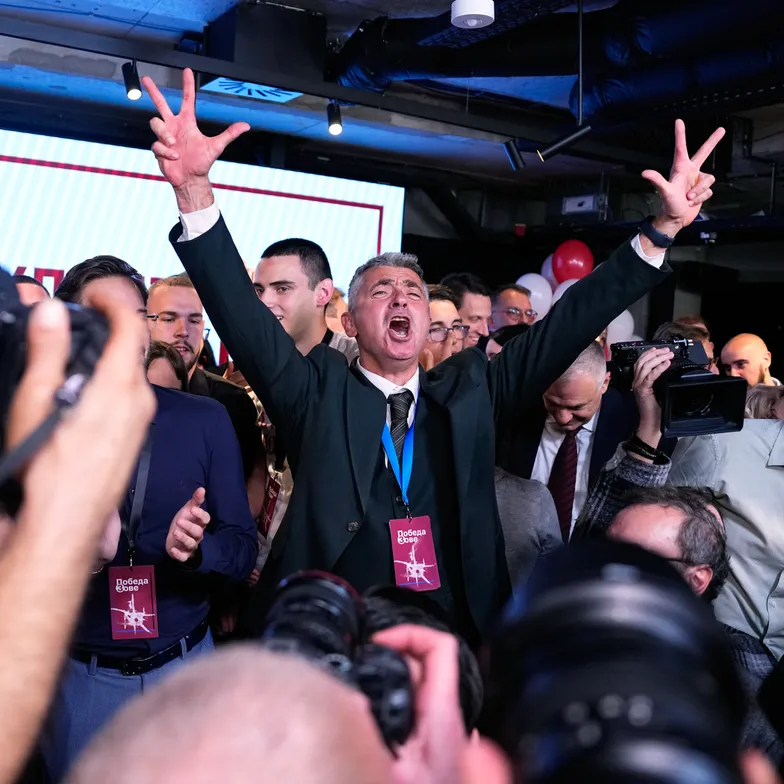
Supporters of the Student List celebrate the movement’s victory in Serbia’s parliamentary elections, Belgrade, October 25, 2026
Olivier Bunic / AFP / Scanpix / LETA
Who will seek the post of prime minister remains unclear. Dejan Šoškić, a Student List candidate for parliament and former governor of the National Bank of Serbia, said before the vote that the makeup of the future government would be discussed after a possible election victory.
Whether Serbia will change its foreign policy toward Russia remains a separate question. Less than a week before the election, Vučić gave an interview to Ksenia Sobchak, saying that if his party lost the election, “within 10 days of the new government’s formation, we would see sanctions being imposed against Russia.”
“But I don’t want to talk this way in front of Russian media, because it comes across as if I’m speaking badly about someone from my own country,” he added. Vučić repeated his warning about possible sanctions even after his election defeat, saying he expected them to take effect by March or April 2027.
In their foreign policy platform, released in late September, representatives of the student movement said Serbia would maintain its principled position against imposing restrictive measures on Russia.
Student List representative Aleksandar Baucal confirmed this position during preelection debates in mid-October. “We have taken the position that sanctions against Russia will not be imposed; on the other hand, there is a need to coordinate foreign policy [with the European Union], but, I repeat, all of this is a matter of negotiation,” he said.
At Meduza, we are committed to transparency about our use of artificial intelligence in the newsroom. The story you’re reading was written by one of our living, breathing journalists and translated from Russian using an AI model configured to follow our strict editorial standards. This translation process is the result of extensive testing and refinements to ensure our English-language coverage is timely and accurate. A Meduza editor reviews every draft before publication.
If you find any errors in this translation, please contact us at reports@meduza.io.
To read Meduza’s exclusive content in English, please subscribe to our newsletter.
Meduza