Russian authorities move to evict war refugees from temporary shelters south of Moscow. Many have nowhere else to go.
The Tula regional government has decided to evict residents from local temporary accommodation centers. Since 2022, the centers have housed refugees from Ukraine and Russia’s border communities. Many are single mothers with children, older people, or people who only recently escaped the fighting and have yet to find work and settle in. They cannot return home: The war continues where they lived, and many homes and even entire communities have been destroyed.
Journalists from the Bereg cooperative spoke with residents of one temporary accommodation center in the Tula region about how they became refugees and what they expect after eviction. Meduza is translating their report in full.
‘We’re all pleading with you not to throw us out on the street’
The parking lot outside a health resort in the Tula region is packed with cars bearing license plate codes rarely seen here. “180” and “181” designate the annexed Donetsk and Luhansk People’s Republics. The rarest code is “188.” Those plates were issued in the Kharkiv region during the six months in 2022 when Russia occupied part of the region.
Schoolchildren play on swings outside two buildings that were temporarily converted into a refugee accommodation center just two years ago. Pine trees surround the courtyard. Adults sit on benches under plastic canopies, smoking and talking.
These residents usually live in the neighboring complex, which has operated as a temporary accommodation center since 2022. In the summer, management moves them out and gives the better rooms to tourists and people attending forums held here. Those guests pay 8,000 rubles a night for the cheapest two-person cottage.
The refugees praise the accommodations. Their only complaint is the food: Cooking in the rooms is prohibited, and the cafeteria food is sometimes undercooked or spoiled.
Refugees waiting in line for food in the center’s cafeteria. The bags hold plastic food containers; glass containers are prohibited.
Bereg
In May 2026, the Tula regional government issued a decree requiring all refugees to leave temporary accommodation centers by September 1. Only a few categories of residents were exempt.
Residents say they were threatened with eviction by OMON riot police if they did not leave voluntarily. The refugees sought help from the regional Social Protection Ministry, the prosecutor’s office, and Tula Governor Dmitry Milyaev. Then they recorded a video appeal to Vladimir Putin.
Shortly after it was published, officers from Russia’s Federal Security Service came to the resort, residents told Bereg. “They searched all of us from top to bottom. They went through my entire phone. They asked: Who are the activists? Who are the traitors? Who do you support? How do you feel about the special military operation? What do you think of the president?” says one refugee, who asks not to be named.
Residents received perfunctory replies to their complaints about the eviction. But the deadline for leaving the resort was extended — first to October 1, then to October 15. In early October, the center’s management gathered the residents and told them there would be no further extensions.
The refugees have been unable to obtain any official documents explaining the grounds for their eviction. The prosecutor’s office had asked residents to supply those documents before it would look into the matter. Local officials said the residents were being evicted due to insufficient funding.
The center’s main building
Bereg
Almost all the center’s residents prefer to eat in their rooms. The cafeteria tables have been pushed together because they are rarely used.
Bereg
On October 4, the refugees recorded another video appeal to the president. About 70 people lined up in a clearing beneath the pines. The previous video had been filmed on the resort’s front steps, but this time, management asked them to ensure the center could not be identified in the footage.
Anna, 39, and Nataliya, who is about 50, address Putin on behalf of all the center’s residents. “Our communities are closed off and completely destroyed. We have nowhere to go back to,” Nataliya says. Her voice trembles slightly, and she breaks off midsentence. A dog barks nearby: Some residents managed to bring their pets out amid the shelling.
Nataliya continues the appeal. She says eviction will cost people both their housing and their temporary residence registration at the center. Without it, they will have trouble finding formal employment, enrolling their children in preschools and schools, and obtaining medical care.
Anna says refugees from the Kharkiv region will face particular hardship: They have neither official recognition as forcibly displaced people nor permanent residence registration in Russia. “We’re all pleading with you not to throw us out on the street,” she says as she finishes her appeal.
The participants disperse. Some recall that their previous video was mistaken for an AI-generated fake. I ask whether they believe the appeal will work. “We’ve already appealed to every authority there is!” one of them says in despair.
An appeal to Vladimir Putin from residents of the center, refugees from Ukraine and Russia’s border regions
Participants provided the video to journalists from the Bereg cooperative
‘We supported the Russians so much — you wouldn’t believe it. But after living here for four years… It hurts that nobody wants us’
The resort currently houses 246 refugees. Roughly as many live in two neighboring temporary accommodation centers. All fled shelling in Russia’s border regions or destroyed towns and villages in the Donetsk, Luhansk, and Kharkiv regions. Some are still afraid to return home; many simply have no home to return to.
At the start of Russia’s full-scale invasion of Ukraine, the Russian army captured part of the Kharkiv region, including Izium, Kupiansk, and Vovchansk. But by September 2022, during Ukraine’s counteroffensive, Russian forces had retreated — or, as the center’s residents cautiously put it, “redeployed.”
Vladimir, 61, is a refugee from Vovchansk in the Kharkiv region. He was evacuated from the city on June 12, 2026. Vladimir has no Russian passport but has already applied for citizenship. Under the center’s criteria, he faces eviction.
Bereg
Vladimir’s Ukrainian passport on the bed in his room
Bereg
The number of cases in Ukraine involving collaboration with Russian forces is growing: Even residents of formerly occupied territories who worked as cleaners or building attendants and agreed to cooperate with Russian authorities are going on trial. Some refugees at the Tula center say they worked as teachers or distributed humanitarian aid, then found themselves on lists of “collaborators” in Ukrainian Telegram channels.
Tatyana worked on the railroad for many years. “I worked the switchboard: They moved railcars back and forth. And we were basically working with the Russian military,” she says. When Ukrainian forces entered Kupiansk, Tatyana and her husband were attending a funeral in another city. After learning that Kupiansk was back under Ukrainian control, they fled to Russia with just the clothes they were wearing and their passports.
“We supported the Russians so much — you wouldn’t believe it. But after living here for four years… It’s not exactly disappointment, but it hurts. It hurts that nobody wants us. Wherever you go, they tell you, ‘You’re one of us.’ And then it turns out we’re not,” Tatyana says with a sigh.
The Tula regional authorities are promising to reimburse rental expenses for families with three or more children and refugees receiving old-age pensions. People living alone will receive up to 20,000 rubles, and families up to 30,000.
Balconies on the center’s main building
Bereg
Tatyana can barely fit an ironing board between the two beds in her room.
Bereg
But to apply for the payments, refugees need a rental agreement. Finding a landlord willing to sign a formal lease, pay taxes on the rental income, and then wait while local authorities review the tenants’ application is not easy.
Residents say they know of cases in which assistance was denied without justification: “There’s simply no money in the budget.” Many residents are also older people living alone who have never rented a home themselves.
Anyone who moved into a temporary accommodation center after July 1, 2025, is ineligible for the payments. The refugees estimate that one in five residents falls into that category. Some arrived as recently as September 2026. They are now being asked to sign an agreement to leave the center by April 1, 2027.
Marina, 50, fled the town of Yampil in the Donetsk region with her husband, Sergei, and their 15-year-old daughter, Daryna. They spent three and a half years living in a dugout Sergei had built under a shed. Daryna suffered a mild concussion when a drone struck the shelter.
Marina with her daughter Daryna in their room
Bereg
Marina and her family’s belongings in boxes that held humanitarian aid from the International Committee of the Red Cross
Bereg
Marina did not want to leave for Ukrainian-held territory. “Yes, I speak Ukrainian, and so does my daughter. But I’m Russian. I wasn’t going to live there looking over my shoulder and letting people push me around. [In a country] where they send men off as cannon fodder,” she says.
The family did not escape the combat zone until February 2026 and arrived at the temporary accommodation center in April. Sergei now works at the neighboring hotel complex, while Marina is currently unable to work because of health problems. In six months in Russia, the family has saved just 35,000 rubles — not enough to rent a home or move elsewhere. They do not even have warm clothes.
Marina is angry at indifferent officials who “sneer” when they see her Ukrainian documents. She emphasizes that she and her parents are Russian, and that she was desperate to get to Russia. But so far, she has been unable to obtain any compensation. “It hurts to spend all those years hiding from the Nazis, lose your health, have your daughter miss out on her childhood — and end up like this,” she says with a sigh.
Residents are certain it will be hard to find a landlord willing to arrange temporary residence registration for them. Without permanent registration in their passports, they believe it will be almost impossible.
The refugees insist that when they moved in, they were promised they could stay until the war ended. Still, those whose homes were destroyed would like to leave — if they received compensation to rebuild.
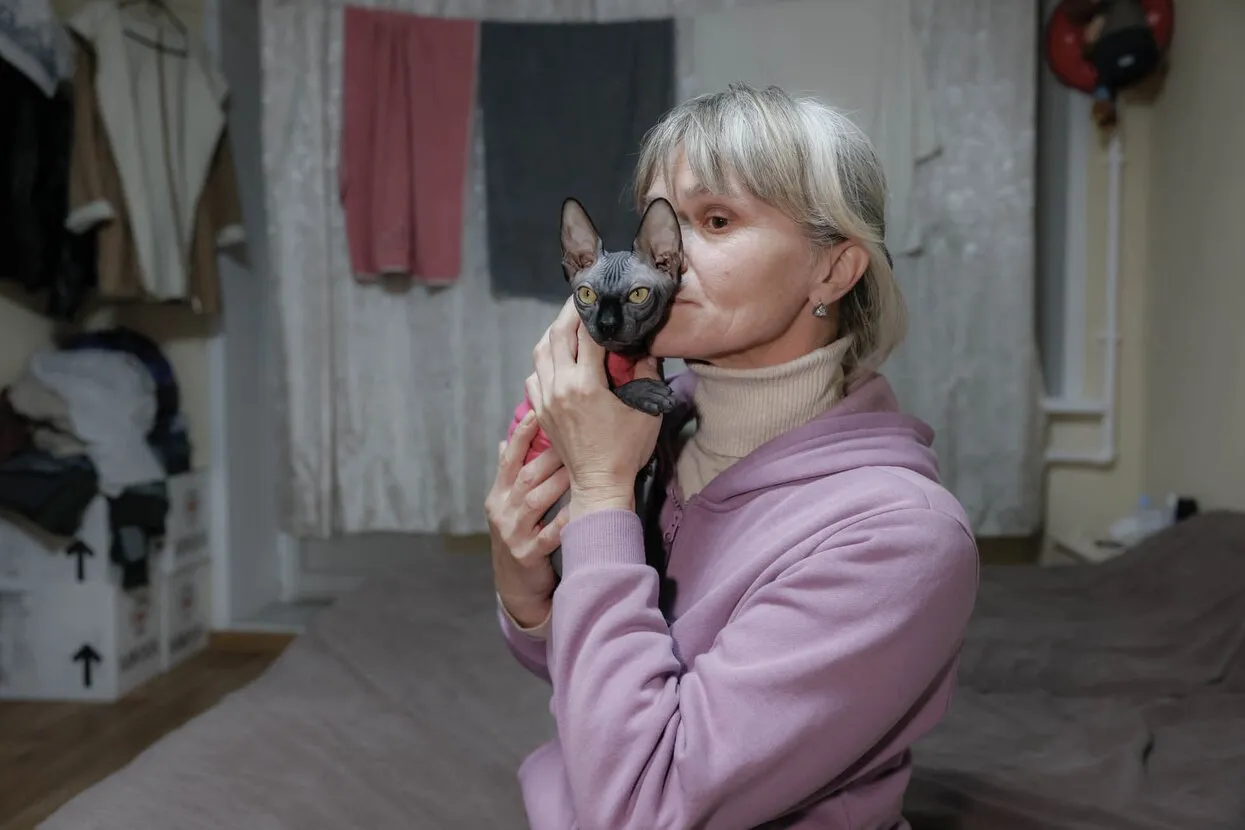
Daryna with Rusya the cat
Bereg
Rusya the cat is named after Russia. Daryna and Marina got her after they were evacuated. Their previous cat was killed in a drone attack.
Bereg
‘They came to our homes and destroyed everything’
Temporary accommodation centers in other regions remain open. Residents of the Tula centers have already learned that some even have vacancies. But they need authorization from the regional administrations to move in and have not received it.
Refugees who have received Russian passports do not understand why they face contempt from officials, bureaucratic hurdles, and scrutiny from the security services in their new homeland, which claimed the places they lived as its own.
“They [the officials] say: We want you to integrate into the Russian Federation. When did the DPR and LPR become part of the Russian Federation? When Putin signed the law in 2022. So we’re already integrated! I understand that every country has its own laws, and I accept that. But people were desperate to come here. They were desperate to come home,” says a refugee from the Donetsk region.
Balloons are taped to the walls of Anna’s room. She fled Kupiansk. The family recently celebrated her daughter Rita’s 12th birthday, then her mother Irina’s 62nd. For both, it was their fourth birthday away from home.
Anna in her room
Bereg
The Russian army entered Kupiansk without a fight in the first days of the invasion. Anna lived near a bridge that was repeatedly shelled. The family spent all of March in the basement.
During that time, Anna developed anemia and thyroid problems — she was later diagnosed with hypothyroidism. Rita also began getting sick. Rumors were circulating in Kupiansk that Russia would not hold the city and fierce fighting would soon break out. In April 2022, the family decided to leave.
Anna says she was in such a hurry that she did not even take her daughter’s birth certificate, and Rita was so nervous at border control that she forgot her mother’s name. But the border guards let them through: The photo gallery on Anna’s phone was full of pictures of Rita, so the guards believed them.
The family spent the next eight months in Belgorod. Without residence registration, Anna and Irina could not get passports, and schools would not enroll Rita. Eventually, Anna found a job and met a colleague who helped them arrange temporary registration. Other refugees had to pay for it: At the time, six months of temporary registration in Belgorod cost 9,000 rubles, Anna says.
The family’s life was starting to improve, but in late 2022, a Ukrainian missile hit a neighboring house. “It sliced the roof clean off, like a knife through butter,” Anna says. After that, the family decided to move to Voronezh.
A hallway in the main building. Most residents take off their shoes and leave them outside their rooms to save space inside.
Bereg
In 2023, Irina was diagnosed with breast cancer, and the family was offered a place at a temporary accommodation center in the Tula region. Anna’s brother Andrei and his family were already living at another center in Tula.
Anna says he stayed in Kupiansk until September 2022 and “left the city in a tank.” Andrei was at work across the river when the bridge connecting the two parts of the city was destroyed. Ukrainian forces entered the area where his wife and their 1-year-old child were still at home. Andrei did not want to leave his family behind, but Anna says the Russian soldiers insisted: “Do you want to live? Then come on, [get in].” In November, Andrei’s wife and child managed to leave, traveling through Ukraine and Europe to reach Russia.
Before the war, Anna and Andrei’s family had two houses in a neighborhood of detached homes. Both are now destroyed.
In Russia, Irina underwent two operations and needed care. Meanwhile, Rita was bullied at school, so Anna switched her to a paid online school. Anna left her job to care for her mother and raise her daughter. The family now lives entirely on Irina’s pension and a child benefit — just 34,000 rubles. Anna says almost half goes toward schooling.
They were barely getting by on that money until the Tula regional authorities decided to evict the refugees. Only Irina can stay at the resort: She has a Group II disability classification.
Anna with her daughter Rita in their room
Bereg
Rita’s watch is her only reminder of home. It no longer works, but she keeps it as a memento. Most refugees try to get rid of old belongings to avoid reminders of a life that is painful to remember.
Bereg
Rita recently turned 12. She has spent four of those years living at a temporary accommodation center.
Bereg
To keep his family, which now has a second child, from ending up on the street, Anna’s brother Andrei bought an apartment with a mortgage. He used the government’s maternity capital benefit for the down payment. Anna says there was no money left for furniture, and the family is sleeping on the floor for now. The terms of his loan prevent Andrei from registering his mother and sister at his apartment.
Anna now uses the printer she bought for Rita’s schoolwork to print letters, complaints, and applications to help refugees from the Kharkiv region who have spent four years in Russia without official recognition as forcibly displaced people or compensation for their destroyed homes.
“Social services say, ‘You’ve been sitting here for four years. You should’ve saved up for an apartment.’ They also say, ‘We started from scratch too!’ But we didn’t choose to be in this situation, having to start over from scratch. They came to our homes and destroyed everything!” Anna says angrily.
Bags of belongings sit half-packed in Anna’s room as the family awaits confirmation of their eviction and prepares to leave.
Bereg
‘We’ve been here all this time, and we’ll go home and get killed’
Vera Nikolayevna, 72, moved to the center from the Kursk region. She is shy about speaking to journalists: She feels others have it worse and that she should not complain.
Her village is about 60 kilometers (37 miles) from the border. She says the “incredibly loud explosions” began in the first days of the war. But Vera Nikolayevna did not consider leaving until the summer of 2023, when, she says, Ukrainian saboteurs shot up a column of Russian troops 20 kilometers (12 miles) from her home. Bereg could not confirm this account.
Her 48-year-old daughter, Olga, lived in a neighboring village and immediately drove over to her mother’s house. They packed in a hurry. Later, Olga and Vera Nikolayevna told neighbors they could take their stock of canned food — they no longer expected to return.
Vera Nikolayevna and Olga have lived at the center ever since. Vera Nikolayevna’s room is tidy, with few possessions. Photographs of relatives hang on the wall above her bed — she has three daughters and three grandchildren.
Vera Nikolayevna, from the Kursk region, in the room she shares with her daughter. Portraits of family members hang above her.
Bereg
In one photograph, a young man in military dress uniform adjusts a young woman’s blond curls. Vera Nikolayevna’s grandson serves in Astrakhan. He was recently sent on a temporary assignment near Kaluga to “shoot down drones.” She speaks proudly of him and Olga. Her daughter received a “medal for supporting the special military operation”: While working at a kindergarten near the border, she spent her evenings mending soldiers’ uniforms.
Vera Nikolayevna’s house has not been destroyed, but she has been back only once since leaving, in 2025. She decided to stay, but on the very first night, an explosion woke her. “It wasn’t just a bang — I can’t even describe it. I thought the roof was gone, that everything had been blown away. We sat there and couldn’t tell whether we were alive or dead. We didn’t turn on the lights. We didn’t breathe,” she says.
In the morning, she learned that Ukrainian forces had attacked a place where Russian soldiers were sheltering. The missiles left craters and damaged neighboring houses, and Vera Nikolayevna changed her mind about staying in the village. “There are explosions and gunfire, and drones are flying around. We’ve been here all this time, and we’ll go home and get killed,” she says.
Vera Nikolayevna receives a pension of 20,000 rubles. Olga works every other day and is paying off a loan. Despite Olga’s disability, the family is not entitled to stay at the center: She has a Group III classification, while only people with Group I or II classifications are allowed to remain.
Vera Nikolayevna calculates that even with rental assistance, she and her daughter will not have enough money to live on. “The main thing is for them to let us stay here,” she says. “At least until spring. Surely the special military operation will be over by spring?”
In the lobby of the main building
Bereg
‘We just believed in Russia, believed the words “We don’t abandon our own”’
Wagner fighters took Alina, her mother Olga, and her father Nikolai out of Soledar, a city in the Bakhmut district of the Donetsk region. The fighters forbade the refugees from looking out the windows of the combat vehicle, which was covered in camouflage netting, so they would not see anything they were not meant to see.
By early January 2023, when the private military company entered the city, Soledar had suffered extensive damage. Alina had already spent six months sleeping on the floor in the hallway; the family cooked over fires in the courtyard. Her grandmother died of cardiac arrest around that time, and they buried her amid the shelling.
Ukrainian forces repeatedly offered to evacuate the family, but they refused. Nikolai turned 58 in 2022 and was still eligible for conscription. He had worked as a miner for almost his entire life, Alina’s mother was a senior laboratory technician, and Alina managed facilities at a company. The family loved their city, lived comfortably, and did not want to lose everything they had built up.
Olga, Alina, and Nikolai were waiting for Russian forces to arrive. “We just believed in Russia, believed the words ‘We don’t abandon our own.’ Those exact words,” Alina says.
Alina and her parents did not want to leave Soledar with the Wagner fighters either. The family even offered to sign a statement accepting responsibility for their own lives, but the fighters would not listen and would not let them leave the basement to collect belongings from home. Fortunately, Alina always carried a backpack with their documents, and they were allowed to take their cat, Maruska.
Alina with her mother Olga
Bereg
Alina and Olga both recall the soldiers’ assurances: “Don’t worry, everything will be fine. Russia will welcome you there and give you everything. A shower, clothes, shoes, passports — they’ll take care of everything.” The family left Soledar confident they would be welcomed in Russia.
Disappointment came quickly. In Pervomaisk, a city 35 kilometers (22 miles) from Soledar, the evacuees were given a sack of sugar and flour for food. In Torez, 80 kilometers (50 miles) from Soledar, the local authorities did not welcome the displaced people either. “And that’s when we realized: Nobody wants us,” Olga says.
Despite his years of work as a miner, Nikolai was awarded a 10,000-ruble pension in Russia. Alina found work at a café in Torez, while her parents went to the Vladimir region to earn money. Her father died there of cardiac arrest in 2024. Olga returned to her daughter.
By June 2025, the temporary accommodation center in Torez had closed, and the women moved to the Tula region. Both started working and saving money. Alina developed rheumatoid arthritis. In the DPR, she was given expensive steroid medication, but her supply is running out. To receive the medication in Russia, she needs to have her disability officially recognized, which requires medical examinations she must pay for.
Olga’s husband. He died in Russia in 2024.
Bereg
The women are upset that Russia has not welcomed people it claims as its own. Alina has changed jobs several times, and at every workplace, colleagues called her “khokhlushka,” an anti-Ukrainian slur. Sometimes people she spoke with blamed her and all of Donbas for starting the war.
Alina hopes they will be allowed to stay at the center at least until spring so they have time to save enough to rent a home in the Tula region. If that does not happen, Alina and Olga plan to move to Svitlodarsk, a city 35 kilometers (22 miles) from Soledar. Svitlodarsk is being shelled, but rent there is cheap.
Alina and Olga take turns showing a video from an unidentified Ukrainian Telegram channel. It shows part of a residential building in Soledar collapsing after a strike. Their apartment was in that very building.
Olga cries. She does not have a single photograph of her loved ones left. In a choked voice, she says: “We understand that nobody wants us. They took our lives away. Our bodies are still here, but our lives are gone.”
Anna Stepanovna, 93, is a refugee from Artyomovsk. She has no officially recognized disability and could therefore be evicted from the shelter. She lives with her daughter, her daughter’s husband and his father. His father has a disability and will be allowed to stay. Anna Stepanovna does not leave her room; the shelter has no elevator. When residents were repeatedly required to move between buildings, neighbors carried her up and down the stairs in her wheelchair.
Bereg
In the lobby of the main building
Bereg
* * *
On October 5, regional officials visited the center. They offered to let the refugees continue living there if they paid. They did not give exact prices but said food would cost 300 rubles a day.
The residents who spoke with Bereg fear that staying at the center will cost about as much as renting a home in the Tula region. They do not have that kind of money.
From Meduza’s archives
‘People are more willing to help residents of Shebekino than refugees from Donbas’How Ukrainian refugees and Russians displaced from the border regions resettle in Belgorod
‘I don’t know what to do’Taken to the Russian Far East, refugees from Mariupol were promised housing and jobs. They have yet to receive either.
The Russians who’ve tasted occupationMeet the desperate relatives of trapped Sudzha residents and the refugees who fled Ukrainian troops in time
At Meduza, we are committed to transparency about our use of artificial intelligence in the newsroom. The story you’re reading was written by one of our living, breathing journalists and translated from Russian using an AI model configured to follow our strict editorial standards. This translation process is the result of extensive testing and refinements to ensure our English-language coverage is timely and accurate. A Meduza editor reviews every draft before publication.
If you find any errors in this translation, please contact us at reports@meduza.io.
To read Meduza’s exclusive content in English, please subscribe to our newsletter.
Bereg
Note
Bereg is withholding the name of the health resort at the request of the refugees living there.
Which ones?
Orphaned children (who live with guardians), children with disabilities, and adults with Group I or Group II disabilities, as well as their guardians or parents, spouses, and minor children.
What does that mean?
Some towns and villages near the front line or where fighting is currently taking place can only be entered with a permit.
Is that true?
Under Article 64 of Russia’s Labor Code, a lack of residence registration cannot be grounds for refusing to enter into an employment contract. In practice, however, refugees without temporary residence registration have a much harder time finding work. Human rights advocates and even former human rights commissioner Tatyana Moskalkova have spoken about this problem. Following numerous complaints from refugees in 2022, the Labor Ministry issued a letter emphasizing that such refusals are illegal.
Is that true?
Under the law, the only valid reason for denying admission to an educational institution is a lack of available places. In practice, however, preschools and schools turn away the children of refugees who lack residence registration.
Is that really true?
By law, a lack of residence registration should not prevent someone from registering as a patient at an outpatient clinic. In practice, medical facilities sometimes require it and refuse to provide free medications to people who do not have it.
Why?
In late August, the Tula authorities ruled that people who moved into temporary accommodation centers after August 20 could stay there for no more than six months.
Hypothyroidism
A condition in which the thyroid gland is underactive. Symptoms include chronic fatigue, low mood, dry skin, and forgetfulness.
Child benefit
Families whose per capita income is below the regional subsistence minimum receive a child benefit. In the Tula region, the payment is 18,371 rubles.