‘Ford v Ferrari’ gets a tsarist makeover in ‘Battle of Motors,’ a lavish Russian drama about a race from St. Petersburg to Monte Carlo
“Bitva motorov” (“Battle of the Engines”), an adventure film directed by Ilya Malanin and inspired by real events, is now in Russian theaters. Andrey Nagel (played by Ivan Yankovsky), an automobile enthusiast in the early 20th century, decides to test the first Russian car, the Russo-Balt, in the Monte Carlo Rally. He and engineer Dmitry Bondarev (Yura Borisov) set out from St. Petersburg. Film critic Eduard Zhuravlev reviews this entertaining film, which can’t quite avoid patriotic undertones.
It’s the early 20th century. Andrey Nagel (Ivan Yankovsky), a young lawyer, racing driver, entrepreneur, and publisher of Avtomobil magazine, has decided to begin manufacturing the Russian Empire’s first homegrown car. But neither private investors nor the Ministry of Railways believes in his venture. Working people can’t afford cars, while the wealthy prefer European models. Nagel nevertheless finds allies at the Russian-Baltic Wagon Works in Riga, where he builds the Russo-Balt with engineer Dmitry Bondarev (Yura Borisov).
Central Partnership
After spending almost his entire fortune on the car, Nagel decides to prove its quality at the Monte Carlo Rally. He and Bondarev set off straight from a wintry St. Petersburg. Nagel hopes to secure a government order from Emperor Nicholas II (Sergey Volkov), who dreams of showing up his German “cousin Willy.” Nagel is also courting racing driver Lidia (Paulina Andreeva), though their relationship remains platonic. Meanwhile, industrialist Gustav List (Yehezkel Lazarov), a loathsome rival from Benz, sets out to throw a wrench into the Russo-Balt’s progress — almost literally.
Actor Ilya Malanin directed this patriotic racing drama. His screen credits include “Tobol” (“The Conquest of Siberia”), “Na rayone” (“In the Hood”), and “Inye” (“Others”). As a director, he made the uplifting dramedy “Nenormalny” (“Extraordinary”) and the Netflix series “Nichego osobennogo” (“Nothing Special”), which the American streaming service shelved because of the war. Besides Gazprom-Media and TNT, the film was produced by Pyotr Anurov’s Kinoslovo and Nikita Mikhalkov’s TriTe studio, which previously teamed up on the blockbusters “Serebryanye konki” (“Silver Skates”) and “Volshebnik Izumrudnogo goroda” (“The Wizard of the Emerald City: Part I”), as well as “Prorok” (“The Poet”), a musical about Pushkin. From the latter film, “Bitva motorov” (also known internationally by the title “Race to Monte Carlo”) inherited a wig-wearing Yura Borisov and almost the entire team: screenwriter Andrey Kurganov, cinematographer Mikhail Khasaya, composer Ryan Otter, and costume designer Tatyana Patrakhaltseva.
Kinopoisk
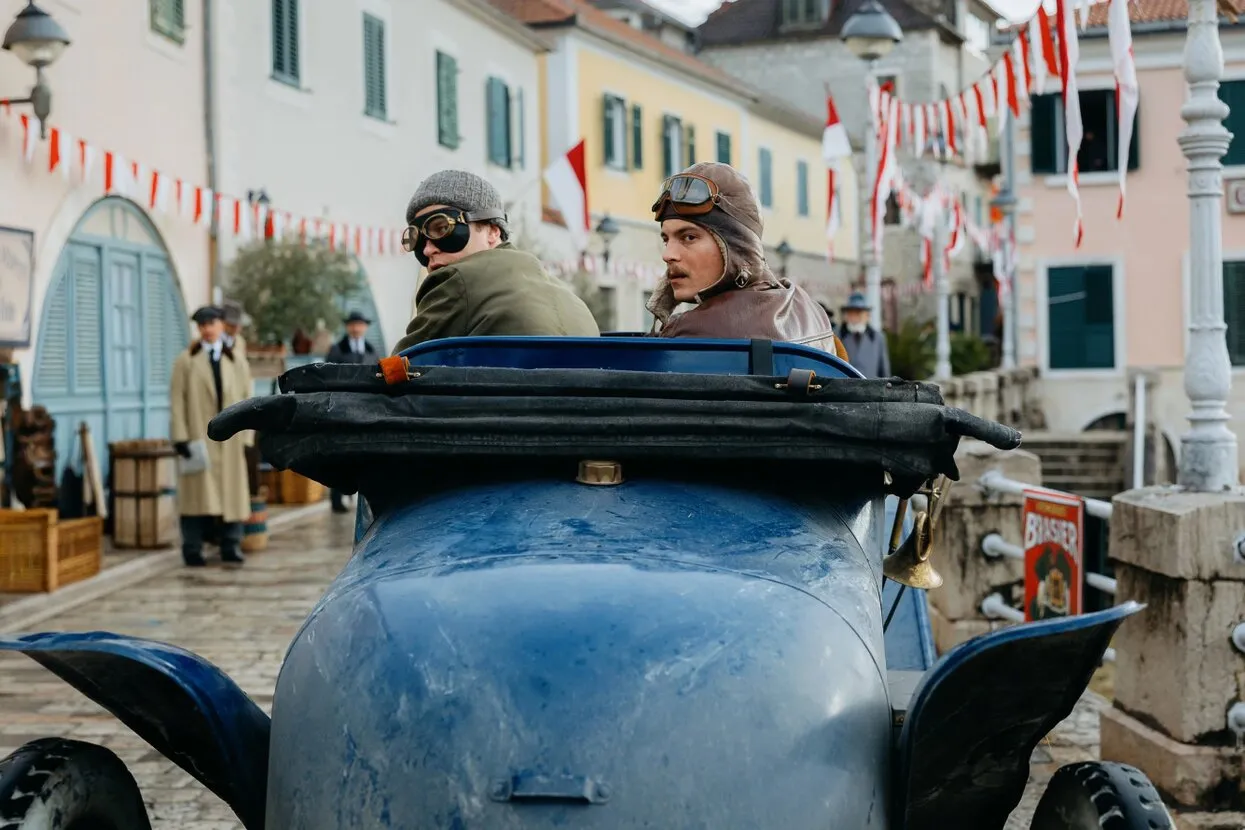
The blockbuster has the scale of a Hollywood production. Its prerevolutionary Russia is all spotless St. Petersburg streets, gleaming cars, Nagel’s immaculate three-piece suits, and the delightful hats worn by the endearing suffragist Lidia. We also get a detailed look at the workshops of the Russian-Baltic Wagon Works in Riga, where the “Russian Cucumber” is repeatedly assembled and taken apart. An energetic race through the mud outside St. Petersburg looks impressive thanks to judicious slow motion, unexpected camera angles, and rapid editing. The final drive from Russia to Monaco is a full-fledged road movie within the film, taking up a third of its running time (it was filmed in Montenegro). Cars get stuck in the snow, hurtle along winding mountain roads, and fly through narrow European streets. For the film, the production team found authentic period cars or built replicas — about 50 in all.
The early 20th century isn’t a favorite period for makers of racing movies, although the 1960s produced two hit comedies starring Tony Curtis: “The Great Race” and “Monte Carlo or Bust!” Structurally, however, “Bitva motorov” is closer to “Ford v Ferrari,” in which two men with different backgrounds and temperaments put up with each other in pursuit of victory.
Nagel, a businessman with a taste for adventure, dreams of making history in his own right. He doesn’t want to remain a dreamer with grand but unrealized schemes in the shadow of his grandfather, Andrey Krayevsky, who published Lermontov, Gogol, and Dostoevsky. He’s willing to sell off the furniture in his apartment to fund the venture. Bondarev doesn’t always share his enthusiasm. He’s a hotheaded worker and devoted family man who has already spent time in exile for revolutionary activity. The bromance between Nagel and Bondarev is the heart of a film whose other characters are all one-dimensional. Still, Israeli actor Lazarov, who has worked with Nadav Lapid and Ari Folman, makes an impression through sheer charisma. His German scoundrel List is such a cartoonish villain that he would fit right into “Who Framed Roger Rabbit.”
Kinopoisk
The real List, incidentally, didn’t compete in the Monte Carlo Rally — he was nearly 80 at the time. In real life, Bondarev oversaw Russo-Balt production but didn’t travel to Monaco for the rally himself. Vadim Mikhailov took part in the race, but the film never mentions him.
The film ends in both triumph and defeat: The Russians reach Monte Carlo first but finish only ninth on points, winning prizes for endurance and the longest route. Nevertheless, the kindly Tsar Nicholas II appreciates their achievement, pardons the politically suspect Bondarev for taking part in the race illegally, and buys a batch of cars. For a couple of years, the Russian-Baltic Wagon Works becomes a center of automobile manufacturing. The closing titles conveniently omit that Nagel would move to Paris, the factory would be repurposed for military production, and Bondarev would be executed in 1937.
At the end, the villain List wonders why “these Russians” risk their lives, freedom, and standing for minor victories, while the tsar says it doesn’t matter how things are judged in Europe — everyone already knows who the real winner is. This gentle patriotism may leave viewers feeling proud of the indomitable Russian spirit. But stepping out of the theater may dampen that feeling a little: Benzes are still on the road.
At Meduza, we are committed to transparency about our use of artificial intelligence in the newsroom. The story you’re reading was written by one of our living, breathing journalists and translated from Russian using an AI model configured to follow our strict editorial standards. This translation process is the result of extensive testing and refinements to ensure our English-language coverage is timely and accurate. A Meduza editor reviews every draft before publication.
If you find any errors in this translation, please contact us at reports@meduza.io.
To read Meduza’s exclusive content in English, please subscribe to our newsletter.
Eduard Zhuravlev
Monte Carlo Rally
A race first held in the early 20th century that continues today as a round of the World Rally Championship. Teams from around the world could enter, each taking its own route. For example, the Russo-Balt started in St. Petersburg, while its main rivals started in Berlin. All finished in Monaco. The winner was determined by total points, awarded for speed, the car’s condition at the finish, the length of the route, and other factors.
Who is that?
German Emperor Wilhelm II. He was Nicholas II’s second cousin once removed.
Cucumber?
A nickname given to the Russo-Balt race car because of its green color and streamlined shape.