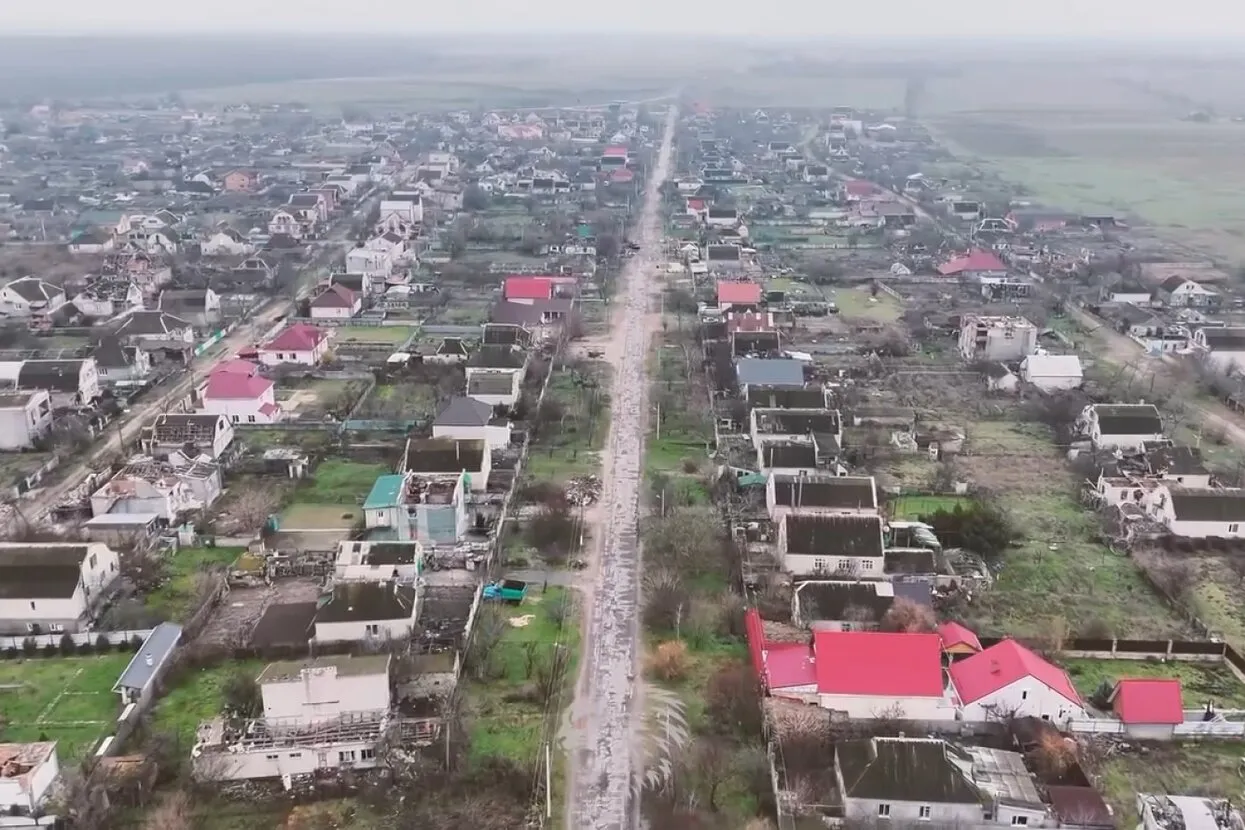
‘The smell of death is everywhere’: Inside the humanitarian catastrophe unfolding in Russian-occupied Oleshky, where hundreds are trapped without food, electricity, or medicine
Since 2022, residents of Oleshky in Ukraine’s Kherson region have lived under occupation. In 2023, the city was flooded after the Kakhovka dam was blown up: the flooding destroyed dozens of residential blocks and all of its infrastructure. In the fall of 2026, Oleshky found itself cut off. There’s a humanitarian catastrophe there: the city has no electricity, food, or medicine. Every way out is mined and blocked by Russian troops. Meduza spoke to people who have miraculously managed to stay in touch with those who remain in Oleshky. Here’s what they told us.
‘The harvest was so plentiful there was nowhere to put it’
“Oh, it smells amazing here!”
Svitlana (not her real name), a former resident of Oleshky who fled the city in 2022 because of the war, smiles as she recalls her garden — and the compliments her friend Nina used to pay it. Before the full-scale war, Nina used to bring her homemade milk every Thursday.
“I had [about a third of an acre] of land, and I planted peony bushes all along the perimeter. The scent was intoxicating!” Svitlana says. “Nina asked why I didn’t take the flowers to market. But how could I sell something so beautiful?”
Svitlana’s yard brimmed with flowers until autumn, and hers wasn’t the only one. “It was as if the townspeople were competing over whose front garden was more lavish. Oleshky bloomed and smelled wonderful.”
Svitlana calls the land she lived on for three decades “rodiucha,” which translates from Ukrainian as “fertile”:
Stick a branch in the ground and it will sprout. Everyone had everything: tomatoes, cucumbers, orchards… I grew 14 varieties of grapes, three varieties each of apricots and peaches. There was so much of a harvest that there was nowhere to put it: I sold some and canned the rest. I shared preserves with people displaced from Donbas — I’d send volunteers whole crates of it.
On weekends, Svitlana liked to spend time along the Kinska River, a left tributary of the Dnipro. The Kinska had a beach and good fishing spots, and from its pier you could catch a pleasure boat or a passenger ferry to Kherson, about 9 kilometers (5.6 miles) away by water.
Russian cell service in Oleshky, which has been under occupation since the first days of Russia’s invasion, operates with severe disruptions. But because the city is close to Kherson, Ukrainian mobile networks can still be picked up at random spots around town. That is how Svitlana stays in touch with her neighbors Olha and Dmytro (not their real names), the people closest to her who remain in Oleshky.
These days, Svitlana hears little from her neighbors. She says the constant risk of a drone strike keeps them in the basement most of the time. In the spring, Olha wrote to her on Viber: “We just need to survive.”
‘Every day I hear explosions over the phone’
Mykyta (not his real name), another resident who also fled the city in 2022, keeps in touch with Oleshky through Ukrainian mobile networks. He calls his mother, Tamara (not her real name), every day, and to reach him, she has to go out into the yard, find a signal, and stay put wherever she finds it.
Sometimes the call cuts off mid-sentence. “My mother runs from drones. She hears a sound in the sky and rushes straight into the house, where the signal disappears,” Mykyta explains. “Every day I hear explosions over the phone.”
Mykyta spent six months living under occupation: he didn’t want to leave right away, thinking “it would all be over quickly.” “But then [representatives of the occupation authorities] came to search my place and beat my legs so badly that I couldn’t walk normally for two months. That’s when I realized nothing was going to end quickly, and I left.”
Tamara and her husband, Borys (not his real name), stayed in Oleshky. According to Mykyta, his father refused outright to leave the city — he didn’t want to abandon the household. “Dad used to say, ‘Let’s just sit tight, maybe things will get better.’ Nothing got better. He got seriously ill, and that’s when my mother said they were staying — Dad wouldn’t have survived the trip. She’s already buried him.”
After her husband’s death, Tamara kept putting off leaving because she didn’t want to abandon her two dogs. But both dogs died this year, Mykyta says:
My mother tried hard: she wouldn’t cook anything extra for herself, she’d give it to them instead. But she had to feed them whatever she could. A lot of people in Oleshky now eat purslane — it’s this fatty grass. My mother added it to the dogs’ food. They ate tomatoes, cucumbers, honey, pasta — whatever supplies were left. I think that’s what did them in.
The humanitarian crisis in Oleshky began in 2023. After the Kakhovka dam was blown up, the city was flooded by 90%, and its infrastructure was severely damaged. Since then, there has been no electricity or gas.
Flooding in Oleshky after the Kakhovka dam was blown up. June 10, 2023
Evgeniy Maloletka / AP / Scanpix / LETA
Ukrainian soldiers help civilians after the flooding in Oleshky. June 7, 2023
AP / Scanpix / LETA
Only people with their own wells have drinking water. But pumping water from a well requires a pump, running the pump without electricity requires a generator, and the generator needs fuel. The last fuel delivery to the city coincided with the final food supplies, in late spring 2026.
Kseniia Arkhipova, a police officer in Oleshky before the invasion, tells Meduza this. In 2022, during the occupation, she began volunteering to help local residents, which angered the pro-Russian authorities. After they detained her, she left her hometown for Ukrainian-controlled territory.
Since getting out of Oleshky, Arkhipova has coordinated help for her fellow residents remotely, helping deliver food and medicine, taking part in organizing evacuations, and keeping a list of people who have died in the city during the war. By August 30, she had confirmed 136 deaths since the start of the invasion.
As far as the volunteer knows, no one has managed to bring food into Oleshky since spring 2026: vehicles that have tried have come under fire and been forced to turn back.
The Ukrainian news outlet Ukrainska Pravda has reported that by the end of summer it had become impossible to enter the city: Russian and Ukrainian drones clashed in the skies over Oleshky every day. The occupation administration itself accuses the Ukrainian military of blockading the city and claims that Ukrainian drones attack convoys carrying humanitarian aid.
Kseniia Arkhipova recalls:
In May and June, people in Oleshky still had supplies, then the harvest came in from their gardens: grapes, tomatoes, potatoes, zucchini. But the supplies ran out, and people started sounding the alarm — there’s no food. Mothers write to me: “Ksyusha, my child has nothing to eat, what do I do? He’s hungry all the time.” It’s like 1933 all over again, “wonderful Russian culture” in all its glory.
Kseniia is referring to the Holodomor, which killed nearly 4 million residents of the Ukrainian SSR. Ukraine’s official position, backed by 29 countries (Russia is not among them), holds that the Holodomor was a deliberate genocide of the Ukrainian people by the Soviet government.
Mykyta says that, just as in Soviet times, Ukrainians are dying of hunger because of Russia: “It doesn’t fit in my head that something like this could happen in this day and age. This is an actual Holodomor.”
In July, the occupation authorities in the Kherson region denied there was a humanitarian catastrophe. By August, however, they had acknowledged that Oleshky and nearby villages had no water or electricity, and that utility crews weren’t making repairs because of the shelling.
On September 21, Putin’s press secretary, Dmitry Peskov, called the situation in the Russian-occupied city “critical.” “The Kyiv regime is doing everything it can to hinder deliveries [of food and medicine]. Russian troops continue working to resolve the situation,” he said.
Ukrainian President Volodymyr Zelensky has also addressed the crisis in Oleshky. In one of his evening addresses in May, he said: “The situation specifically in this part of the occupied territory is extremely difficult, and it’s very hard to carry out evacuations. It’s important that international organizations — everyone able to help with this — are engaged and take decisive action.”
‘Oleshky is closed off on all sides’
Residents of Oleshky have very few ways to get food: Ukrainian authorities say the city is under a complete blockade.
Tetiana Hasanenko, who heads the Oleshky city military administration from Ukrainian-controlled territory, said in comments to Ukrainska Pravda that Russian troops have mined every route out of Oleshky:
People have two options: either die from starvation, or come under drone or artillery fire and be killed. There is no third option.
At the same time, Yevhen Voronetskyi, a serviceman with the 34th Independent Marine Brigade “Borysfen” of the Ukrainian armed forces, told Ukrainska Pravda that Ukrainian troops have mined some routes out of Oleshky to prevent Russian forces from bringing in weapons. Voronetskyi said Ukraine’s military keeps the main road out of the city clear so civilians can leave, even helping people make their way along it and sometimes guiding them with drones along a relatively safe route.
In 2023, Russian forces mined the fields around the city out of fear of a Ukrainian military landing on the left bank of the Dnipro. There is no confirmation that the Russian army has continued mining the main roads around Oleshky. Each side blames the other.
Petro Andryushchenko, a former adviser to the mayor of Mariupol who now heads the Center for Occupation Studies, said in an interview with the Ukrainian outlet NV that Russian forces are using the city’s residents as human shields: “This is a real humanitarian catastrophe, and one created entirely by the Russians as cover for military operations.”
34th Independent Marine Brigade “Borysfen” / Facebook
The UN Human Rights Monitoring Mission in Ukraine reported on June 25 that “thousands of civilians trapped in frontline communities in southern Ukraine are facing a deepening humanitarian crisis.”
Oleshky became a front-line city in the fall of 2022, when the Russian army, under pressure from Ukrainian forces, retreated from the right bank of the Dnipro and left Kherson. Since then, the occupation authorities say, Ukrainian attacks have hindered their efforts to rebuild Oleshky — including after the 2023 flooding — and to deliver food and medicine to the city.
As FPV drones became more common on the battlefield, Oleshky, like Kherson on the opposite bank, grew increasingly dangerous. The front line runs right between the two cities, along the river, and it takes drones only a few minutes to cross the Dnipro and reach a target.
But drones aren’t the only threat in the city and its surrounding area. The area around the city has been mined so heavily that by early 2026, entering or leaving it had become very difficult. That, said Tetiana Hasanenko, who is trying to stay in touch with the city’s residents, is precisely what led to the sharp deterioration of the situation in Oleshky.
Vegetable gardens in Oleshky have turned into a deadly obstacle course. Neighbors told Mykyta that the plot around his house, which he abandoned in 2022, is “littered with mines,” including antitank mines and “petal” mines.
According to Mykyta, the areas around the city are unsafe too: “The riverbanks were mined, and after the flooding [from the destruction of the Kakhovka dam], the water scattered those mines who knows where.”
“Oleshky is closed off on all sides,” Kseniia Arkhipova sums up. “There are about 1,500 people caught in this trap.” Since the start of the Russian invasion, the city’s population has shrunk nearly 15-fold: according to figures from the Oleshky city military administration, 22,000 people lived in Oleshky before 2022.
Some residents risk their lives to walk to Radensk, a nearby village, in search of food. Like Oleshky, it’s under Russian control. The roughly 20-kilometer (12-mile) route is extremely dangerous: the road is mined, and the open terrain is exposed to drone fire.
Some still manage to get food, which is sold at an improvised market in Oleshky. Mykyta learned the prices there from his mother: “I’m in shock. A sack of potatoes costs 7,000 rubles! A can of sprats costs 1,000 rubles, compared to 60 in Radensk.”
Mykyta says a friend of his mother’s advised her to turn to “some religious people.” He doesn’t know who they are, but he’s heard from his mother that they have more food than many other residents. Through these people, his mother Tamara was able to get “a couple of kilograms of buckwheat, some pasta, canned meat, oil, flour — a little of everything.”
Mykyta has been trying to arrange food deliveries to his mother through charitable organizations in nearby cities, but so far without success.
The Ukrainian military sometimes sends humanitarian cargo into the blockaded city. Since March, Ukrainian forces have used drones capable of carrying up to 10 kilograms (22 pounds) of cargo, dropping boxes of canned meat, flour, crackers, oil, and grains directly onto Oleshky.
Boxes of humanitarian aid delivered by Ukrainian military drones
34th Independent Marine Brigade “Borysfen” / Facebook
But this isn’t regular supply, and not every resident gets a package. “A ten-kilo package is enough for one family for a week. And then what?” Kseniia Arkhipova adds.
On September 27, the Ukrainian military dropped its largest shipment of food into Oleshky to date, delivering about four tons (4.4 tons) of food at roughly 100 pre-selected locations. Arkhipova afterward received many grateful messages from locals, and she shows Meduza one of them: “A huge, huge thank you to the guys. God bless them, a deep bow to them!”
Ukrainian military drones drop boxes of humanitarian aid over Oleshky. September 27, 2026
Telegram channel of Kherson region military administration head Oleksandr Prokudin / Reuters / Scanpix / LETA
Overnight on October 4, the Ukrainian military carried out another operation delivering four tons (4.4 tons) of humanitarian aid to Oleshky by drone.
‘There were more than 200 people on the lists. But no evacuation ever happened.’
According to figures from Ukrainska Pravda, no evacuation of Oleshky has ever been officially organized in four years of occupation. In the spring, the occupation authorities promised for the first time to move Oleshky residents to safer towns. Hoping that would happen, Arkhipova, the volunteer, began coordinating people in a Telegram chat.
Svitlana, the Oleshky resident who left her blooming garden behind in 2022, followed Arkhipova’s messages in the chat. On March 5, she wrote to a neighbor: “Olechka, the question of evacuating Oleshky residents is being decided at the highest level. They’re compiling lists of people so they know exactly how many buses are needed.”
Kseniia recalls how “everyone hoped the Red Cross would come and evacuate everyone”:
The Russians started urging people: “Come to the hospital, sign up, leave your contact numbers. We need to know how many buses to send you. We need to count you — who’s bedridden, who isn’t.” There were more than 200 people on the lists. But no evacuation ever happened.
Ukrainian Ombudsman Dmytro Lubinets said, without specifying dates, that Kyiv had agreed on “clear mechanisms” for evacuation with Russia, backed by the International Red Cross. But Russia, he said, has stalled the process: “For a long time now, after the talks that were held, the Russian side has not confirmed its readiness to carry out a humanitarian mission to evacuate people.”
Kseniia Arkhipova said that by believing the rumors about the Red Cross and an organized evacuation, people missed their last real chance to leave: “Most of those 200 people are still in Oleshky. In the end, only 67 risked leaving on foot.”
Volunteers coordinate on-foot evacuations from Oleshky remotely, Kseniia says. They put together a plan based on information residents share with them whenever they manage to get in touch.
Residents of Oleshky during an evacuation in May 2026
@khersonoleshky / Telegram
The last “window of opportunity” for evacuating on foot opened on September 10 and lasted about two weeks, Arkhipova said. That was when Russian troops cleared mines from a stretch of one of the roads leading out of the city.
The first thing residents do is make their way to nearby Radensk (also occupied by Russia). After making the trip, some are “completely unable to move,” Kseniia continues:
They arrive dirty, emaciated, with nothing. Sometimes they weigh less than 50 kilograms (110 pounds), just skin and bones. No clothes, no shoes, no money — no home. Recently an 87-year-old woman was brought out on a cart. When she saw bread, she took out a handkerchief, wrapped a crust in it, pressed it to her chest and said, “I won’t give it up, this is my bread.”
In Radensk, refugees from Oleshky are housed with volunteers willing to take them in, and “they just rest for a few days,” Kseniia says. Some are put up in empty, nonresidential spaces, like stores. Then those who are able make their way to free Ukrainian territory — through Russia and Europe. About 30 Oleshky residents have left the occupation since the start of September.
The volunteer says that among those who left, everyone who initially didn’t want to evacuate “regrets, without exception, staying stuck for so long.” “I yell at them: ‘I told you to leave a year ago, two years ago, three years ago!’ And they answer: ‘Ksyusha, it’s hard to leave everything behind. You’re young — you just turned around and left. We can’t do that.’”
Among those Arkhipova has helped leave are also refugees who for a long time didn’t believe they were really in danger. She said they decided to evacuate only after someone close to them had been killed.
After being rescued from occupation, Oleshky residents can count on support that Ukraine provides to evacuees and internally displaced persons (IDPs). ”[But] while they fill out the paperwork and wait for that measly 2,000 hryvnias [about 40 euros or 3,800 rubles], what are they supposed to do in the meantime?” Kseniia says.
From time to time, she manages to persuade Ukrainian charitable foundations and Russian antiwar organizations to help refugees from Oleshky.
The “window of opportunity” for evacuation has now closed again, Arkhipova says.
‘These people are in a cage’
Dmytro Lubinets, Ukraine’s ombudsman, is convinced that an evacuation of Oleshky’s residents could realistically be carried out in a single day.
Kseniia agrees:
All that’s needed is to clear the road of mines and send in, roughly speaking, four big buses [into the city]. People will come out on their own, and those who can’t move will be wheeled out on carts. Loading everyone up and driving them out — the whole operation would take three hours! Why isn’t this being done? Because Russia can’t be negotiated with.
In late September, Ukrainian Foreign Minister Andrii Sybiha spoke about the crisis in Oleshky in an address to the UN and the International Red Cross. At Ukraine’s request, the OSCE called on Russia to give international organizations access to Oleshky, supply residents with food and medicine, and allow them to leave the city safely.
Vladimir Saldo, the Kremlin-appointed governor of the Russian-occupied part of the Kherson region, gave an interview to the television channel Vesti on September 28. Asked whether a full evacuation of Oleshky was possible and necessary, he said:
Of course such a possibility exists. But let’s try to understand the residents who are there. Taking them and forcibly removing them right now would probably be wrong and unfair. Those who wanted to leave have already left. There are no restrictions for anyone there.
Saldo then added: “We need to do everything so that they [the local residents] can get everything they need to live there: fuel, food, medicine, communications.”
Two days after Saldo’s interview aired, Kseniia Arkhipova learned that several Oleshky residents had again tried to walk to Radensk for food. She posted a notice in the city chat warning that four people had been injured by landmines along a certain route that day and urging anyone heading to Radensk to avoid that stretch of road:
Regardless of Saldo’s statements, many Oleshky residents genuinely don’t want to, or can’t, get out. For instance, Mykyta’s mother isn’t willing to abandon her home, he says: “She says if she leaves, everything will be looted. ‘And who needs us there [outside our hometown] anyway?’”
Kseniia Arkhipova also described the fear that residents still in Oleshky feel toward looters.
From her conversations with residents, she learned that Russian troops rotated through Oleshky around mid-September: “The ones who came in now are polite — they might come ask for food, [saying] ‘you leave us alone, and we’ll leave you alone,’” Kseniia recounts from her acquaintances’ stories. “But before that there were ones who took everything. Or they’d kick people out of their homes and onto the street because they had solar panels, which meant they had electricity.”
Among those who can’t leave the city are the people Arkhipova calls the “undocumented.” These are Oleshky residents whose Ukrainian passports and other documents were lost in the flooding after the Kakhovka dam was destroyed. They didn’t want to get Russian passports.
Now, to be evacuated from Oleshky, these people need at least some kind of passport: both the occupation authorities and border guards on the way to Ukrainian-controlled territory demand to see documents. Getting a Russian passport without other documents is very difficult: applicants first have to confirm their identity with the occupation authorities.
These bureaucratic hurdles come with additional checks, and the fighting makes moving between offices simply dangerous.
34th Independent Marine Brigade “Borysfen” / Facebook
“I have acquaintances who have been trying to restore their documents for three years now,” Arkhipova says. “They have witnesses, they’re going through the courts, they’ve already gone around to every [office]. And they still won’t give them a passport.”
Without documents, Kseniia reasons, it’s impossible to cross any major checkpoint: “Not Novoazovsk, not Chonhar, not Armiansk will let them through. These people are in a cage.”
Kseniia calls other residents who remain in Oleshky the “low-mobility”: bedridden patients and elderly people who can’t be evacuated without special transport and an escort.
On top of that, Kseniia says, there are people in the city who are simply afraid of the filtration procedure at Russian checkpoints. According to Human Rights Watch’s observations, even civilians leaving occupied territory for areas under Ukrainian control often have to go through it — not just those entering Russia.
‘The smell of death is everywhere’
“Those who left after me say Oleshky is simply unrecognizable. The city is gone. There are no stores left, no post office,” Mykyta tells Meduza. “I look at photos myself, and I don’t recognize a lot of the places.”
An airstrike near the Ametist machine-building plant in Oleshky. May 2026
“Nash Kherson” / Facebook
Kseniia Arkhipova adds that in Oleshky, “people live in an isolated world”: “It’s worse than after the flooding [from the destruction of the Kakhovka dam]. There’s devastation and chaos in Oleshky. There’s no administration, no police. Cars don’t drive around — bicycles are the best you get.”
Arkhipova calls the hospital the “only intact island” in Oleshky. It used to give out food to those who were completely exhausted from malnutrition. But lately the facility “is operating on its last legs: there’s no medicine, no fuel — nothing.”
Mykyta also knows from his mother that there’s a medicine shortage in the city, and he recalls overhearing a Russian soldier say, back when he himself was still in Oleshky: “Why do you need medicine? Consider yourselves already dead.”
Still, Arkhipova says, the hospital can currently provide help: “There are doctors there who worked even before the war, even though they had chances to leave. They said, ‘I’m not going anywhere. What will people do without me?’ Recently an 11-year-old boy stepped on a ‘petal’ mine and lost his leg. If it weren’t for these surgeons, who would have performed the amputation? The child would have simply bled to death.”
The occupation authorities don’t allow burials for people killed in the fighting, the volunteer says. Novaya Gazeta reported that there is “no one to process” deaths in the city, but Arkhipova doubts that’s the real reason for the delay.
She says that people who die of natural causes are still being buried. “They [the occupation authorities] need a forensic medical examination so that a medical examiner will write: ‘These people were killed by the Ukrainian military,’” the volunteer explains. “And they need that so they can later pass that data on to the UN [and blame Ukraine]. That’s the scheme.”
Aftermath of shelling in Oleshky. August 2026
@khersonoleshky / Telegram
This image contains graphic content and may be disturbing to some readers.
The body of a person killed in Oleshky
@khersonoleshky / Telegram
The only way to bury those killed in the fighting, Kseniia says, is “quietly, in the garden.” But that’s dangerous: the occupation authorities consider these “spontaneous burials” illegal. “One girl buried a neighbor who was killed in a shelling attack in his own garden. They dragged her through the courts for two years afterward — had she killed him? They even came and dug up the body,” Arkhipova says. Meduza was unable to reach the Oleshky resident the volunteer describes.
Mykyta, whose father died under occupation, and Svitlana, whose husband, Ihor, also chose to stay in their hometown but then fell ill and died in the hospital, both confirm to Meduza that people who die of natural causes are allowed to be buried. Svitlana says that “by today’s standards” Ihor was buried “like a king.” She was able to send money to acquaintances in Oleshky, and they organized the ceremony.
“They reported everything to me: how they dug the grave, how a priest performed the burial service, how many wreaths they laid, what kind of cross they put up,” Svitlana recounts. “They buried my Ihor in not just one but two plastic bags, which was difficult because bags are in short supply there [at the hospital], and you have to sign for each one.”
Asked why her husband wasn’t buried in a coffin, Svitlana says: “There are no coffins left in Oleshky.” That’s what the acquaintance who organized the funeral told her. Svitlana believes it: there’s no way to bring new coffins into Oleshky, and getting wood from the forest is dangerous — it’s mined and exposed to drone fire.
Mykyta tells Meduza that his mother sometimes mentions acquaintances of hers who have been killed. “In March, a woman was killed — a strike hit a store while she was standing in line. Her husband hasn’t been able to retrieve the body since spring — they won’t give it to him,” Mykyta says, citing one example.
According to Kseniia Arkhipova, the morgue is “a small building not far from the hospital,” where bodies are “just stored.” “A body has been lying in a bag without refrigeration since January. What’s going to be left of it?” Arkhipova adds.
The Insider reported that the refrigerators in the morgue don’t work because there’s no fuel for the hospital generator. Tetiana Hasanenko, the head of the city military administration, said the morgue had effectively stopped functioning ever since the Kakhovka dam was destroyed. She said bodies have been stored in the hospital basement in recent months.
Sometimes, Meduza’s sources say, bodies are left lying right out in the street. “Russian [soldiers] lie on the roads for weeks, their own side doesn’t pick them up,” Mykyta says. “Dogs drag the bodies around. For my mother, these are just ordinary moments now — a dog tears off an arm or a leg and runs off.”
Kseniia Arkhipova also tells Meduza that stray dogs in Oleshky feed on human bodies. The Ukrainian news outlet Hromadske also reported that dogs dig up shallow graves in gardens and “drag off pieces of bodies,” while Ukrainska Pravda reported that bodies of not only Russian soldiers but also killed civilians lie in the city’s streets.
In the last days of September, Mykyta spoke with his mother again. Tamara told her son she had gone to see a doctor. “My mother says it’s hard to walk through the hospital,” Mykyta says. “The smell of death is everywhere.”
The Oleshky city military administration responded to Meduza’s request by referring to Tetiana Hasanenko’s previously published interviews. Meduza also sent a request to the occupation administration of the Kherson region but had not received a response at the time this story was published.
At Meduza, we are committed to transparency about our use of artificial intelligence in the newsroom. The story you’re reading was written by one of our living, breathing journalists and translated from Russian using an AI model configured to follow our strict editorial standards. This translation process is the result of extensive testing and refinements to ensure our English-language coverage is timely and accurate. A Meduza editor reviews every draft before publication.
If you find any errors in this translation, please contact us at reports@meduza.io.
To read Meduza’s exclusive content in English, please subscribe to our newsletter.
Meduza
Note
In Russian, the city’s name is spelled Aleshki. In this piece, we use its Ukrainian spelling — Oleshky — at the author’s request.
Purslane (Portulaca oleracea)
A herbaceous plant in the purslane family, found in Ukraine, among other places. It grows in gardens, fields, and vacant lots, and is often considered a weed, though it is edible.
The plant is notable for its succulent, fleshy leaves, which store water. Because of this dense, juicy texture, purslane is popularly known as “fat grass.”
Holodomor
The mass famine in the Ukrainian SSR in 1932–1933 was caused by the policy of collectivization. It claimed the lives of several million people. During the same period, mass famine also struck Siberia, the Volga region, the North Caucasus, and the Byelorussian SSR, a fact Russian authorities use as an argument to deny that the Holodomor was a genocide of Ukrainians.
Center for Occupation Studies
The organization is a Ukrainian civil society group established in 2025 and headed by Petro Andryushchenko, a former adviser to the mayor of Mariupol. It monitors and analyzes the Russian occupation of Ukrainian territories: gathering information from these territories, tracking Russian administrative and demographic policy, documenting the situation in Mariupol and other occupied cities, and publishing assessments of current events. Ukrainian media regularly interview Andryushchenko as an expert on the occupied territories.
What does he mean by that?
According to Andryushchenko, Russian troops are preventing Oleshky residents from leaving while using the city to station drone units that carry out attacks on Ukrainian-controlled territory on the right bank of the Dnipro River, including Kherson. These claims have not been independently verified.
FPV drones
First Person View (FPV) is a cheap, fast quadcopter — reaching speeds over 100 kilometers per hour (62 mph) — often printed on a 3D printer. The pilot controls the drone through goggles that stream a live video feed from the drone’s camera. It’s used for reconnaissance and to destroy equipment and enemy forces.
“Petal” Mine
An antipersonnel blast mine (PFM-1 and PFM-1S). The device is deployed using remote mining systems, including artillery and multiple rocket launchers. The “Petal” mine was manufactured in the USSR and has been used by the armies of Russia, Ukraine, and Belarus.
Are there other figures?
The Oleshky city military administration says that about 2,000 people remain in the city.
What kind of support?
Support includes free evacuation, temporary housing, and medical, psychological, and social assistance. After obtaining internally displaced person (IDP) status, some categories of evacuees are also eligible for monthly payments and other support measures, including, under certain conditions, a housing voucher of up to 2 million hryvnias.
What are they needed for?
Witnesses must confirm that a person is who they say they are: their identity and the information they’ve provided, such as their name, date and place of birth, and living circumstances.